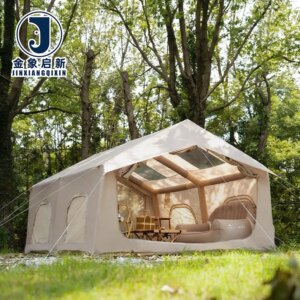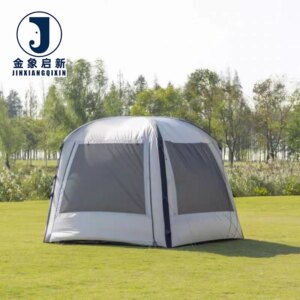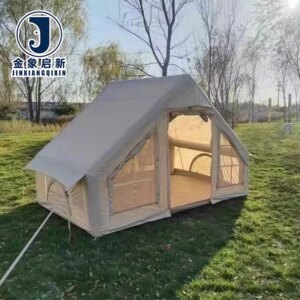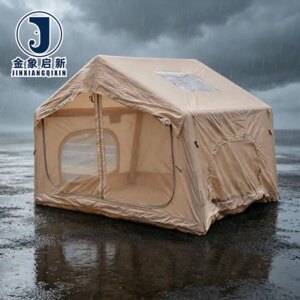

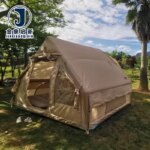
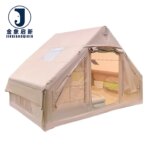
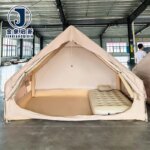
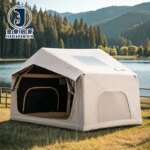
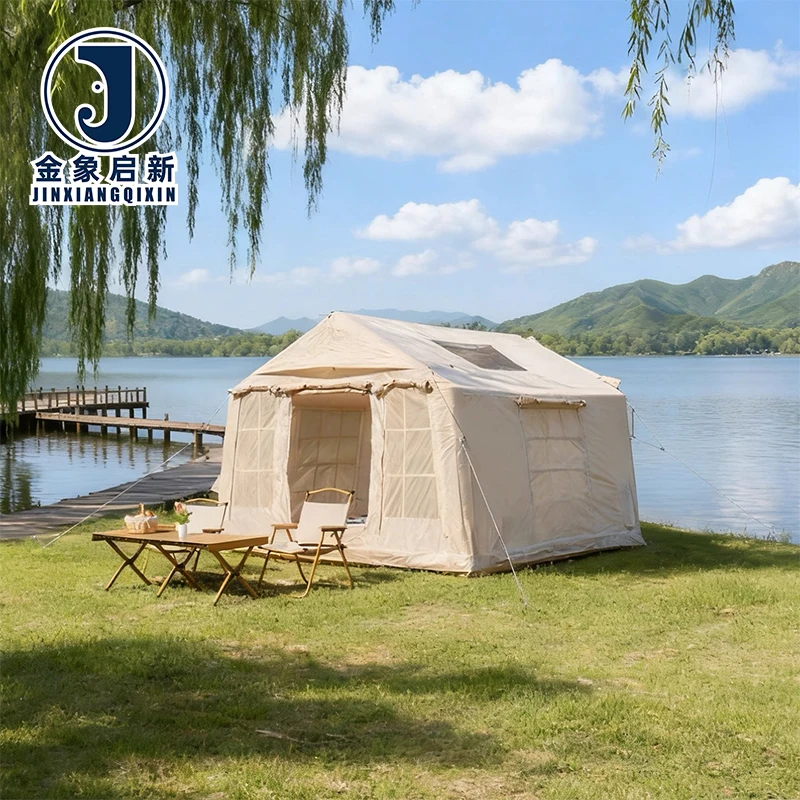
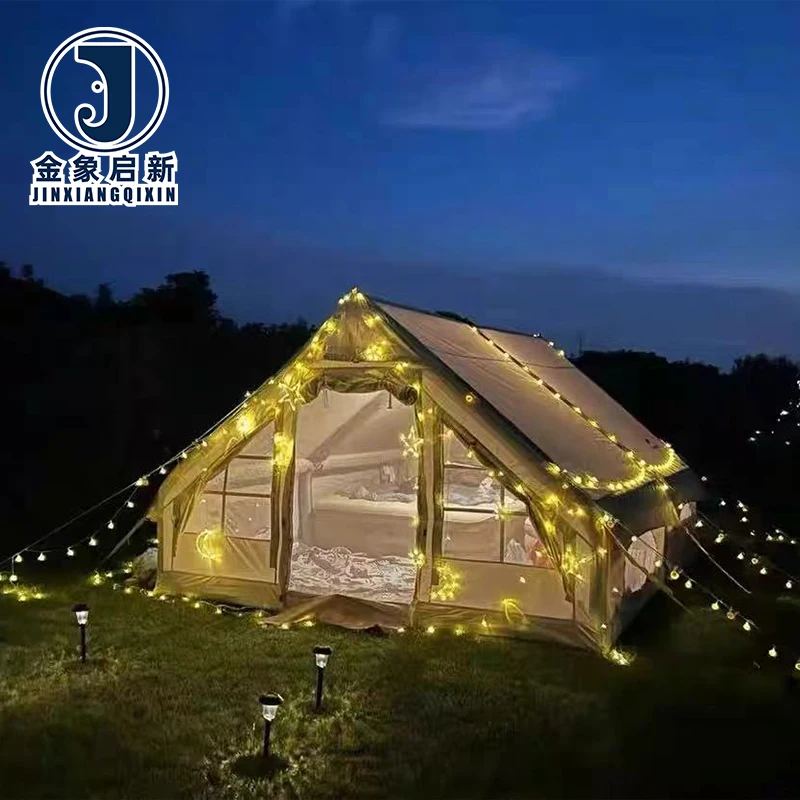
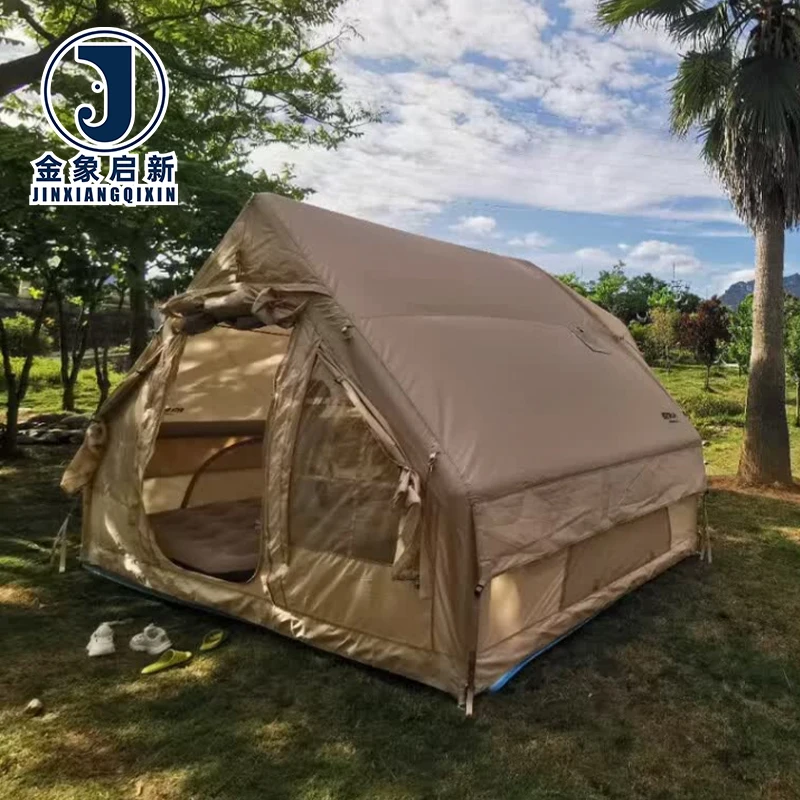
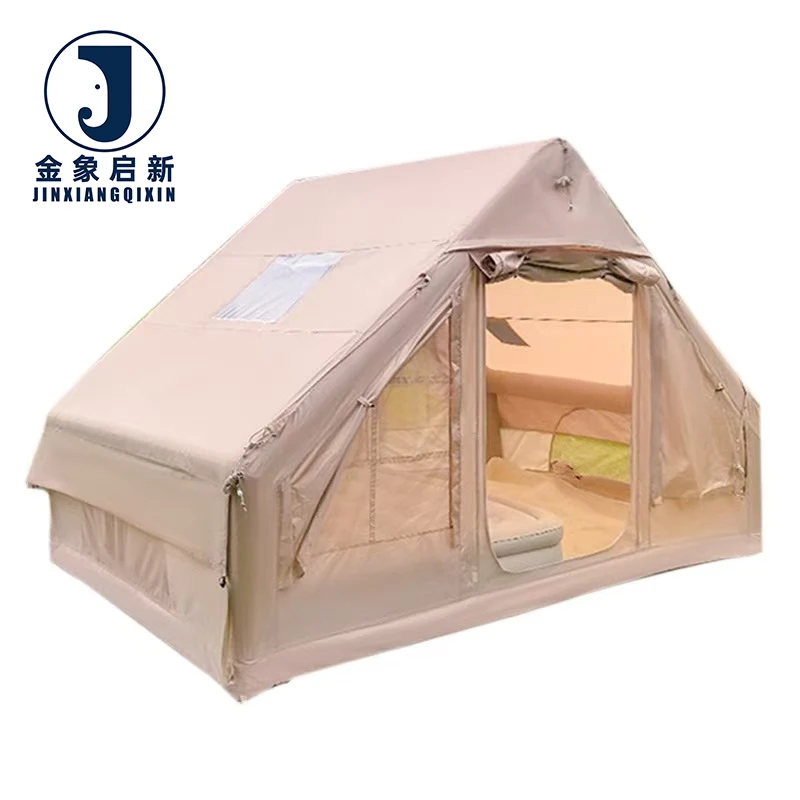
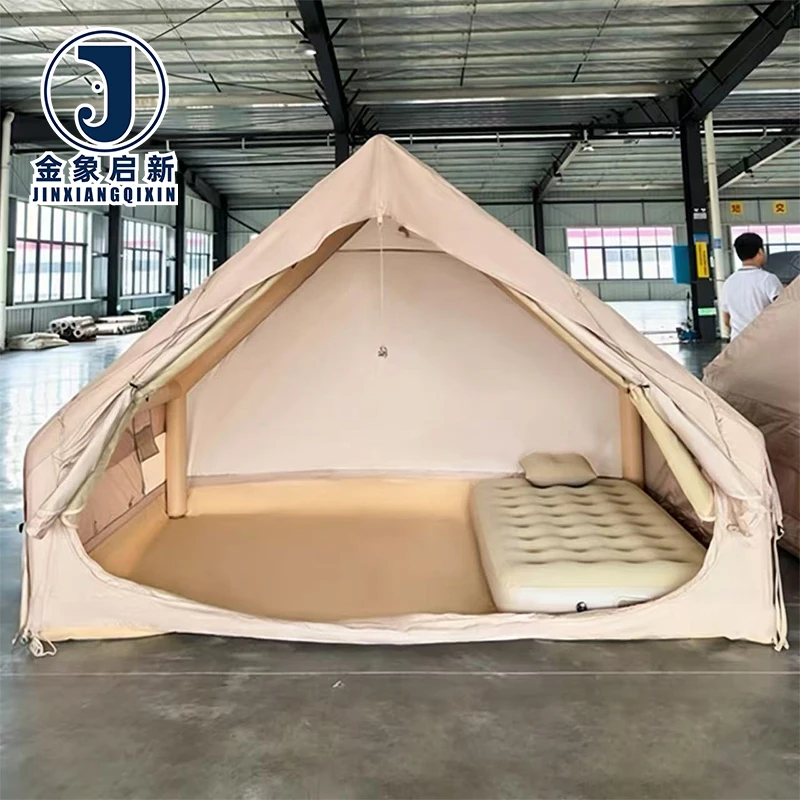
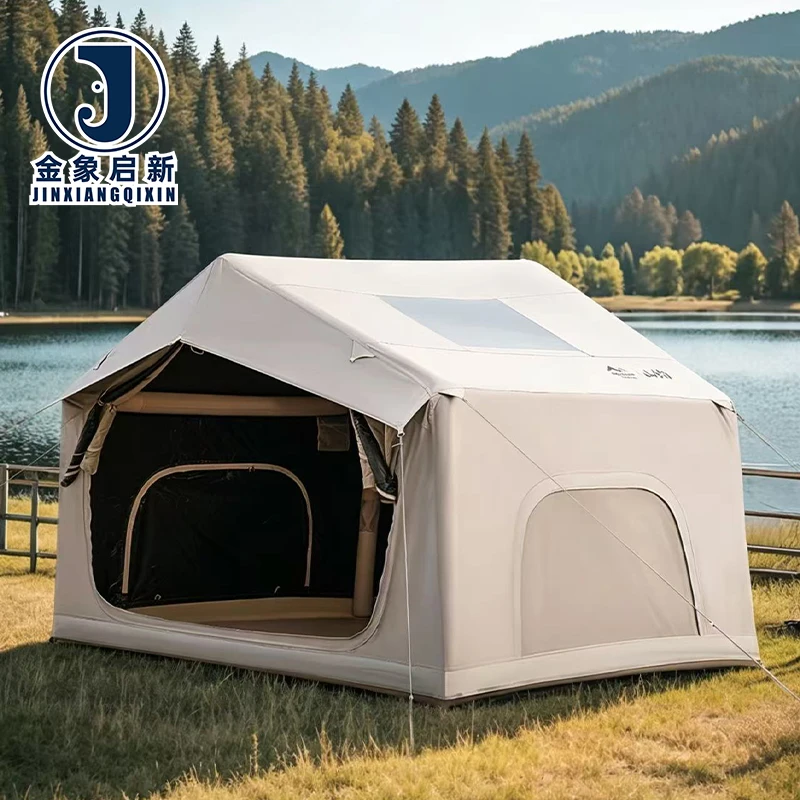
Coated Fabric Process Control — nearly 30 years focused on PVC coating adhesion and weight consistency, applied here to inflatable tent membrane production where airtight seam integrity depends on uniform coating thickness across every roll.
Technical Specifications
| Parameter | Value |
|---|---|
| Product Type | Inflatable tent |
| Core Material | PVC tarpaulin |
| Construction | Single layer |
| Capacity | 6-8 Person |
| Opening Mechanism | Quick automatic opening (inflatable) |
| Season Rating | Four-season |
| Waterproof | Yes |
| UV-Resistant | Available — test basis to be confirmed for your market requirements |
| Flame Retardant | Available in flame retardant grades — confirm the grade required for your market |
| Anti-Static | Available — surface resistance value and standard to be confirmed |
| Tear-Resistant | Yes |
| Customization | OEM & ODM, material thickness adjustment, pattern printing, custom color matching |
| Manufacturing Standards | ISO 9001, ISO 14001, ISO 45001, CE |
Application Suitability
| Application | Exposure & Requirement |
|---|---|
| Commercial camping equipment manufacturing | Repeated inflation cycles, flex stress at seam lines, outdoor UV and moisture exposure |
| Wholesale distribution of certified outdoor gear | Batch-to-batch consistency for retail packaging, fire-safety documentation for target markets |
| Specialist inflatable membrane structures | Airtight integrity under sustained internal pressure, wind load stress on fabric panels |
| Year-round outdoor deployment operations | Temperature fluctuation, prolonged sun exposure, ground contact abrasion |
What "Certified" Inflatable Tent Fabric Actually Requires on Paper
Certification without a traceable test report attached to your specific batch is marketing copy, not compliance.
Inflatable tent fabric marketed as fire-retardant or anti-static often ships without the test documentation that site inspectors and customs authorities in regulated markets demand. Commercial outdoor equipment manufacturers integrating inflatable tent shells into their product lines discover this gap only when a distributor in Europe or North America requests the certificate and the supplier cannot produce one tied to the actual production run. Inflatable Tent Fabric fire retardant anti-static certified claims must be backed by order-specific test reports [NEED_CITE: fire classification standards for temporary structures and tents in European and North American markets]. The consequence is not a delayed shipment — it is a rejected container, a recalled product line, or a voided insurance policy on a commercial campsite.
Membrane Performance Under Sustained Inflation Pressure
An inflatable camping tent relies on continuous internal air pressure to maintain structural shape, which means the PVC tarpaulin membrane operates under constant tensile load for the entire pitched duration. Unlike a pole-supported tent where the fabric can relax between gusts, inflatable tent fabric must resist creep — the slow, permanent stretching that compromises airtightness over time. The single-layer construction specified for this product reduces weight and packing volume for the end user while placing higher demands on the base fabric’s dimensional stability and the coating’s adhesion to the yarn substrate.
Airtight Seam Integrity at Welded Joint Lines
The inflation tubes and panel junctions in a 6-8 person inflatable tent create concentrated stress zones where welded seams bear both internal pressure and external wind load simultaneously. PVC tarpaulin’s thermoplastic coating allows high-frequency or hot-air welding that fuses the coating layers into a continuous bond, but weld strength depends directly on coating uniformity and the thermal profile applied during fabrication [NEED_CITE: weld peel strength test methods for coated fabrics per ISO 1421]. Inconsistent coating weight across a roll leads to weak weld spots that fail during pressure testing or, worse, in the field after the tent has been sold and deployed.
Reading the Specifications That Determine Field Performance
The PVC tarpaulin core material provides the waterproof barrier and the weldable surface that inflatable tent fabrication requires, but its actual performance depends on parameters beyond the material name. Coating weight and base fabric denier work together — a heavier coating on a low-denier scrim may resist puncture but tear easily along the warp or weft, while a high-denier base with insufficient coating adhesion will delaminate at the weld line under inflation pressure. The flame retardant and anti-static treatments available for this fabric must be specified against the regulatory framework of your target market, as different jurisdictions reference different test standards for temporary structures [NEED_CITE: NFPA 701 and EN 13501 test methods for tent and membrane materials]. UV-resistant formulation extends outdoor service life but the test basis — whether accelerated weathering or natural exposure — determines what claim you can legitimately make on your product packaging. Single-layer construction simplifies the fabrication process and reduces material cost per unit, which matters when you are producing inflatable tent shells at commercial scale for wholesale distribution.
The Hidden Cost of Specifying on Price per Square Metre Alone
When inflatable tent fabric is selected primarily on unit cost, the shortcuts taken to hit that price point surface as field failures that damage your brand, not your supplier’s. Coating weight reduced below what the inflation pressure demands leads to tubes that lose pressure within hours, forcing end users to constantly re-inflate — a complaint that ends up on your product review page, not theirs. Flame retardant treatment claimed without a supporting test report means your entire product line can be pulled from a retailer’s shelf the moment a compliance audit occurs [NEED_CITE: product recall procedures for non-compliant fire safety claims in consumer outdoor equipment]. Batch colour variation across rolls in the same production run becomes visible once panels are welded side by side on the assembly line, forcing manufacturers to sort and match panels manually — adding labour cost and delaying shipment schedules.
Why Source Inflatable Tent Fabric Through This Facility
Three full production lines and 36 sets of professional equipment support the volume consistency that commercial tent manufacturers require when ordering inflatable tent fabric across multiple production seasons. A 10-person R&D team handles material thickness adjustment, custom color matching, and pattern printing development, producing samples within days so you can validate fabrication parameters before committing to bulk yardage. Dedicated QA/QC at every production stage includes 100% pre-shipment inspection with pressure testing for airtightness and structural integrity on finished inflatable units. Raw material inspection verifies tensile strength and thickness before production commences, preventing off-spec base fabric from entering the coating line. ISO and CE certified manufacturing processes ensure the compliance documentation your distributors and customs brokers need is generated as a standard output of every order, not an afterthought.
Documentation & Verification
- Material specification sheet stating PVC tarpaulin composition, coating type, and available treatment options per order
- Batch inspection report certifying performance parameters, traceable by order number for regulatory audits
- ISO 9001, ISO 14001, ISO 45001, and CE certificates included with shipment documentation
- Pre-shipment inspection record covering airtightness pressure test results on inflatable units
- Test reports for flame retardant and anti-static properties available — specify required standard at inquiry
- Certificate of origin and customs support documentation for international freight clearance
Fabrication, Handling & Storage
- Hot-air weld temperature profiles must be calibrated to the specific PVC tarpaulin coating thickness before production runs commence
- Store rolls horizontally on pallets in climate-controlled conditions to prevent permanent creasing in the PVC coating layer
- Allow cold-stored PVC tarpaulin rolls to acclimate to workshop temperature before unrolling to avoid coating micro-cracking
- Use compatible PVC adhesive for field repair patches on inflatable tube seams to maintain airtight bond integrity
- Pattern printing on single-layer PVC tarpaulin requires surface preparation to ensure ink adhesion through inflation flex cycles
- Cut panels with sealed-edge techniques to prevent base fabric wicking moisture into the scrim at exposed edges
Preparing Your Inquiry for Accurate Quotation
To receive a specification and sample matched to your inflatable tent production line, provide the target market’s fire-safety and anti-static compliance requirements, your annual volume forecast, and whether you need roll stock for in-house fabrication or finished inflatable tube assemblies. Include your preferred material thickness range, color references or printing artwork, and the inflation pressure your tent design operates at so we can recommend the appropriate base fabric and coating configuration. Sample development proceeds once these parameters are confirmed.
Frequently Asked Questions
Q: What fire-retardant grade and test standard does this inflatable tent fabric carry?
A: Flame retardant treatment is available in multiple grades. The specific grade and test standard depend on your target market’s regulatory framework for temporary structures. Specify the standard required — such as NFPA 701, EN 13501, or DIN 4102 — at inquiry stage and we will confirm availability, provide the corresponding test report, and include it with your shipment documentation.
Q: How is anti-static performance verified and what surface resistance value is achieved?
A: Anti-static treatment is available for this PVC tarpaulin inflatable tent fabric. The surface resistance value and applicable test standard must be confirmed against your application requirements. Request a sample with anti-static treatment and the associated test data sheet so your technical team can validate performance before approving bulk production.
Q: What UV-resistance test basis supports the outdoor lifespan claim?
A: UV-resistant formulation is incorporated into the PVC tarpaulin, but the specific test method — accelerated xenon arc weathering or natural outdoor exposure — determines what durability claim you can substantiate. Specify the test basis required for your market and we will provide the corresponding data sheet with your material specification documentation.
Q: What OEM customization options are available for this inflatable tent fabric?
A: Customization includes material thickness adjustment to match your inflation pressure requirements, custom color matching against Pantone or RAL references, pattern printing for branding or instructional graphics, and OEM or ODM development of finished inflatable components. Sample development is completed within days of specification confirmation for your fabrication team to evaluate.
Q: What compliance documentation ships with each order for customs and regulatory clearance?
A: Every shipment includes material specification sheets, ISO 9001, ISO 14001, ISO 45001, and CE certificates, a batch inspection report traceable by order number, pre-shipment inspection records, and a certificate of origin. Test reports for specific performance requirements such as flame retardancy or anti-static properties are included when specified at inquiry stage.