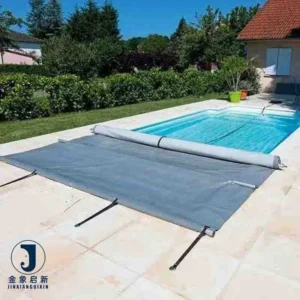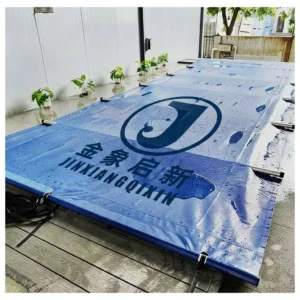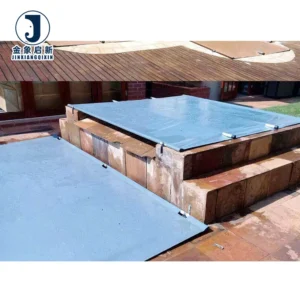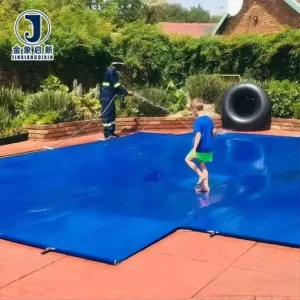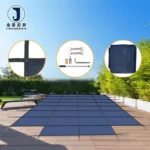
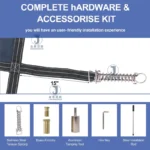
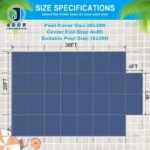

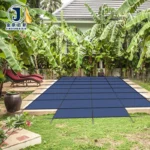
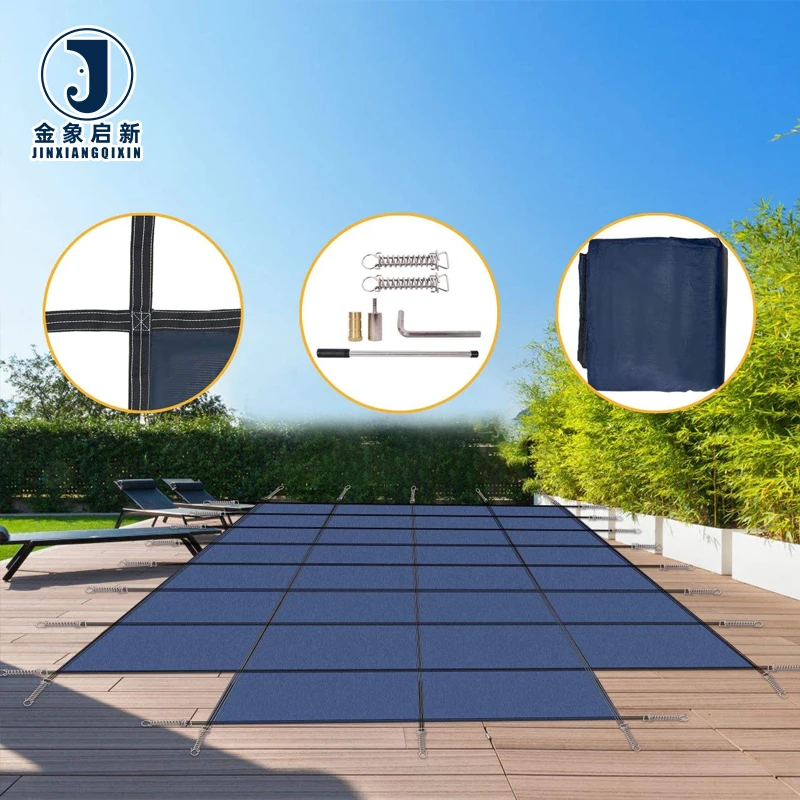
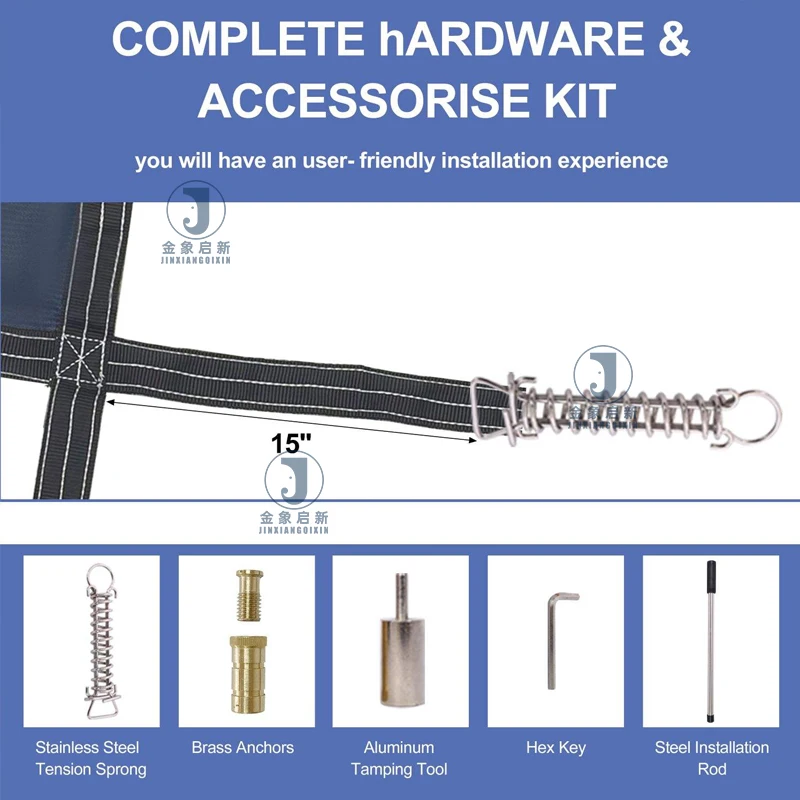
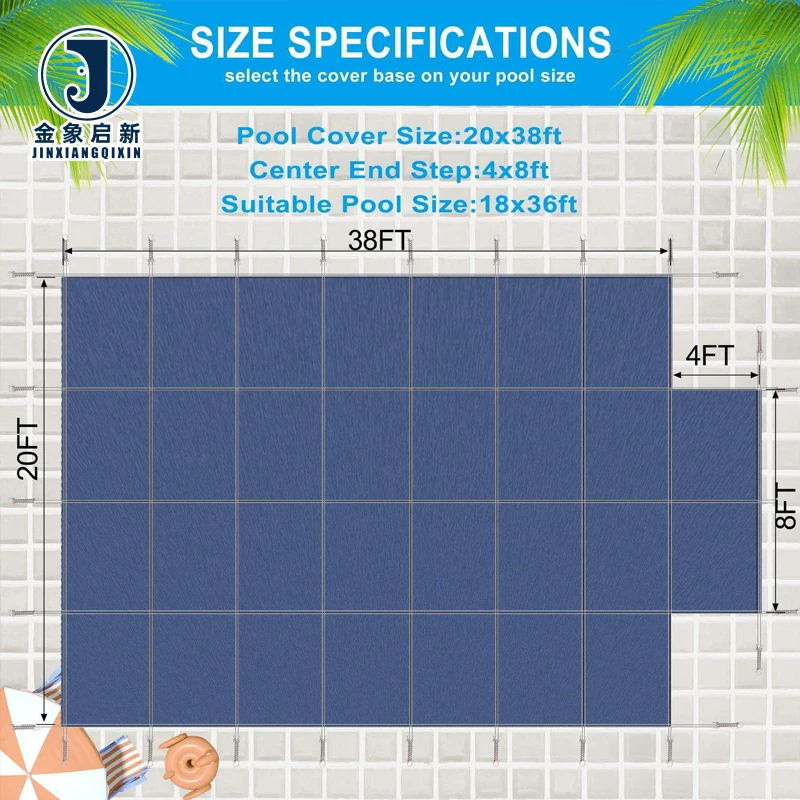
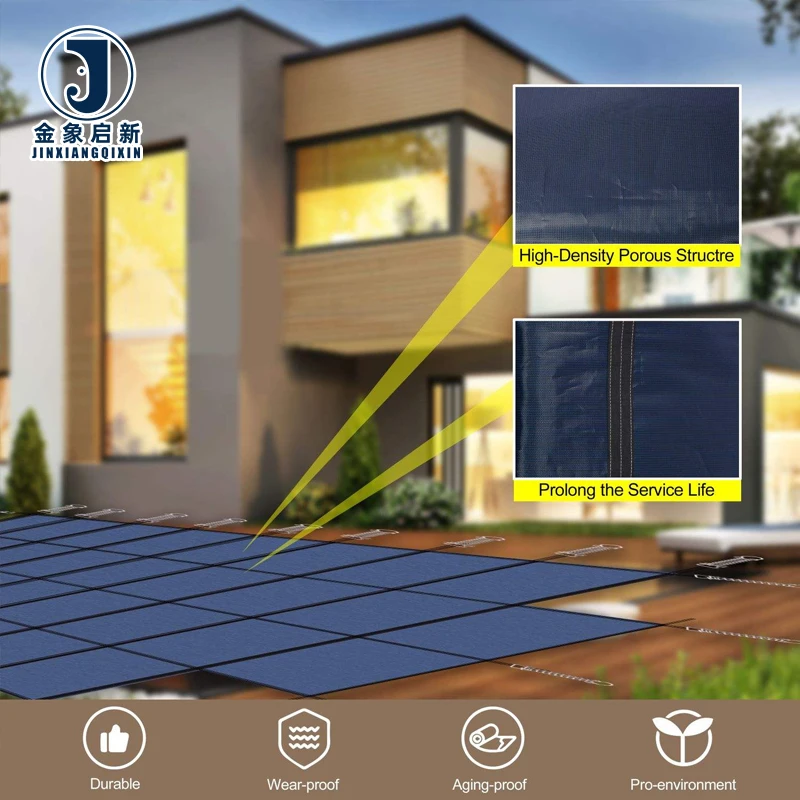
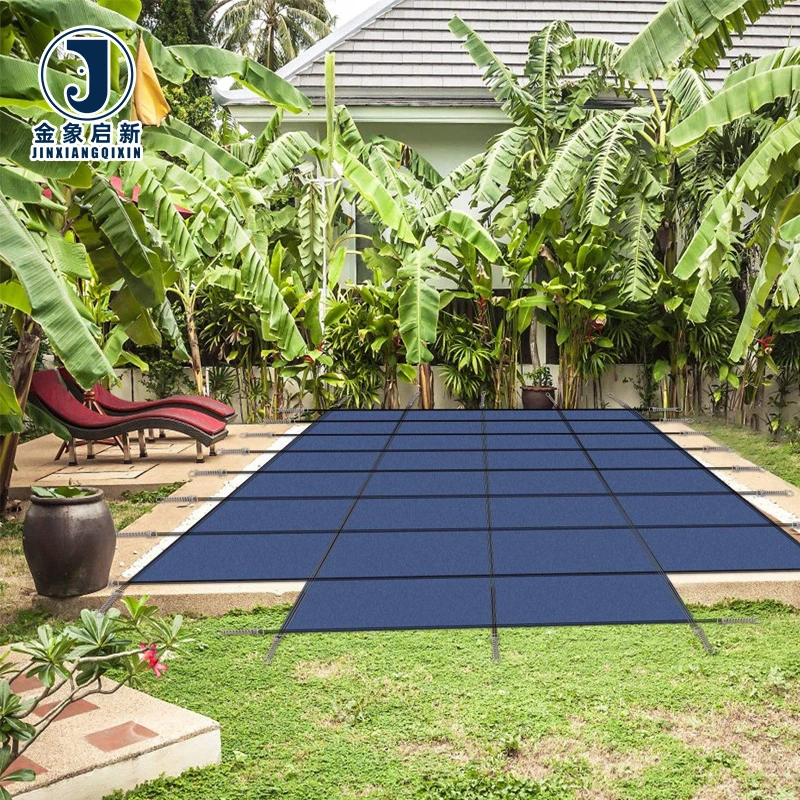
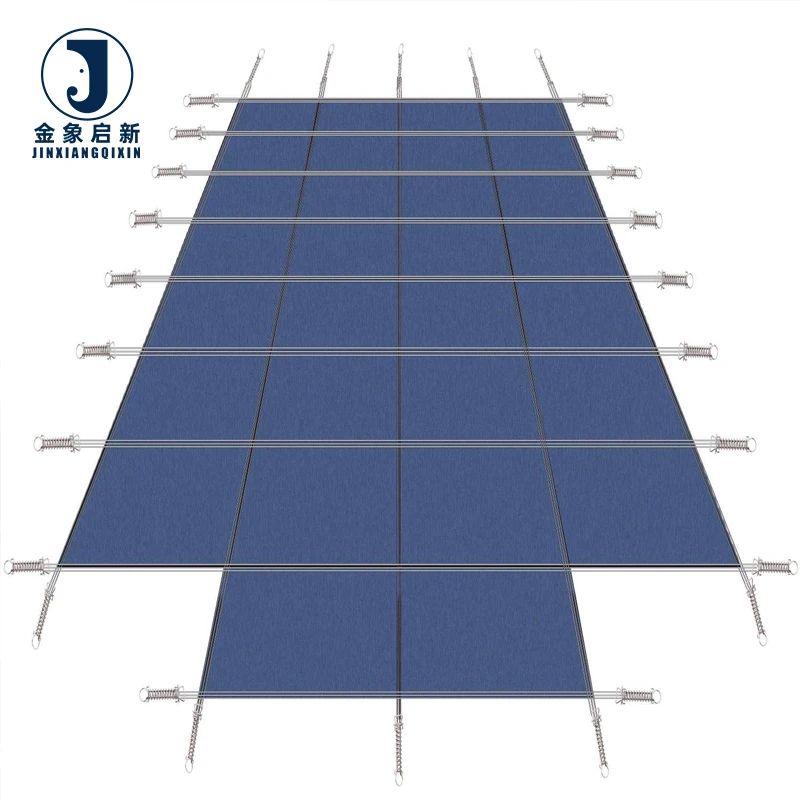
Material Adhesion Control — Hot-melt coating and laminated technology ensure the PVC layer bonds to the high-tenacity polyester base fabric without delamination at seam stress points, a critical requirement for pool safety covers and inflatable structures.
Technical Specifications
| Parameter | Value |
|---|---|
| Product Type | PVC Pool Cover |
| Material | PVC + High-strength polyester mesh fabric |
| Weight (GSM) | 350gsm / 420gsm / 500gsm / 550gsm / 600gsm / 750gsm |
| Total Thickness | 0.32mm / 0.35mm / 0.4mm / 0.45mm / 0.5mm / 0.65mm |
| Roll Size | 2m width × 75m length / 2.1m width × 50m length |
| Finish Product Size | Custom items as per customer’s needs, or sold by inventory |
| Coating Technology | Laminated technology & Hot-melt coating technology |
| Color Options | Blue / Red / Yellow / Light blue / Grey (Customized) |
| Special Treatments | Flame retardant, anti-static, anti-cold, anti-mildew, 3P (grades available on request — confirm the grade required for your market) |
| Key Features | Waterproof, sunproof, anti-mildew, cold crack resistance, outstanding tearing strength for welding, best color fastness |
| Service Life | 3-7 years under normal circumstances |
| Standards | ISO, CE |
Application Suitability
| Application | Exposure & Requirement |
|---|---|
| Inground pool winter safety cover | Snow load, standing water, freeze-thaw cycles, debris accumulation, UV exposure during off-season |
| Hotel and commercial pool enclosure | High-frequency deployment and removal, chlorine vapor exposure, compliance with public safety codes |
| Inflatable structures and temporary event enclosures | Internal air pressure stress, wind load, repeated inflation and deflation cycles, fire-retardant certification requirements |
| Aquaculture pond and reservoir liner | Permanent water contact, soil chemistry, puncture risk from substrate, UV degradation over extended exposure |
| Membrane structure and tensile architecture | Biaxial tension, weld integrity at connection points, weather exposure across seasonal temperature swings |
What "Fire Retardant" Means Without a Certified Grade
A PVC pool cover fabric fire retardant anti-static certified claim without a supporting test report is a compliance risk, not a specification.
Pool operators and membrane structure contractors frequently specify flame retardant fabric based on a supplier’s general claim, only to discover at site inspection that the installed material does not meet the local fire code. The consequence is not a minor paperwork delay — it can mean tearing down an entire pool enclosure or inflatable structure and replacing the fabric at the contractor’s expense [NEED_CITE: fire classification requirements for temporary structures and pool enclosures]. The PVC pool cover aftermarket supplier market is filled with generic "FR" labels that do not correspond to any recognized standard such as DIN 4102, NFPA 701, or M2. Buyers need to see the grade, the test method, and the issuing laboratory before the roll ships.
Coating Adhesion and Weld Integrity for Fabricated Structures
When fabricators heat-weld seams on PVC coated polyester fabric, the bond between the coating and the base yarn determines whether the weld holds or the coating peels under load. Hot-melt coating technology drives the PVC compound into the mesh structure under heat and pressure, creating a mechanical lock that resists delamination during welding. Laminated technology bonds pre-formed PVC films to the base fabric, offering a different balance of cost and peel strength. For pool safety covers that experience tension at anchor points and inflatable structures that flex under internal pressure, weld failure before fabric failure is a common field complaint. Selecting the coating technology to match the fabrication method is part of the specification process, not an afterthought.
Anti-Static Treatment for Compliance-Sensitive Environments
Environments such as aviation maintenance hangars, mining ventilation enclosures, and certain event venues require fabric that dissipates static charge to prevent spark ignition or interference with sensitive equipment. Anti-static treatment is available as an additive applied during coating or as a surface finish, but the performance level varies significantly depending on the formulation and the test method used to measure it. Buyers specifying PVC pool cover fabric fire retardant anti-static certified material should request the surface resistivity value measured according to an applicable standard, along with a test report that corresponds to the batch being supplied. Without documentation, the anti-static claim cannot be verified at the receiving dock.
How Base Fabric Construction Determines Real-World Strength
The GSM figure tells you how much material is on the roll, but it does not tell you how that weight is distributed between the polyester base yarns and the PVC coating. A 650gsm fabric with a loose weave and heavy coating will tear more easily than a 550gsm fabric with a tighter, high-tenacity yarn construction, because the yarns carry the tensile and tear load while the coating primarily provides waterproofing and surface protection. The high-strength polyester mesh used in these PVC pool covers is engineered so the warp and weft yarns share the load evenly, reducing the chance that a single broken yarn propagates into a full tear. Cold crack resistance is a function of the PVC formulation’s plasticizer system — a fabric that remains flexible at low temperatures will not crack when deployed over a pool in winter conditions, preserving the waterproof barrier when it is needed most [NEED_CITE: relationship between polyester denier, weave density, and tear propagation in coated fabrics per ISO 1421].
The Cost of Specifying Without Verification
When a pool cover fabric arrives lighter than the GSM stated on the quotation, the immediate consequence is reduced tensile and tear resistance, but the secondary consequence is less obvious: thinner coatings offer less protection to the base yarns from UV degradation and chemical exposure, accelerating the onset of brittleness and failure. Colour variation between rolls in the same order becomes visible once multiple panels are welded together on site, turning a material supply issue into a cosmetic rejection that delays the entire project. Welded seams failing before the fabric does is often traced back to inconsistent coating weight across the roll, which causes the heat-weld parameters to be correct for some sections and insufficient for others. These are not theoretical risks — they are documented failure modes in coated fabric installations [NEED_CITE: common failure modes in PVC coated fabric pool covers and membrane structures].
Why Fabricators and Contractors Source This Material Here
Three full production lines and 36 sets of professional equipment provide the capacity to supply container-load volumes of PVC coated pool cover fabric with consistent coating weight and colour across every roll in the shipment. A 10-person R&D team handles custom width, colour matching, and sample development, producing samples within days so that fabricators can test weld parameters and confirm fire-retardant or anti-static grades before committing to a production order. Dedicated QA/QC at every production stage with 100% pre-shipment inspection means that GSM, coating adhesion, and surface finish are verified at the roll level before packing. Nearly 30 years of focused production on coated fabric has built process control that goes beyond the specification sheet — it covers the relationship between coating temperature, line speed, and the final peel strength that determines how the fabric performs at the weld.
Documentation & Verification
- Material specification sheet stating GSM, base fabric denier, coating weight, and colour reference for each roll
- Test report for flame-retardant and anti-static grades documenting the standard and test method used
- Pre-shipment inspection record confirming weight, thickness, and visual quality per roll
- ISO and CE certificates covering the production facility and quality management system
- Roll packing list with individual roll weights and dimensions for container loading planning
Fabrication, Handling & Storage
- Set heat-weld temperature and dwell time based on the specific coating technology — hot-melt coated rolls tolerate higher temperatures without base fabric damage
- Store rolls upright on pallets to prevent flat-spot deformation that can cause tracking issues during unrolling and cutting
- Allow cold-stored rolls to acclimatize to ambient temperature before fabrication to avoid cracking the PVC coating at fold lines
- Use compatible PVC solvent cement or hot air welding for seam repairs in the field, matching the repair material to the coating formulation
- Plan cutting layout to maximize utilization from 2m or 2.1m roll widths, accounting for weld allowance at each seam
Preparing Your Inquiry for a Pool Cover Fabric Quotation
To receive an accurate specification recommendation and sample, provide the end-use application and the environmental exposure conditions the fabric will face, including temperature range and any chemical contact such as pool chlorine or saltwater. Specify the fire-retardant or anti-static grade required by your local code or the project specification, along with the target GSM and colour. Indicate whether you require roll stock for your own fabrication or finished cut sizes, and the annual volume to establish pricing tiers and production scheduling.
Frequently Asked Questions
Q: What fire-retardant grade can be supplied and does it meet my local code?
A: Flame retardant treatment is available in multiple grades depending on the target market and application. Specify the standard your project requires — such as DIN 4102 B1, NFPA 701, or M2 — and the production team will confirm the matching formulation and provide a test report from a recognized laboratory with the sample for your approval.
Q: How is anti-static performance measured and certified?
A: Anti-static treatment is applied during the coating process, and performance is measured by surface resistivity according to the applicable test standard. Request the specific measurement value and test report for the batch you are ordering so that you can verify compliance with your site’s static dissipation requirements before installation.
Q: How do I confirm GSM and coating weight on arrival?
A: Every roll undergoes 100% pre-shipment inspection with recorded weight and thickness values. On receipt, you can verify GSM by cutting a measured sample from the roll end and weighing it on a calibrated scale. The pre-shipment inspection record provided with the shipment documents the measured values for each roll.
Q: What weld and seam strength can be expected after fabrication?
A: The high-strength polyester mesh base is designed for outstanding tearing strength at weld points. Hot-melt coated grades provide strong coating-to-yarn adhesion, which allows heat-welded seams to approach the tensile strength of the base fabric. Request a sample to test your specific welding equipment and parameters before placing a production order.
Q: How are custom width, colour and cut sizes handled for project orders?
A: Custom widths, colours, and finished cut sizes are produced to order with samples developed within days for your approval. The 10-person R&D team manages colour matching, pattern requirements, and sizing confirmation including any special features such as center step accommodations. Minimum order quantities and lead times are provided with the quotation.