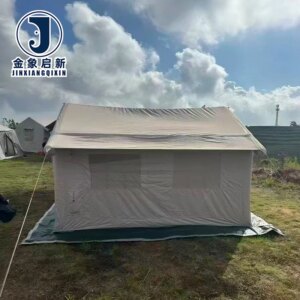
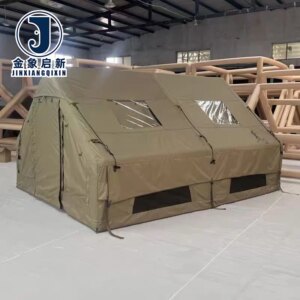
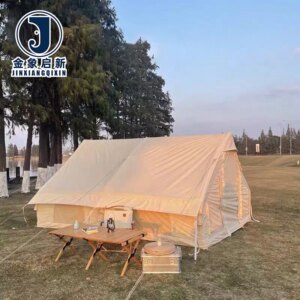
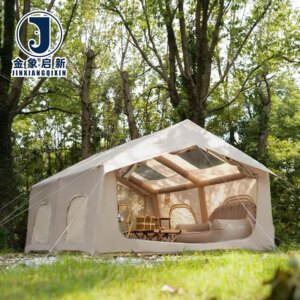
Deep Process Control Over Coated Fabric — every batch of PVC inflatable tent fabric we produce undergoes dedicated QA at each coating and lamination stage, ensuring fire-retardant and anti-static treatments meet the certification your site demands.
Technical Specifications
| Parameter | Value |
|---|---|
| Product Type | Inflatable Tent |
| Core Material | PVC tarpaulin |
| Capacity | 8-10 Person |
| Deployment | Quick Automatic Opening |
| Season Rating | Four-Season |
| Waterproof | Stated (rating not stated in source) |
| UV Treatment | Stated (test basis not stated in source) |
| Flame Retardant | Stated (grade not stated in source) |
| Anti-Static | Stated (surface resistance / standard not stated in source) |
| Tear Resistance | Stated (test standard not stated in source) |
| Customization | OEM & ODM, sample customization, pattern printing |
| Certifications | ISO 9001, ISO 14001, ISO 45001, CE |
Application Suitability
| Application | Exposure & Requirement |
|---|---|
| Mining & tunnelling command shelters | Fire and static compliance in enclosed or hazardous underground environments |
| Aviation ground support inflatable structures | Rapid deployment on tarmac, fuel-proximity static discharge risk, wind loading |
| Construction site temporary offices | Continuous UV and rain exposure, equipment proximity, repeated inflation cycles |
| Emergency response centres | Fast deployment under adverse weather, need for verified safety documentation |
| Temporary event venues | Public occupancy fire code compliance, high foot-traffic abrasion at entry points |
What "Certified Fire Retardant" Actually Means for an Inflatable Tent on Site
A fire-retardant claim without a test report matching your jurisdiction is a compliance gap, not a product feature.
When an inflatable tent arrives on a mining lease or an aviation apron, the safety officer asks for the test certificate before the structure is inflated. If the PVC inflatable tent fabric carries no documentation aligned to the site’s fire code, the structure sits deflated while procurement scrambles for paperwork. I have seen project timelines slip by weeks because the fabric supplier could not produce a batch-specific test report [NEED_CITE: fire classification standards for temporary membrane structures]. The Inflatable Tent Fabric fire retardant certified you specify at inquiry must be the same grade documented at delivery.
How Fire-Retardant and Anti-Static Treatments Interact in Enclosed Inflatable Structures
Inflatable tents used in mining, tunnelling or aviation environments face a dual hazard: ignition sources from equipment and static discharge in low-humidity or fuel-adjacent conditions. The PVC tarpaulin core must carry both treatments without one compromising the other. Available in flame retardant grades — confirm the grade required for your market — and anti-static treatment with surface resistance values to be verified against your project specification. The Inflatable Tent Fabric fire retardant certified for one jurisdiction may not satisfy another, so early alignment on the applicable standard is essential before production begins.
Why Four-Season Weather Resistance Matters Beyond the Brochure
A four-season rating on an inflatable tent means the fabric must perform from freezing mornings to high-UV afternoons without losing structural integrity through the inflation cycle. The PVC coating must remain flexible at low temperatures to prevent brittle cracking at fold lines, while the UV treatment prevents surface chalking that weakens the coating-to-substrate bond over time. Tear resistance supports the fabric through repeated inflation and deflation, where stress concentrates at valve surrounds and seam junctions [NEED_CITE: cyclic stress behaviour in coated technical textiles]. Waterproof performance keeps the interior dry during sustained rain, a baseline expectation for any command shelter or site office operating through wet seasons.
Reading Between the Specs: Coating, Base Fabric and Treatment Layers
The performance of an inflatable tent fabric depends on how the PVC coating, base fabric and functional treatments work as a system rather than as isolated values. The base fabric denier and weave density determine how a tear propagates once initiated — a tighter weave arrests tear spread more effectively than a heavier but looser construction. The coating method influences peel strength at welded seams, which is critical for inflatable structures where internal air pressure loads every joint. Surface treatment choices affect whether the fabric can accept pattern printing or branding without delamination. Fire-retardant additives are incorporated during the coating stage, while anti-static treatment may be applied as a surface finish, meaning the sequence and compatibility of these layers must be controlled during production to avoid one treatment neutralising the other.
The Hidden Cost of Specifying Inflatable Tent Fabric on Price Alone
When procurement selects inflatable tent fabric based on the lowest quotation without verifying treatment documentation, the consequences surface at the worst possible moment — site inspection day. A fire-retardant grade that does not match the local authority’s accepted standard means the entire structure must be removed before personnel can occupy it. Anti-static claims unsupported by surface resistance test data create liability exposure in fuel-handling or mining zones where static discharge is a documented ignition pathway [NEED_CITE: static discharge incidents in temporary industrial shelters]. Batch-to-batch colour variation across multiple units deployed on the same site signals inconsistent coating formulation, raising questions about whether the functional treatments are equally variable.
Why Technical Buyers Source Inflatable Tent Fabric Through This Facility
The 10-person R&D team handles material selection, treatment specification and sample development for each inflatable tent project, aligning the PVC formulation to the fire and static standards your site requires. Three full production lines and 36 sets of processing equipment support volume orders while maintaining coating consistency across every roll in a batch. Dedicated QA and QC staff inspect at each production stage, with 100 percent pre-shipment inspection ensuring the Inflatable Tent Fabric fire retardant certified on your purchase order matches the material dispatched. Sample development within days allows you to verify colour, hand feel and weld behaviour before committing to full production. Nearly 30 years of focus on coated fabric means the process controls governing coating weight, adhesion and treatment loading are embedded in daily production, not added as an afterthought.
Documentation & Verification
- Material specification sheet stating PVC coating weight, base fabric construction and treatment parameters for each inflatable tent order
- Fire-retardant and anti-static test reports matched to the compliance standard your project specifies
- Batch-specific quality inspection record with order-traceable coating and treatment data
- Pre-shipment inspection record confirming roll count, colour consistency and dimensional accuracy
- ISO 9001, ISO 14001, ISO 45001 and CE certificates included with every dispatch
Fabrication, Handling & Storage
- Heat-weld seam parameters must match the PVC coating thickness to prevent seam failure under inflation pressure
- Store rolls horizontally on padded racks to avoid permanent creasing in the PVC tarpaulin coating layer
- Allow cold-stored rolls to reach ambient temperature before unrolling to prevent low-temperature coating fracture
- Use compatible PVC adhesive patches for field repairs on punctured inflatable tent panels
- Clean with neutral pH detergent only — solvent-based cleaners degrade the anti-static surface treatment
- Plan cutting layout to minimise offcuts, accounting for the custom width specified for your inflatable tent project
Request a Material Proposal for Your Inflatable Structure Project
To move forward, share the fire-retardant and anti-static standards your site or jurisdiction requires, along with the deployment environment and expected occupancy classification. Let us know whether you need fabric by the roll for your own fabrication line or finished inflatable tent units with custom sizing and pattern printing. If colour consistency across multiple units matters for your project, specify the reference colour so we can develop a sample for your approval before production.
Frequently Asked Questions
Q: Does this inflatable tent fabric come with fire-retardant and anti-static test certificates?
A: Fire-retardant and anti-static test reports are provided with each batch, matched to the standard your project requires. Confirm the applicable grade and surface resistance value for your market at inquiry stage so we align the formulation and testing before production begins.
Q: What is the process for custom sizing, pattern printing and OEM or ODM orders?
A: Share your dimensional drawings, colour references and print artwork. Our R&D team develops a sample within days for your approval. Once confirmed, production proceeds with in-process QA checkpoints and 100 percent pre-shipment inspection before dispatch.
Q: How is batch consistency maintained across multiple inflatable tent units?
A: Every roll in a production run passes through the same coating line under controlled formulation parameters. Dedicated QA staff verify colour, coating weight and treatment loading per roll, and a batch inspection record accompanies each shipment for your traceability.
Q: Can you provide the documentation needed for project compliance submissions?
A: Each order ships with a material specification sheet, batch quality inspection record, fire-retardant and anti-static test reports, ISO and CE certificates, and a pre-shipment inspection record — sufficient for most site safety and regulatory submissions.
Q: How should the inflatable tent air-column structure be maintained or repaired on site?
A: Minor punctures in the PVC tarpaulin panels can be patched using compatible PVC adhesive repair kits. Avoid solvent-based cleaners on the fabric surface. Store deflated units clean and dry, folded along original crease lines to protect the coating integrity.