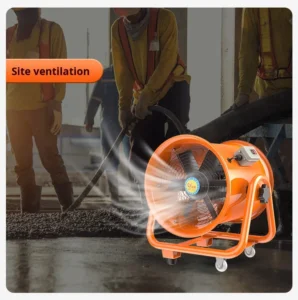


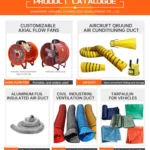

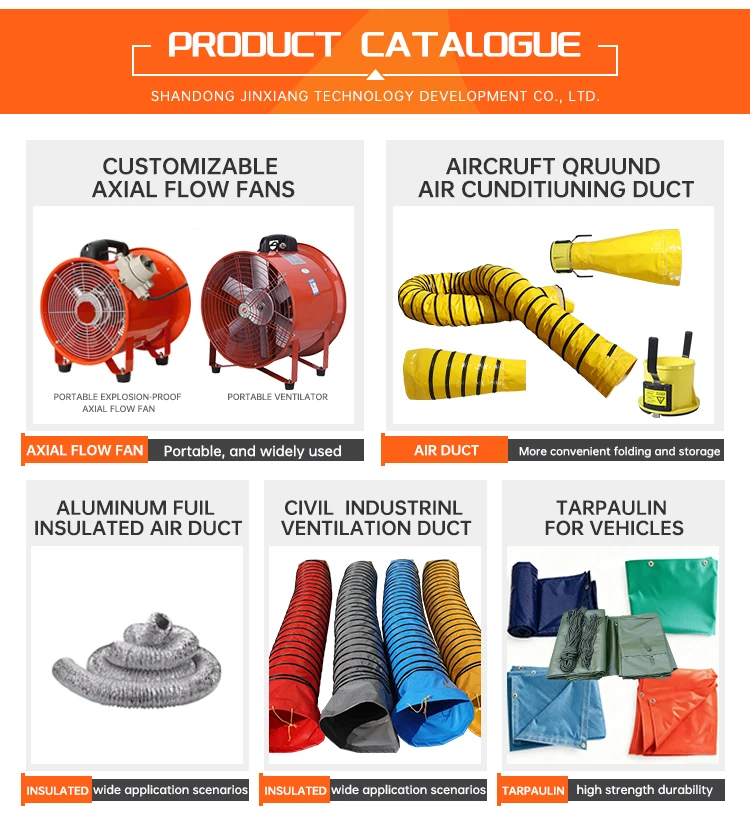

Deep Process Control Over Coated Duct Fabric — Our in-house coating lines allow us to verify fire-retardant and anti-static treatment on every batch of flexible duct hose before it is paired with a matching axial flow fan.
Technical Specifications
| Parameter | Value |
|---|---|
| Product Type | Axial Flow Fan with Flexible Duct |
| Size Options | 200mm / 250mm / 300mm / 350mm / 400mm / 450mm / 550mm / 650mm / 750mm / 850mm / 900mm |
| Power Range | 250W to 5500W |
| Air Volume Range | 1300 m³/h to 28000 m³/h |
| Total Pressure Range | 140 Pa to 320 Pa |
| Voltage | 220V/380V |
| Noise Level | 57-88 dB(A) depending on model |
| Rotation Speed | 3000 RPM |
| Duct Type | Flexible Duct Hose |
| Fan Type | Handheld / Portable Axial Flow |
Application Suitability
| Application | Exposure & Requirement |
|---|---|
| Mining and Tunnelling | Constant moisture, rock dust, fire risk, strict anti-static compliance |
| Confined Space Entry | Welding fumes, solvent vapours, limited access, rapid deployment need |
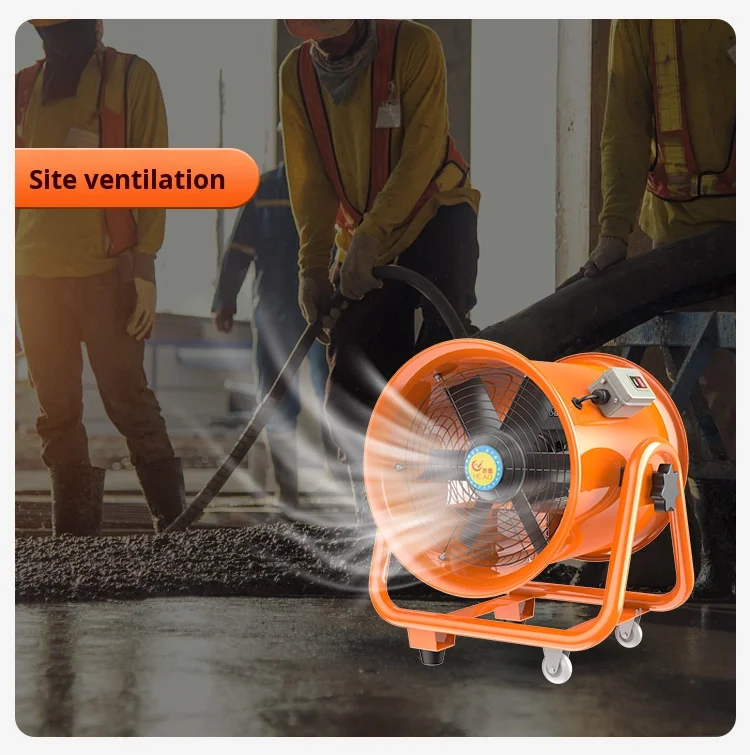
| Construction Sites | Abrasive dust, temporary power supply, irregular duct routing |
| Aviation Ground Support | Fuel vapour extraction, anti-static ducting, strict safety protocols |
Why Certifications Matter More Than Airflow Claims
A Portable Axial Flow Fan with Flexible Duct can move a massive volume of air, but without the correct fire-retardant or anti-static certification on the hose, the entire ventilation system fails the site safety audit. Airflow is only half the specification; the duct material must carry the compliance paperwork that the site safety officer requires.
I have seen operations halt mid-shift because the ventilation duct arrived with a generic material certificate instead of the specific fire-retardant grade mandated for underground work. In mining and tunnelling, the gap between a "flame resistant" claim and a tested grade is the difference between passing inspection and facing a shutdown [NEED_CITE: fire safety regulations for underground ventilation]. When you specify a fan and duct package, the test reports must match the exact material batch being installed.
Matching Fan Pressure to Duct Length and Bends
The Portable Axial Flow Fan with Flexible Duct must overcome the friction loss inside the hose, which increases with every meter of length and every bend in the route. A 900mm fan generating 28,000 m³/h can push air through a long tunnel run, but a 300mm unit on a complex, multi-bend layout will lose pressure before the air reaches the work face. The total pressure rating of the fan must be verified against the actual installed duct configuration, not just the straight-line distance.
Voltage Compatibility and Site Power Supply
The 220V/380V dual-voltage availability allows the Portable Axial Flow Fan with Flexible Duct to integrate with different site power configurations without requiring an external transformer. A 380V three-phase supply typically supports the larger models (650mm to 900mm) that demand higher starting torque for heavy-duty tunnel ventilation. Confirming the available site voltage before ordering prevents motor burnout or underperformance on arrival [NEED_CITE: electrical safety standards for industrial ventilation equipment].
How Duct Diameter Dictates Air Velocity and Noise
The air volume generated by the fan must pass through the cross-sectional area of the flexible duct hose. A smaller diameter duct paired with a high-volume fan increases air velocity, which raises friction loss and generates higher noise levels inside the hose. The noise specifications, ranging from 57 dB(A) on the 200mm model to 88 dB(A) on the 900mm model, reflect this relationship. Selecting the correct diameter ensures that the system delivers the required air exchange rate without exceeding site noise exposure limits.
The Hidden Cost of Uncertified Duct Fabric
When the flexible duct hose lacks the fire-retardant or anti-static certification required for the specific site, the contractor faces a compliance gap that cannot be resolved on the ground. The fan may operate perfectly, but the safety officer will not approve the installation until the duct material is replaced with a certified grade. This delay halts work in the affected zone, pushes back project milestones, and forces a re-order under urgent lead times, often at a premium [NEED_CITE: compliance requirements for mining ventilation systems].
Why Source Your Fan and Duct System Here
The R&D team handles material selection for the duct fabric, ensuring that the fire-retardant and anti-static treatments are matched to the specific hazard classification of your site.
Three full production lines and 36 sets of professional equipment support bulk capacity, allowing us to deliver matched fan and duct packages on reliable schedules.
Dedicated QA/QC inspects every stage, from the fan motor winding to the duct seam integrity, with 100% pre-shipment inspection before dispatch.
Samples of the duct fabric are developed within days, allowing you to verify the fire-retardant grade and anti-static surface resistance before committing to a production order.
The 10-person technical team provides documentation packages that include the material specification sheet and test reports, closing the compliance gap before the system arrives on site.
Documentation & Verification
- Material specification sheet stating the fire-retardant grade and anti-static surface resistance of the duct fabric
- Test reports for flame retardant and anti-static properties matched to the specific duct batch
- ISO and CE certificates covering the fan motor and electrical components
- Pre-shipment inspection record confirming fan rotation speed and duct seam integrity
- Certificate of origin and customs support for international dispatch
Fabrication, Handling & Storage
- Ensure the flexible duct hose is routed without sharp kinks that restrict airflow and stress the coated fabric
- Store rolled duct hose in a dry, shaded area to prevent UV degradation of the coating before deployment
- Verify the fan-to-duct coupling is secured with the correct clamp to prevent air leakage under pressure
- Avoid dragging the duct hose over abrasive surfaces that could compromise the fire-retardant coating layer
- Clean the duct interior with a mild detergent, avoiding solvents that attack the PVC coating and anti-static treatment
Specify Your Ventilation Requirements
To receive a matched fan and duct proposal, provide the total duct run length, the number of bends in your routing layout, and the target air exchange rate for the workspace. Confirm the fire-retardant and anti-static grades required by your local mining or tunnelling safety regulations. Specify the available site voltage and whether you require the duct in custom lengths or standard roll packing.
Frequently Asked Questions
Q: What fire-retardant or anti-static certification does the duct carry?
A: The duct fabric can be supplied with fire-retardant and anti-static treatments, but the specific grade must be confirmed against your site safety requirements. Request the test reports for the exact duct batch you are ordering to ensure compliance with your local mining or tunnelling regulations.
Q: How do I match fan size and pressure to my duct run length?
A: You must calculate the total friction loss based on duct length, diameter, and the number of bends, then select a fan with a total pressure rating that exceeds this loss. Our technical team can verify your layout calculations against the fan performance curve.
Q: Can I order duct and fan as a single package with matched couplings?
A: Yes, the fan and duct hose can be supplied as a single package with couplings that match the fan outlet diameter, ensuring a sealed connection and preventing air leakage at the joint under full system pressure.
Q: What voltage options are available for different site power supplies?
A: The fans are available in 220V and 380V configurations. Confirm your site power supply before ordering, as the larger diameter models typically require 380V three-phase power to deliver the necessary starting torque and continuous airflow.
Q: How is the duct packed for transport to avoid coating damage?
A: The flexible duct hose is rolled and packed to prevent sharp creases that could damage the fire-retardant coating or anti-static treatment. Confirm the packing method if your transport route involves extreme temperatures that could affect the fabric flexibility.