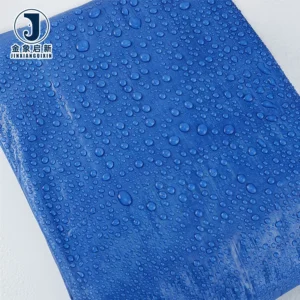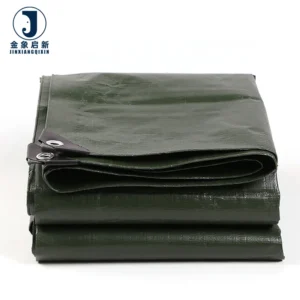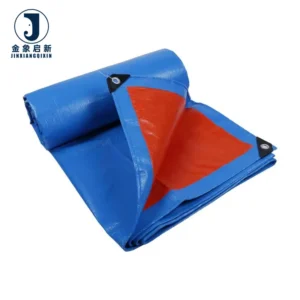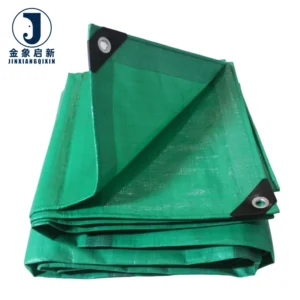
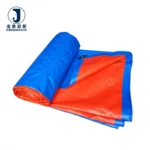
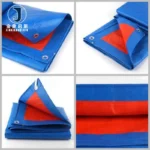
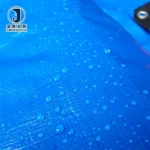
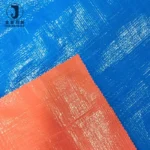

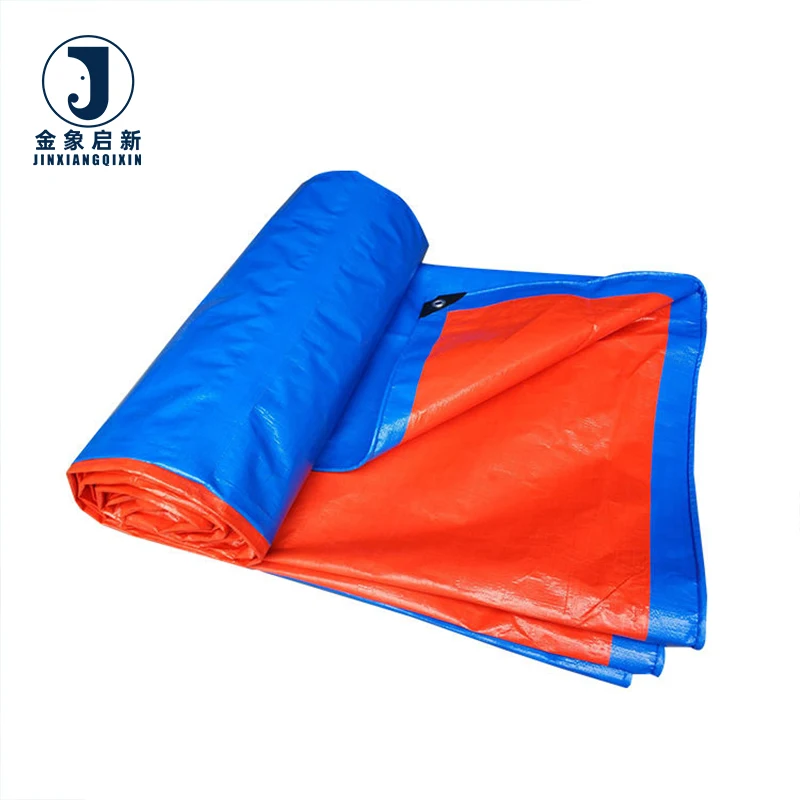
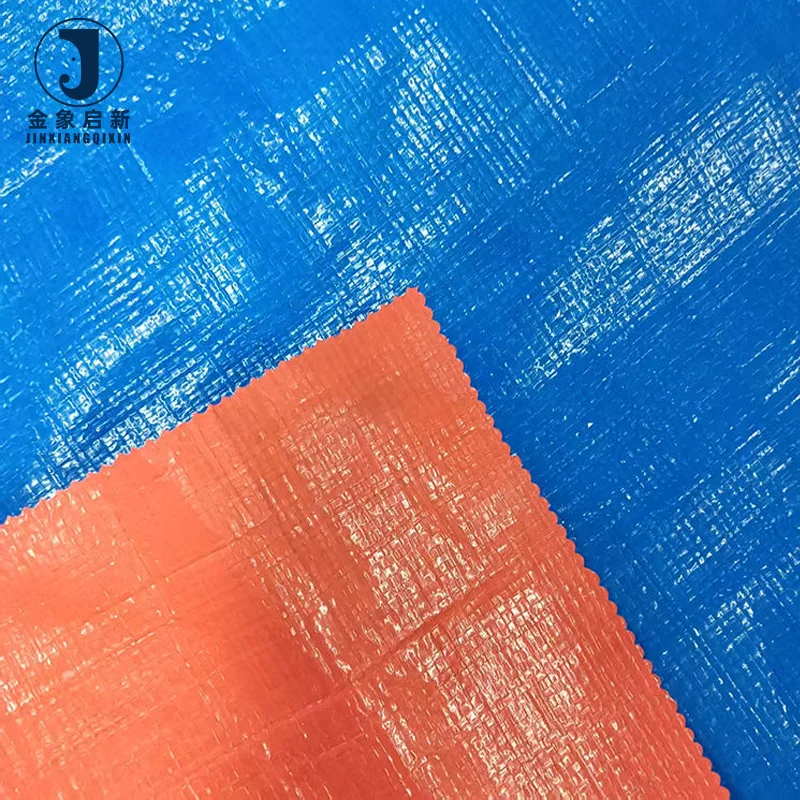
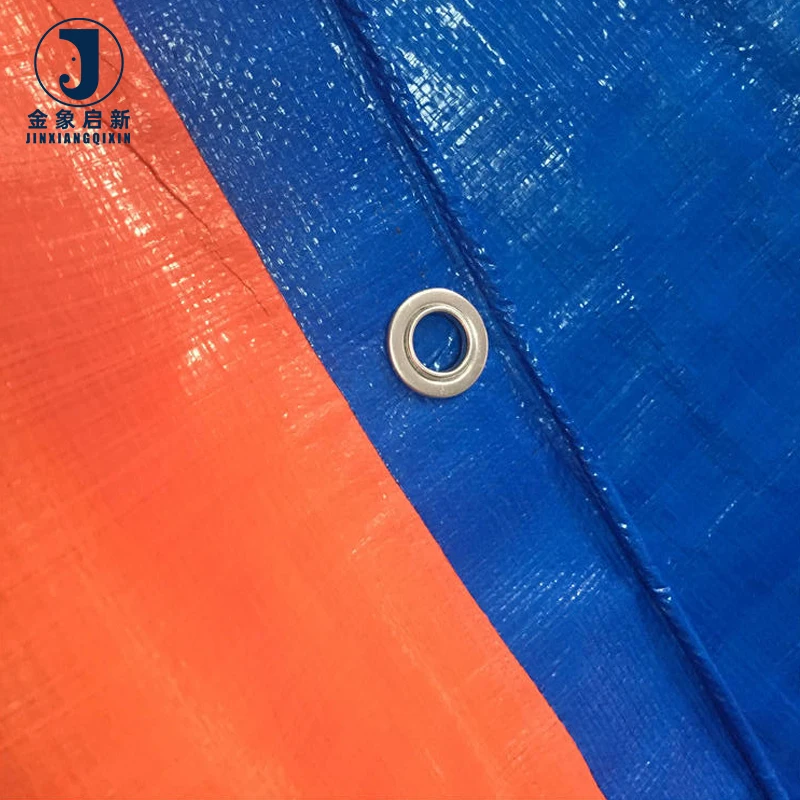
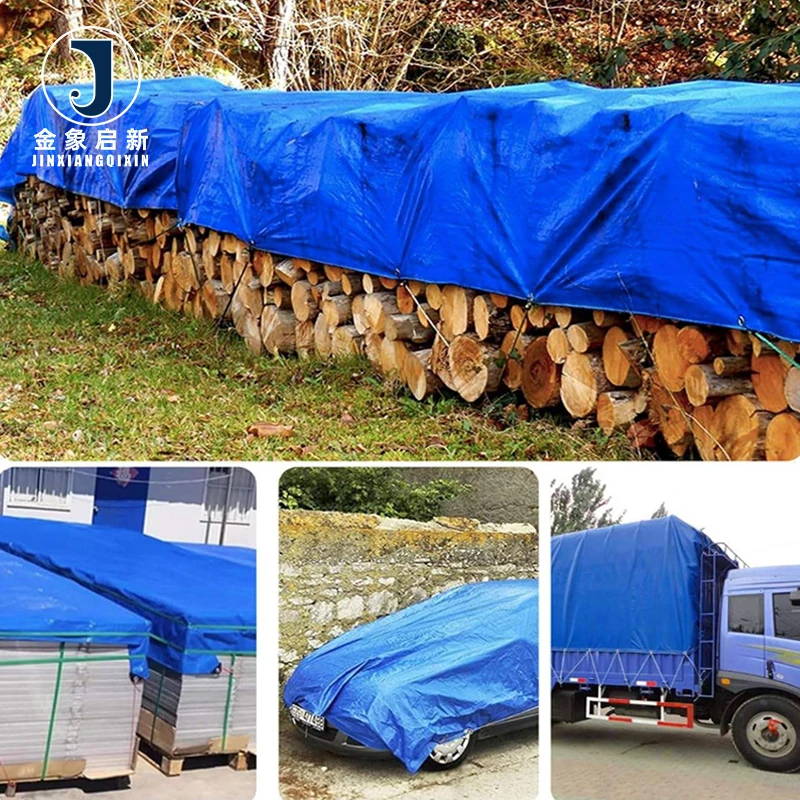
Three Full Production Lines — dedicated QA/QC checks at every production stage verify mesh count, coating adhesion, and GSM before this PE Tarpaulin leaves the facility.
Technical Specifications
| Parameter | Value |
|---|---|
| Product Type | PE Tarpaulin |
| Material | HDPE woven fabric with LDPE coat on both sides |
| Density (Mesh Count) | 6×6 to 16×16 mesh |
| Weight | From 50 g/m² up to 300 g/m² (confirm specific grade for your project) |
| Fire Resistance | Available in fire resistant grades — confirm the standard required for your market (grade not stated) |
| UV Protection | UV protection available — confirm the test basis required for your region (test basis not stated) |
| Color Options | Blue, Orange, White, Black, Grey, Yellow, Green, Red, or custom colors |
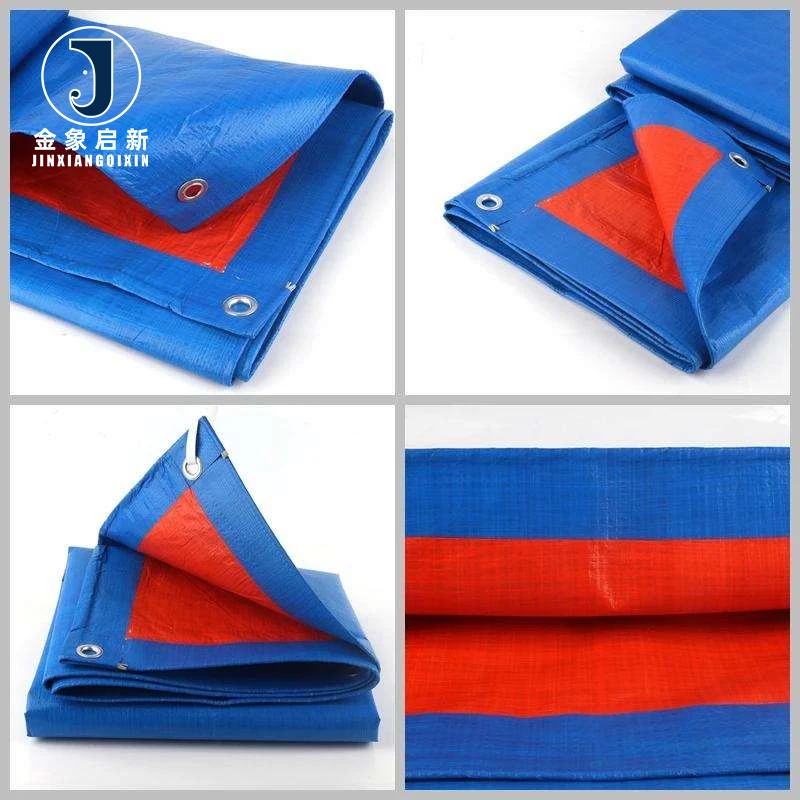
| Edge Construction | All edges hemmed with PP ropes; corners reinforced with black plastic triangles |
| Eyelet Specification | Rustproof aluminum eyelets at 1 m or 1.5 m intervals, or per project requirement |
| Sheet Sizes | 2×3, 3×4, 3×5, 4×5, 5×6, 6×8, 10×10, 10×12, 12×14, or custom dimensions |
| Roll Size | 100 m per roll or as required |
| Printing | Logos or company information; reinforced strip can be added |
Application Suitability
| Application | Exposure & Requirement |
|---|---|
| Mine & tunnel ventilation enclosures | Fire safety compliance, confined-space regulations, dust containment |
| Construction site temporary covers | Weather exposure, wind load, frequent handling, site safety color coding |
| Aviation and industrial ground protection | Equipment protection, fire management protocols, anti-static site requirements |
| Inflatable & membrane structure components | Air retention, structural paneling, lightweight weather barrier |
| General industrial cargo and equipment covers | Waterproofing, UV degradation resistance, mechanical abrasion during transport |
Why Certifications Define a Technical PE Tarpaulin’s Real Value on Site
A PE Tarpaulin fire retardant or anti-static claim means nothing without a verifiable test report tied to a recognized standard.
Technical buyers specifying ventilation duct, membrane structures, or site enclosures for mining and tunnelling projects routinely encounter tarpaulins labeled "flame retardant" that carry no supporting documentation. When a site inspector requests a certificate during a safety audit, a supplier’s verbal assurance does not satisfy the compliance requirement. The gap between a marketing claim and a documented grade is where project delays, rejected shipments, and failed inspections originate [NEED_CITE: fire safety compliance requirements for temporary industrial enclosures in mining operations].
Compliance Documentation Starts at the Inquiry Stage
Specifying a PE Tarpaulin fire retardant grade for a ventilation or temporary structure project requires more than a checkbox on a quotation. The target market’s regulatory framework — whether European, North American, or regional mining authority standards — dictates the exact test method and pass criteria the material must meet. Buyers who communicate the specific standard at the inquiry stage allow the R&D team to select the appropriate additive package and confirm whether the LDPE coating formulation can deliver the required classification.
Verifying Treatment Performance Before the Roll Ships
UV protection and fire resistant treatments in this PE Tarpaulin range are formulated to meet project-specific requirements, and the verification process must match. Request the test report alongside the material specification sheet before production begins, not after the container is loaded. This approach ensures the grade stated on the documentation aligns with the regulatory framework governing your installation site [NEED_CITE: ISO and regional test standards for flame retardant classification of coated polyethylene fabrics].
Reading the Specification Sheet as a Technical Buyer
Mesh density and coating weight operate together to determine how a PE Tarpaulin performs under stress. A 16×16 mesh provides a tighter weave that increases the base fabric’s contribution to tear resistance, while the LDPE coating weight governs surface waterproofing, flexibility, and how well the material responds to heat welding. When a specification sheet lists GSM without breaking it down into base fabric weight and coating weight, the buyer cannot accurately predict weld behavior or flex fatigue at hem and eyelet points. Fire resistant additives modify the LDPE layer’s chemistry, which can affect heat-seal temperature windows — a detail fabricators must confirm before setting up production jigs.
The Cost of Undocumented Fire Resistant Grades on Technical Projects
A PE Tarpaulin that arrives on a tunnelling or mining site without the correct fire classification documentation does not just fail an inspection — it halts the entire work front until compliant material is sourced and delivered. Project schedules compress, demobilization costs accumulate, and the original supplier relationship breaks down under the pressure of replacement timelines. Batch-to-batch color variation across sheets intended for a visible site enclosure forces either full replacement or an inconsistent appearance that undermines site safety color-coding systems [NEED_CITE: documented consequences of non-compliant fire retardant materials in underground construction projects].
Why This PE Tarpaulin Range Meets Technical Procurement Requirements
Three full production lines with 36 sets of professional equipment provide the capacity to deliver consistent bulk rolls and cut sheets within committed lead times for technical projects. A 10-person R&D team handles material selection, treatment formulation confirmation, custom sizing, and sample development for fire resistant and UV-protected grades before full production runs begin. Dedicated QA/QC inspection at every production stage — from base fabric weaving through coating application and final cutting — ensures that mesh count, GSM, and treatment presence are verified on every roll and sheet before dispatch [NEED_CITE: quality control protocols for coated PE fabric production]. Samples for custom color, printing, and treatment requirements are developed within days, allowing technical buyers to confirm material suitability before committing to full order quantities.
Documentation & Verification
- Material specification sheet detailing GSM, mesh count, HDPE base fabric, and LDPE coating composition for each order
- Fire resistant and UV protection test reports issued against the specific standard confirmed at the inquiry stage
- ISO and CE certificates supplied with shipment documentation for customs and site compliance review
- Pre-shipment inspection record confirming GSM, color consistency, and eyelet placement against the purchase order
- Roll packing list and certificate of origin prepared for destination-country import requirements
Fabrication, Handling & Storage
- Heat welding parameters for LDPE-coated sheets should be adjusted to account for any fire resistant additive package affecting melt behavior
- Rustproof aluminum eyelets at 1 m intervals distribute tie-down loads across the PP-rope-hemmed edge without localized tearing
- Rolls stored horizontally on pallets in shaded areas prevent flat-spot deformation that affects unrolling and fabrication accuracy
- Black plastic triangle corner reinforcements protect the highest-stress points during repeated sheet installation and removal cycles
- Custom-printed logos and company information on LDPE-coated surfaces require confirmed ink adhesion before bulk printing runs
What to Include in Your Technical Inquiry
Provide the specific fire safety or anti-static standard your site authority requires so the correct treatment grade can be matched to the PE Tarpaulin formulation from the outset. Specify whether your project calls for sheet or roll delivery, the exact dimensions or roll lengths needed, and any color or printed identification requirements for site safety protocols. Confirm the target mesh density and GSM range your engineering specification calls for, along with eyelet spacing and edge reinforcement preferences, so a complete quotation with accurate lead times can be issued.
Frequently Asked Questions
Q: Which fire resistant standards can this PE Tarpaulin be produced to?
A: Fire resistant treatment is available as an option and the specific grade must be confirmed against your project’s regulatory requirements. Communicate the target standard — such as the classification required by your regional mining authority or construction safety code — at the inquiry stage so the correct formulation is selected and documented with a test report.
Q: How is UV protection verified before shipment?
A: UV protection treatment is available based on project requirements. Request the test basis and report during the specification confirmation stage before production starts. This ensures the protection level matches the exposure duration and climate conditions at your installation site, with documentation included in the shipment file.
Q: How can I confirm the mesh density and GSM on arrival?
A: Each order ships with a pre-shipment inspection record that documents the verified GSM and mesh count for your specific rolls or sheets. On receipt, you can cross-check the material specification sheet against physical samples using standard weighing and mesh counting methods to confirm consistency with the stated values.
Q: What reinforcement options are available for high-stress installations?
A: All sheets come with PP rope-hemmed edges and black plastic triangle corner reinforcements as standard. Rustproof aluminum eyelets are placed at 1 m or 1.5 m intervals, with custom spacing available. For applications involving frequent handling or high wind loads, additional reinforced strips can be added at stress points.
Q: How are custom colors and printed identification managed across bulk orders?
A: Custom colors and logo printing are available across the PE Tarpaulin range. Confirm color references and print specifications during sample development so batch-to-batch consistency is established before full production. The R&D team develops samples within days to verify color match and print adhesion on the LDPE-coated surface.