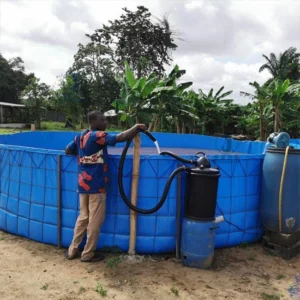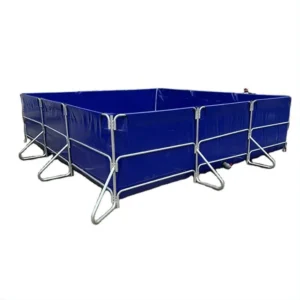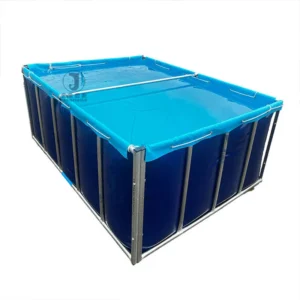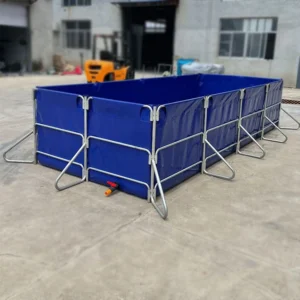
Precision Coating Control — Every roll of PVC pond liner we ship is backed by a material specification sheet stating exact GSM, base fabric denier, and coating weight, so what you order is what you receive on the dock.
Technical Specifications
| Parameter | Value |
|---|---|
| Product Type | PVC Tarpaulin Roll for Fish Pond Lining & Aquaculture Tanks |
| Base Fabric Material | Polyester |
| Yarn Count Options | 500D×840D, 500D×1000D, 1000D×1000D, 1000D×1300D, 1300D×1300D, 1000D×2000D |
| Mesh Count | 20×20, 30×15, 30×19 |
| Weight Range | 350, 400, 420, 500, 600, 650, 750, 900 GSM |
| Thickness Range | 0.29mm, 0.32mm, 0.38mm, 0.44mm, 0.46mm, 0.55mm, 0.65mm |
| Tensile Strength (Warp) | 1650N – 3900N (test basis not stated in source) |
| Tensile Strength (Weft) | 1600N – 3500N (test basis not stated in source) |
| Coating Material | Double-Sided PVC |
| Surface Finish | Smooth, leather-like texture |
| Key Features | Water Resistant, Waterproof, Anti-Bacteria, Abrasion-Resistant, Flame Retardant (grade not stated in source), Anti-UV (test basis not stated in source) |
| Repairability | Hot-air weldable |
| Certifications | ISO, CE (general company certification) |
Application Suitability
| Application | Exposure & Requirement |
|---|---|
| Fish pond lining | Permanent water contact, soil chemistry, puncture risk from substrate stones and roots |
| Aquaculture tanks (shrimp, tilapia) | Constant water immersion, anti-bacteria surface requirement, cleaning and draining cycles |
| Hatchery and nursery tanks | Smooth cleanable interior, non-leaching formulation, frequent partial water changes |
| Agricultural reservoir liners | Sediment abrasion, livestock access at edges, prolonged UV exposure in open-air settings |
| Recirculating aquaculture system (RAS) tanks | Continuous water containment, biofilm resistance, seam integrity under hydrostatic pressure |
Why Coating Weight Verification Matters More Than the Quoted GSM
A quoted GSM means nothing if the roll arriving on your dock weighs less.
PVC pond liner buyers regularly discover that the material delivered is lighter than what the quotation promised. The shortfall may seem minor per square metre, but across a full pond lining project it compounds into thinner coating, reduced abrasion resistance at the pond floor, and earlier failure at stress points. When the PVC pond liner fire retardant grade or certified aquaculture tank liner specification you paid for does not match reality, the entire containment system is compromised. [NEED_CITE: industry reports of GSM discrepancies in imported coated fabrics]
How Double-Sided PVC Coating Secures Long-Term Water Containment
The polyester base fabric in this PVC pond liner fire retardant and aquaculture-grade roll receives PVC coating on both faces, creating a fully sealed structure that eliminates the water leakage paths common in woven PE alternatives. The smooth, leather-like surface finish prevents biofilm adhesion and makes draining and cleaning cycles more effective in aquaculture tank environments. Each yarn count option — from 500D×840D up to 1000D×2000D — is matched to a corresponding coating weight so that the composite material delivers balanced tensile and puncture performance for the intended pond depth and substrate condition.
Seam Integrity Through Hot-Air Welding on Site
Unlike adhesive-bonded joins that degrade under constant water immersion, hot-air welding fuses the PVC coating layers into a continuous bond that matches the parent material. This matters for large aquaculture installations where multiple panels must join on site to cover wide pond floors. The weld line becomes as resistant to water penetration and abrasion as the body of the certified aquaculture tank liner itself. Repairability through the same hot-air process means that localized damage from sharp substrate or equipment contact can be patched without removing and replacing the entire liner section. [NEED_CITE: hot-air weld strength testing methods for PVC coated fabrics]
Reading the Specification Sheet: Yarn Count, GSM, and Mesh Density Together
Selecting the correct pond liner grade requires looking at yarn count, GSM, and mesh density as a system rather than as isolated numbers. A 1000D×2000D base fabric at 900 GSM with a 30×19 mesh count delivers substantially higher tensile and puncture resistance than a 500D×840D fabric at 350 GSM — but the heavier grade also costs more and is harder to handle on site. Mesh count determines how tightly the polyester yarns are woven before coating; a 30×19 density resists tear propagation better than a 20×20 weave at the same yarn denier. The coating thickness, expressed in the total thickness range from 0.29mm to 0.65mm, controls how much PVC protects the base fabric from direct abrasion against the pond floor. Choosing the right combination depends on pond depth, expected livestock load, substrate roughness, and whether the liner will be exposed above the waterline to direct sunlight.
The Hidden Cost of Specifying Liner Grade by Price Alone
When procurement decisions focus on the lowest per-square-metre quote without verifying the underlying specification, the consequences show up months after installation. A liner that is lighter than its quoted GSM will abrade through at the pond floor faster, particularly where sediment accumulates and livestock traffic concentrates. Flame retardant grades claimed without supporting test documentation create compliance risk on sites that require verified fire performance for covered aquaculture facilities. Batch-to-batch colour variation between rolls in the same order becomes visible once adjacent panels are welded together, which may not affect water containment but signals inconsistent coating formulation that could extend to performance properties. [NEED_CITE: coated fabric specification verification practices in aquaculture procurement]
Why Source This PVC Pond Liner Fire Retardant Grade Here
Three full production lines and 36 sets of professional coating equipment maintain consistent output capacity, so large-volume aquaculture projects receive all rolls from matched production runs. A dedicated ten-person R&D team handles material selection and sample development for custom width and length requirements specific to your pond dimensions. Every roll undergoes 100% pre-shipment inspection with weight verification against the quoted GSM, and results are recorded in the inspection documentation you receive. Material specification sheets accompany each shipment, stating the exact base fabric denier, mesh count, and coating weight for traceability. Samples for custom requirements are developed within days, allowing you to test weld parameters and substrate compatibility before committing to production volume.
Documentation & Verification
- Material specification sheet stating exact GSM, base fabric denier, and PVC coating type per roll
- Pre-shipment inspection record confirming weight and thickness against the original quotation
- Test report for flame retardant and Anti-UV grades where applicable to your site compliance requirements
- Roll packing list with individual roll dimensions, net weight, and batch identification
- ISO and CE certificate copies covering the production facility and quality management system
Fabrication, Handling & Storage
- Hot-air weld temperature and speed must be calibrated to the specific GSM and total thickness of the pond liner grade selected
- Store rolls horizontally on pallets in a shaded area to prevent uneven compression marks on the smooth PVC surface
- Avoid dragging rolls across rough ground during deployment to protect the abrasion-resistant coating layer from scoring
- Allow cold-stored rolls to acclimatize to ambient temperature before unrolling and welding to prevent coating crack at low flexibility
- Clean the smooth leather-like surface with mild detergent only; harsh solvents may degrade the PVC coating bond to the polyester base
- Overlap panel joints by a minimum width appropriate to the liner thickness before hot-air welding for full seam integrity
What We Need to Prepare Your Quotation
To provide an accurate specification and lead time, please share your pond dimensions, target depth, substrate type, and whether the liner will be fully buried or partially exposed. Let us know if your local regulations require a specific flame retardant grade or anti-UV test standard for compliance documentation. Indicate the roll width and length you prefer, along with the annual volume you anticipate, so we can structure production runs for consistent batch matching across your project.
Frequently Asked Questions
Q: How is GSM verified on arrival and what documentation supports the quoted weight?
A: Every roll ships with a pre-shipment inspection record that logs the actual measured weight against the quotation. You can verify independently by cutting a known-area sample from the roll edge and weighing it on a calibrated scale. Our material specification sheet states the target GSM, base fabric denier, and coating weight, giving you full traceability from order to delivered product.
Q: What flame retardant grade is available for pond liner and which test standard applies?
A: Flame retardant grades are available for our PVC pond liner range, but the specific grade and applicable test standard depend on your market’s fire safety requirements. We recommend confirming which classification your site demands — such as B1, M2, or NFPA 701 — so we can match the formulation and supply the corresponding test report with your shipment.
Q: Is the PVC formulation safe for direct fish contact and aquaculture use?
A: The PVC coating formulation used on our aquaculture tank liner grades is designed for water containment applications and features an anti-bacteria surface treatment. We recommend sharing your specific species and water chemistry requirements with our technical team so we can confirm formulation compatibility and provide any leaching test documentation your regulatory body requires.
Q: How are seams joined on site and what is the expected seam strength?
A: Seams are joined by hot-air welding, which fuses the PVC coating layers from both panels into a continuous bond. When weld temperature, speed, and overlap width are correctly calibrated to the liner’s GSM and thickness, the weld line performs as a fully waterproof extension of the parent material. We provide recommended welding parameters with each order based on the specific grade supplied.
Q: What is the minimum order for custom width and roll length on pond liner grades?
A: Minimum order quantities for custom widths and roll lengths depend on the specific GSM, yarn count, and colour selected from our range. Share your required dimensions and target grade, and our team will confirm the minimum along with lead time. Samples can be developed within days so you can validate fit and weld performance before full production.