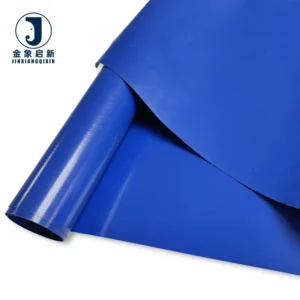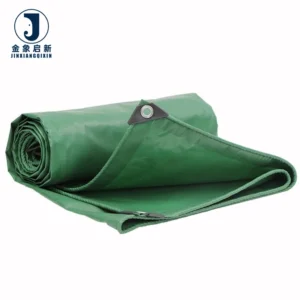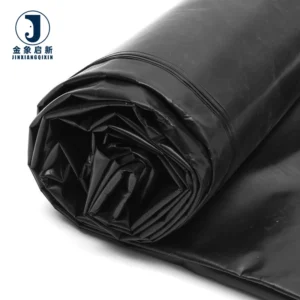
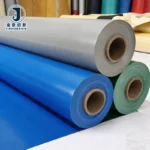
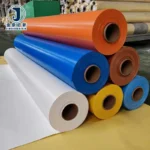
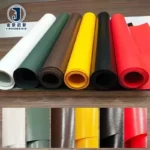
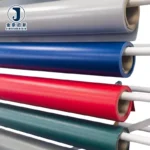
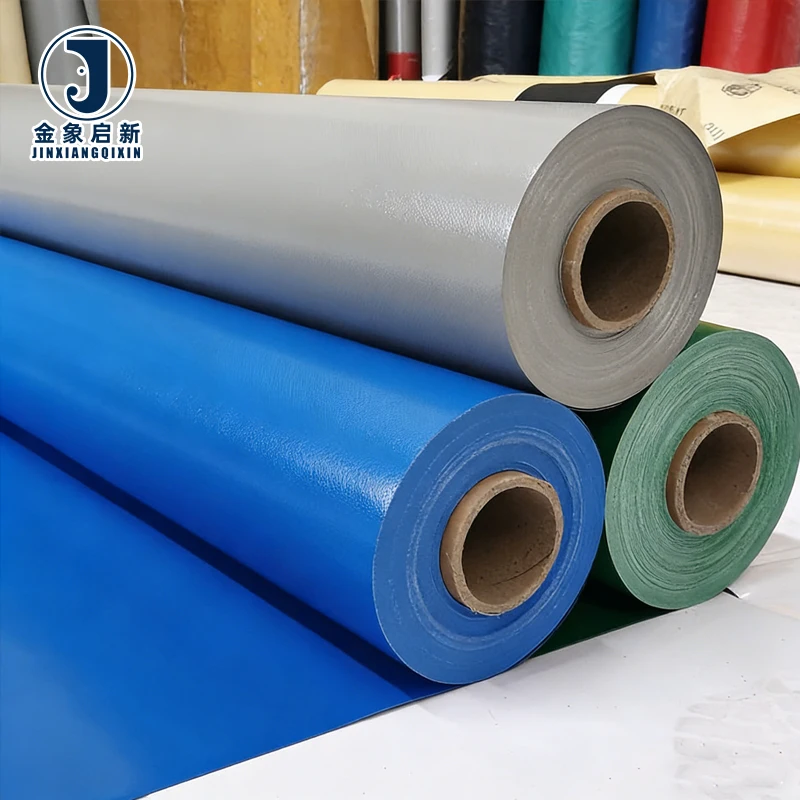
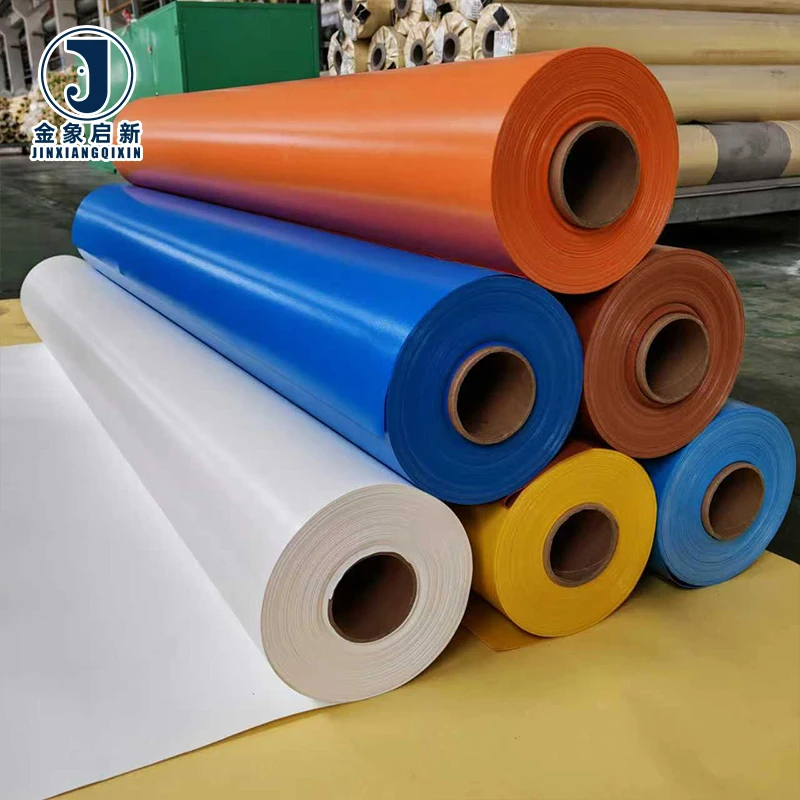
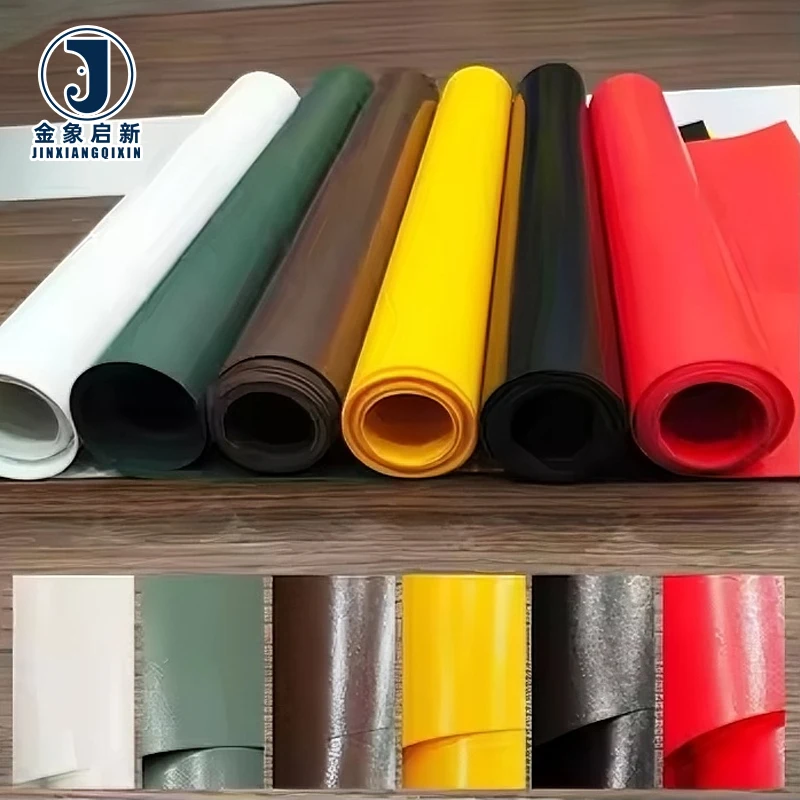
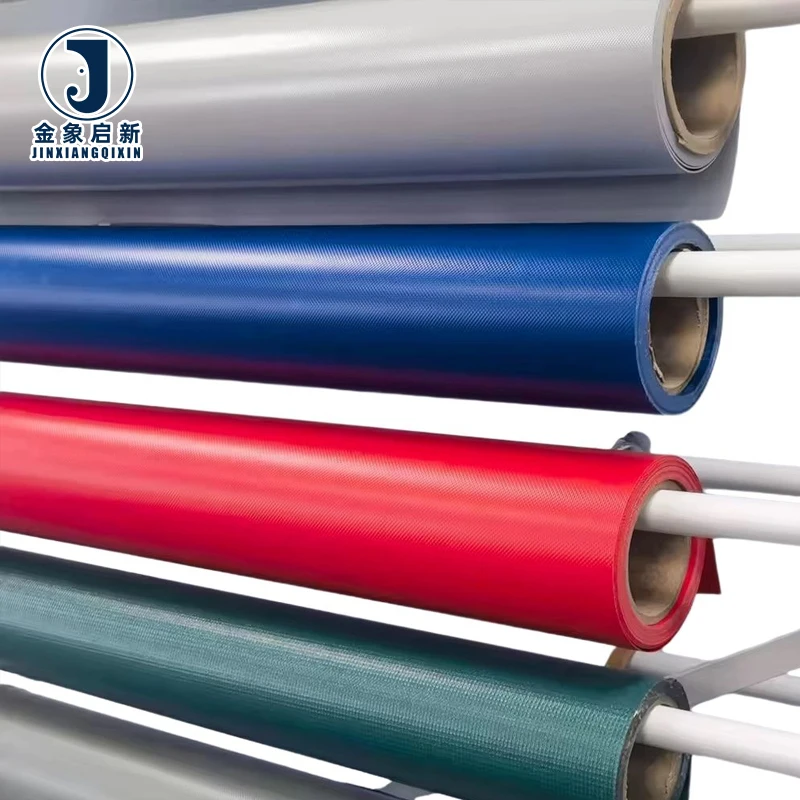
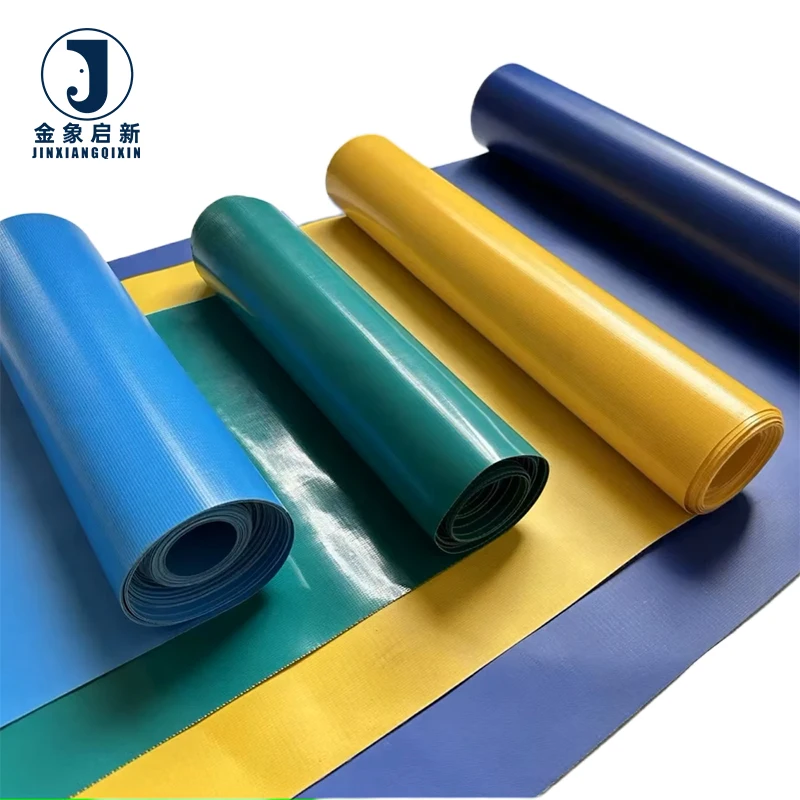
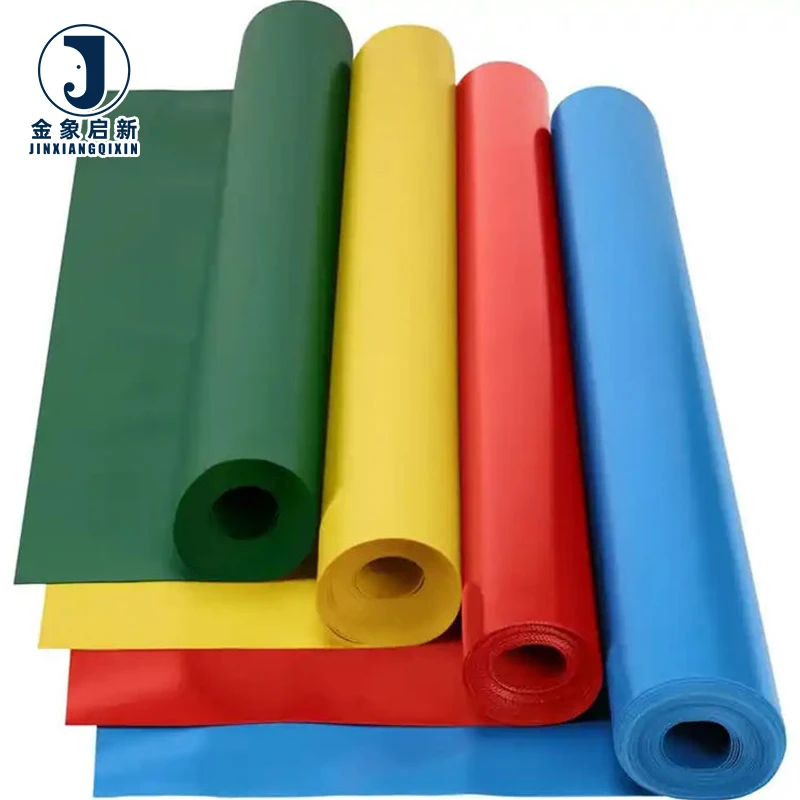
Deep Process Control Over Coating Weight — Every roll of PVC Coated Tarpaulin Roll from Jinan Jinxiang is produced with strict GSM tolerance verification, ensuring the technical fabric you receive matches the specification required for industrial ventilation and membrane structures.
Technical Specifications
| Parameter | Value |
|---|---|
| Product Type | PVC Coated Tarpaulin Roll |
| Material | PVC + High-strength polyester mesh fabric |
| Weight (GSM) | 350gsm / 420g / 500gsm / 550gsm / 600gsm / 750gsm |
| Total Thickness | 0.32mm / 0.35mm / 0.4mm / 0.45mm / 0.5mm / 0.65mm |
| Coating Method | Laminated technology & Hot-melt Coating technology |
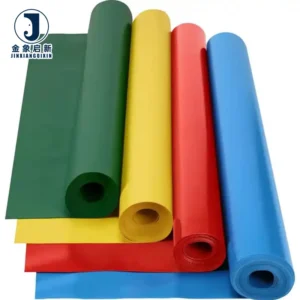
| Color | Blue / Red / Yellow / Light blue / Grey (Customized) |
| Surface Finish | Glossy Surface or Matt Surface |
| Roll Size | 2m × 75m / 2.1m × 50m |
| Waterproof | Double-sided 100% Waterproof |
| Cold Crack Resistance | Yes (grade not stated) |
| Anti-Mildew | Yes (test basis not stated) |
| Anti-Static | Yes (standard not stated) |
| Fire-Retardant | Available in flame retardant grades — confirm the grade required for your market |
| Service Life | 3–7 years under normal conditions |
| Standards | ISO, CE |
Application Suitability
| Application | Exposure & Requirement |
|---|---|
| Mine and tunnel ventilation duct | Continuous airflow, particulate abrasion, fire safety compliance, anti-static dissipation |
| Inflatable and membrane structures | Sustained air pressure, UV exposure, wind load, weld seam integrity |
| Aviation hangar ducting | Flame retardant certification, low smoke emission, large-diameter forming |
| Industrial dust extraction and negative-pressure ventilation | Chemical particulate contact, flexing fatigue, static charge build-up |
What Flame-Retardant Really Means When No Grade Is Specified
A PVC Coated Tarpaulin Roll described as "fire-retardant" without a cited standard creates a compliance gap the moment the site inspector asks for documentation. Confirm the flame-retardant grade and test standard required for your project before placing the order.
Mining ventilation ducts in Australia, tunnel systems in the EU, and aviation facilities in North America each reference different fire classification frameworks [NEED_CITE: fire classification standards for ventilation duct materials in mining and tunnelling]. A roll that passes one test may not satisfy another jurisdiction’s requirement. The cost of discovering this mismatch on-site — after fabrication, welding, and installation — is measured in replacement material, project delay, and contractor liability rather than the original fabric price.
Coating Technology and Weld Behaviour in Duct Fabrication
The choice between laminated and hot-melt coating technology directly affects how the PVC Coated Tarpaulin Roll behaves during hot-welding. Laminated construction bonds the PVC film to the polyester mesh under heat and pressure, producing a clean, consistent surface suited to high-frequency welding on automated duct production lines.
Hot-melt coating penetrates the mesh more deeply, creating a stronger mechanical bond between coating and yarn. This matters when the finished duct flexes under positive or negative pressure — the weld line must hold as long as the fabric body. For mining and tunnel ducts that undergo repeated inflation and deflation cycles, weld adhesion tested to recognised methods [NEED_CITE: weld peel strength test methods for coated technical fabrics] is a more meaningful indicator of service life than coating weight alone.
Width, Roll Length, and Production Line Compatibility
Roll widths of 2.0m and 2.1m determine how many longitudinal welds are needed to fabricate large-diameter ducts. A wider roll reduces seam count, cutting fabrication time and potential failure points in high-pressure ventilation systems.
Roll lengths of 50m and 75m support continuous production runs without frequent changeovers. For membrane and inflatable structure contractors, fewer joins mean fewer visible seam lines and reduced risk of air leakage. Custom widths and lengths are available — confirm your cutting table dimensions and annual roll consumption early to align production scheduling.
How GSM, Thickness, and Base Fabric Interact
Selecting the correct PVC Coated Tarpaulin Roll grade requires reading GSM and thickness together rather than treating either number in isolation. A 350gsm roll at 0.32mm thickness suits lightweight inflatable structures and temporary enclosures, while 750gsm at 0.65mm is specified for heavy-duty mining ducts exposed to rock dust abrasion and sustained air pressure.
The high-strength polyester mesh fabric provides the structural backbone; the coating weight adds tear resistance, chemical barrier properties, and weld surface area. Both laminated and hot-melt methods deliver double-sided waterproof construction, but the coating adhesion strength — the force needed to delaminate PVC from mesh — varies with the process chosen. Surface finish, glossy or matte, also influences how readily the fabric accepts printed markings or reflective safety stripes required on some ventilation installations.
The Hidden Cost of Specifying the Wrong Grade
Specifying a lighter GSM than the application demands leads to premature coating wear at abrasion points, particularly where duct sections join or flex around bends. The fabric body may survive while the coating thins, exposing the polyester mesh to moisture and particulate ingress.
Colour inconsistency across rolls in a single membrane structure project forces contractors to sort and match panels on-site, adding labour and delaying handover [NEED_CITE: colour fastness and batch consistency standards for architectural coated fabrics]. Anti-static treatment claimed without a cited test standard can result in static charge accumulation in dust extraction ducts — a condition that may fail site safety audit even if the fabric itself performs adequately. Each of these issues is preventable when the specification is tied to a verified test result at the point of order.
Why Source Technical Fabric Here
Three full production lines and 36 sets of professional equipment provide the capacity to supply consistent PVC Coated Tarpaulin Roll volumes across multiple GSM grades within a single project timeline.
A 10-person R&D team handles material selection, custom width scheduling, and sample development for project-specific testing. Dedicated QA/QC at every production stage — from base fabric inspection through coating weight verification to final roll winding — catches GSM deviation before the roll leaves the facility. Samples are developed within days, allowing you to run welding trials and confirm duct fabrication parameters before committing to full production volume. Nearly 30 years of focused coated fabric production underpins this process control.
Documentation & Verification
- Material specification sheet listing exact GSM, base fabric construction, and coating method per roll
- 100% pre-shipment inspection record with documented weight and thickness measurements
- Fire-retardant and anti-static test reports matching the grade cited on your purchase order
- Roll packing list with individual roll numbers for traceability through fabrication
- Certificate of origin and customs documentation for export shipment clearance
Fabrication, Handling & Storage
- Hot-weld temperature settings must be adjusted between laminated and hot-melt coated rolls for optimal peel strength
- Store rolls upright on pallets to prevent compression marks on the glossy or matt surface finish
- Allow cold-stored rolls to reach workshop temperature before unrolling to avoid coating crack at low GSM grades
- Use compatible PVC welding tape matched to the 350gsm–750gsm coating weight range for patch repairs
- Cut patterns should account for 2m or 2.1m roll width to minimise off-cuts and longitudinal seam count
- Clean glossy surfaces with mild detergent only; solvent-based cleaners may degrade the PVC coating layer
What to Include in Your Enquiry
Specify the ventilation or structure application, the fire-retardant or anti-static grade your site requires, and the test standard your project references. Provide the roll width and length that match your fabrication equipment, along with estimated annual volume and colour requirements.
Indicate whether you need sample rolls for welding trials before full order commitment. If your project demands batch colour consistency across multiple rolls for a visible membrane structure, state this requirement explicitly so that production can be scheduled from a single coating batch.
Frequently Asked Questions
Q: Can you supply flame-retardant certification matching specific national safety standards?
A: Flame-retardant grades are available across the PVC Coated Tarpaulin Roll range. Provide the standard required by your project — such as the classification referenced by your local mining or construction authority — and the corresponding test report will accompany the shipment. Confirm the grade at enquiry stage to ensure production alignment.
Q: Are non-standard roll widths supported, and what is the minimum order?
A: Custom widths beyond 2.0m and 2.1m are produced to buyer specification, subject to line capability and coating bath limits. Minimum order quantities depend on the GSM grade and colour selected. Submit your required width, length, and annual volume for a production feasibility assessment and scheduling confirmation.
Q: How do laminated and hot-melt coatings differ during hot welding?
A: Laminated PVC Coated Tarpaulin Roll fabric presents a uniform coating surface that responds well to high-frequency welding. Hot-melt coated fabric has deeper mesh penetration, requiring adjusted temperature and dwell time settings. Request sample rolls of both types to validate your welding parameters before placing a full production order.
Q: How is colour and GSM consistency maintained across large orders?
A: Each production run is monitored for coating weight and colour reference against the approved sample. Rolls within a single order are scheduled from the same coating batch to minimise visual variation. A pre-shipment inspection record documents measured GSM and thickness for every roll dispatched.
Q: Can sample rolls be provided for duct fabrication trials?
A: Sample rolls in your specified GSM grade, colour, and coating method are developed within days. Use these samples to confirm welding parameters, duct forming behaviour, and seam strength on your production equipment before committing to full order volume.