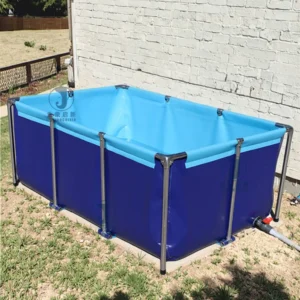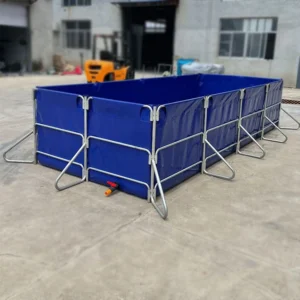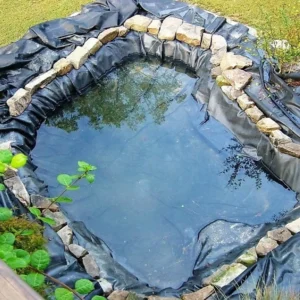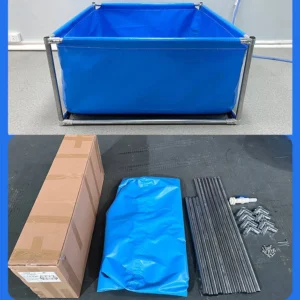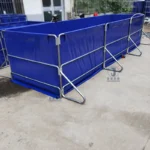

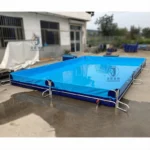
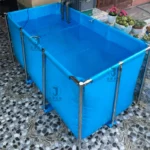

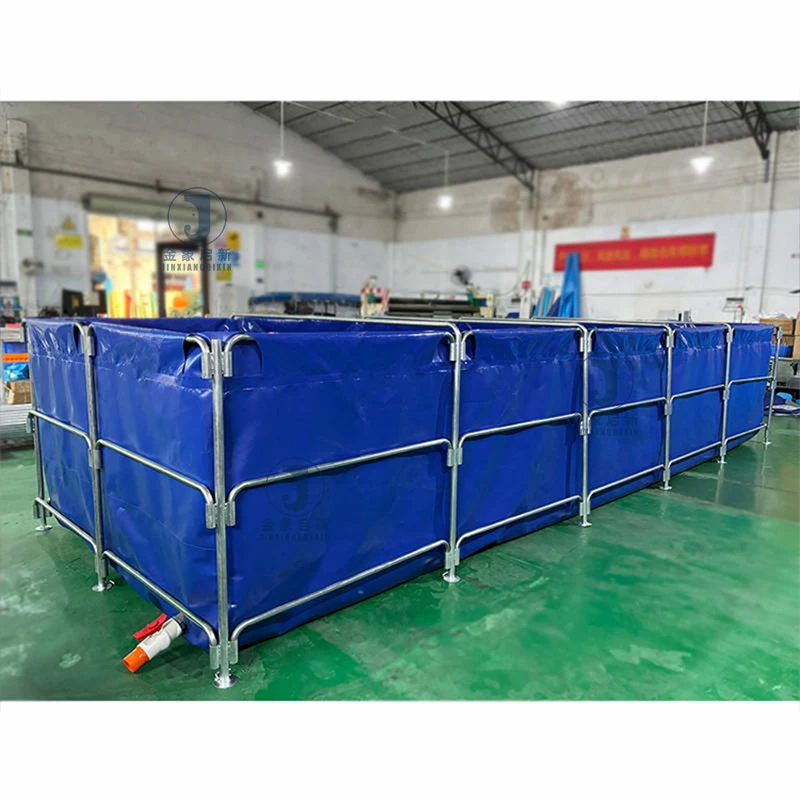
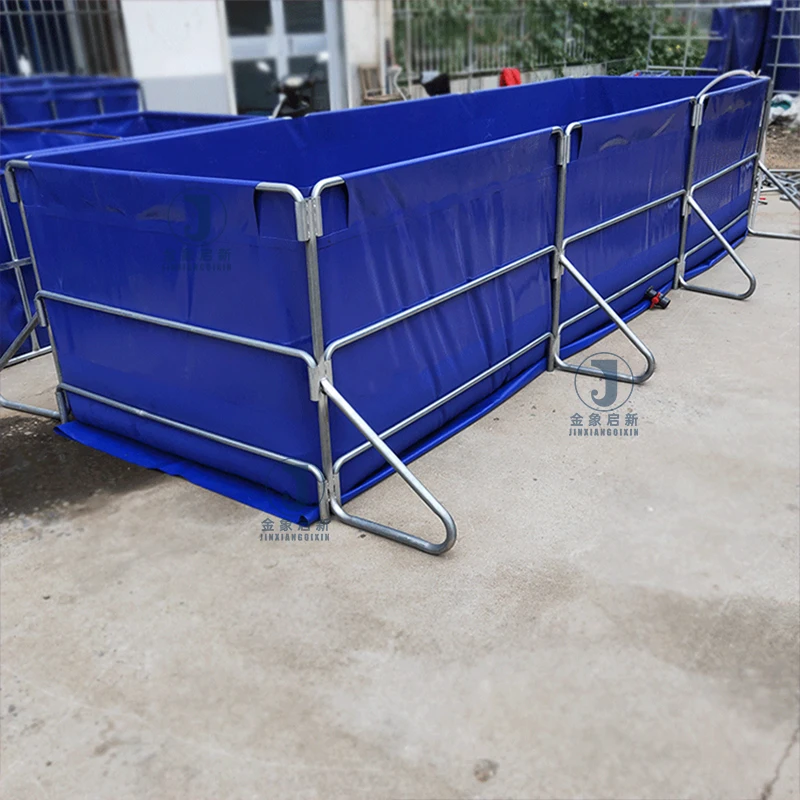
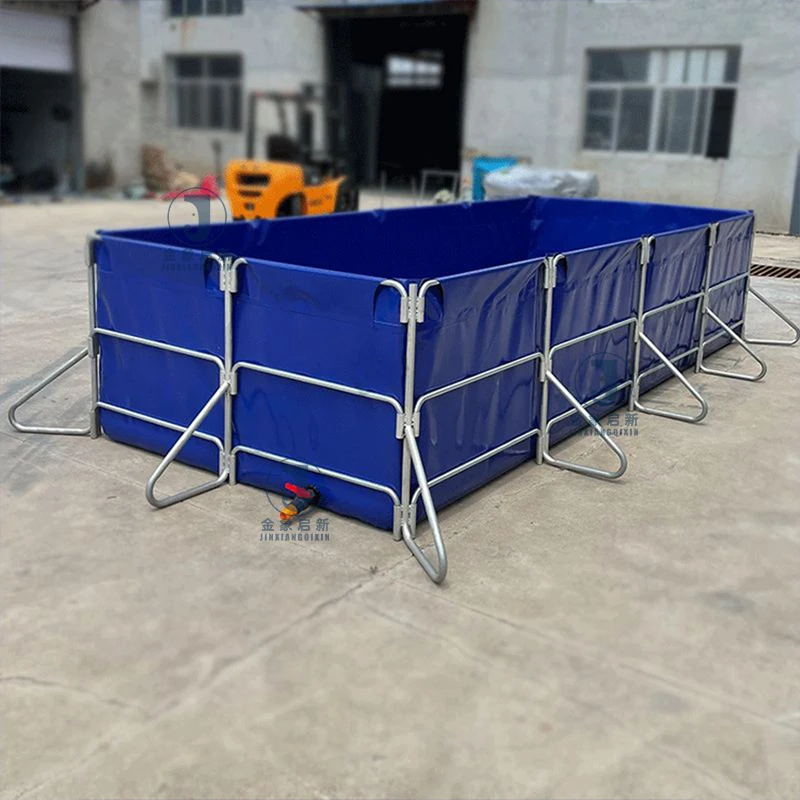
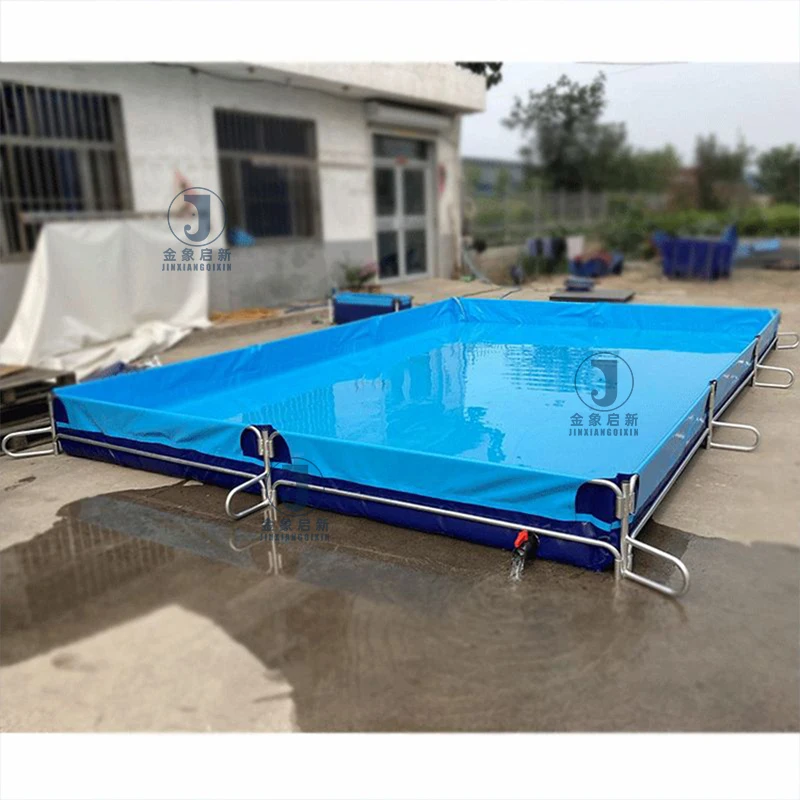
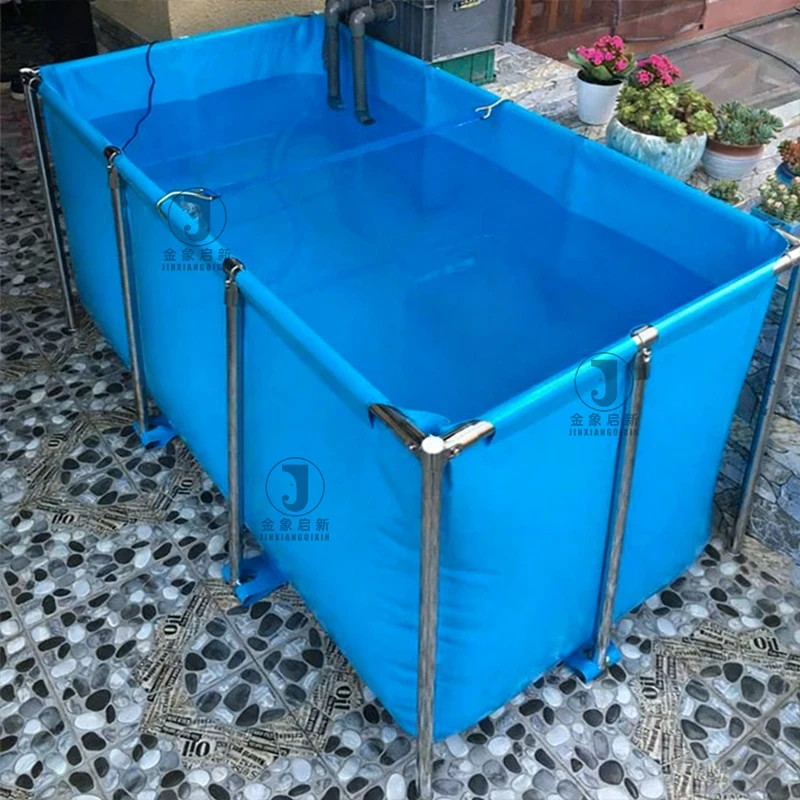
Coated Fabric Expertise — Nearly 30 years of process control over PVC coating weight and adhesion ensures every aquaculture liner ships with verified GSM and full test documentation.
Technical Specifications
| Parameter | Value |
|---|---|
| Product Type | PVC Tarpaulin Fish Pond Liner |
| Base Fabric Denier | 500D×500D, 500D×840D, 500D×1000D, 1000D×1000D, 1000D×1300D, 1300D×1300D, 1000D×2000D |
| Weight Options | 350, 400, 420, 500, 600, 650, 750, 900 GSM |
| Total Thickness | 0.29mm (350GSM), 0.32mm (400GSM), 0.38mm (500GSM), 0.44mm (600GSM), 0.46mm (650GSM), 0.55mm (750GSM), 0.65mm (900GSM) |
| Mesh Density | 30×19 (350–420GSM, 500GSM), 20×20 (600–750GSM), 30×15 (900GSM) |
| Tensile Strength – Warp | 1650N (350GSM), 1800N (400GSM), 1850N (420GSM), 2050N (500GSM), 2500N (600GSM), 2550N (650GSM), 2750N (750GSM), 3900N (900GSM) (test basis not stated) |
| Tensile Strength – Weft | 1600N (350GSM), 1700N (400GSM), 1750N (420GSM), 1900N (500GSM), 2200N (600GSM), 2250N (650GSM), 2850N (750GSM), 3500N (900GSM) (test basis not stated) |
| Coating Material | PVC |
| Base Fabric Material | Polyester |
| Waterproof | Yes |
| Flame Retardant | Available in flame-retardant grades — confirm the grade required for your market |
| UV Treatment | Available with anti-UV treatment — confirm test standard applicable to your region |
| Shape Options | Circular, Rectangular |
| Custom Color | Available |
| Custom Printing | Available |
| Standards | ISO, CE (certified facility) |
Application Suitability
| Application | Exposure & Requirement |
|---|---|
| Commercial fish and shrimp ponds | Permanent water immersion, soil chemistry contact, puncture risk from substrate and stock movement |
| Circular above-ground fish tanks | Constant hydrostatic pressure at wall welds, UV exposure on exposed top edges |
| Agricultural water reservoirs | Extended sun exposure, seasonal temperature cycling, wind-driven debris abrasion |
| Aquaculture facility expansion | Multi-pond batch consistency, compliance documentation for site audit, welded seam integrity under sustained load |
| Replacement liner installation | Compatibility with existing pond footprint, field-weldable seams, resistance to residual biological film |
What "Fire-Retardant" Means When No Grade Ships With the Fabric
A liner labelled fire-retardant without a named test standard is a liability at your next site audit.
Aquaculture facilities in regulated zones increasingly require pond liner materials to carry documented flame-retardant classification, especially where ponds sit near electrical infrastructure or processing buildings. Procurement teams frequently receive liner rolls with a generic "FR" claim on the invoice and no underlying test report to present to inspectors. [NEED_CITE: fire classification standards for coated fabrics used in agricultural installations] This gap between the quotation claim and the documentation on site causes project delays, failed inspections, and in some cases full material rejection after installation. Our approach is to confirm the specific grade your jurisdiction requires before production begins, then ship the corresponding test report with your documentation package.
Ventilation-Grade Compliance Extended to Water Containment
Industrial sites that specify fire-retardant and anti-static ventilation ducting for mining or aviation hangars apply the same documentation standards to every coated fabric on the premises. A PVC fish pond liner ordered for these sites must carry the same traceable certification paperwork as the duct material. We supply pond liner grades that align with these compliance frameworks, with the specific flame-retardant classification confirmed at inquiry against your site requirements.
Pond Liner Integrity Under Hydrostatic and Biological Load
Water containment places sustained stress on every welded seam, particularly at corners and floor-to-wall transitions where pressure concentrates. The polyester base fabric in this PVC fish pond liner range provides dimensional stability under continuous hydrostatic load, while the PVC coating resists degradation from biological film and standard aquaculture water treatments. Seam integrity is maintained through hot-air welding that fuses coating layers rather than relying on adhesive bonding alone. [NEED_CITE: seam strength testing methods for PVC coated pond liners per ISO 1421]
Reading the Numbers Behind GSM and Tensile Values
Selecting a liner by GSM alone ignores how base fabric construction determines real-world performance. The 500D×1000D denier combination, for example, uses a heavier weft yarn that resists puncture from below — relevant when ponds sit on compacted soil with aggregate. Mesh density interacts with coating penetration: the 30×19 weave in lighter grades allows deeper PVC encapsulation of individual yarns, improving adhesion at lower total weight. The warp tensile values scale from 1650N at 350 GSM to 3900N at 900 GSM, but these figures only predict field behaviour when considered alongside the denier and density that produce them. A 750 GSM liner with 1300D×1300D base fabric behaves differently under installation tension than a 750 GSM liner woven from finer yarns at higher density — the coating weight is the same, but tear propagation resistance is not. Thickness correlates with abrasion resistance at contact points, making the 0.55mm and 0.65mm grades suitable for ponds where substrate preparation is minimal.
The Cost of Underspecifying a Pond Liner
A liner that fails at the seam before the fabric body degrades is almost always a specification mismatch rather than a material defect. When GSM is quoted but not verified on arrival, the installed liner sits below the hydrostatic threshold the pond design assumed, and leaks appear within the first filling cycle. [NEED_CITE: common failure modes in PVC coated aquaculture liners at welded seams] Batch colour variation between rolls becomes visible once adjacent ponds are filled and viewed together — a problem that does not affect waterproofing but damages the professional appearance of a commercial aquaculture facility and can signal inconsistent coating weight across the batch.
Why Source This PVC Fish Pond Liner Here
Three full production lines with 36 sets of professional equipment mean bulk pond liner orders ship on schedule without splitting production across external workshops. The 10-person R&D team develops custom-sized circular and rectangular liner samples within days, allowing you to verify fit and weld behaviour before committing to a production run. Dedicated QA/QC at every stage includes roll-by-roll GSM verification against your purchase specification, not a batch average. Coating weight and adhesion are controlled in-house through nearly 30 years of focused process development on PVC-coated polyester. Every dispatch ships with a pre-shipment inspection record, and the documentation package is assembled to match your site compliance requirements rather than a generic export template.
Documentation & Verification
- Material specification sheet stating exact GSM, denier, coating type, and thickness per grade ordered
- Test report for flame-retardant and UV treatment grades where applicable, issued against a named standard
- Pre-shipment inspection record with roll-by-roll GSM and dimension verification
- Certificate of origin and customs documentation package included with every dispatch
- ISO and CE certificates referencing the certified production facility
Fabrication, Handling & Storage
- Hot-air welding at manufacturer-recommended temperature and speed to fuse PVC coating layers without base fabric exposure
- Store rolls horizontally on pallets to prevent permanent creasing in the 0.44mm–0.65mm thickness grades
- Avoid dragging unrolled liner across compacted aggregate substrate to protect the PVC coating surface
- Field-cut panels with sharp blades to prevent fraying the polyester base fabric at seam preparation edges
- Clean installed liner with neutral pH agents to preserve the coating surface and any applied UV treatment
- Allow cold-stored rolls to reach ambient temperature before unrolling to prevent coating crack at low-temperature flex
Specifying Your Liner Order
Provide your pond dimensions, substrate type, and maximum water depth so we can recommend the appropriate GSM and denier combination from the available range. If your site requires fire-retardant or anti-static classification, confirm the specific test standard your jurisdiction mandates so we match the correct grade and include the corresponding test report. Let us know whether you need rolls for field fabrication or pre-cut circular and rectangular panels with factory-welded seams.
Frequently Asked Questions
Q: How is the fire-retardant grade verified and which test standard applies?
A: Fire-retardant treatment is available across this liner range, but the applicable test standard depends on your market and site requirements. We confirm the specific grade during inquiry, produce against that specification, and ship the corresponding test report with your documentation package so your compliance audit has traceable evidence on file.
Q: How do I confirm the GSM on arrival matches what was quoted?
A: Every roll undergoes GSM verification during our pre-shipment inspection, and the results are recorded roll by roll rather than as a batch average. The inspection record ships with your order, and you can perform independent weight checks on arrival using the same cut-sample method to cross-reference against the documented values.
Q: What GSM and thickness suit different pond depths and aquaculture species?
A: Deeper ponds and species with higher substrate disturbance require heavier grades — the 600–900 GSM range with thicker base fabric deniers addresses sustained hydrostatic pressure and puncture risk. Shallower nursery tanks typically perform well in the 350–500 GSM range. Share your pond dimensions and stock type so we recommend from the available specification options.
Q: Can the pond liner be hot-air welded on site and what is needed?
A: Yes, this PVC-coated polyester liner is designed for hot-air welding at seams and corners. Field welding requires a standard hot-air welder set to the temperature range appropriate for your chosen GSM grade. We provide welding guidance with your order, and pre-fabricated panels with factory-welded seams are also available to reduce on-site work.
Q: What documentation ships with each order for site compliance audits?
A: Each dispatch includes a material specification sheet, pre-shipment inspection record with roll-by-roll verification, certificate of origin, and ISO and CE certificates. Where flame-retardant or UV treatment grades are specified, the corresponding test report issued against a named standard is included in your documentation package.