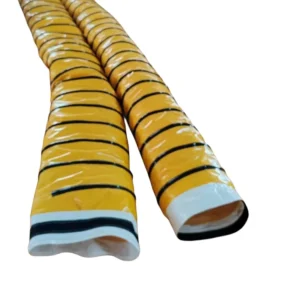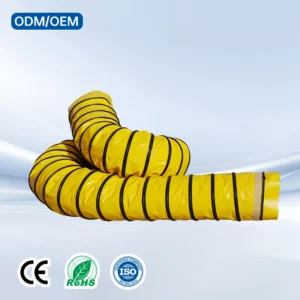
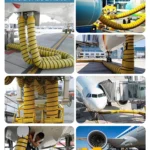


Thermal Insulation Engineering — Built-in aluminum foil bubble film layer integrated within PVC-coated fabric construction, delivering verified thermal performance across the full -30°C to 150°C operating envelope for aviation PCA systems.
Technical Specifications
| Parameter | Value |
|---|---|
| Product Type | Pre-Conditioned Air Hose / Aviation Air Duct |
| Coating Material | PVC |
| Base Layer | Fabric-reinforced layer / aluminum foil |
| Insulation Layer | Built-in aluminum foil bubble film |
| Temperature Range | -30°C to 150°C |
| Outer Color | Yellow-black alternating protective coloring |
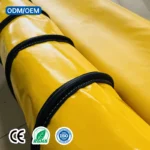
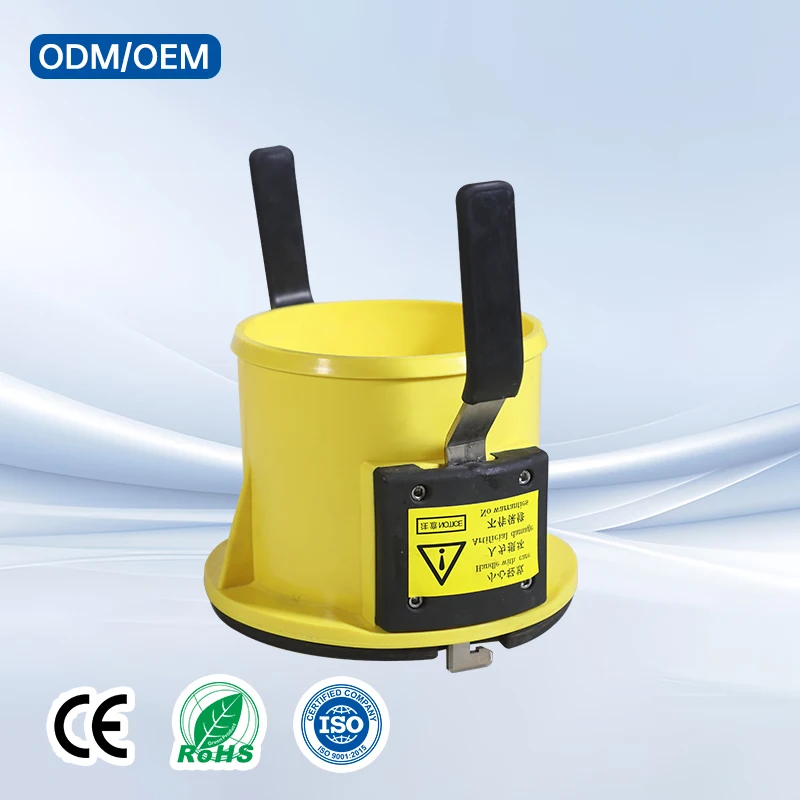
| Connection Method | Zipper and Velcro modular link |
| Mildew Resistance | Yes — PVC coated cloth construction |
| Water Resistance | Yes — PVC coated cloth construction |
| Fire Retardant Grade | Available in fire retardant grades — confirm the grade required for your airport or aviation authority |
| Anti-Static Grade | Available in anti-static grades — confirm the certification required for your site compliance |
| Customization | Length, diameter, connection style, logo (MOQ 100), pattern (MOQ 100) |
Application Suitability
| Application | Exposure & Requirement |
|---|---|
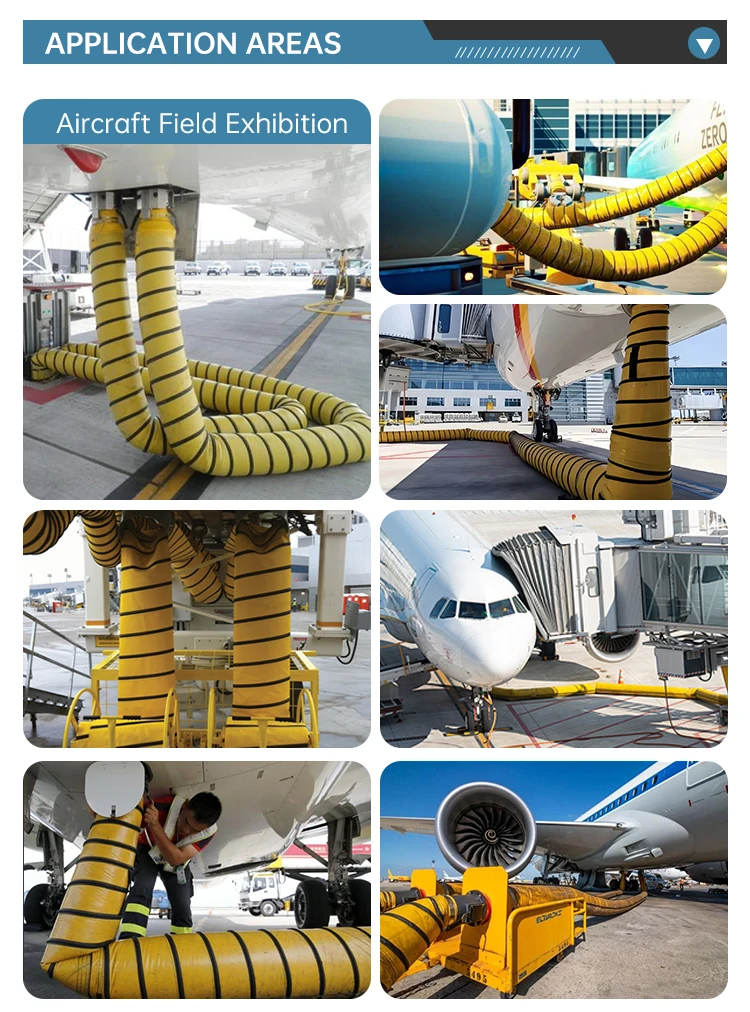
| Airport apron ground air supply | Continuous folding and unfolding cycles, tarmac abrasion, jet blast exposure, high-visibility safety marking required |
| PCA unit to aircraft cabin connection | Thermal stability across seasonal extremes, rapid deployment between aircraft turnarounds, airtight modular coupling |
| Fixed and mobile pre-conditioned air systems on boarding bridges | UV and weather exposure when stored outdoors, repeated compression during retraction, interface matching to multiple aircraft types |
| Military and general aviation ground support | Harsh environment storage, compatibility with varied PCA unit flanges, compliance with military-specification fire safety |
Why Aviation Air Duct Compliance Demands More Than a Material Claim
A duct without verifiable fire-retardant and anti-static certification is a grounded asset, not a working one.
Airport ground support equipment operates under scrutiny from aviation authorities and airline safety audits. When an Aviation PCA Air Duct arrives on the apron without documentation proving its fire classification or static dissipation properties, the equipment it connects to cannot be cleared for service. This is not a paperwork delay — it halts aircraft turnaround operations. [NEED_CITE: aviation ground support equipment fire safety compliance requirements] Procurement specifications that simply state "fire retardant" without naming the applicable standard leave buyers exposed to compliance gaps that surface only at the pre-commissioning inspection stage.
Thermal Continuity Under Apron Operating Extremes
The built-in aluminum foil bubble film insulation layer serves a specific engineering function within this Aviation PCA Air Duct. Pre-conditioned air exits the PCA unit at controlled temperatures, but the duct run across the apron exposes it to ambient extremes — from sub-zero winter mornings to midday tarmac heat. Without continuous insulation along the full duct length, thermal loss degrades the air temperature reaching the aircraft cabin, forcing the PCA unit to work harder and extending turnaround time. The -30°C to 150°C range covers the operational envelope encountered across most climate zones where ground support fleets operate.
Modular Connection Design for Turnaround Speed
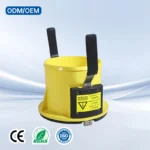
Aircraft turnaround windows are measured in minutes. The zipper and Velcro connection system on this Aviation PCA Air Duct allows ground handlers to deploy, connect, disconnect, and stow the duct without tools or fastener hardware. Between consecutive flights at the same gate, the duct must be coiled, moved, and reconnected to a different aircraft type — often with a different interface height or flange configuration. [NEED_CITE: typical aircraft turnaround ground support equipment deployment procedures] The modular link system accommodates this operational rhythm while maintaining an airtight seal sufficient to prevent conditioned air loss at connection points.
Reading the Construction: What Each Layer Actually Does
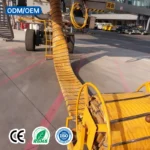
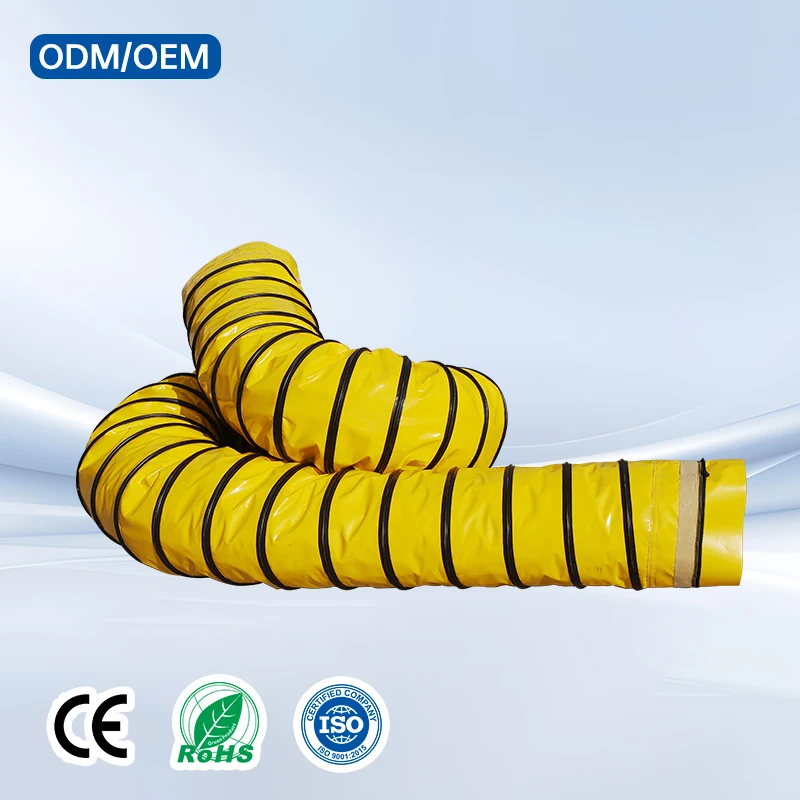
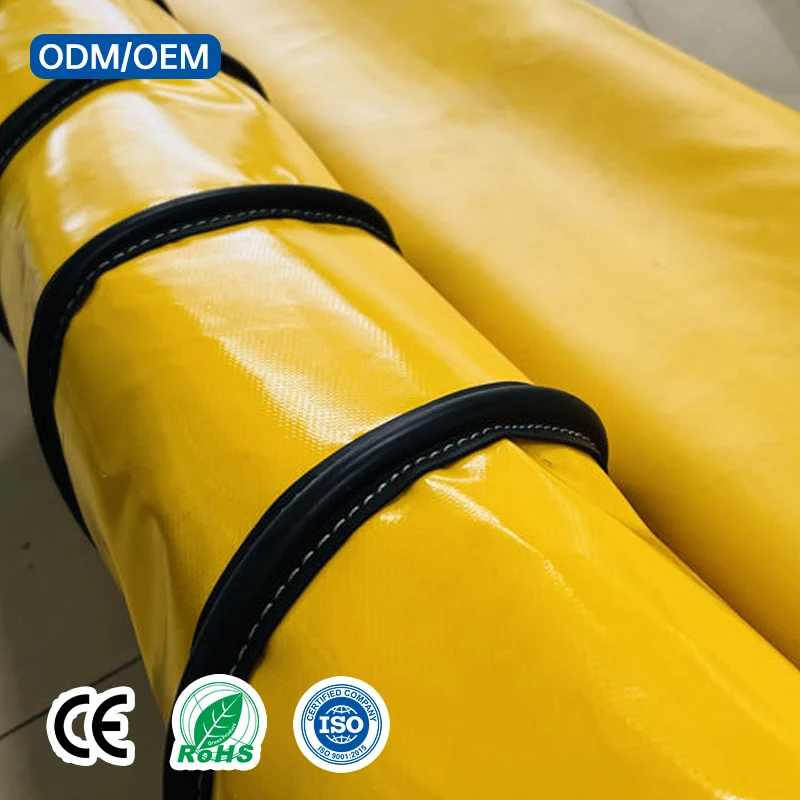
The PVC-coated fabric outer layer provides the structural backbone. Its tensile strength and mildew resistance are what allow the duct to survive being dragged across concrete apron surfaces, coiled tightly for storage, and exposed to standing water after rain. The fabric-reinforced base layer with aluminum foil adds dimensional stability — without it, the duct would collapse under its own weight when extended horizontally at full length. The built-in aluminum foil bubble film is the thermal barrier; its position within the wall construction rather than on the surface protects it from mechanical damage during handling. The yellow-black alternating outer coloring is not decorative — it serves as high-visibility safety marking in an environment where ground vehicles, baggage carts, and fuel trucks operate in close proximity to deployed ducting. [NEED_CITE: airport apron safety marking standards for ground support equipment]
What Happens When the Wrong Duct Reaches the Apron
Ducting specified without insulation integrity verification loses thermal performance progressively as the insulation layer delaminates from the outer fabric under repeated folding stress. When fire-retardant grade is assumed rather than confirmed, the duct passes initial procurement but fails the airport authority’s pre-commissioning material audit — sometimes after an entire fleet has been delivered. Connection interfaces that do not match the PCA unit flange force ground crews to improvise adapters, creating leak points where conditioned air escapes and condensation forms. [NEED_CITE: coated fabric insulation delamination under cyclic flexing] These failures do not appear in warehouse inspection; they surface during the first winter morning turnaround or the first safety audit of the season.
Why Procurement Teams Source This Aviation PCA Air Duct Here
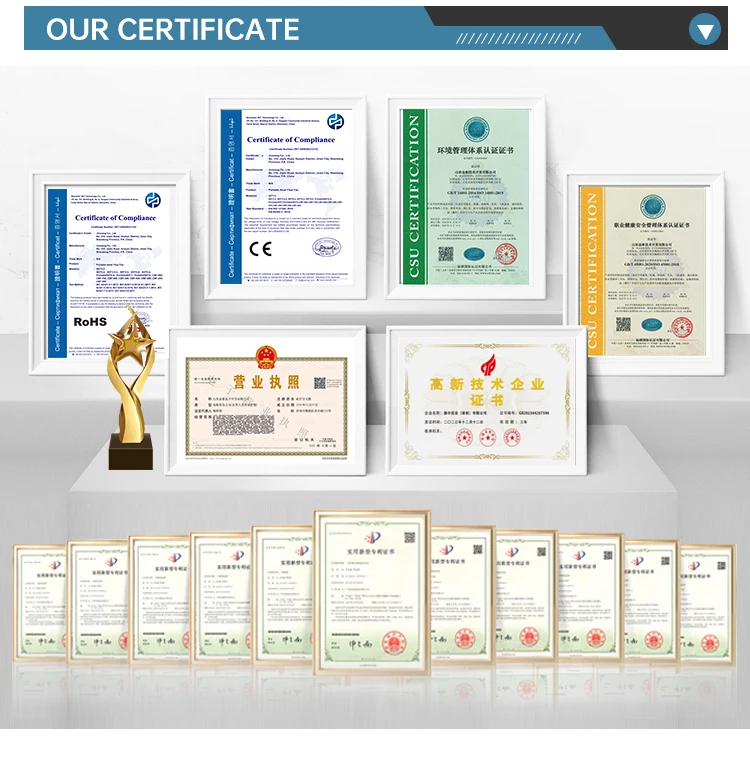
Three full production lines and 36 sets of professional equipment support batch consistency across duct diameters and lengths ordered for fleet-wide replacement programs. The 10-person R&D team handles custom interface configurations, developing samples within days when a GSE manufacturer needs a duct matched to a new PCA unit flange design. Nearly 30 years of coated fabric production experience translates to process control over PVC coating weight and adhesion to the aluminum foil insulation layer — the bond that determines whether the thermal barrier survives operational life. Dedicated QA/QC runs at every production stage with 100% inspection before dispatch, checking insulation layer integrity, zipper and Velcro function, and dimensional accuracy on every unit. ISO and CE certified production supports documentation requirements for international airport project tenders.
Documentation & Verification
- Material specification sheet documenting PVC coating weight, base fabric construction, and aluminum foil insulation layer specification
- Fire-retardant and anti-static test reports aligned to the aviation authority standard applicable at your airport
- Pre-shipment inspection record verifying insulation integrity, connection system function, and dimensional accuracy
- Certificate of origin and customs documentation prepared for international airport project delivery
- Roll or unit packing list with batch traceability for fleet-wide compliance records
Fabrication, Handling & Storage
- Heat-weld seam parameters must account for the aluminum foil insulation layer to avoid delamination at joint lines
- Store coiled ducts vertically or on wide-radius supports to prevent permanent creasing of the PVC-coated fabric outer layer
- Zipper and Velcro connections should be cleaned of apron debris after each turnaround cycle to maintain airtight seal integrity
- Avoid dragging the yellow-black outer surface across abrasive concrete; deploy using handling straps where possible
- Inspect insulation layer bond at fold points quarterly during continuous airport operations to catch early delamination
Specifying Your Aviation PCA Air Duct Requirement
Confirm the fire-retardant classification and anti-static standard your airport authority or airline safety protocol requires before placing an order. Provide the duct diameter, run length, and PCA unit flange interface dimensions for each aircraft type in your ground support fleet. Specify whether you need the duct supplied as individual assembled units or as bulk fabric for on-site fabrication, and whether logo or pattern customization applies to your GSE branding requirements.
Frequently Asked Questions
Q: What fire-retardant and anti-static certifications are available for aviation PCA duct compliance?
A: Fire-retardant and anti-static grades are available, but the applicable standard depends on your airport authority or airline specification. Confirm the required classification — such as FAR 25.853 or your national aviation authority equivalent — before production. We supply test reports matched to the standard you specify.
Q: How is the -30°C to 150°C temperature range verified?
A: The temperature range reflects the operational limits of the PVC-coated fabric outer layer combined with the built-in aluminum foil bubble film insulation. Request the test method documentation applicable to your procurement specification so that thermal performance can be validated against your local climate extremes.
Q: Can duct diameter and length be customized to specific aircraft models and PCA unit configurations?
A: Yes. Diameter, length, and connection end configuration are customizable to match your PCA unit flange and aircraft interface. Provide the interface dimensions and aircraft types in your fleet, and samples can be developed within days for fitment verification before bulk production.
Q: How does the zipper and Velcro connection system hold up under repeated daily deployment?
A: The modular connection system is designed for the turnaround cycle rhythm of airport ground operations. Zipper and Velcro components are integrated into the PVC-coated fabric construction. Inspect connection points periodically for apron debris accumulation and mechanical wear, particularly at high-frequency gate positions.
Q: What inspection schedule is recommended for PCA hoses in continuous airport operations?
A: Quarterly inspection of insulation layer bond integrity at fold points, connection system function, and outer surface condition is recommended for ducts in daily service. High-frequency gates may require more frequent checks. Pre-shipment inspection records document baseline condition for comparison during in-service audits.