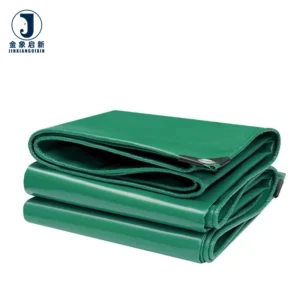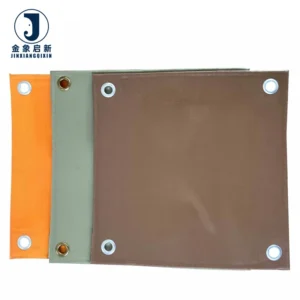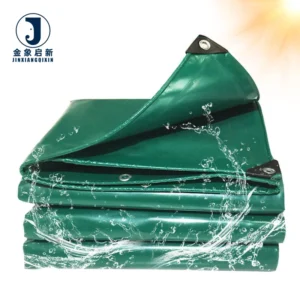
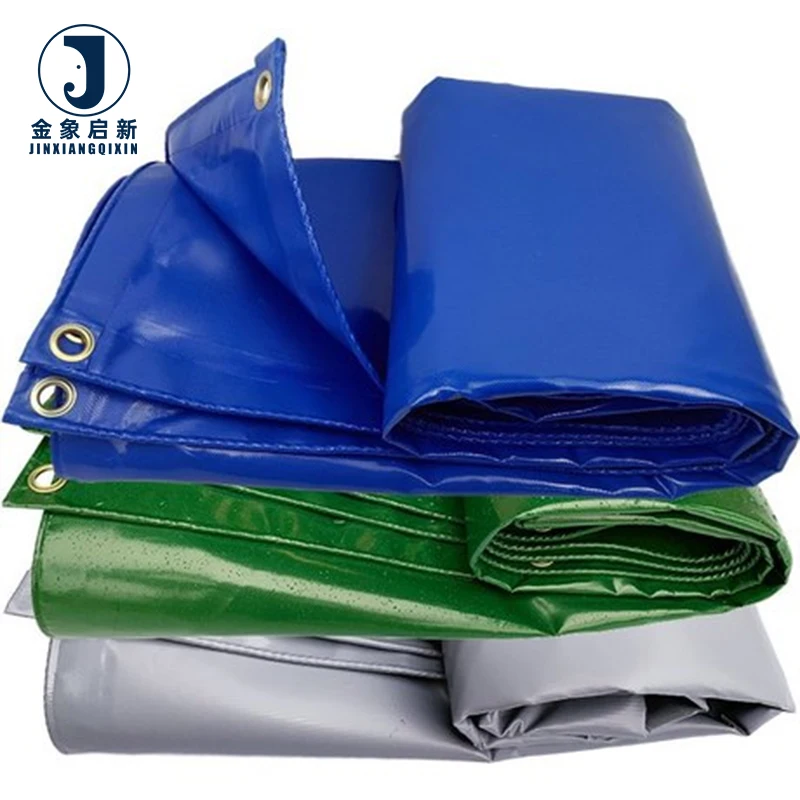
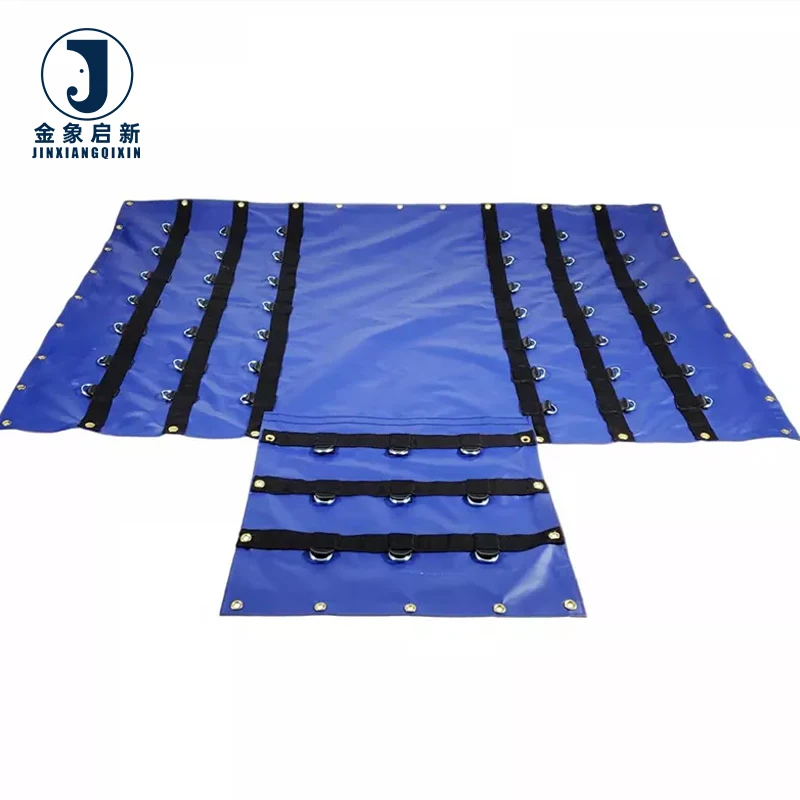
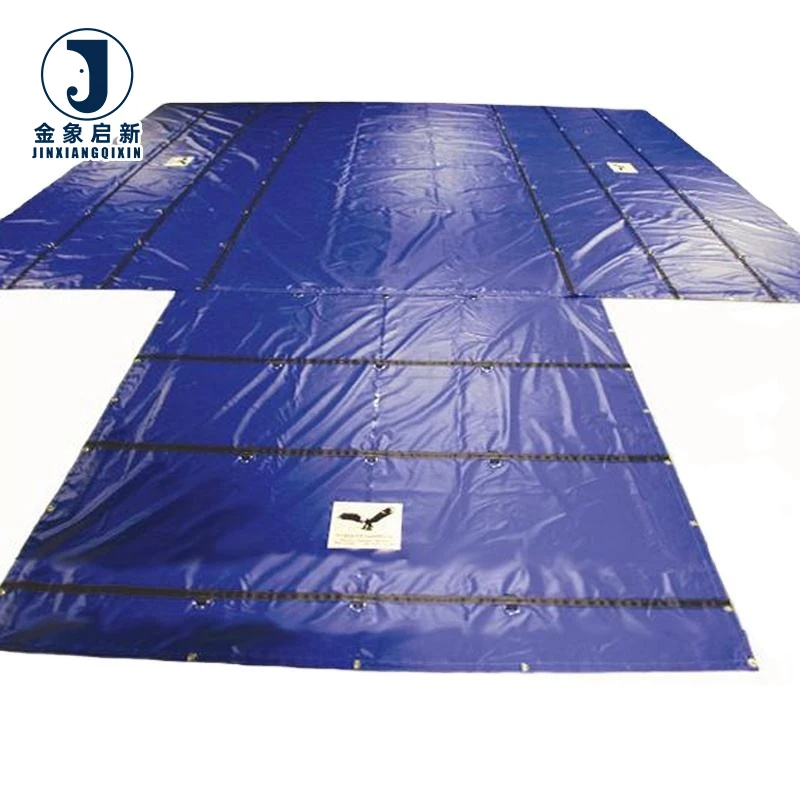
Specialist Fabrication Control — our coating lines maintain GSM accuracy and treatment adhesion across every roll, verified before dispatch for ventilation and technical fabric applications.
Technical Specifications
| Parameter | Value |
|---|---|
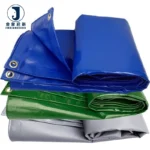
| Product Type | PVC Coated Tarpaulin |
| Weight Options | 500gsm, 600gsm, 700gsm, 850gsm, 900gsm |
| Coating Material | PVC |
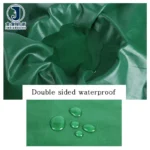
| Waterproof | Yes |
| Flame Retardant | Fireproof (grade to be confirmed per project standard) |
| Anti-Static | Available (surface resistance value to be confirmed) |
| Anti-Mildew | Available |
| Anti-Cold | Available |
| UV Protection | Yes (test basis to be confirmed) |
| Weather Resistance | Suited to extended outdoor exposure |
| Standards | ISO, CE (company certified) |
Application Suitability
| Application | Exposure & Requirement |
|---|---|
| Mine ventilation ducts | Continuous airflow, underground humidity, fire-retardant and anti-static compliance mandatory |
| Tunnelling air ducts | Confined-space dust and gas exposure, duct collapse risk under negative pressure |
| Inflatable membrane structures | Wind load, UV exposure, structural weld integrity at seam intersections |
| Aviation enclosure fabric | Fuel proximity, fire safety compliance, rapid deployment and pack-down cycles |
| Construction site ventilation | Temporary duct runs, abrasion from handling and repositioning, weather exposure |
Why Ventilation Duct Fabric Fails Compliance Before It Fails Physically
A PVC coated tarpaulin specified for underground ventilation must carry documented proof of fire-retardant and anti-static performance — without it, the fabric is not just non-compliant, it is a project-stopping liability. Compliance is binary on a mine site: the test report matches the regulatory requirement, or work stops.
Ventilation ducts operate in environments where electrostatic discharge and flame propagation are not theoretical risks. The fabric itself may last for years, but if the fire-retardant grade does not match M2, B1, NFPA 701, or DIN 4102 as required by the site’s safety specification, the entire duct run is rejected at inspection. [NEED_CITE: fire classification standards for textile materials in underground mining per regional regulatory frameworks]
Anti-static requirements add another layer. In gas-prone environments, the surface resistance value must fall within a defined range to prevent charge accumulation. A PVC coated tarpaulin fire retardant fabric without a stated surface resistance figure cannot be approved for these zones, regardless of how well it performs in other respects.
Fire-Retardant Grades and What Each One Actually Covers
Flame retardant treatment in PVC coated fabrics is not a single standard — it is a family of test methods, each tied to a specific market and application. A PVC coated tarpaulin fire retardant grade that passes DIN 4102 B1 in a European construction context may not satisfy NFPA 701 requirements on a North American project. The treatment chemistry may be similar, but the test protocols differ in ignition source, specimen orientation, and pass criteria.
Before production begins, the exact standard must be identified from the project specification. We supply test reports matched to the confirmed grade, so the documentation aligns with what the site inspector will check against.
Anti-Static Performance in Gas and Dust Environments
Underground ventilation ducts in coal mines, grain handling facilities, and chemical processing plants all share a requirement: the duct fabric must not accumulate electrostatic charge. Anti-static treatment modifies the surface conductivity of the PVC coating, allowing charge to dissipate rather than build to a discharge-capable level.
The required surface resistance value depends on the hazard classification of the environment. [NEED_CITE: IEC 60079 electrostatic risk parameters for explosive atmospheres] Confirm the target range with your site safety officer before ordering, and we will match the treatment and provide documentation showing the measured value.
How GSM, Base Fabric, and Coating Weight Interact
Selecting the right weight for a ventilation duct is not simply a matter of choosing the highest GSM available. A 500gsm fabric may be appropriate for smaller-diameter ducts operating at lower static pressures, where flexibility and pack-down weight are priorities. A 900gsm grade suits larger ducts under higher pressure, where the fabric must resist billowing and maintain its cross-section without excessive support rings.
The base fabric denier and weave density determine tensile and tear strength independently of the coating weight. A tightly woven high-denier base at a moderate GSM can outperform a loosely woven heavy-coated fabric in tear resistance. The coating method — whether knife-coated, laminated, or calendered — affects peel strength between layers and the quality of thermal welds at seam joints. For duct fabrication, weld integrity at the seam is as critical as the fabric body itself, because that is where air pressure concentrates during operation.
Anti-cold and anti-mildew treatments extend service life in specific environments without altering the base mechanical properties. Anti-mildew prevents fungal growth on the coating surface in humid underground conditions, while anti-cold treatment maintains flexibility at low temperatures, reducing the risk of cracking during handling in cold-climate installations.
When the Wrong Grade Reaches the Site
A ventilation duct installed underground with an unverified fire-retardant claim does not fail gradually — it fails at the compliance inspection, and the entire duct run must be removed and replaced before ventilation resumes. The cost is not the fabric; it is the lost production time and the mobilisation of a replacement installation crew.
Anti-static non-compliance surfaces later and more dangerously. A duct that accumulates charge in a gas-prone zone creates an ignition source that may not manifest until conditions reach a critical threshold. [NEED_CITE: electrostatic ignition incidents in underground ventilation systems] Batch-to-batch treatment inconsistency compounds the problem: one roll may pass surface resistance testing while the next in the same shipment does not, creating a patchwork of compliant and non-compliant sections within a single duct run.
Weld seam failure in ducts typically occurs at the flex points where the duct changes direction or where support rings create local stress concentrations. If the thermal welding parameters are not matched to the specific coating formulation and GSM of the fabric, the seam becomes the weakest element in the system.
What We Bring to Technical Fabric Supply
Nearly 30 years of coated fabric production gives us process control over coating weight and adhesion that shows up in consistent weld behaviour and reliable GSM delivery — critical for duct fabricators who set their thermal welding equipment to specific parameters.
Three full production lines and 36 sets of equipment mean bulk duct fabric orders ship on schedule, with capacity to handle large-diameter, long-run duct projects without splitting production across facilities.
Our 10-person R&D team handles material selection and sample development for projects requiring specific fire-retardant grades or anti-static values, producing samples within days so you can validate weld parameters and duct construction before committing to full production.
Dedicated QA/QC runs through every production stage, with 100% inspection before shipment covering coating weight verification, treatment consistency, and dimensional accuracy — documented and shipped with the order.
Documentation & Verification
- Material specification sheet stating confirmed GSM, base fabric construction, and coating type for this production run
- Test reports for flame-retardant and anti-static treatments matched to your project’s stated standard
- Weight verification per roll against the stated GSM before dispatch, recorded on inspection documentation
- Pre-shipment inspection record covering treatment consistency, colour, and dimensional accuracy
- ISO and CE certificates included in the documentation package for site compliance files
- Certificate of origin and customs documentation for international shipment clearance
Fabrication, Handling & Storage
- Set thermal welder temperature and dwell time to match the specific 500gsm or 600gsm grade coating formulation for clean seam adhesion
- Allow anti-cold treated rolls to acclimatise to workshop temperature before unrolling to prevent coating stress cracks
- Store rolls horizontally on padded racks to avoid flat-spot deformation that affects duct circularity during fabrication
- Use compatible PVC-based repair tape or liquid PVC for field patching of minor punctures on installed duct runs
- Clean anti-mildew treated surfaces with neutral pH cleaners only to preserve the biocidal coating layer integrity
What to Include in Your Enquiry
Specify the duct diameter, operating static pressure, and total linear metres required so we can confirm the appropriate GSM grade for your duct construction. Include the fire-retardant standard and anti-static surface resistance value mandated by your site safety specification, along with any third-party certification requirements.
Confirm whether you need rolls in standard or custom widths for your fabrication setup, and whether samples are required for weld parameter validation before full production. State your project timeline and destination port so we can align lead time and documentation.
Frequently Asked Questions
Q: Which fire-retardant standard applies to my mining ventilation duct, and how do I confirm it?
A: The applicable standard depends on your jurisdiction and mine safety regulation — common requirements include DIN 4102, NFPA 701, or region-specific mining codes. Check your project specification document for the exact clause, then provide it to us so we can match the treatment and supply the corresponding test report with your shipment.
Q: What surface resistance value is needed for anti-static ducts in gas-prone zones?
A: Typical requirements fall within a defined range specified by your site’s hazard classification, often referencing IEC or local mining standards. Confirm the target value with your safety officer before ordering. We will formulate the anti-static treatment to meet that range and document the measured result.
Q: Does welding affect fire-retardant or anti-static treatment at the seam?
A: Thermal welding can alter the treatment concentration locally at the seam line. We recommend fabricating test samples from production rolls to verify that weld parameters preserve both fire-retardant and anti-static performance at the joint. Sample material is available for this validation before full production runs.
Q: Can anti-mildew treatment be combined with fire-retardant and anti-static on the same fabric?
A: Yes, multiple treatments can be combined within a single coating formulation. The key is confirming that the combined treatment package still passes each individual test requirement. We supply test documentation for each specified treatment so compliance is verified independently.
Q: What GSM grade should I select for different duct diameters?
A: Smaller-diameter ducts at lower static pressures typically suit lighter grades, while larger ducts under higher pressure need heavier fabric to maintain cross-section stability. Provide your duct diameter and operating pressure, and we will confirm the appropriate grade from our range for your application.