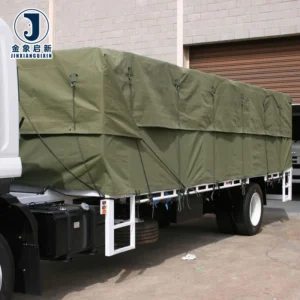





Precision-Coated Specialist Fabric — Every roll of PVC Laminated Canvas Tarpaulin is produced with documented fire-retardant and anti-static treatment where specified, backed by test reports matched to your project compliance standard.
Technical Specifications
| Parameter | Value |
|---|---|
| Product Type | Laminated Canvas Tarpaulin |
| Base Fabric | Polyester cotton industrial textile with 8-12 strands of fine cotton yarn |
| Weight | 600gsm |
| Thickness Options | 0.5mm / 0.6mm / 0.7mm |
| Coating Method | PVC Laminated |
| Roll Width | 2m |
| Roll Length | 100m |
| Colour | Army Green Camouflage / Custom |
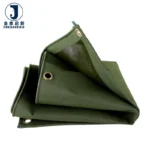
| Eyelet & Hem | Rust-proof aluminum eyelets every 1 meter at corners and hem; folded and welded seams with poly rope reinforcement |
| Fire-Retardant Treatment | Available in certified grades — confirm the grade required for your market |
| Anti-Static Treatment | Available for mining and tunnelling ventilation duct applications — specify required surface resistance standard |
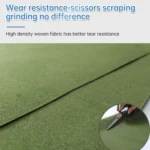
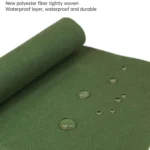
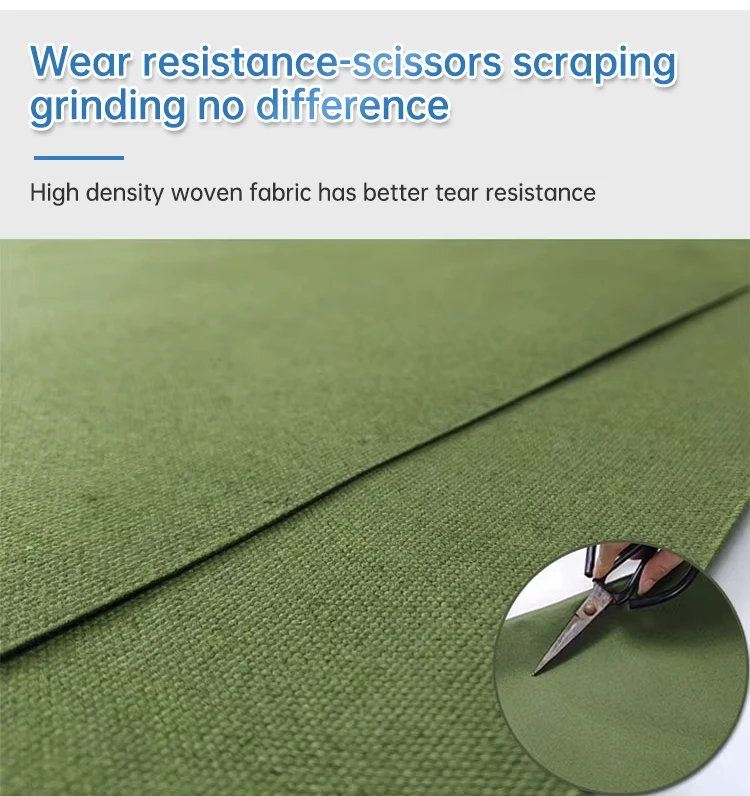
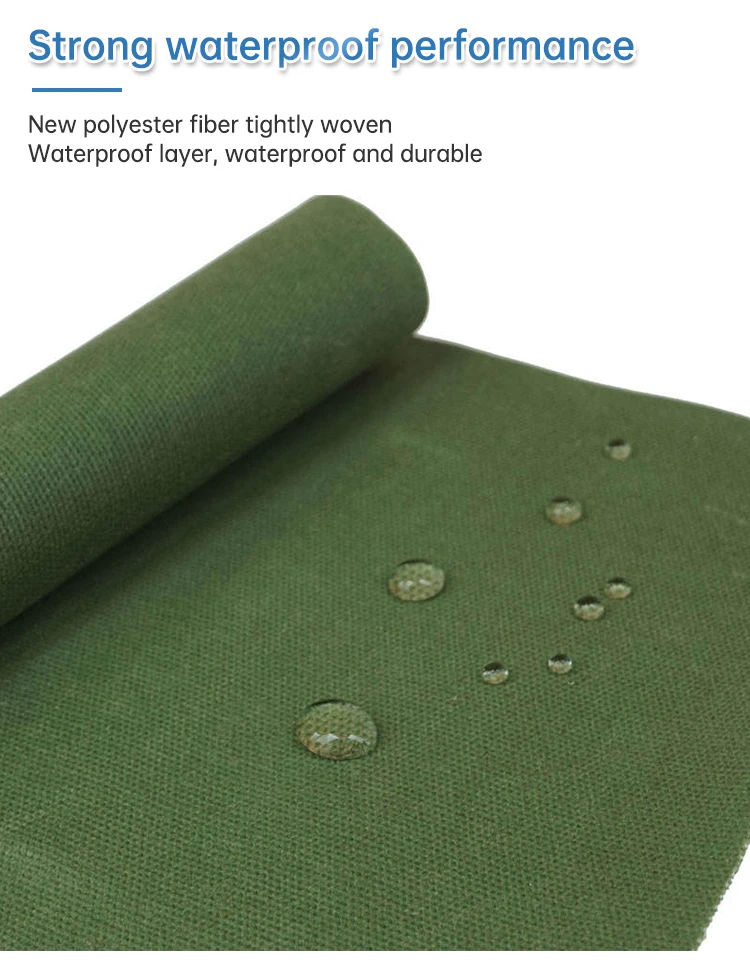
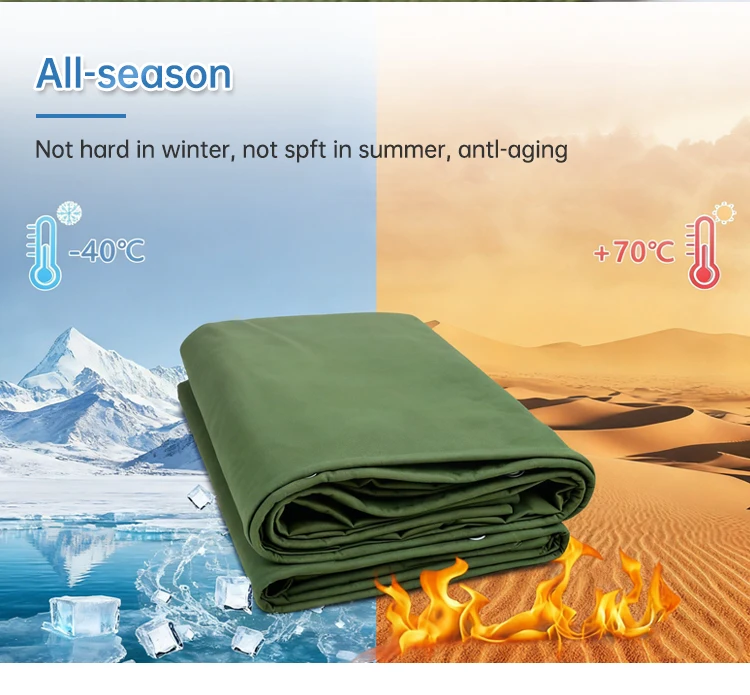
| Key Features | Wear-resistant, corrosion-resistant, tensile-resistant, high- and low-temperature resistant |
Application Suitability
| Application | Exposure & Requirement |
|---|---|
| Mining ventilation duct | Constant flexing, rock-dust abrasion, mandatory fire-retardant and anti-static compliance per site regulations |
| Tunnelling air duct | Confined-space fire risk, high humidity, mechanical contact with machinery and rough surfaces |
| Aviation facility duct | Fuel-vapour environment, strict flame-retardant certification, long continuous runs requiring weld reliability |
| Membrane and inflatable structures | Sustained wind load, tensile stress at anchor points, weather exposure over extended periods |
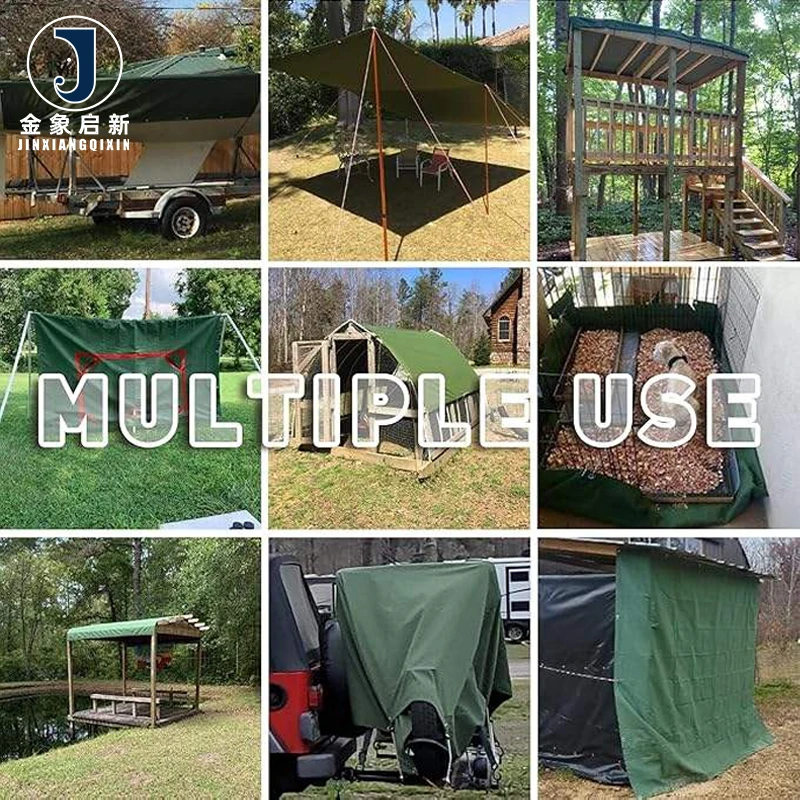
| Construction temporary enclosures | UV and rain exposure, repeated handling and relocation, scaffold abrasion at contact points |
What "Fire-Retardant Canvas" Means Without a Certified Grade Behind It
A laminated canvas tarpaulin is only as compliant as the test report that ships with it.
Engineering teams on mining and tunnelling projects routinely specify fire-retardant duct fabric, only to discover at site inspection that the material carries no documented grade. The contractor faces rework, project delay, or a failed audit [NEED_CITE: fire classification requirements for underground ventilation fabric per regional mining codes]. For aviation and industrial duct installations, the absence of a verified standard means the entire duct run may be rejected before commissioning. Procurement teams need the test result in hand before the container is sealed, not after the material arrives.
How Laminated PVC Coating Supports Ventilation Duct Performance
The PVC laminated construction on a polyester cotton base textile gives this PVC Laminated Canvas Tarpaulin the dimensional stability needed for duct sections that must hold their profile under airflow pressure. Lamination bonds the coating to the base fabric across the full surface, reducing the risk of delamination at the weld lines where duct sections join. This matters in mining ventilation runs where the fabric flexes with every fan cycle and the seam is the first point of failure if adhesion is insufficient.
Anti-Static Surface Resistance for Underground Compliance
In coal and hard-rock mining environments, static charge build-up on duct surfaces presents an ignition risk that fire-retardant treatment alone cannot address. Anti-static treatment must be measured and documented against the surface resistance threshold specified by the site safety authority [NEED_CITE: anti-static surface resistance testing for underground ventilation materials]. When requesting a quotation for this laminated canvas tarpaulin in an anti-static grade, provide the required resistance range so the correct formulation can be applied and verified before dispatch.
Why GSM and Base Weave Together Define Duct Fabric Strength
A 600gsm weight indicates the total mass per square metre of coating plus base fabric, but it does not isolate how much strength comes from the polyester cotton yarn structure versus the PVC laminate. The 8-12 strand cotton yarn count interacts with the polyester warp to determine tear propagation resistance — a critical property when a duct section is dragged along a tunnel floor or catches on a rock bolt. The 0.5mm, 0.6mm, and 0.7mm thickness options allow selection matched to the mechanical exposure of the installation: lighter gauge for suspended runs with minimal contact, heavier gauge for ground-level or high-abrasion zones. Coating adhesion from lamination, rather than knife-over-roll coating, provides stronger peel resistance at thermally welded seams [NEED_CITE: peel strength comparison of laminated versus coated PVC fabrics per ISO 1421].
The Hidden Cost of Undocumented Treatment Grades
A ventilation duct specified as fire-retardant but delivered without a matching test certificate forces the contractor to either halt installation for third-party testing or proceed at compliance risk. Both paths add cost and delay. Similarly, a batch of duct fabric that arrives with inconsistent anti-static loading across rolls may pass a spot test on one panel and fail on another once installed end-to-end. Colour variation between rolls in the same shipment also matters when duct sections are visible in surface-level installations, creating an inconsistent appearance that signals poor quality control to the site owner [NEED_CITE: batch consistency testing methods for coated and laminated industrial fabrics].
Why Source This Laminated Canvas Tarpaulin Here
Full production control over lamination temperature and pressure ensures consistent PVC adhesion to the polyester cotton base textile across every roll in the shipment.
Three production lines and 36 sets of equipment support bulk volume orders with documented lead times for mining and tunnelling projects requiring simultaneous duct fabrication.
A 10-person R&D team develops sample panels with your specified fire-retardant and anti-static treatment for site approval before full production runs.
Dedicated QA/QC inspection at every production stage catches coating weight drift, weld adhesion defects, and eyelet placement errors before the roll leaves the facility.
Pre-shipment documentation packages include the material specification sheet, test reports, and packing lists assembled per container for smooth customs clearance.
Documentation & Verification
- Material specification sheet stating 600gsm weight, base fabric yarn count, PVC laminate type, and thickness for each roll
- Fire-retardant test report matching the certified grade specified for your ventilation duct project
- Anti-static surface resistance measurement per roll where applicable, referenced to your site standard
- Pre-shipment inspection record confirming colour consistency across all rolls in the order
- Certificate of origin, CE and ISO certificates, and roll packing list for international customs dispatch
Fabrication, Handling & Storage
- Thermally weld PVC laminated seams at manufacturer-recommended temperature to avoid delamination of the 600gsm coating from the base fabric
- Position rust-proof aluminum eyelets into the poly rope reinforced hem to distribute tie-down load across the 2m roll width
- Store rolls upright on a flat surface to prevent permanent creasing in the 0.5mm/0.6mm/0.7mm laminate layers
- Unroll laminated canvas tarpaulin at above freezing temperature to prevent stiff cracking at the PVC surface
- Clean with mild detergent only to preserve the anti-static or fire-retardant treatment applied to the coating surface
What to Include in Your Inquiry
Provide the ventilation duct diameter, section length, and the specific fire-retardant or anti-static standard required by your site authority. Confirm whether you need rolls for your own fabrication or finished duct sections with welded seams and flanges. Indicate the annual volume and project timeline so production slots can be reserved against your schedule.
Frequently Asked Questions
Q: What fire-retardant standard can you certify this laminated canvas tarpaulin to?
A: We supply this PVC Laminated Canvas Tarpaulin with fire-retardant treatment certified to standards including M2, B1, NFPA 701, and DIN 4102. Specify the grade required by your project or site authority in your inquiry. A test report for the exact standard will accompany the shipment documentation package for compliance verification at installation.
Q: How is anti-static surface resistance measured for mining duct fabric?
A: Anti-static treatment is applied to the PVC laminated surface and measured against the surface resistance threshold specified by your mine safety authority. We document the result per roll and include the measurement in the pre-shipment inspection record. Confirm your required resistance range at inquiry stage so the correct formulation is selected.
Q: How do you verify the 600gsm weight on arrival?
A: Each roll is weighed and sampled for GSM verification during pre-shipment inspection. The inspection record included in the documentation package states the measured weight per roll against the specified 600gsm target. Any roll falling outside the acceptable tolerance is flagged and replaced before the container is sealed.
Q: What duct construction support do you provide for mining and tunnelling projects?
A: Our R&D team reviews your duct diameter, section length, and airflow requirements to recommend thickness selection between the 0.5mm, 0.6mm, and 0.7mm options. We provide sample sections with welded seams and eyelet placement for site evaluation. Full production follows once the sample is approved against your project specification.
Q: Can you supply UV resistance test reports for outdoor duct installations?
A: UV treatment is available for this laminated canvas tarpaulin where the duct run is exposed to direct sunlight. Specify the test duration or grade required for your market in your inquiry. A test report documenting UV resistance performance will be included with the shipment documentation for your records and site audit.