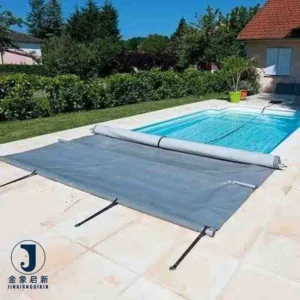
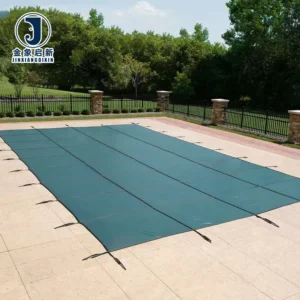
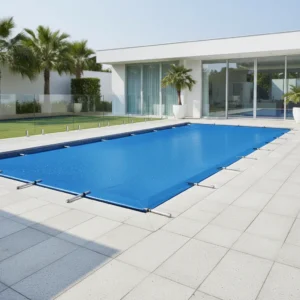
Precision-Coated Ventilation & Pool Fabric — Three full production lines and 36 sets of equipment ensure consistent GSM control and batch uniformity across every roll of PVC laminated pool cover fabric.
Technical Specifications
| Parameter | Value |
|---|---|
| Product Type | PVC Tarpaulin / Pool Cover |
| Material | PVC + High-strength polyester mesh fabric |
| Coating Method | Laminated technology & Hot-melt coating technology |
| Color Options | Blue / Red / Yellow / Light blue / Grey (Customized) |
| Weight Options | 350gsm / 420gsm / 500gsm / 550gsm / 600gsm / 750gsm |
| Thickness Options | 0.32mm / 0.35mm / 0.4mm / 0.45mm / 0.5mm / 0.65mm |
| Roll Size | 2m width × 75m length / 2.1m width × 50m length |
| Finish Product Size | Custom items as per customer’s needs, or sold by inventory |
| Key Features | Waterproof, sunproof, cold crack resistance, anti-mildew, anti-static treatment, outstanding tearing strength for welding, best color fastness |
| Flame Retardant | Available in flame retardant grades — confirm the grade required for your market |
| Anti-Static | Treatment available — surface resistance standard to be confirmed per project |
| UV Treatment | Anti-UV treatment available — test basis to be confirmed at order |
| Special Treatments | Anti-cold, anti-mildew, 3P options available |
| Standards | ISO, CE certified facility |
Application Suitability
| Application | Exposure & Requirement |
|---|---|
| Commercial swimming pool safety covers | Repeated tension cycles, UV exposure, documented fire-retardant compliance for public facilities |
| Industrial water containment and reservoir lining | Permanent water contact, membrane integrity, certification for environmental compliance |
| Municipal pool facilities | Seasonal temperature variation, public safety codes, flame-retardant material mandates |
| Inflatable and membrane structures using pool-grade fabric | Structural tension, welded seam integrity, air-holding performance under load |
| Aquaculture and fish tank covers | Constant moisture exposure, anti-mildew requirement, chemical resistance from water treatment |
Why Certified Pool Cover Fabric Matters More Than Stated GSM
A pool cover without verifiable fire-retardant or anti-static documentation is a compliance liability, not a safety solution.
Municipal and commercial pool operators increasingly face site inspections that demand test reports — not quotation claims — for fire-retardant and anti-static performance. PVC pool cover tarpaulin specified without documented grades routinely fails inspection, forcing costly replacement mid-season [NEED_CITE: fire classification standards for building and pool enclosure materials]. Fabricators who source on GSM alone often discover that a heavier roll with poor adhesion at the laminate interface will delaminate before a lighter, properly coated alternative shows any surface wear. The gap between what is quoted and what arrives on site accounts for a significant share of pool cover project delays.
Coating Integrity at Welded Seams
The laminated and hot-melt coating technologies used in this PVC pool cover tarpaulin produce adhesion strength that directly determines weld performance. When a pool cover is tensioned across a rectangular or custom-shaped installation, the seams bear concentrated stress at anchor points and corners. Laminated construction bonds the PVC layers to the polyester mesh base under heat and pressure, creating a unified structure that resists separation during high-frequency welding. This matters for fabricators who need seams that hold as long as the fabric itself.
Anti-Static and Fire-Retardant Compliance for Regulated Environments
Specialist pool installations — particularly indoor aquatic centres, mining site water containment, and inflatable structures — operate under compliance frameworks that require documented anti-static or fire-retardant performance. This PVC pool cover fabric is available with anti-static treatment and flame-retardant grades, each supported by test documentation upon confirmation [NEED_CITE: anti-static surface resistance test methods for coated technical fabrics]. Specifying the exact standard your project requires at inquiry stage ensures the correct formulation is applied and certified before production begins.
How GSM, Base Fabric, and Coating Method Interact
Weight alone does not predict how a PVC pool cover tarpaulin will perform under tension. The high-strength polyester mesh base provides the structural skeleton — its yarn tenacity and weave density determine how load distributes across the fabric before the coating engages. A 550gsm roll with a tightly woven base may outperform a 750gsm roll with a loose weave in tear resistance, because tear propagation follows the path of least resistance through the mesh structure. Laminated coating fills the interstices of the weave uniformly, while hot-melt coating creates a thicker surface film. For pool covers that undergo repeated removal and reinstallation, the choice between these methods affects both flexibility at fold lines and the ease of achieving consistent welds during fabrication.
The Hidden Cost of Undocumented Material Claims
Pool cover projects fail in patterns. A batch arrives with colour variation visible once two rolls are installed side by side on a large commercial pool deck — the entire installation is rejected and re-ordered. A fire-retardant claim on the quotation cannot be backed with a test report when the building inspector requests it, and the cover is removed pending compliance verification [NEED_CITE: pre-shipment inspection protocols for coated fabric batches]. Anti-static treatment is specified for an indoor aquatic centre but no surface resistance measurement accompanies the shipment, delaying commissioning. These are not material failures; they are documentation and specification failures that cost weeks on site.
Why Technical Buyers Source This Fabric Here
Deep process control over coating weight and adhesion comes from nearly 30 years focused exclusively on coated fabric, not from a general product range. The 10-person R&D team handles material selection, custom sizing, and sample development specifically for technical applications like pool containment and ventilation structures. Three full production lines with 36 sets of professional equipment support bulk roll orders with consistent batch-to-batch output. Dedicated QA/QC runs at every production stage, with 100% inspection before any roll ships. Samples for custom colour, width, or treatment requirements are developed within days, not weeks.
Documentation & Verification
- Material specification sheet stating exact GSM, base fabric construction, and coating method per grade ordered
- Test reports for flame-retardant grade and anti-static surface resistance where applicable to your compliance framework
- Pre-shipment inspection record confirming weight, colour consistency, and dimensional accuracy per roll
- ISO and CE certificates with batch traceability linked to your purchase order
- Roll packing list with net weight and linear metre count for container loading verification
- Certificate of origin and customs documentation for international shipment
Fabrication, Handling & Storage
- High-frequency welding parameters must be adjusted per GSM grade — test weld on offcuts before production runs
- Reinforced hems at anchor points distribute tension loads across multiple yarn rows in the polyester mesh base
- Store rolls upright on pallets to prevent flat-spotting and permanent creasing in the PVC coating
- Unroll at ambient temperature — cold-stored rolls risk surface micro-cracking if flexed below rated cold crack threshold
- Clean with mild detergent only; solvent-based cleaners may degrade the anti-static or flame-retardant surface treatment
- Custom cut-to-size panels should be patterned to minimize weld seams across high-tension zones
What to Include in Your Inquiry
Provide the specific pool or containment geometry, local wind load conditions, and whether the installation is indoor or outdoor. Confirm any fire-retardant or anti-static standards mandated by your building code or site safety plan. Specify required roll width and whether you need finished panels with hems or raw roll stock.
Frequently Asked Questions
Q: What fire-retardant grade can you supply for pool cover fabric, and which test standard does it meet?
A: Flame-retardant grades are available for this PVC laminated pool cover fabric. The specific grade and test standard depend on your market’s regulatory requirements. State the standard your project mandates at inquiry stage so the correct formulation is applied and a supporting test report ships with your order.
Q: How is anti-static performance measured, and can you provide a surface resistance test report?
A: Anti-static treatment is available as an option. Surface resistance is measured according to recognized test methods for coated technical fabrics. Confirm the resistance range or standard your compliance framework requires, and the corresponding test report will be included in your shipment documentation.
Q: How do you verify GSM on arrival matches the quotation?
A: Every roll undergoes weight verification during pre-shipment inspection. The inspection record documenting actual GSM per roll ships with your order, so you can cross-reference against your quotation before the material enters production.
Q: What is the difference between laminated and hot-melt coating for welded pool cover seams?
A: Laminated coating bonds PVC to the polyester mesh under heat and pressure for strong interlayer adhesion. Hot-melt coating applies a thicker surface film. Both support high-frequency welding, but laminated construction generally delivers better peel strength at seam edges under repeated tension cycles.
Q: Can you supply custom cut-to-size pool covers with reinforced hems?
A: Yes. Custom dimensions with reinforced hems and edge treatments are produced based on your pool geometry drawings. Provide panel dimensions, hem type, and any eyelet or anchor point specifications with your inquiry for sample development and lead time confirmation.