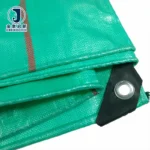
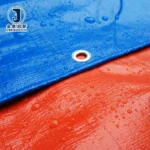
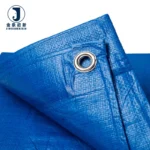
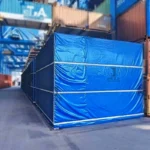
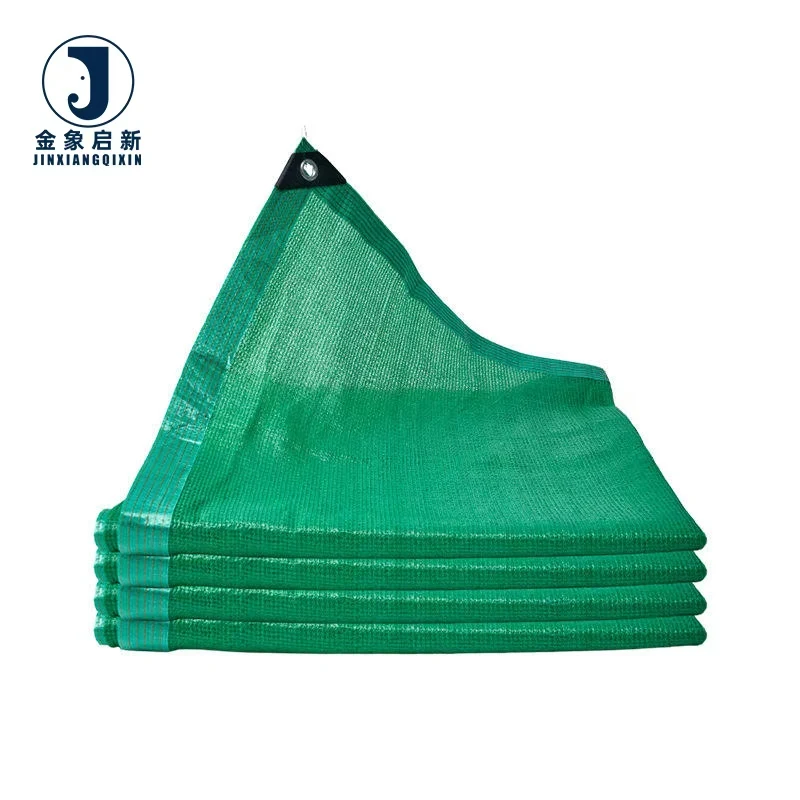

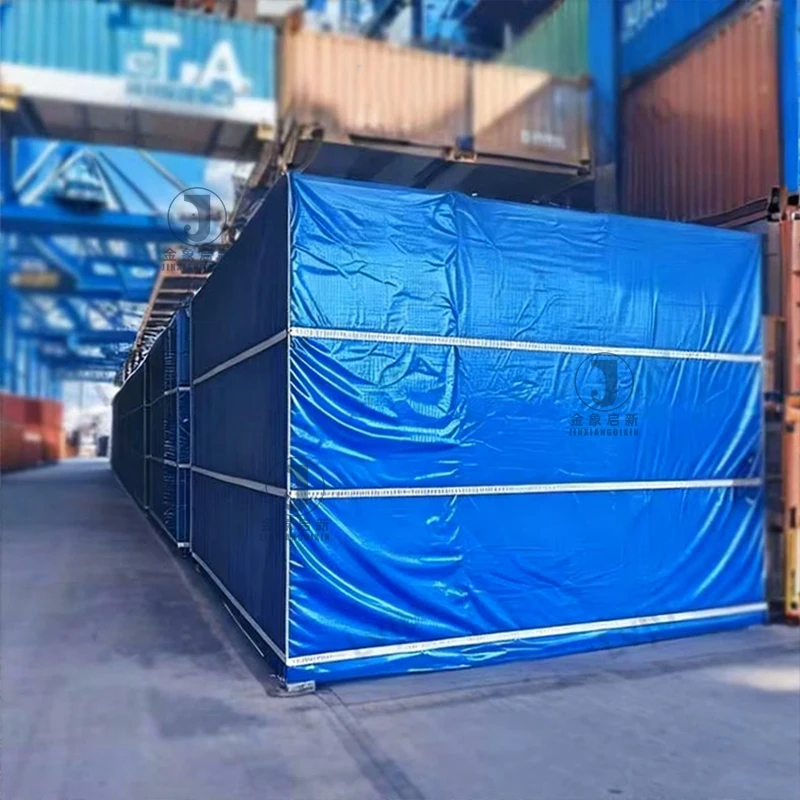
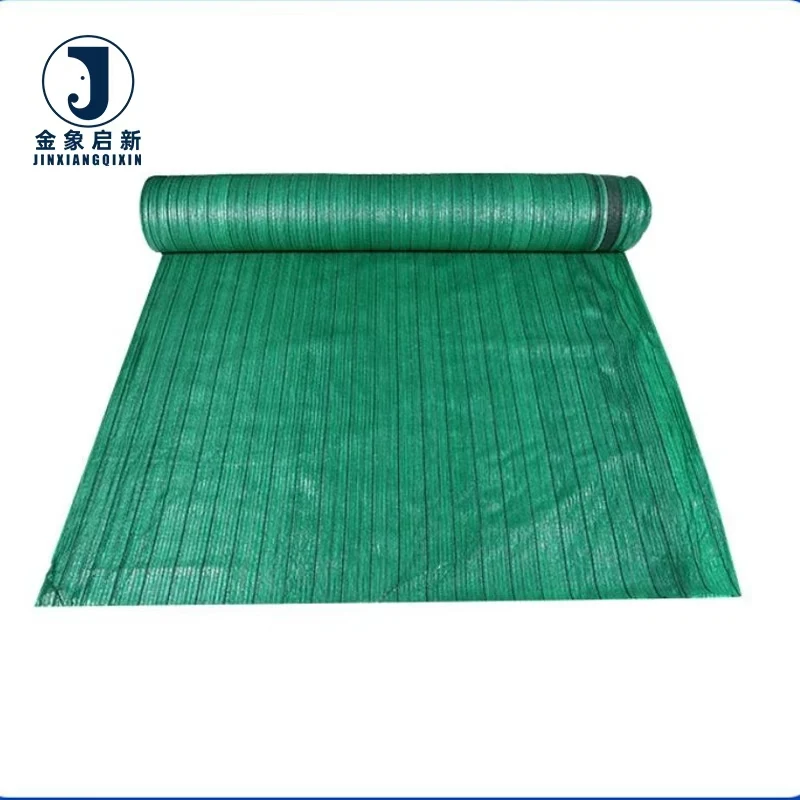
Technical-grade PE tarpaulin with documented certification — every roll ships with material specification sheets, test reports and compliance documentation matching the grade your site contractually requires, backed by 100% pre-shipment inspection.
Technical Specifications
| Parameter | Value |
|---|---|
| Product Type | PE Tarpaulin |
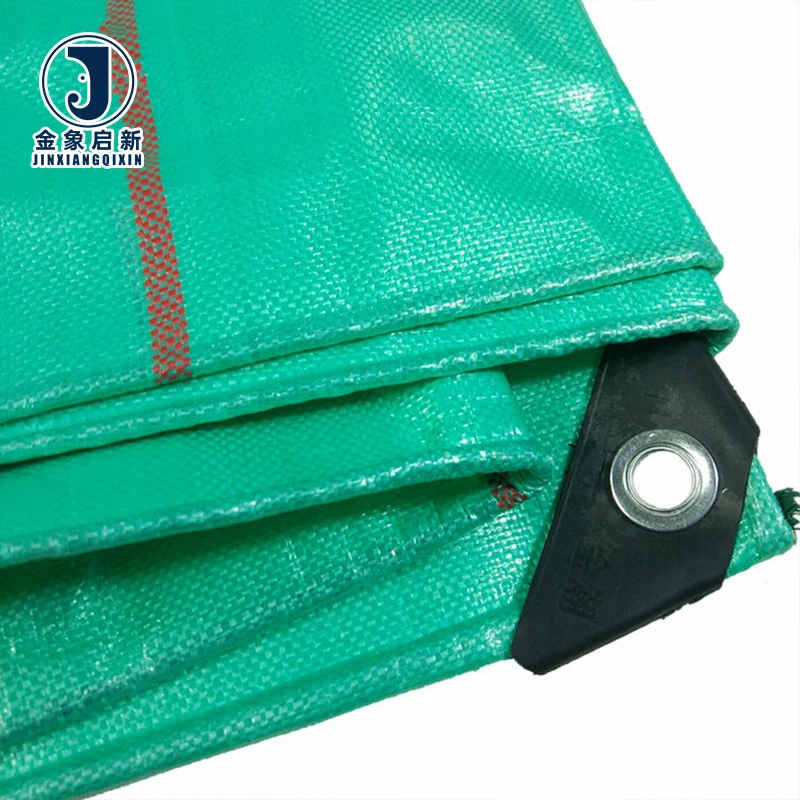
| Material | HDPE woven base with LDPE lamination on both sides |
| GSM Range | 50 g/m² to 220 g/m² (confirm the grade for your application) |
| Thickness | 0.2 mm – 0.4 mm / 8 mil – 16 mil |
| Mesh Count Options | 6×6, 6×7, 7×7, 7×8, 8×8, 9×9, 8×10, 10×10, 12×12, 14×14, 14×16 |
| Roll Width | 6 ft, 8 ft, 10 ft, 12 ft or 2 m, 4 m, 6 m |
| Roll Length | 100 yards, 100 meters, or custom length |
| Finished Sizes | 2×2 m through 8×10 m, or custom cut |
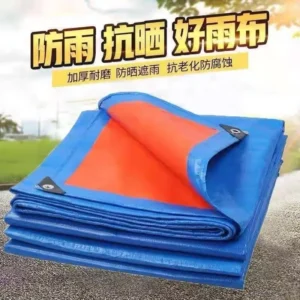
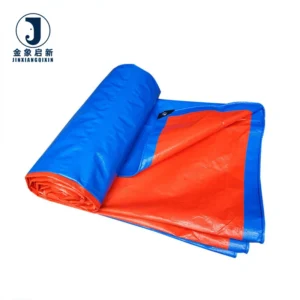
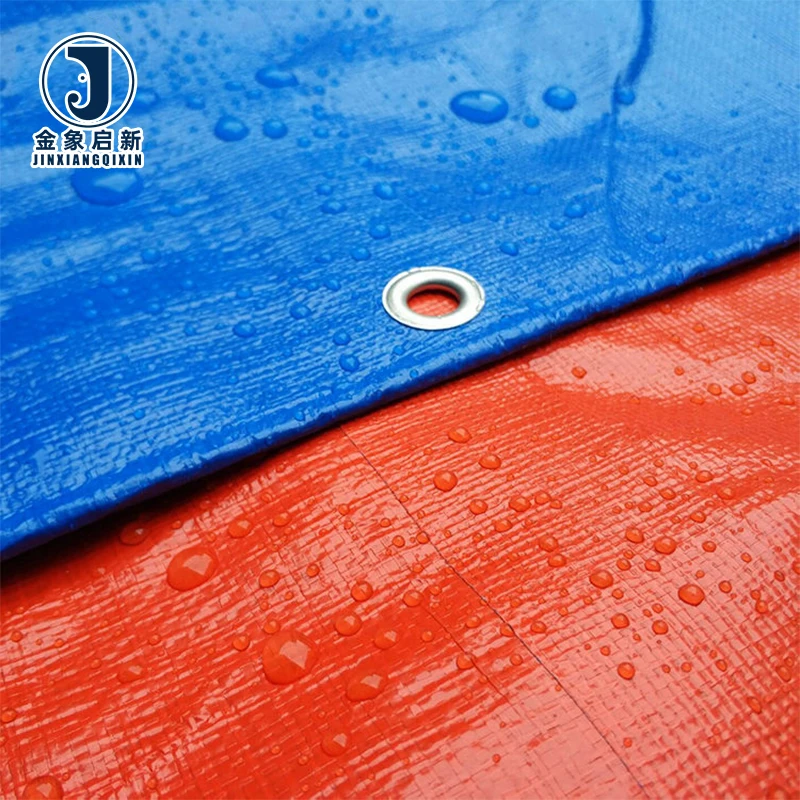
| Colour Options | Blue, Blue/Orange, Green, Grey, Black, Clear, Grey/Green, Orange, or custom |
| Edge Reinforcement | All four edges reinforced with PP rope in hem |
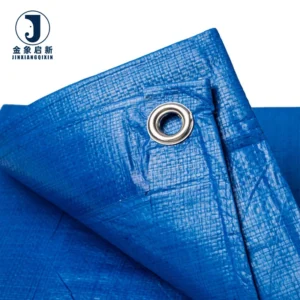
| Eyelets | Galvanized eyelets every 3 ft or 1 m interval |
| Corners | Reinforced plastic corners |
| UV Treatment | Available (test basis not stated — confirm standard for your market) |
| Fire-Retardant Grade | Available (confirm the grade required for your site) |
| Anti-Static Grade | Available (confirm the standard applicable to your operation) |
| Standards | ISO, CE |
Application Suitability
| Application | Exposure & Requirement |
|---|---|
| Mining ventilation duct | Continuous airflow, flexing at bends, fire-retardant or anti-static compliance required on site |
| Aviation ground covers | Fuel and hydraulic fluid exposure, fire safety compliance, UV exposure during extended outdoor staging |
| Inflatable and membrane structures | Tensile loading at seams, UV and weather exposure, batch-consistent appearance across panels |
| Tunnelling duct runs | Abrasion against tunnel walls, moisture ingress, fire safety regulation enforcement underground |
| Specialist architectural covers | Long-term weathering, colour consistency across installed panels, structural tensile demand |
What "Certified" Means When the Paperwork Does Not Match the Fabric
Certification is only meaningful when the test report, the material spec sheet and the physical roll all describe the same product.
Ventilation duct fabric arrives on a mining site and the safety officer asks for the fire-retardant certificate. The supplier sends a generic PDF that references a different product family. Installation is delayed while the contractor argues with procurement. This happens regularly when PE tarpaulin is sourced from catalogues where fire-retardant and anti-static grades are listed as options but never tied to specific production batches [NEED_CITE: fire safety documentation requirements for underground mining ventilation materials]. The PE Tarpaulin fire retardant / anti-static / certified specification you order is the one documented in the shipment — not a general claim covering an entire product range.
Matching Weave Density to Ventilation and Structural Demand
Ventilation duct construction places PE tarpaulin under sustained internal pressure with repeated flex cycles at every bend and junction. A 6×6 weave at 50 g/m² may handle light-duty temporary covers, but duct fabrication for mining or tunnelling typically calls for a denser construction such as 12×12 or 14×14 to resist tear propagation at welded seams. The HDPE woven base provides the structural skeleton; the LDPE lamination seals the weave and delivers waterproof performance. Choosing the correct mesh count and corresponding GSM grade at the specification stage prevents mid-project failures where the fabric tears along the heat-welded joint line. PE Tarpaulin fire retardant / anti-static / certified grades are produced across the full weave range so that compliance and mechanical performance are specified together.
How Anti-Static and Fire-Retardant Treatments Interact with PE Lamination
Adding fire-retardant or anti-static chemistry to a PE tarpaulin changes how the LDPE lamination behaves during heat welding and how the finished duct or membrane performs under site conditions. The treatment must be compatible with the coating formulation so that weld strength is not compromised at the seam — a frequent failure point when the chemical additive migrates or softens the lamination layer. For mining ventilation, anti-static performance must persist through abrasion and repeated duct relocation [NEED_CITE: anti-static test methods for flexible ventilation duct fabrics]. Aviation ground covers require fire-retardant grades that satisfy both fabric flammability and fluid-resistance criteria. Confirming the exact test standard your site requires before production ensures the treatment chemistry is matched to the compliance target, not applied generically.
Reading the Specification Sheet Before the Roll Arrives
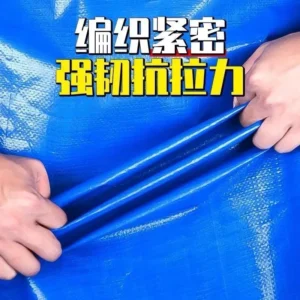
Mesh count and GSM grade work together to define how the PE tarpaulin will behave under load. A 14×14 weave at 150–250 g/m² provides substantially higher tear resistance than a 7×7 weave at 60–80 g/m², but the weight alone does not tell the full story — the denier of the HDPE tape yarn and the tightness of the weave determine how force distributes across the fabric when a seam is stressed. LDPE lamination thickness, measured across the 0.2–0.4 mm range, adds waterproof sealing and surface abrasion resistance but does not contribute proportionally to tensile strength. Understanding this distinction prevents specifying a heavy-coated, low-density fabric that feels substantial on the roll but tears at the eyelet under wind load.
The Cost of Specifying Without Test Documentation
A contractor orders fire-retardant PE tarpaulin for a tunnel ventilation run. The rolls arrive without a batch-specific test report. The site safety manager refuses installation until documentation is produced, costing the project days of downtime and re-inspection fees. In another scenario, anti-static fabric for an aviation fuel farm is delivered with a certificate referencing a different product code — the entire shipment is quarantined. These are not edge cases; they occur when suppliers treat compliance as a catalogue line rather than a production-controlled variable [NEED_CITE: pre-shipment inspection standards for certified technical fabrics]. Batch-to-batch consistency in both physical properties and documentation prevents these delays.
Why This PE Tarpaulin Source Meets Technical-Grade Requirements
Three full production lines and 36 sets of professional equipment support bulk PE tarpaulin output with on-time delivery across certified and standard grades. A 10-person R&D team handles material selection, custom sizing and sample development, producing samples within days for fire-retardant or anti-static specifications. Dedicated QA/QC runs at every production stage with 100% inspection before shipment, ensuring the GSM, weave density and treatment performance match the order documentation. Nearly 30 years of focused coated fabric production provides deep process control over coating weight and adhesion — the variables that determine whether a welded duct seam holds under pressure. Full customs and compliance documentation packages accompany every dispatch.
Documentation & Verification
- Material specification sheet stating GSM, HDPE base weave, LDPE coating weight and colour reference for every roll
- Fire-retardant or anti-static test report matched to the specific grade and batch produced
- ISO and CE certificates included with shipment documentation package
- Pre-shipment inspection record confirming GSM and weave density against the purchase order
- Certificate of origin and full customs support documentation for destination-country clearance
- Roll packing list with individual roll weights and dimensions for freight verification
Fabrication, Handling & Storage
- Heat-weld seams using temperature settings matched to the LDPE lamination thickness — excessive heat degrades the fire-retardant additive at the joint
- Reinforce eyelet positions with additional LDPE patches on lighter GSM grades to prevent pull-through under tie-down tension
- Store rolls upright on pallets to prevent flat-spot deformation across the HDPE woven core
- Unroll and allow the PE tarpaulin to relax before fabrication in cold conditions to avoid lamination cracking
- Clean surfaces with mild detergent only — solvent-based cleaners can degrade the anti-static treatment layer
What to Include in Your Enquiry
To receive an accurate specification and sample, provide the end-use application and the specific fire-retardant or anti-static standard your site or contract mandates. Confirm whether you require PE tarpaulin in roll form for your own fabrication or as finished cut-to-size sheets with eyelets and reinforced hems. Include the target colour, required width and roll length or finished dimensions, and your estimated annual volume so that batch-consistent production can be planned from the first order.
Frequently Asked Questions
Q: What fire-retardant or anti-static certification does the PE tarpaulin carry?
A: Fire-retardant and anti-static grades are available across the PE tarpaulin range. The specific test standard and grade depend on the formulation produced for your order. State the standard your site requires — such as the fire classification applicable to underground ventilation or the anti-static threshold for fuel-handling areas — and the matching test report ships with the batch.
Q: How is GSM verified before the shipment leaves the factory?
A: Every roll undergoes pre-shipment inspection where the actual weight is measured and recorded against the GSM stated on your purchase order. The inspection record accompanies the shipment documentation. If a roll falls outside the agreed tolerance, it is replaced before dispatch rather than flagged after arrival.
Q: Which mesh count and GSM should I specify for ventilation duct versus membrane structure use?
A: Ventilation ducts typically require a denser weave such as 12×12 or 14×14 with a correspondingly higher GSM to resist tear propagation at welded seams under internal pressure. Membrane structures may use a wider range depending on tensile design loads. Provide your engineering requirements and the appropriate grade will be recommended with sample confirmation.
Q: Can custom colours and widths be produced with batch-to-batch consistency?
A: Custom colours, widths and finished sizes are produced by the R&D team with samples developed within days. Once approved, the colour reference and formulation are locked for repeat orders. Roll-to-roll colour consistency is verified during pre-shipment inspection, so installed panels match across the full order quantity.
Q: What is the sample and lead-time process for certified PE tarpaulin?
A: Submit your application details, required certifications and target specifications. A sample is developed and dispatched within days for your evaluation. After sample approval, production is scheduled with in-process QA at every stage. Typical lead times vary by order volume and customisation scope — confirm timing at the quotation stage.