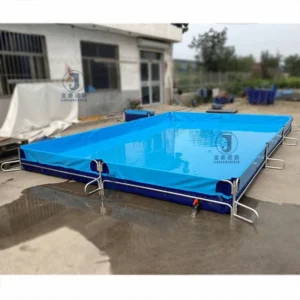
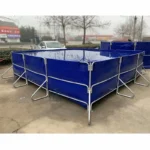
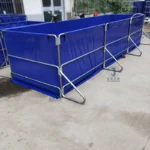

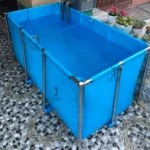
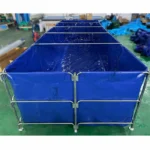
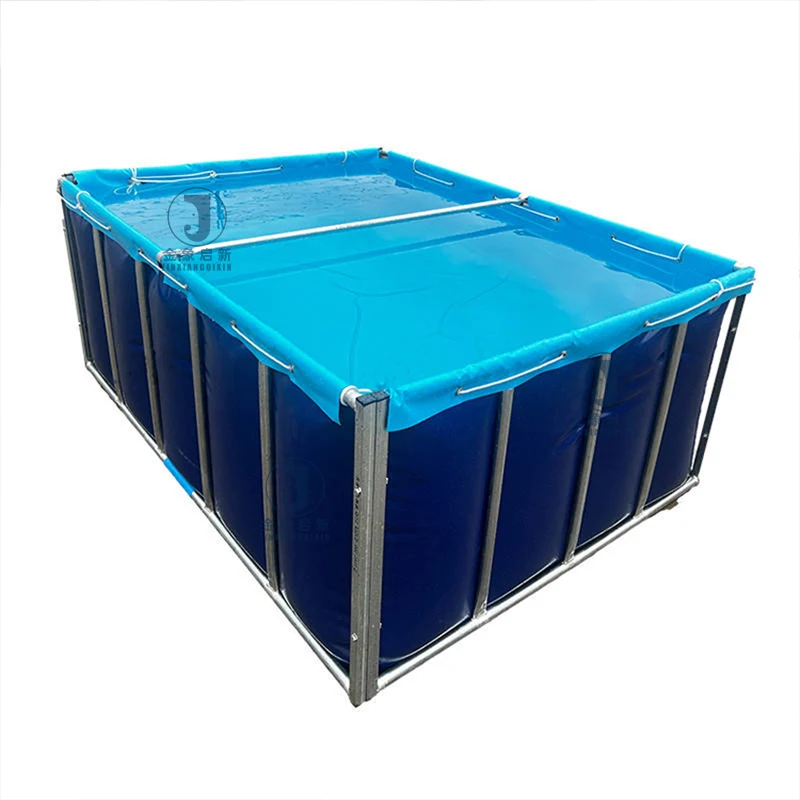
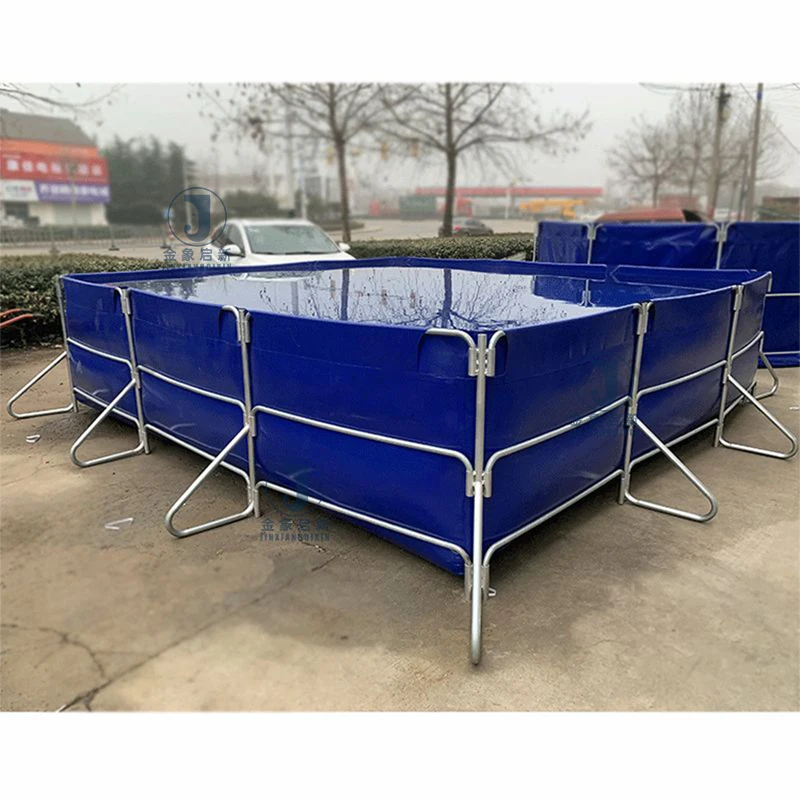
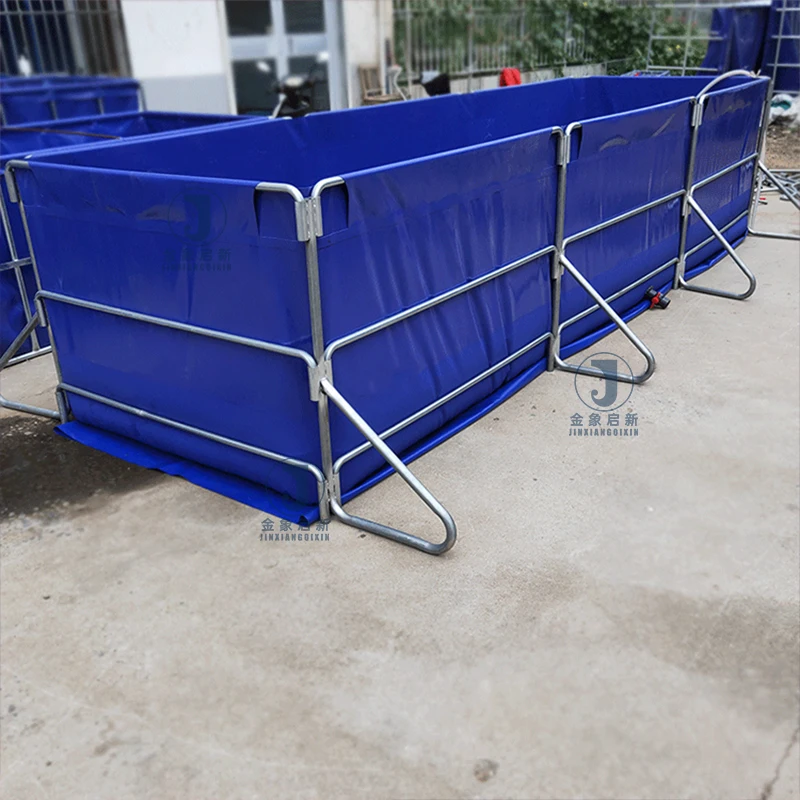
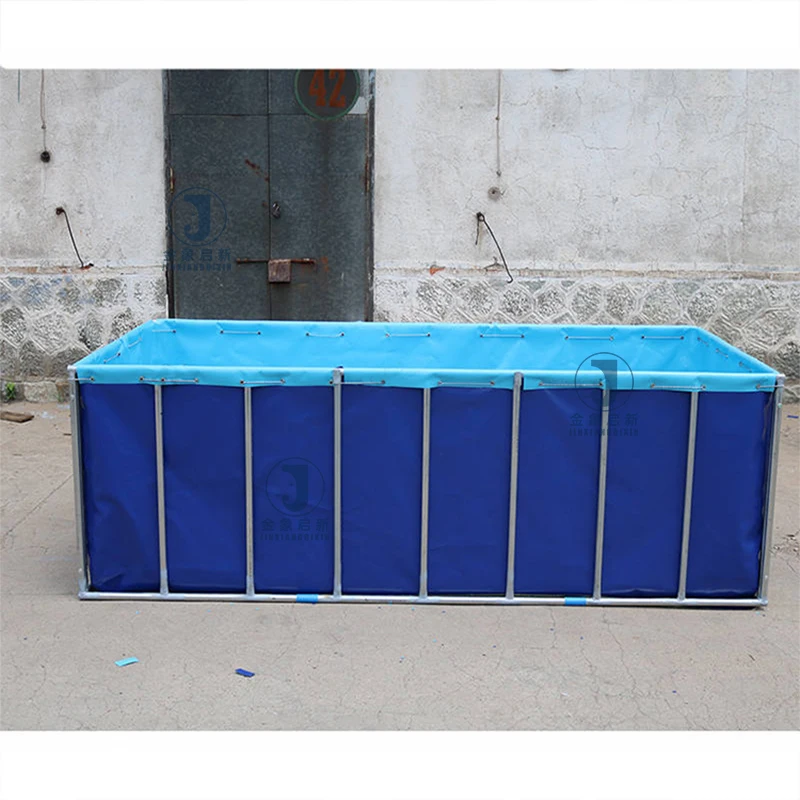
Deep Process Control — Three full production lines and 36 sets of equipment maintain coating weight and adhesion consistency across every roll of PVC coated tarpaulin destined for water containment applications.
Technical Specifications
| Parameter | Value |
|---|---|
| Product Type | PVC Coated Tarpaulin |
| Base Fabric | High-strength polyester mesh fabric |
| Coating Material | PVC |
| Coating Method | Laminated technology & Hot-melt Coating technology |
| Weight Options | 350gsm / 420gsm / 500gsm / 550gsm / 600gsm / 750gsm |
| Thickness Options | 0.32mm / 0.35mm / 0.4mm / 0.45mm / 0.5mm / 0.65mm |
| Roll Size | 2m × 75m / 2.1m × 50m |
| Colour Options | Blue / Red / Yellow / Light Blue / Grey (customised on request) |
| Key Features | Cold Crack Resistance, Anti-Mildew, Waterproof, Sunproof, High Colour Fastness |
| Special Treatments | Flame Retardant, Anti-Static, Anti-Cold, Anti-Mildew, 3P (available — confirm the grade required for your market) |
| Tearing Strength at Weld | Outstanding tearing strength for welding (test basis not stated in source — request report) |
| Certification | ISO, CE |
Application Suitability
| Application | Exposure & Requirement |
|---|---|
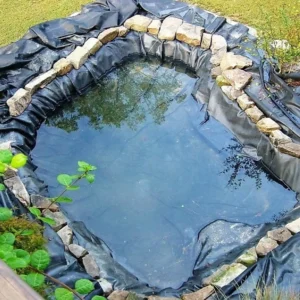
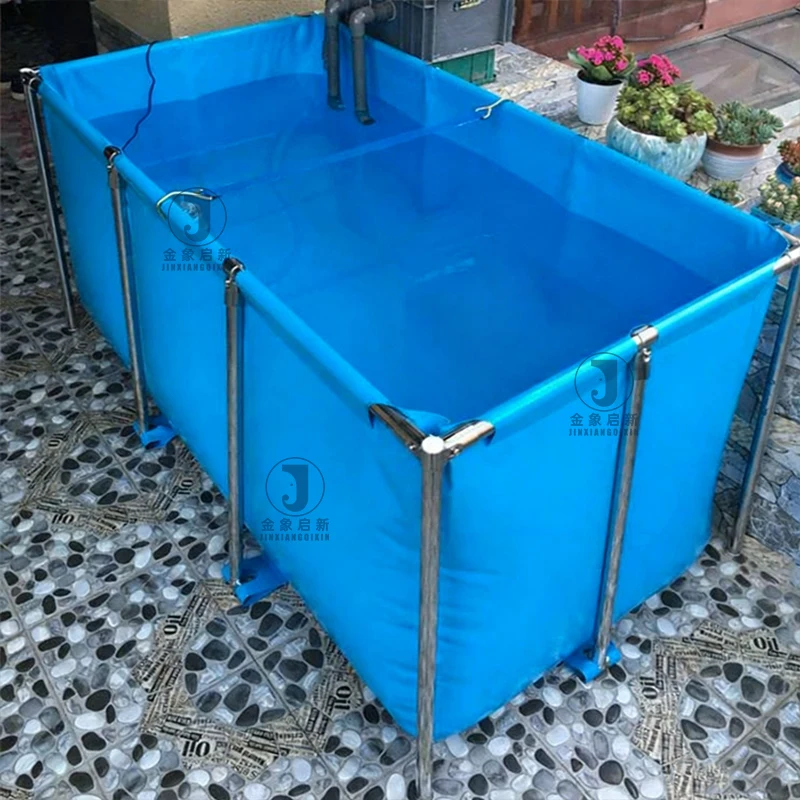
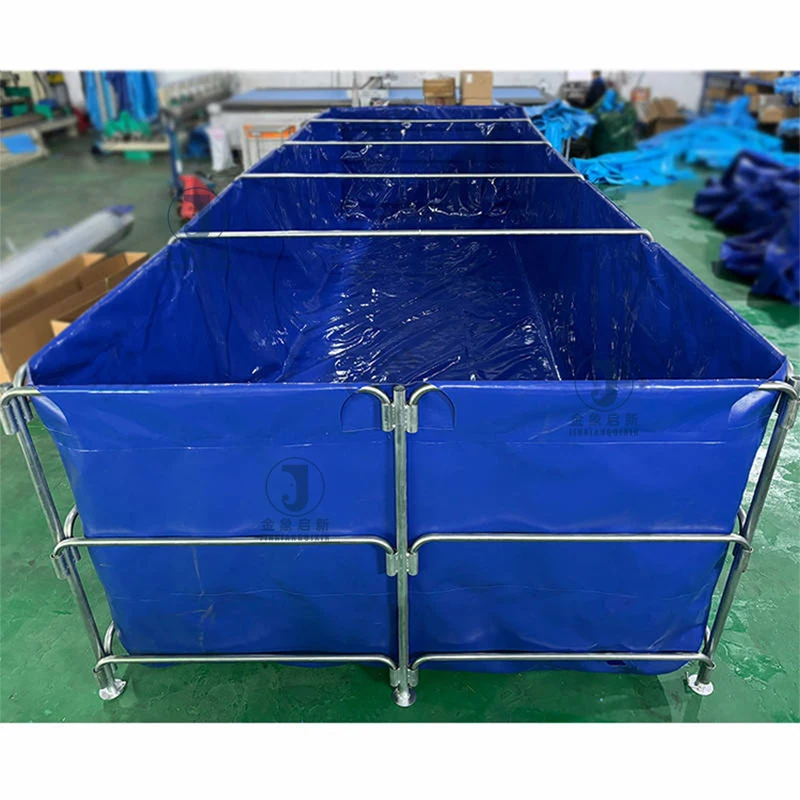
| Fish pond and shrimp pond lining | Permanent submersion, soil chemistry contact, puncture risk from substrate, non-toxic waterproof barrier required |
| Agricultural and irrigation reservoirs | Large-format liner panels, seam welding over long runs, UV and water exposure across seasons |
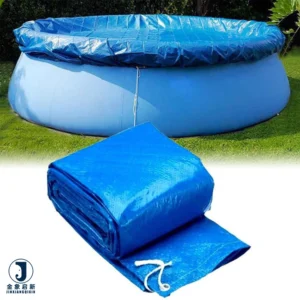
| Above-ground swimming pool metal frame liners | Constant hydrostatic pressure, flex at frame joints, repeated assembly and disassembly cycles |
| Inground pool safety covers | Weather exposure, load-bearing demand, seasonal deployment and storage |
Why "Waterproof" on the Label Is Not Enough for Pond and Pool Liners
A PVC coated tarpaulin destined for permanent water contact must perform beyond the initial waterproof claim. The adhesion between the PVC coating and the polyester base fabric determines whether the liner survives seasons of submersion without delaminating at the seams.
Buyers sourcing pond liner fabric by the roll frequently discover that waterproof performance degrades not in the body of the material but at welded joints, where coating adhesion is weakest. When a liner is filled with thousands of litres of water, every welded seam carries continuous hydrostatic load. A delamination failure at the weld releases the entire volume. Laminated and hot-melt coating technology addresses this by fusing the PVC layers into the polyester mesh rather than sitting on the surface, producing higher peel strength at the critical seam zones [NEED_CITE: peel strength test methods for coated fabrics per ISO 1421].
Hot-Melt Coating and What It Changes for Water Containment
The hot-melt coating process forces PVC into the interstices of the high-strength polyester mesh base fabric, creating a mechanical bond that goes deeper than surface lamination. For pond liner applications, this means the coating resists peeling away from the base yarns when the liner flexes under water weight or shifts against an uneven substrate.
Laminated technology adds a second bonding mechanism, pressing PVC films onto both faces of the mesh under heat and pressure. The combination yields a PVC coated tarpaulin with strong adhesion at the very locations — the welded seams — where water containment liners most commonly fail. Specifiers evaluating PVC Pond Liner for aquaculture and water containment should request peel strength data to confirm the bond exceeds the demands of their water volume and depth.
Anti-Mildew and Cold Crack Resistance in Submerged Service
Pond and reservoir liners sit in constant moisture, often in warm climates where mildew growth accelerates on organic residues settling on the liner surface. Anti-mildew treatment embedded in the PVC coating slows biological colonisation, reducing the frequency of cleaning cycles and the risk of coating degradation from microbial acids.
Cold crack resistance matters in regions where above-ground pools or seasonal reservoirs experience freezing temperatures. PVC becomes brittle below its glass transition point, and an unmodified coating can crack when the liner is folded for storage or when ice forms against the surface. The anti-cold treatment extends the serviceable temperature range downward, preserving flexibility in cold weather deployment [NEED_CITE: cold crack testing standards for flexible PVC compounds].
Reading the Specification Sheet Beyond the GSM Number
GSM tells you how much material is in each square metre, but it does not tell you how that mass is distributed between the polyester base fabric and the PVC coating. A 550gsm liner with a dense, high-denier mesh base and a thinner coating will resist tearing and puncture far better than a 550gsm liner where most of the weight comes from a thick but unsupported PVC layer. The thickness values — ranging from 0.32mm to 0.65mm — correlate with total material build but must be read alongside the base fabric construction to understand real-world performance.
The choice between 2m × 75m and 2.1m × 50m roll formats affects fabrication layout and waste. Wider rolls reduce the number of longitudinal welds needed to cover a large pond, directly reducing the total seam length exposed to hydrostatic pressure. Longer rolls reduce transverse welds. Planning the cut layout against available roll sizes before ordering minimises offcut waste and keeps weld counts low. The hot-melt and laminated coating combination supports high-frequency and hot-air welding, both common in liner fabrication shops.
The Hidden Cost of Selecting the Wrong Roll Format
Ordering PVC coated tarpaulin rolls without mapping the pond dimensions against available widths leads to excessive welding. Each additional weld is a potential failure line under water pressure. When a liner fabricated from narrow panels holds thousands of litres, the cumulative weld length becomes the weakest link — not the fabric itself.
Colour inconsistency across rolls in the same order becomes visible once panels are welded side by side in the finished pond. For above-ground pools sold as finished products to end consumers, visible colour variation between panels reads as a manufacturing defect. Batch traceability and roll-to-roll colour verification at the production stage prevent this downstream rejection [NEED_CITE: colour fastness and batch consistency standards for coated textiles].
What Three Decades of Coated Fabric Production Means for Your Liner Order
Coating weight and adhesion control come from process maturity, not equipment alone. The dedicated QA and QC protocol at every production stage catches adhesion variation, GSM drift, and colour shift before rolls leave the line — verified by 100 percent pre-shipment inspection rather than spot sampling.
The 10-person R&D team handles material selection, custom sizing, and sample development, producing samples within days when a specifier needs to confirm weld behaviour or colour match before committing to a full container order. Three full production lines and 36 sets of professional equipment support bulk volume commitments with reliable on-time dispatch, while custom widths and non-standard lengths remain achievable without prohibitive minimums. ISO and CE certification underpins the documentation chain that customs authorities and site inspectors require at destination.
Documentation & Verification
- Material specification sheet stating exact GSM, base fabric denier, and coating weight per roll of PVC coated tarpaulin
- Pre-shipment inspection record with 100 percent QA verification against the quoted liner specification
- Roll packing list with batch codes enabling traceability for colour and thickness across the order
- ISO and CE certificates accompanying each shipment for customs clearance and site compliance
- Custom colour reference documentation confirming the agreed shade before production begins
Fabrication, Handling & Storage
- Hot-air weld temperature and speed must be matched to the specific GSM grade — 350gsm and 750gsm require different settings to avoid under-welding or burning through the PVC coating
- Store rolls upright on their cores in a shaded, ventilated area to prevent flat-spotting and permanent creasing of the polyester mesh base
- When unrolling 2.1m × 50m panels in cold weather, allow the PVC coated tarpaulin to acclimatise before folding or welding to prevent stress cracking at the crease lines
- Cut layout should be planned against roll width to minimise longitudinal welds, since each weld is a potential leak path under hydrostatic pressure
- Surface cleaning should use mild, non-solvent detergents to avoid degrading the anti-mildew treatment embedded in the PVC coating layer
Requesting a Quote That Matches Your Liner Project
Provide the target water volume, liner dimensions, and whether you need rolls for your own fabrication shop or finished cut-to-size panels. Specify the GSM grade or describe the depth and substrate conditions so the correct weight and thickness can be recommended. Include any colour, printing, or special treatment requirements — flame retardant or anti-static grades must be confirmed against your local regulatory framework before production begins.
Frequently Asked Questions
Q: How is GSM verified on arrival to match the quoted pond liner specification?
A: Each roll is weighed and measured during the 100 percent pre-shipment inspection. The pre-shipment inspection record documents the actual GSM per roll against the quoted value. Request this record alongside the material specification sheet so you can cross-check weight on receipt before fabrication begins.
Q: What welding and seam techniques work best for PVC pond liner installation?
A: Hot-air welding and high-frequency welding both produce reliable seams on hot-melt coated polyester mesh fabric. Weld temperature, speed, and pressure must be calibrated to the specific GSM and thickness grade. Request weld parameter guidance matched to your ordered specification before starting production runs.
Q: How do you control colour and thickness consistency across multiple rolls for large pond projects?
A: Dedicated QA and QC runs at every production stage monitors colour shade and coating thickness roll by roll. Batch codes on the packing list enable full traceability. Specify that all rolls for a single project must come from the same production run to eliminate visible variation between welded panels.
Q: What custom widths and lengths are available, and what is the minimum order for non-standard sizes?
A: Standard rolls are produced in 2m × 75m and 2.1m × 50m formats. Custom widths and lengths are supported across three production lines, with minimums depending on the colour and GSM grade requested. The R&D team develops samples for non-standard sizes within days so you can confirm fit and weld behaviour before full production.
Q: Is the PVC liner material suitable for direct contact with fish and potable water?
A: The PVC coated tarpaulin is used in fish tank and pond applications across aquaculture operations. For potable water or sensitive aquaculture species, request confirmation that the specific coating formulation and any anti-mildew or flame retardant additives meet the health and safety standards required in your market before placing the order.