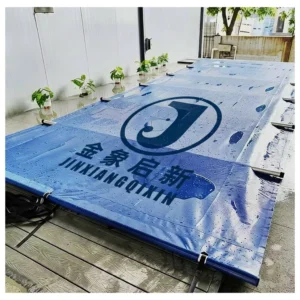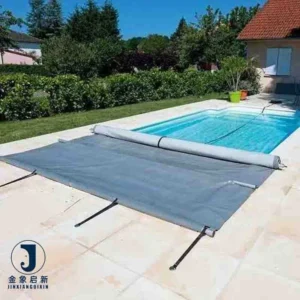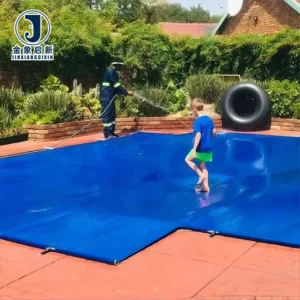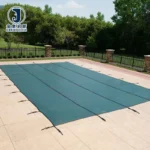
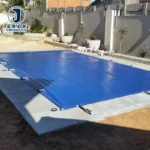
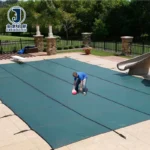
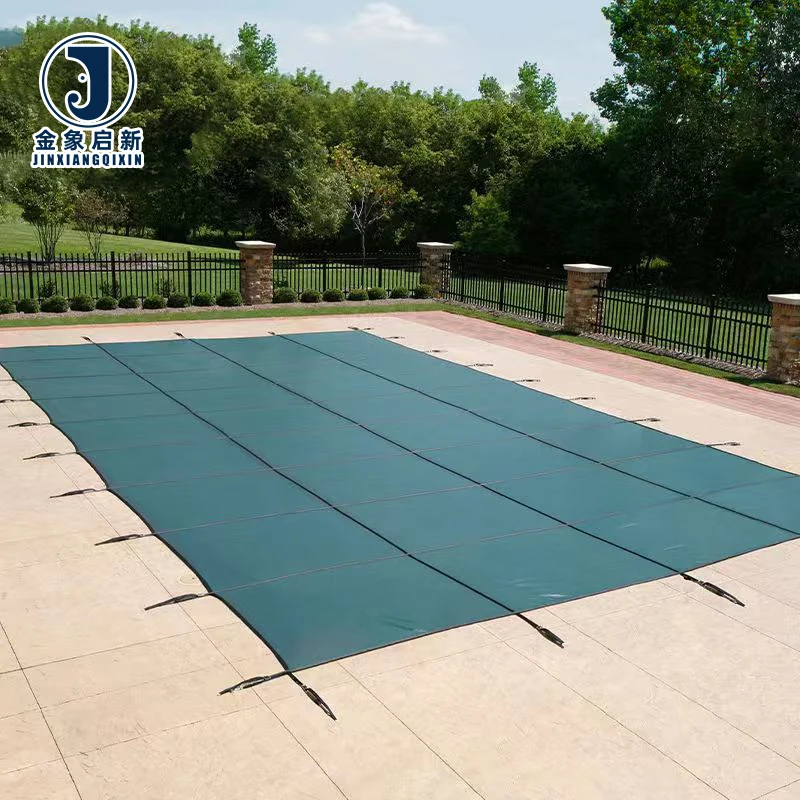
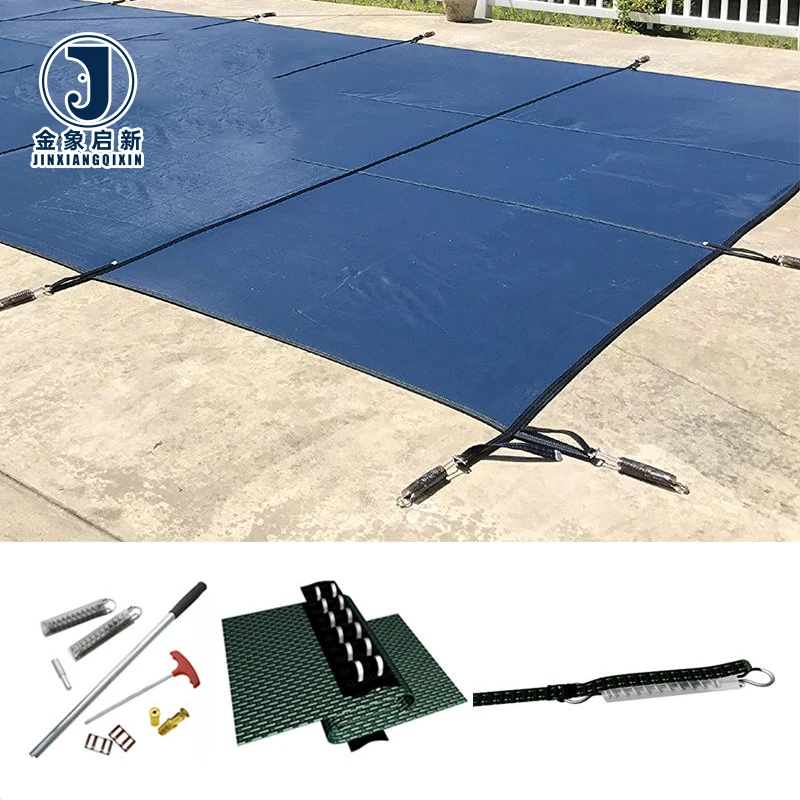
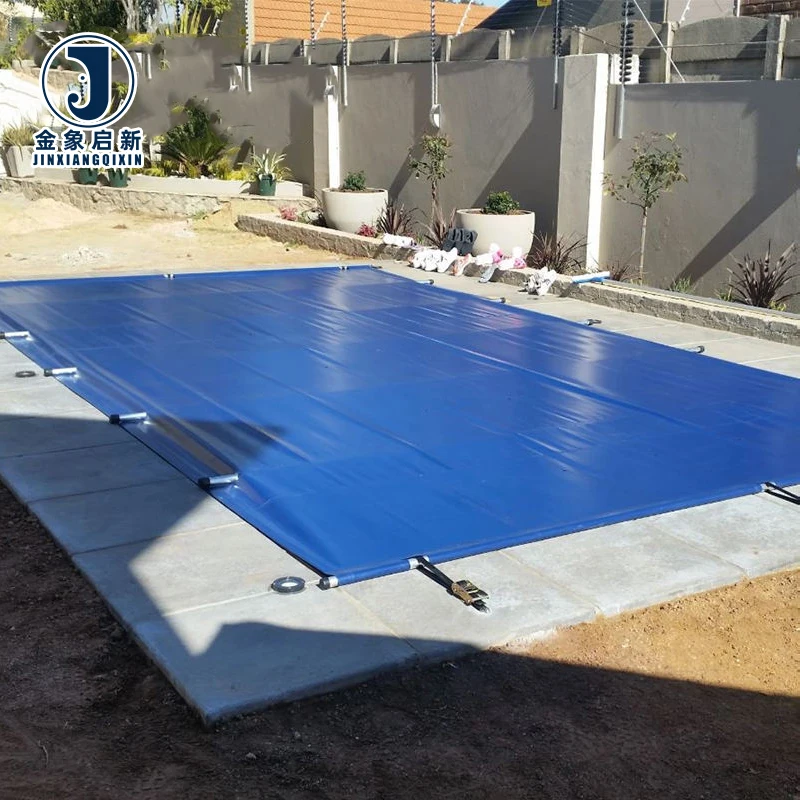
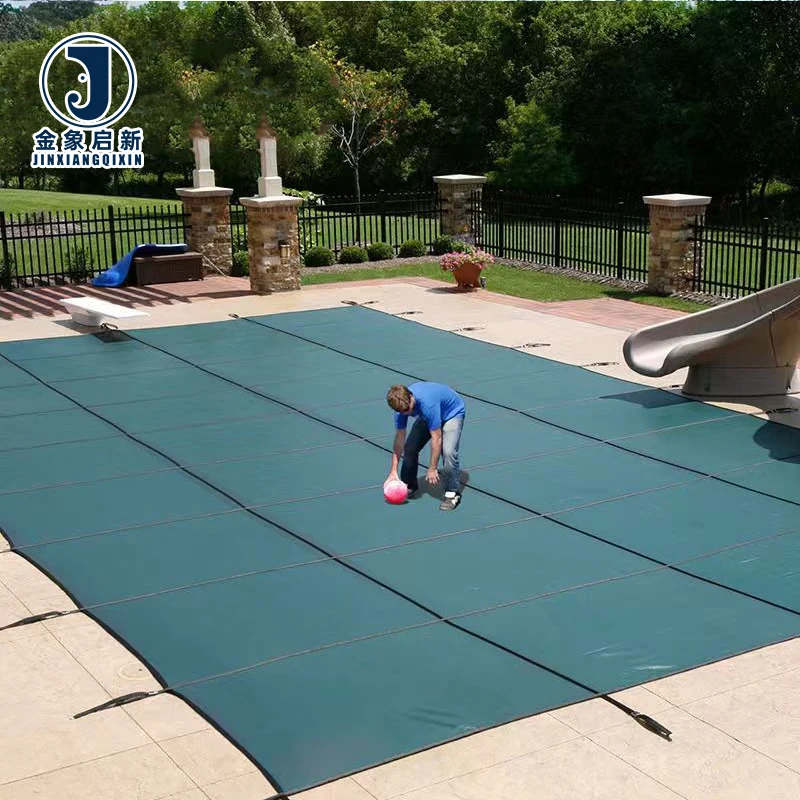
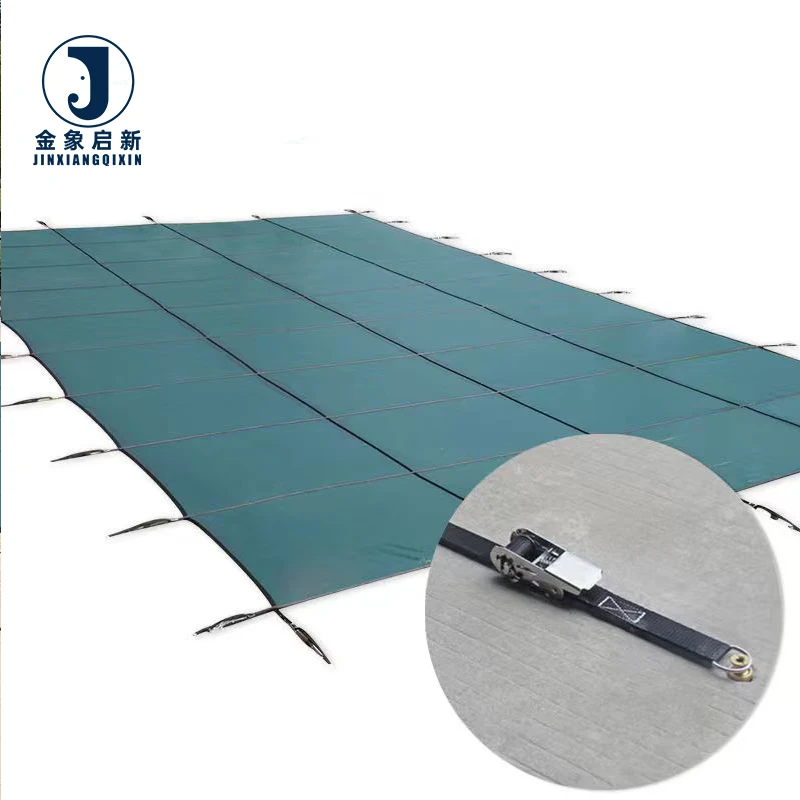
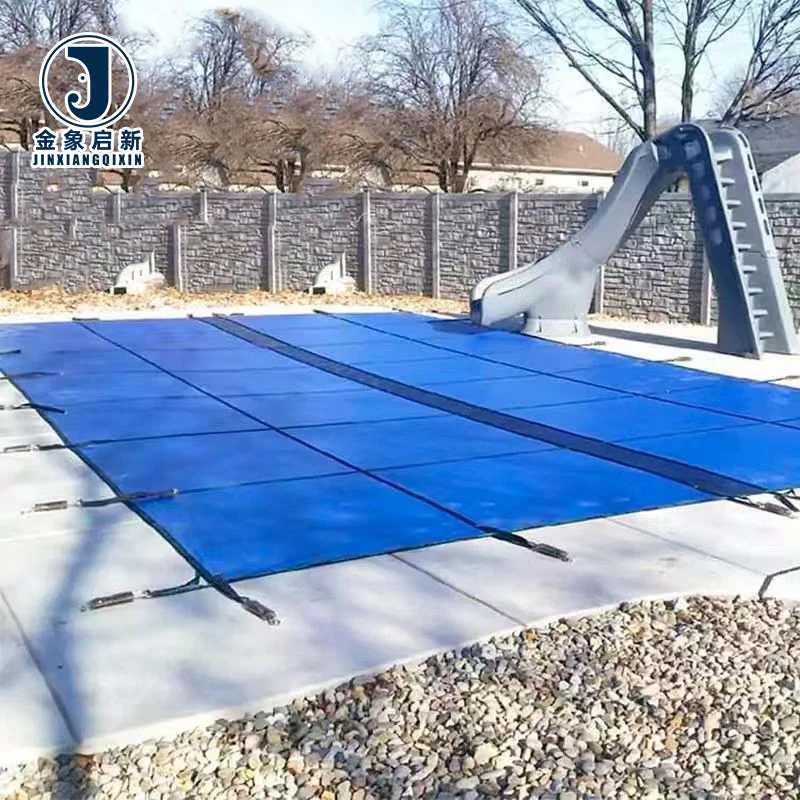
Integrated Pressing Construction — every PVC Pool Cover fire retardant certified panel is heat-welded as a single membrane, eliminating the stitched seams that leak and tear under seasonal tension.
Technical Specifications
| Parameter | Value |
|---|---|
| Product Type | PVC Coated Tarpaulin Pool Cover |
| Base Fabric | 500D-500D Polyester |
| Coating Material | PVC (both sides) |
| Construction Method | Integrated pressing (no stitching) |
| Weight Range | 450–900 g/m² |
| Water Resistance | Waterproof |
| Flame Retardant | Available in flame retardant grades — confirm the grade required for your market |
| Anti-UV | Available with anti-UV treatment — confirm test basis for your region |
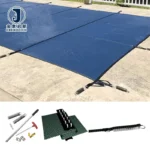
| Installation Option 1 | Brass anchoring system |
| Installation Option 2 | Aluminium battens with stainless steel hook, plate and ratchets |
| Installation Option 3 | Heavy-duty water tube loops every 4 ft |
| Standards Referenced | ISO, CE (documentation available per order) |
Application Suitability
| Application | Exposure & Requirement |
|---|---|
| Residential in-ground pool winter cover | Snow load, standing water, leaf debris, repeated seasonal tensioning |
| Commercial and resort pool safety barrier | High foot-traffic perimeter, regulatory fire safety compliance, daily inspection access |
| Pool service contractor seasonal deployment | Repeated installation and removal, abrasion against coping and deck hardware |
| Outdoor pool evaporation control | Continuous UV exposure, wind uplift, chemical splash from pool treatment |
Why Flame Retardant Certification Matters on a PVC Pool Cover
A flame retardant claim without a test certificate is a liability, not a feature.
When a commercial pool facility specifies a PVC Pool Cover fire retardant certified product, the procurement team often receives a quotation that says "flame retardant treated" with no standard reference. On site, the fire marshal asks for a certificate matching the local building code, and the cover sits uninstalled while the contractor chases paperwork [NEED_CITE: fire classification standards for outdoor membrane structures in commercial facilities]. I have seen project handovers delayed because the cover supplier could not produce a test report aligned with the destination market. The material itself may perform adequately, but without documentation the entire installation fails the compliance check.
Anchoring Systems That Match the Pool Edge Profile
Selecting the correct anchoring method is as important as the fabric itself. A brass anchoring system works well on concrete decks where flush-mount anchors can be drilled into the coping. For timber or composite decking, aluminium battens secured with stainless steel hooks and ratchets distribute tension across a wider area, preventing point loading that cracks the deck surface. Water tube loops provide a non-penetrating option for temporary seasonal covers on rental properties or heritage sites where drilling is restricted. Each PVC Pool Cover fire retardant certified panel can be configured with one of these three systems during fabrication.
Integrated Pressing and the Elimination of Stitch Lines
Traditional pool covers are sewn at the seams and then taped, creating a two-step failure path where thread degrades before the coating does. Integrated pressing bonds the PVC layers directly through heat and pressure, forming a continuous membrane with no needle holes. This matters most at the corners and anchor points where wind uplift concentrates force. A stitched seam under constant tension will wick water through the thread channel, eventually delaminating the coating from the base fabric [NEED_CITE: seam failure mechanisms in coated polyester fabrics under cyclic loading]. Pressed seams fail only when the fabric itself reaches its tensile limit, which shifts the weak point away from the joint.
Reading the Specification Sheet Beyond the GSM Number
The 450–900 g/m² weight range covers everything from a light seasonal cover to a heavy safety barrier. GSM alone does not determine strength — a 650 g/m² fabric woven from 500D-500D polyester with a tight weave will outperform a 750 g/m² fabric using lower-denier yarn with a looser construction, because tensile and tear resistance depend on yarn count and weave density working together. The PVC coating weight must also be considered: a thicker coating adds abrasion resistance and UV protection but increases stiffness, making the cover harder to fold and store. For in-ground pools that experience winter snow load, a mid-range GSM with a high-density base fabric provides the best balance of strength and handling [NEED_CITE: relationship between base fabric denier and coated fabric tensile performance per ISO 1421]. Anti-UV and flame retardant treatments are applied at the coating stage, and their effectiveness depends on the coating method used.
What Happens When the Specification Is Wrong
Ordering a PVC Pool Cover fire retardant certified product without confirming the exact flame retardant grade for your market leads to one of two outcomes: the cover passes the local fire inspection but was over-specified and cost more than necessary, or it fails inspection and must be replaced before the pool opens. Colour inconsistency between rolls is another issue that surfaces only after installation — when two covers sit side by side on adjacent pools at a resort, a visible shade difference reflects poorly on the contractor. Weld failures at anchor points typically appear mid-season when the cover has been under sustained tension for several weeks, and by then the pool is already in use, making replacement disruptive [NEED_CITE: field reports of coated fabric seam separation under sustained tensile load].
Procurement Advantages at This Facility
Nearly 30 years of coating process control means the PVC adhesion to the 500D-500D polyester base is consistent from the first roll to the last in your order. Three full production lines and 36 sets of professional equipment support volume orders without compromising delivery schedules, which matters when a resort needs 20 covers before the winter shutdown. The 10-person R&D team develops samples within days for custom pool dimensions and anchoring configurations, so you can verify fit and hardware compatibility before committing to production. Dedicated QA and QC inspection at every production stage catches coating weight deviations and colour drift before they reach the packing line. Every PVC Pool Cover fire retardant certified shipment includes the documentation package your site requires, assembled before dispatch rather than chased after arrival.
Documentation & Verification
- Material specification sheet confirming base fabric denier, coating weight and colour reference per roll
- Flame retardant test report matched to destination market standard where applicable
- Anti-UV treatment documentation with test basis stated for the grade supplied
- Pre-shipment inspection record covering dimensional accuracy and hardware completeness
- Certificate of origin and customs documentation for cross-border delivery
- Roll packing list with individual roll weights and dimensions for container planning
Fabrication, Handling & Storage
- Heat-weld at temperatures suited to the PVC coating thickness; test a sample offcut before full production to confirm bond strength
- Store rolls horizontally on pallets to prevent permanent creasing across the 500D-500D base fabric
- Allow folded covers to acclimatise before unfolding in cold weather to avoid cracking the PVC coating
- Clean with mild detergent only; avoid solvents that attack the PVC surface treatment layer
- Inspect brass anchors and ratchet hardware after each season for corrosion and replace worn components
What We Need From Your Inquiry
Send us the exact pool dimensions including any step-outs, tanning ledges or irregular corners so we can calculate the cover size and anchor spacing. Specify which anchoring system suits your deck construction and whether you need a flame retardant grade to meet a particular local standard. Let us know the quantity, colour preference and whether you require samples before full production.
Frequently Asked Questions
Q: What flame retardant grades can you supply for pool covers?
A: We offer PVC Pool Cover fire retardant certified options in multiple grades. The correct grade depends on your local fire safety regulation and the authority having jurisdiction. Send us the standard reference required at your site, and we will match the treatment and provide the corresponding test report with your shipment documentation.
Q: How do I measure my in-ground pool for a custom cover?
A: Measure the longest and widest points of the water surface, then add the required overlap for your chosen anchoring system. For irregular shapes, provide a diagram with all radii and step-out dimensions. Our R&D team will return a cutting layout for your approval before production begins.
Q: Can you provide UV and flame retardant test reports?
A: Yes. Every treated grade ships with a test report stating the standard used and the result achieved. We provide these before dispatch so your compliance paperwork is ready when the cover arrives on site. Confirm the specific standard your market requires at inquiry stage.
Q: What lead time should I expect for custom-sized covers?
A: Custom sizing involves pattern development, sample confirmation and production scheduling. Typical multi-week lead times apply, with exact timing depending on order volume and colour specifications. We provide a confirmed delivery date at quotation stage so you can plan your seasonal installation window.
Q: How do PVC covers compare to PE tarpaulins for pool winterisation?
A: PVC coated polyester with integrated pressing construction delivers substantially higher tear resistance and seam integrity than PE tarpaulin. The PVC coating also provides better long-term UV and chemical resistance, making it suited to extended outdoor exposure over multiple seasons of installation and removal.