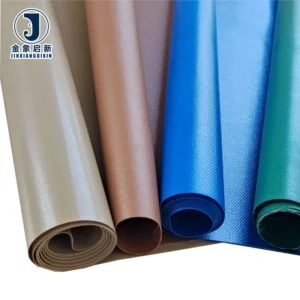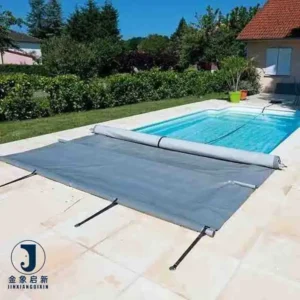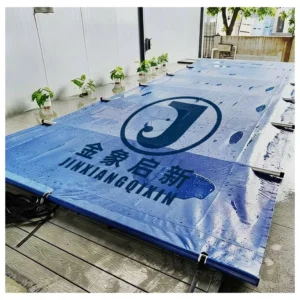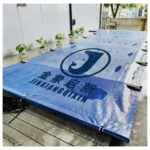
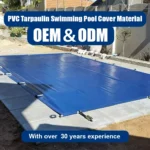
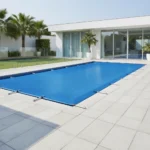
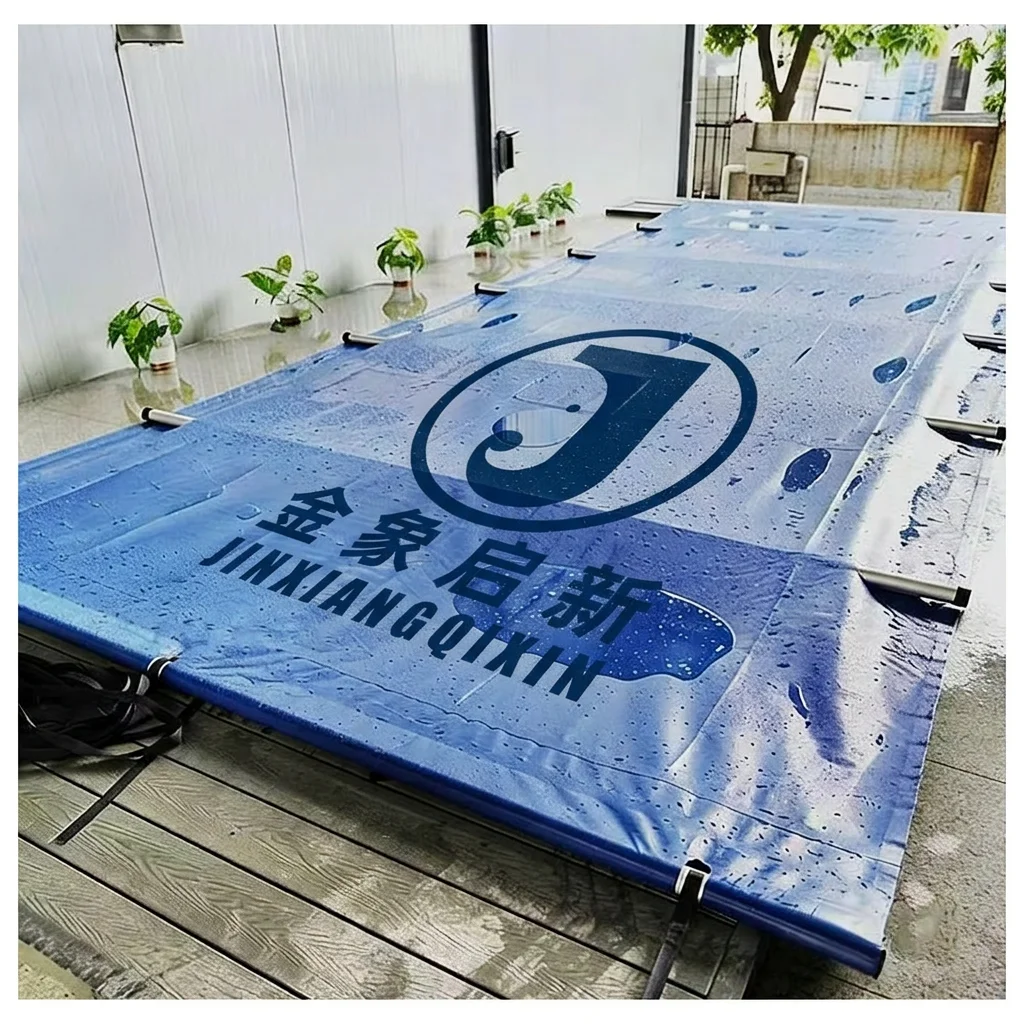
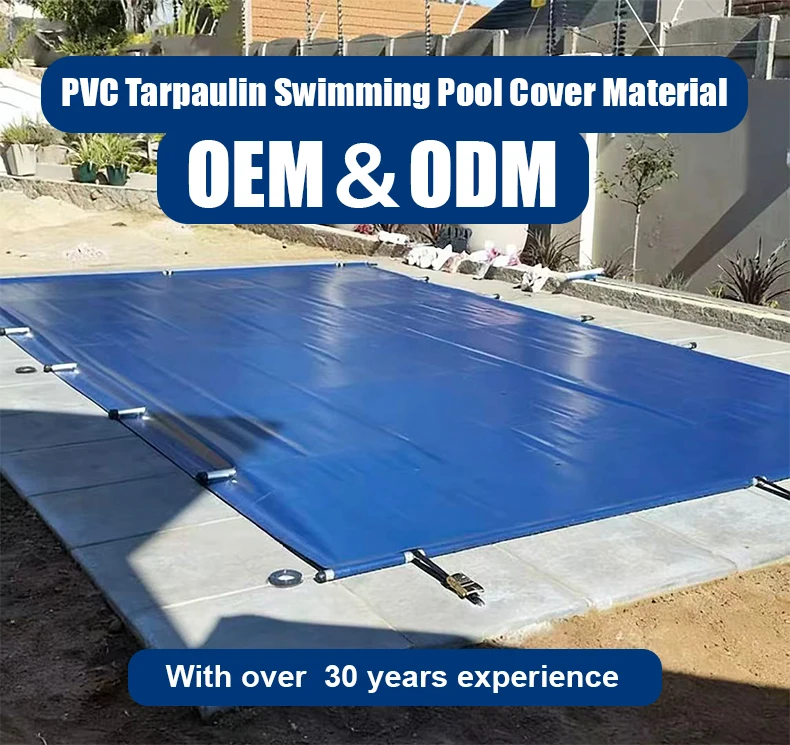
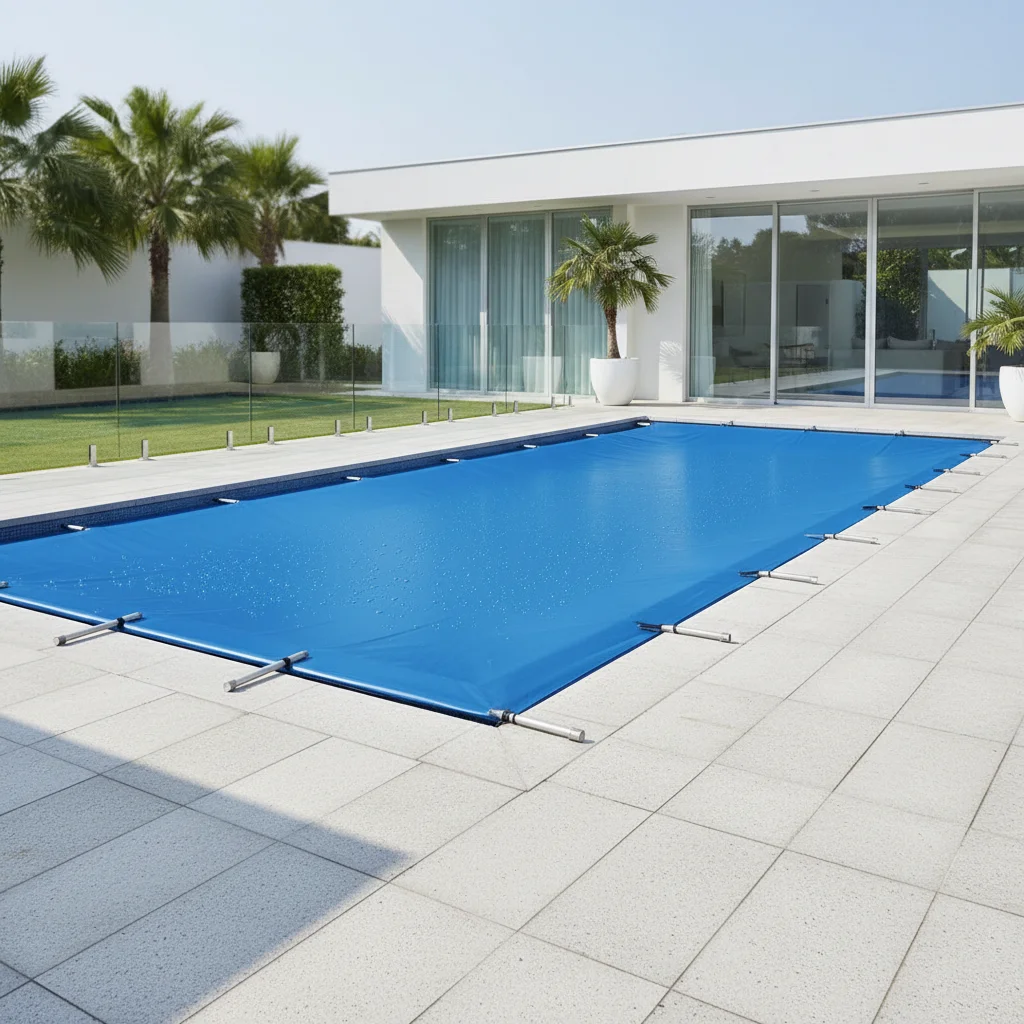
Process-Controlled Coating — Every roll of PVC tarpaulin swimming pool cover material undergoes stage-gated QA with 100% pre-shipment inspection, ensuring GSM, adhesion and colour match the specification sheet before it leaves the line.
Technical Specifications
| Parameter | Value |
|---|---|
| Product Type | PVC Tarpaulin Swimming Pool Cover Material |
| Coating Material | PVC (knife coated) |
| Weight (GSM) | 50gr/m² ~ 220gr/m² available — confirm the grade for your application |
| Total Thickness | 0.2-0.4mm / 8 mil-16 mil / Custom |
| Color Options | Blue, Blue/Orange, Green, Grey, Black, Clear, Grey/Green, Orange, or custom |
| UV Treatment | Anti-UV available — test basis available on request |
| Waterproof | Fully waterproof coated construction |
| Mildew Resistance | Mildew proof and anti-aging (test basis not stated) |
| Flame Retardant | Available in flame retardant grades — confirm the grade required for your market |
| Anti-Static | Available on request — confirm certification required for your facility |
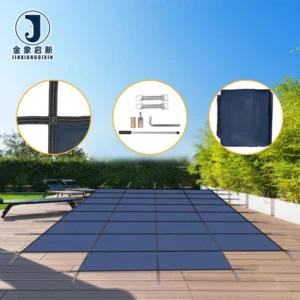
| Hardware Compatibility | Brass anchor, triangular hook, ratchet system, aluminium poles |
| Operation Mode | Manual or motorized winders |
| Attachment System | Self-sinking stainless steel connections at six points |
| Manufacturing Standards | ISO9001, ISO14001, ISO45001, CE |
Application Suitability
| Application | Exposure & Requirement |
|---|---|
| Residential solid pool covers | Year-round UV exposure, pool chemical splash, debris loading, wind uplift tension |
| Commercial aquatic facility covers | High-frequency deployment and retraction, regulatory compliance, heavy foot-traffic zone proximity |
| Pool cover OEM roll stock | Batch-to-batch colour and GSM consistency across production runs, hardware integration at fabrication stage |
| Seasonal winterization covers | Freeze-thaw cycling, standing water and snow load, extended low-temperature flexibility |
| Specialist leisure structure covers | Fire-retardant compliance for enclosed leisure environments, membrane tension and anchorage loads |
Why PVC Pool Cover Material Fire Retardant Anti-Static Certified Matters More Than a Data Sheet Claim
A certificate only protects you if the grade matches the regulation your local authority enforces.
Buyers sourcing PVC pool cover material fire retardant anti-static certified often discover after delivery that the flame-retardant grade supplied does not satisfy the fire code their leisure facility must comply with. The fabric arrives with a generic test report, but the inspector on site asks for classification against a specific standard — and the paperwork does not align. This is not a supplier issue in isolation; it is a specification gap that surfaces only at the compliance checkpoint. [NEED_CITE: fire classification standards for leisure facility textiles vary by jurisdiction]
The same pattern appears with anti-static requirements. A ventilation-adjacent pool environment or an indoor aquatic centre with sensitive electronic monitoring equipment may require verified anti-static performance, yet the material arrives without the test method the safety auditor recognises. Procurement teams then face the choice of accepting a compliance risk or rejecting a full container of fabric mid-project.
Knife Coated Construction and Pool Cover Durability
The PVC tarpaulin swimming pool cover material is produced through knife coating, where PVC compound is applied directly onto the base fabric under controlled tension and temperature. This process delivers consistent coating weight across the full width of the roll, which directly influences how the cover behaves under sustained water pooling and debris loading. Knife coated PVC maintains adhesion between coating and base fabric through seasonal temperature swings — a critical factor when the cover transitions from summer heat to winter freeze cycles.
For pool cover fabricators, the uniformity of the knife coated surface also determines how cleanly the material cuts, how reliably it accepts high-frequency welding, and how evenly hardware attachment points distribute stress. Inconsistent coating thickness creates weak zones where anchor points concentrate load, leading to premature tearing at the brass anchor or ratchet connection points.
Consistency Across Rolls for Production-Scale Fabrication
When a pool cover manufacturer sources multiple rolls for a production run, colour variation between rolls becomes visible once the covers are installed side by side on adjacent pools. This is particularly acute in neutral tones like grey and green, where even slight batch differences register clearly in daylight. Our R&D team develops samples within days and locks colour references before production begins, so the shade approved at sampling stage is the shade delivered across every roll in the order.
Coating weight consistency matters equally. A roll that measures lighter than the quoted GSM may still pass a casual visual check but will underperform in tear resistance and puncture tolerance. [NEED_CITE: relationship between coating weight variance and tensile performance in coated technical fabrics] Every roll undergoes 100% inspection before dispatch, with GSM and coating adhesion verified against the material specification sheet — not just at first article stage but across the full batch.
How Base Fabric, Coating Weight and Thickness Interact in Pool Cover Performance
The relationship between GSM, base fabric density and total thickness determines how the PVC pool cover material behaves under real-world loads. GSM alone is an incomplete indicator: a 220gr/m² fabric with a loose base weave may tear more easily than a lighter fabric with a tighter construction and well-distributed coating. The base fabric denier and thread count govern how the material resists tear propagation once a puncture or cut initiates — critical when the cover is dragged across rough pool coping or subjected to sharp debris impact.
Total thickness in the 0.2-0.4mm range influences both flexibility and stiffness. Thinner grades drape more easily over pool contours and suit motorized winder systems where the cover must spool tightly. Heavier, thicker grades provide greater puncture resistance for solid covers that must support snow load or occasional foot traffic during maintenance. The knife coating process allows the PVC compound to penetrate the base fabric weave, creating mechanical interlock that improves peel strength — essential when welded seams carry tension from ratchet systems and brass anchors.
Surface finish also plays a functional role. A gloss finish sheds standing water and debris more readily, reducing the cleaning burden on commercial pool operators. A matte finish reduces glare in residential settings and can improve grip during manual deployment.
The Cost of Overlooking Specification Verification Before Shipment
Accepting a container of pool cover fabric without confirming GSM, colour reference and treatment documentation at pre-shipment stage creates downstream problems that compound quickly. A colour mismatch discovered after fabrication means the finished covers cannot be sold to the client who specified an exact shade — the entire batch may need re-dyeing or replacement. A flame-retardant grade that does not match the local fire code means the leisure facility cannot obtain its operating certificate, and the cover fabricator carries liability. [NEED_CITE: pre-shipment inspection protocols for coated technical fabrics]
Hardware compatibility failures surface later still. If the fabric stiffness or thickness does not match the winder mechanism tolerances, the cover jams during motorized retraction or fails to seat properly in the aluminium pole support structure. These are not material defects — they are specification mismatches that a thorough pre-shipment verification process catches before the rolls leave the factory.
What Distinguishes This Supply Source for Technical Pool Cover Fabric
Deep process control over coating weight and adhesion comes from nearly 30 years of continuous PVC coated fabric production, giving this PVC pool cover material fire retardant anti-static certified supply chain a foundation that newer producers cannot replicate quickly. Three full production lines and 36 sets of professional equipment support bulk roll output while maintaining the coating consistency that pool cover fabricators depend on.
A dedicated 10-person R&D team handles material selection, custom sizing, colour matching and sample development — samples are typically ready within days rather than weeks. ISO9001, ISO14001, ISO45001 and CE certifications are maintained as active quality management systems, not static wall certificates. Every order ships with a complete documentation package traceable from coating batch to finished roll.
Documentation & Verification
- Material specification sheet stating GSM, base fabric type, coating method and colour reference per roll
- UV treatment test report available where applicable to support outdoor exposure claims
- Fire-retardant and anti-static test documentation matched to the grade specified on the purchase order
- Pre-shipment inspection record confirming 100% inspection with GSM and coating weight verification
- ISO9001, ISO14001, ISO45001 and CE certificates included in the shipment documentation package
- Certificate of origin and customs support documentation for cross-border logistics
Fabrication, Handling & Storage
- High-frequency welding parameters should be calibrated to the specific PVC coating thickness before production runs begin
- Brass anchor and ratchet attachment points require reinforced hem folds to distribute load across the base fabric weave
- Store rolls horizontally on flat racking to prevent permanent creasing in the 0.2-0.4mm coating layer
- Allow cold-stored rolls to acclimatise to workshop temperature before unrolling to avoid coating crack at low flexibility
- Cut patterns should account for fabric width to minimise off-cuts and maximise yield per roll
- Clean finished covers with neutral pH detergent to preserve the anti-UV treatment integrity in the PVC surface
Request a Specification Proposal
To move from inquiry to sample stage, provide the target pool dimensions or cover fabrication method, the climate zone and UV exposure profile, and any fire-retardant or anti-static grades your local authority requires. Specify whether you need roll stock in standard widths for your own cutting line or custom widths to reduce waste, along with annual volume estimates and colour references. If hardware integration is part of your assembly process, share the winder type and anchor system so the fabric stiffness and thickness can be matched accordingly.
Frequently Asked Questions
Q: How is GSM verified before shipment and what does the inspection record include?
A: Every roll is weighed and measured against the stated GSM during the 100% pre-shipment inspection. The inspection record documents actual GSM readings, coating adhesion checks, colour reference comparison and visual defect screening. This record ships with the documentation package so you can cross-check on arrival without relying on the quotation alone.
Q: What UV treatment test basis is available for outdoor pool cover exposure?
A: UV treatment is integrated into the coating formulation and a test report is available on request. The report documents the test method and exposure duration used. We recommend specifying the UV performance standard your end-market requires so the correct treatment grade is selected before production begins.
Q: Can the fabric carry fire-retardant certification for regulated leisure facilities?
A: Flame-retardant grades are available, and the specific classification must match the fire code enforced at the installation site. Confirm the standard your authority requires — such as a national or regional building material classification — at inquiry stage so the correct grade and corresponding test documentation are included with your shipment.
Q: How is roll-to-roll colour and coating consistency controlled across a single order?
A: Colour references are locked at the sample approval stage, and every subsequent roll in the production run is compared against that reference during in-process QA. Coating weight is monitored continuously on the production line and verified again at final inspection, ensuring uniformity across all rolls in your order.