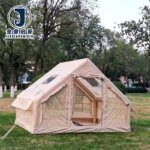
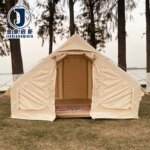
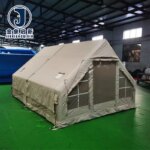

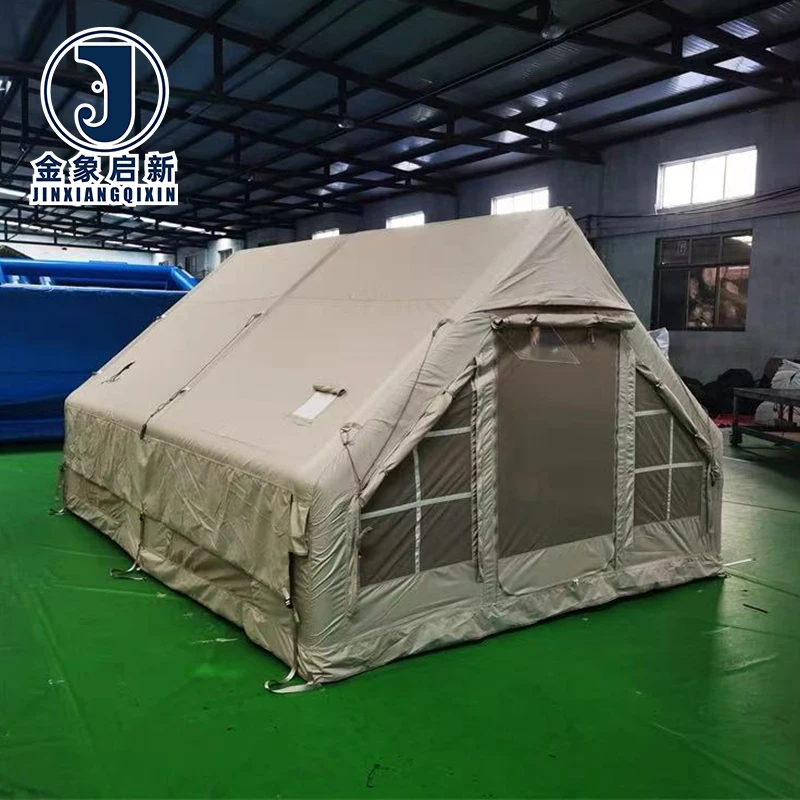
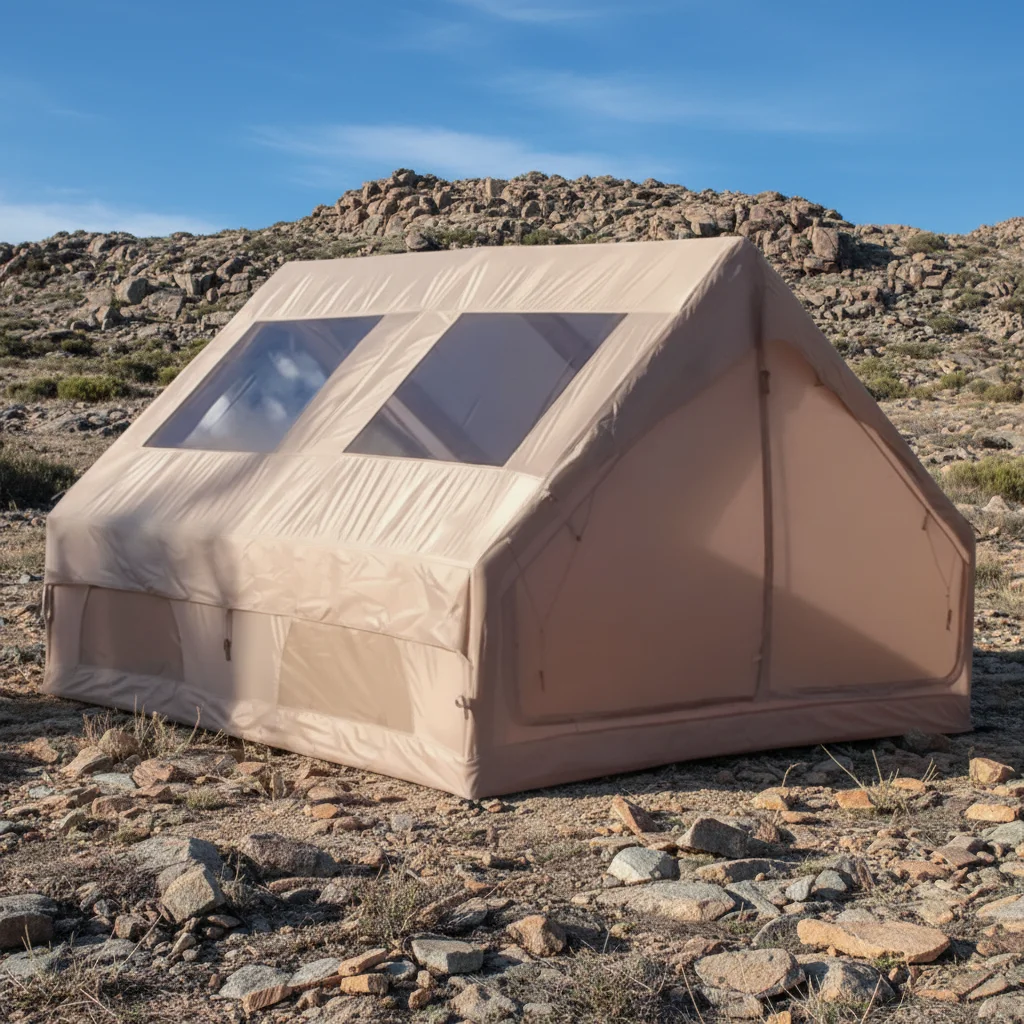
Technical Fabric Authority — nearly three decades of coated fabric engineering applied to inflatable and membrane structure applications, with full in-house customization from base fabric selection to finished roll dispatch.
Technical Specifications
| Parameter | Value |
|---|---|
| Product Type | Inflatable Tent Fabric |
| Core Material | PVC waterproof fabric |
| Key Performance | Waterproof, UV-resistant (test basis not stated), tear-resistant |
| Product Forms | Automatic opening, four-season design, single layer construction, extended type |
| Customization | OEM & ODM customization, sample customization, pattern printing |
| Standards | ISO9001, ISO14001, ISO45001, CE |
| R&D Capability | 10 technicians supporting specification development |
| Production Facility | 3 full production lines, 36 sets of processing equipment |
Application Suitability
| Application | Exposure & Requirement |
|---|---|
| Disaster relief operations | Rapid deployment, unpredictable weather, transport over rough terrain |
| Temporary storage facilities | Continuous UV exposure, wind load on inflated structure, abrasion from stored goods |
| Construction site shelters | Dust, debris impact, repeated inflation-deflation cycles |
| Emergency response centers | Immediate weather protection, high-visibility requirements, frequent relocation |
| Industrial emergency preparedness | Long-term storage followed by instant deployment, compliance documentation |
Why Inflatable Shelter Fabric Fails When Certifications Are Missing
Certified material with complete documentation eliminates compliance risk at the project level.
Sourcing inflatable tent fabric for industrial emergency applications often means the buyer receives a material data sheet that claims performance without linking it to a test method or grade. A fabric described as UV-resistant without a stated test basis leaves the buyer uncertain whether it will maintain structural integrity through a full season of sun exposure on a remote mining site. [NEED_CITE: ISO 1421 tensile and tear test methods for coated fabrics]
When emergency response coordinators specify shelters for disaster relief or construction contractors require temporary operational space, the absence of verifiable test reports creates a gap between what was ordered and what arrives. Batch-to-batch inconsistency in coating weight or colour compounds the problem when multiple units are deployed side by side on a single project site.
Coating Integrity for Inflatable Structure Performance
The PVC waterproof fabric base used in this Inflatable Tent Fabric for Industrial Emergency delivers a fully sealed coating layer that prevents water penetration during sustained rainfall or humid conditions typical of disaster relief scenarios. The single-layer construction reduces overall weight for transport while maintaining the coated barrier necessary for reliable waterproof performance in field conditions.
Four-season design considerations require the material to remain flexible in cold temperatures and stable under high heat, characteristics governed by the plasticiser formulation within the PVC coating. The automatic opening mechanism depends on consistent fabric stiffness across the entire roll, making batch-level coating uniformity a functional requirement rather than a cosmetic one.
Weld Seam Behaviour Under Inflation Pressure
Inflatable structures concentrate stress at welded seams every time the unit is pressurised, and those seams must match or exceed the base fabric strength. The tear-resistant construction of this material supports seam integrity during inflation cycles, though the specific tear test method should be confirmed for your application requirements. [NEED_CITE: welded seam strength testing for PVC coated fabrics per ISO 1421]
Pattern printing and OEM customization are handled by the 10-person R&D team, allowing project-specific branding and dimensional modifications without compromising the underlying coated fabric performance. Each custom specification undergoes sample development before full production runs begin.
Reading the Specification Sheet Beyond Marketing Claims
Waterproof performance in PVC coated fabrics depends on coating continuity and adhesion to the base fabric, not simply the presence of a PVC layer. Knife-coated applications typically achieve superior adhesion compared to laminated alternatives, directly influencing how the material behaves at welded seams during inflation. UV-resistant treatment requires verification through a stated test method to confirm the fabric will resist degradation across seasonal temperature fluctuations — always request the test basis for your market. [NEED_CITE: UV degradation testing standards for PVC coated textiles]
Tear resistance is governed by the base fabric denier and weave density working together with the coating weight. A heavier coating does not automatically deliver higher tear strength if the underlying scrim is loosely woven. Understanding this relationship helps buyers evaluate quotations on material science rather than GSM alone.
The Cost of Specification Mismatches in Emergency Deployment
Ordering inflatable tent fabric without verifying batch-to-batch colour consistency leads to visible variation once multiple shelters are erected on the same site, requiring partial replacement or complete reorder. When UV treatment is claimed without a test report, the fabric may degrade faster than expected under continuous sun exposure, compromising the structure during a critical operational window. [NEED_CITE: field failure analysis of PVC coated fabrics in temporary structures]
Welded seams that fail before the fabric itself indicate a mismatch between the coating formulation and the heat-sealing parameters used during fabrication. This failure mode is particularly dangerous in inflatable applications where seam integrity directly determines structural stability under wind load and internal pressure.
What This Manufacturer Brings to Technical Fabric Projects
Three full production lines and 36 sets of professional processing equipment provide the capacity to fulfil large-volume orders for Inflatable Tent Fabric for Industrial Emergency without splitting production across external facilities. This keeps coating parameters consistent from first roll to last within a single batch.
A dedicated 10-person R&D team handles material selection, pattern printing, custom sizing, and sample development entirely in-house, reducing the communication gaps that arise when design and production are separated. Strict full-process quality inspection with dedicated QA and QC staff on site means every roll is examined before dispatch, not just sampled.
ISO9001, ISO14001, ISO45001, and CE certifications are maintained across the production system, providing the documentation trail that mining, tunnelling, and emergency response contractors require for project compliance. Samples for custom specifications are developed within days, allowing buyers to verify material properties before committing to production volumes.
Documentation & Verification
- Material specification sheet stating base fabric type, coating method, and waterproof rating per batch
- Test reports for UV resistance and tear strength provided on request with order documentation
- ISO9001, ISO14001, ISO45001, and CE certificates included with every shipment
- Pre-shipment inflation testing and 100% inspection record provided before dispatch
- Roll packing list with batch identification for full traceability
Fabrication, Handling & Storage
- Heat-seal temperature and dwell time must be calibrated to the PVC coating formulation for reliable seam strength
- Single-layer construction requires careful handling during fabrication to avoid surface scoring before welding
- Store rolls horizontally on padded racks to prevent permanent creasing in the PVC coated surface
- Allow fabric to acclimatise to ambient temperature before unrolling in cold conditions to avoid coating stiffness cracks
- Use only PVC-compatible cleaning agents to preserve the waterproof coating layer and UV treatment
Project Specification Inquiry
Provide the intended application scenario and environmental exposure conditions so the R&D team can recommend the appropriate material grade and construction. Specify any fire safety or compliance requirements for your target market, along with dimensional needs and whether pattern printing or custom colour matching is required.
Confirm whether you need finished fabricated units or roll stock for your own production line, and indicate your estimated annual volume to determine the most efficient production scheduling. Sample approval is recommended before full production to verify material properties match your project specifications.
Frequently Asked Questions
Q: What certifications and compliance documentation accompany inflatable tent fabric shipments?
A: Each shipment includes ISO9001, ISO14001, ISO45001, and CE certificates along with a material specification sheet detailing the base fabric, coating type, and waterproof rating. Test reports for UV resistance and tear strength are available on request. A pre-shipment inspection record and roll packing list with batch traceability are provided before dispatch.
Q: How is batch-to-batch colour and material consistency controlled across large orders?
A: All production runs for Inflatable Tent Fabric for Industrial Emergency are completed on the same production lines with dedicated QA and QC staff monitoring coating weight, colour, and adhesion at every stage. Rolls from a single order are kept within the same batch to ensure uniformity. Pre-shipment inspection compares rolls side by side before packing.
Q: What OEM customization options are available for dimensions, pattern printing, and material specifications?
A: The 10-person R&D team supports full OEM and ODM customization including custom sizing, pattern printing, and material specification modifications. Sample development is completed within days for buyer approval before production begins. Both single-layer and extended-type configurations can be adapted to project requirements.
Q: How are welded seams tested to ensure they withstand flex and inflation pressure?
A: Welded seams are inspected during the full-process quality control system with dedicated QA and QC staff on site. Pre-shipment inflation testing verifies seam integrity under pressurised conditions. Buyers should confirm the specific seam strength test method required for their application and market compliance standards.
Q: What is the sample development and approval process for custom inflatable structure fabric?
A: Once the buyer provides application details, dimensions, and any treatment requirements, the R&D team develops a sample within days. The buyer reviews and approves the sample before full production begins. This process ensures the material properties, colour, and construction meet project specifications prior to volume commitment.