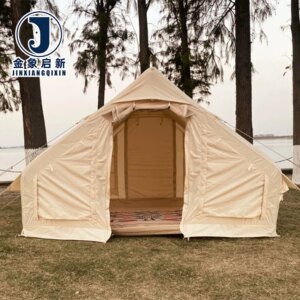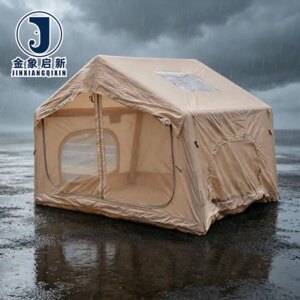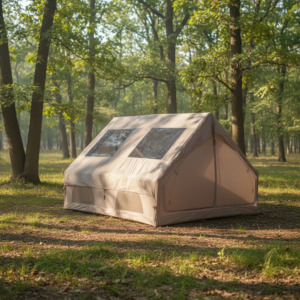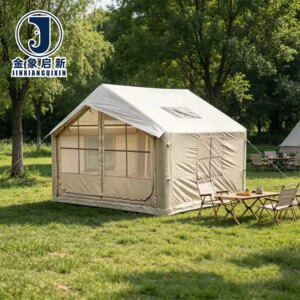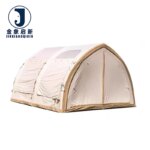
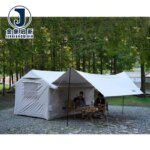
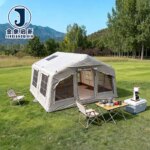
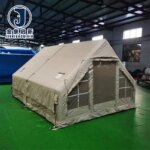

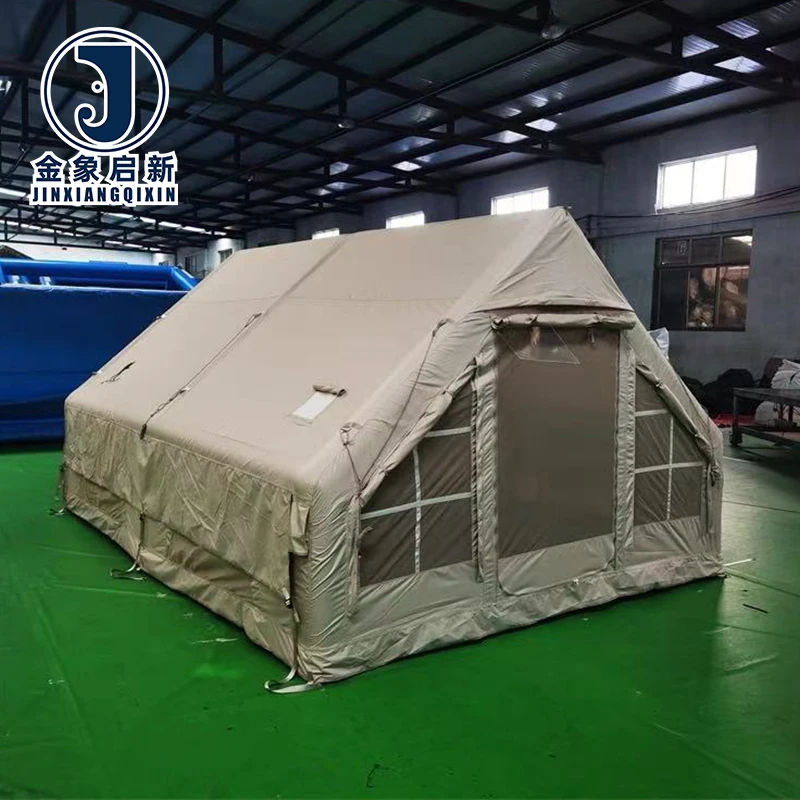
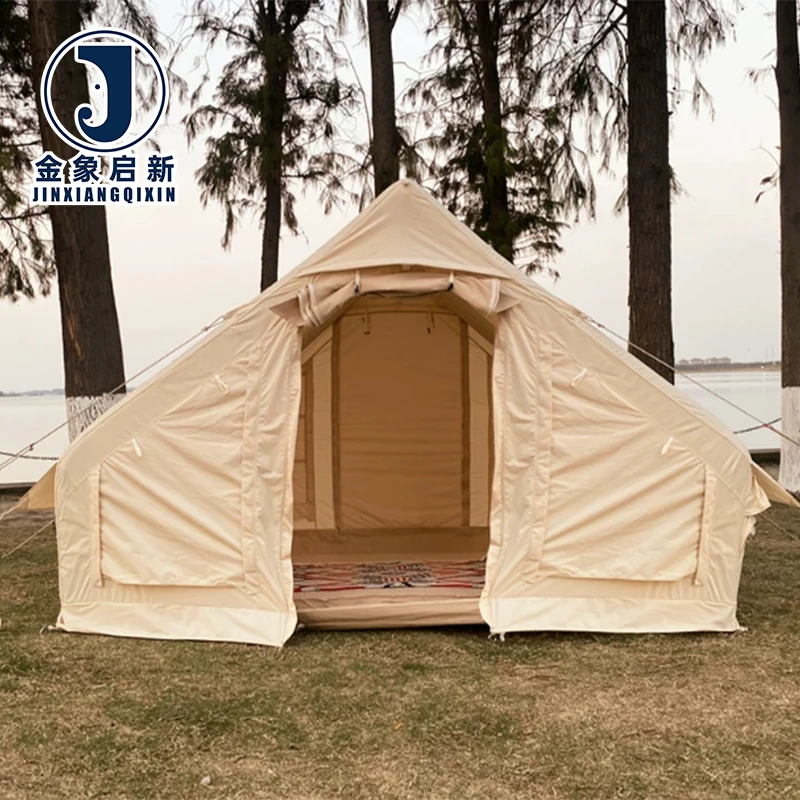
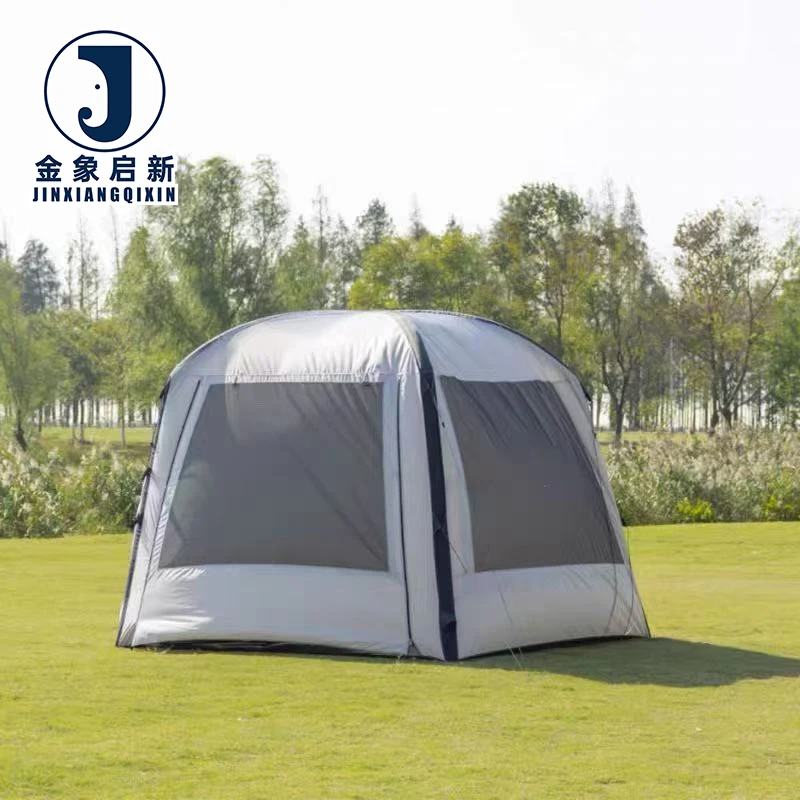
Coated Fabric Process Control — nearly three decades focused on PVC coating weight and adhesion, applied to inflatable tent fabric where airtight seam integrity and fire compliance define field safety.
Technical Specifications
| Parameter | Value |
|---|---|
| Product Type | Inflatable Tent |
| Core Material | PVC Tarpaulin |
| Product Forms | Single Layer Construction, Extended Type |
| Key Performance | Waterproof, UV-resistant, Tear-resistant, Fire-retardant (grade not stated in source), Anti-static (test basis not stated in source) |
| Customization | OEM & ODM, sample customization, pattern printing |
| Certifications | ISO9001, ISO14001, ISO45001, CE |
Application Suitability
| Application | Exposure & Requirement |
|---|---|
| Emergency disaster relief shelters | Rapid deployment, four-season weather exposure, fire safety compliance in crowded temporary housing |
| Construction site temporary shelters | Dust, debris impact, UV exposure, repeated inflation and deflation cycles |
| Mining and tunnelling inflatable enclosures | Fire-retardant and anti-static mandates, confined-space ventilation adjacency, abrasion from particulate-laden air |
| Aviation membrane structures | Static discharge control, wind load flexing, regulatory fire classification |
| Outdoor industrial event coverings | Large-span inflation, UV and rain exposure, branding and pattern printing on membrane surface |
Why Certification Gaps Put Inflatable Shelters at Risk on Site
Fire-retardant and anti-static inflatable tent fabric must ship with batch-traceable test documentation, not just a claim on the quotation.
Procurement teams sourcing inflatable membrane structures for mining, tunnelling, or disaster-relief deployment frequently receive material that states "fire retardant" on the invoice but arrives without a test report tied to the batch number. Safety officers on regulated sites reject the shipment, the deployment schedule slips, and the contractor absorbs the cost of air-freighting replacement material. Inflatable Tent Fabric fire retardant certified to a documented grade eliminates that rejection risk by pairing the coating chemistry with verifiable compliance paperwork [NEED_CITE: fire classification standards for temporary membrane structures].
The same pattern appears with anti-static requirements. Inflatable structures in aviation fuel zones or grain-handling environments must demonstrate surface resistivity within a defined range. Without a test certificate referencing the applicable standard, the fabric is functionally indistinguishable from a standard-grade PVC tarpaulin once the site auditor asks for proof.
Engineering the Membrane for Rapid Inflation and Structural Hold
Single-layer PVC inflatable tent construction balances portability against air-holding capacity. The coated fabric must maintain dimensional stability under internal pressure while remaining light enough for two-person carry and deployment. Our Inflatable Tent Fabric fire retardant certified for industrial use is engineered so that the coating weight and base fabric denier work together to resist stretching at the tube seams, which is where most air-loss failures originate in field conditions.
Extended-type designs push this balance further. Larger inflatable spans place continuous hoop stress on the tube walls, demanding consistent coating adhesion across the full roll width. Any weak point in the coating bond becomes a delamination origin under cyclic inflation.
Anti-Static and Fire-Retardant Coating Chemistry in Hazard Zones
In environments where combustible dust, flammable vapours, or high-voltage equipment are present, the inflatable membrane surface must dissipate electrostatic charge rather than accumulate it. Anti-static treatment integrated into the PVC coating layer addresses this requirement, though the specific surface resistivity range must be confirmed against your site safety standard before order placement. Fire-retardant treatment operates on a parallel track — the coating formulation must meet the flame-spread classification your local authority enforces for temporary structures, and that classification varies between jurisdictions [NEED_CITE: regional fire safety requirements for temporary inflatable enclosures].
How Base Fabric and Coating Weight Interact in Inflatable Applications
The tear resistance of an inflatable tent membrane depends on the interplay between base fabric denier, weave density, and coating penetration. A heavier coating does not automatically deliver higher tear strength if the base fabric uses a loose weave that allows the coating to crack under flex. Conversely, a tightly woven high-denier base with insufficient coating penetration will fray at cut edges during fabrication. For inflatable tent applications, the coating must penetrate the weave fully to lock the yarns in place, preventing the micro-movements that initiate tear propagation at the inflation tube bend points.
Surface finish also plays a role in field maintenance. Glossy surfaces shed dust and water more readily, which matters for inflatable shelters deployed in muddy disaster-relief zones, while matte finishes reduce glare in aviation-adjacent applications. Available surface finishes should be confirmed at sample stage.
The Cost of Specifying the Wrong Inflatable Membrane Grade
When an inflatable shelter fails at the weld line during inflation testing, the root cause is often a mismatch between the thermal properties of the PVC coating and the welding parameters used on the fabrication floor. A coating formulated for general-purpose tarpaulin use may require different heat input than one engineered for inflatable membrane construction, and applying standard hot-air weld settings can produce a bond that passes initial inspection but separates under sustained internal pressure [NEED_CITE: thermal welding parameters for PVC coated fabrics in inflatable applications].
Batch-to-batch colour variation is another hidden cost. If a disaster-relief contract requires twenty identical inflatable shelters and the rolls arrive in slightly different shades, the visual inconsistency undermines the professional appearance of the deployed camp and can trigger a rejection from the contracting agency.
What Distinguishes This Inflatable Fabric Supply Chain
Deep process control over coating weight and adhesion means the PVC layer is applied to the base fabric under monitored conditions, reducing the variation that causes weld failures in finished inflatable structures.
Three full production lines and dedicated processing equipment support bulk roll output with consistent coating thickness across the run, which is essential when a single inflatable tent order consumes multiple rolls that must perform identically.
A ten-technician R&D team handles material selection and sample development specific to inflatable membrane requirements, including pattern printing and custom sizing, so that the fabric you approve at sample stage matches production output.
Dedicated QA/QC staff inspect every production stage with full pre-shipment verification, catching coating adhesion defects and surface irregularities before the rolls leave the facility.
ISO9001, ISO14001, ISO45001, and CE certification frameworks structure the quality and environmental management systems that govern how this Inflatable Tent Fabric fire retardant certified material is produced and documented.
Documentation & Verification
- Material specification sheet covering PVC coating composition, base fabric denier, and performance parameters for inflatable membrane use
- Fire-retardant test report linked to batch number, available for submission to site safety officers
- Anti-static surface resistivity documentation provided upon request with the applicable test standard referenced
- Pre-shipment inspection record covering coating adhesion, surface quality, and dimensional accuracy per roll
- ISO9001, ISO14001, ISO45001, and CE certificates available for compliance filing
- Certificate of origin and customs documentation supporting international shipment of inflatable fabric rolls
Fabrication, Handling & Storage
- Hot-air welding temperature and speed must be calibrated to the specific PVC coating formulation used on this inflatable membrane fabric
- Cut edges should be sealed immediately after fabrication to prevent base fabric yarn fraying at inflation tube junctions
- Rolls should be stored upright on pallets in a shaded, ventilated area to prevent flat-spot deformation of the coating layer
- Low-temperature transport requires careful handling as PVC inflatable fabric becomes stiffer and more prone to crease damage below freezing
- Surface cleaning should use mild detergent only; solvent-based cleaners can degrade the fire-retardant and anti-static coating additives
- Pattern printing areas require compatible ink systems confirmed at sample stage to ensure adhesion to the treated PVC surface
Structuring Your Inflatable Fabric Inquiry
To move from general specification to a firm quotation, share the deployment environment — mining site, disaster-relief zone, aviation perimeter — along with the fire classification and anti-static standard your authority enforces. Specify the inflatable tube diameter and overall structure dimensions so the correct base fabric denier and coating weight can be selected. If pattern printing or branded panels are required, provide artwork at inquiry stage to confirm print feasibility on the chosen surface finish. State your target roll width and total metreage, and indicate whether pre-production samples are needed before bulk release.
Frequently Asked Questions
Q: How do you verify the fire-retardant grade of this inflatable tent fabric?
A: Each production batch is tested against the fire classification standard relevant to your market, and the test report is issued with the batch number. We provide the documentation at shipment so your site safety team can cross-reference the roll labels against the certificate. Confirm your required grade at inquiry stage so the correct coating formulation is selected.
Q: Can I get anti-static documentation for site compliance audits?
A: Yes. Anti-static surface resistivity test results are available upon request, referencing the applicable standard. Because requirements differ between aviation, mining, and grain-handling environments, we ask you to specify your compliance standard early in the inquiry so the coating formulation is matched to your site’s acceptable resistivity range.
Q: What is the sample process for custom inflatable tent specifications?
A: We develop pre-production samples reflecting your requested coating weight, colour, surface finish, and any pattern printing requirements. Samples ship within days of specification confirmation. You evaluate the sample for weld compatibility, inflation behaviour, and visual appearance before authorizing mass production, ensuring the bulk order matches your approved reference.
Q: How do you ensure batch-to-batch consistency across a large inflatable fabric order?
A: Coating weight, colour, and surface finish are monitored at each production stage by dedicated QA/QC staff. Pre-shipment inspection covers every roll against the approved sample. If your order spans multiple production runs, we maintain reference samples from each run to verify that the inflatable membrane material performs identically throughout the shipment.
Q: What lead time should I plan for a customized inflatable fabric order?
A: Lead time depends on the customization scope — standard grades in stock widths ship faster, while custom colours, pattern printing, or non-standard widths require dedicated production scheduling. We confirm the timeline at quotation stage after reviewing your specification. Requesting samples adds a short pre-production phase but prevents costly mismatches in bulk output.