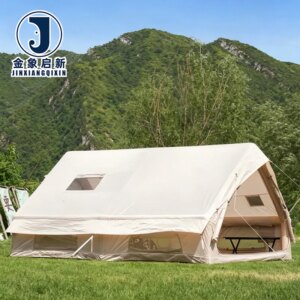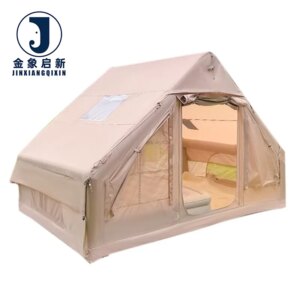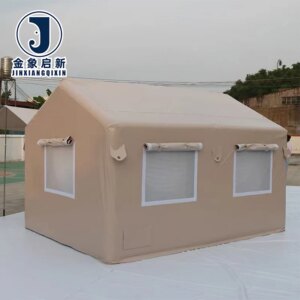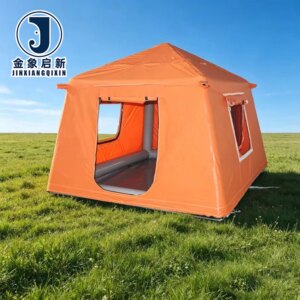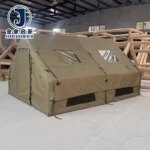
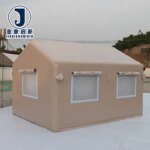
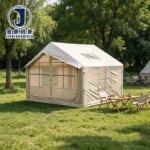
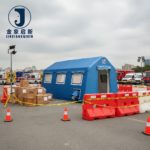
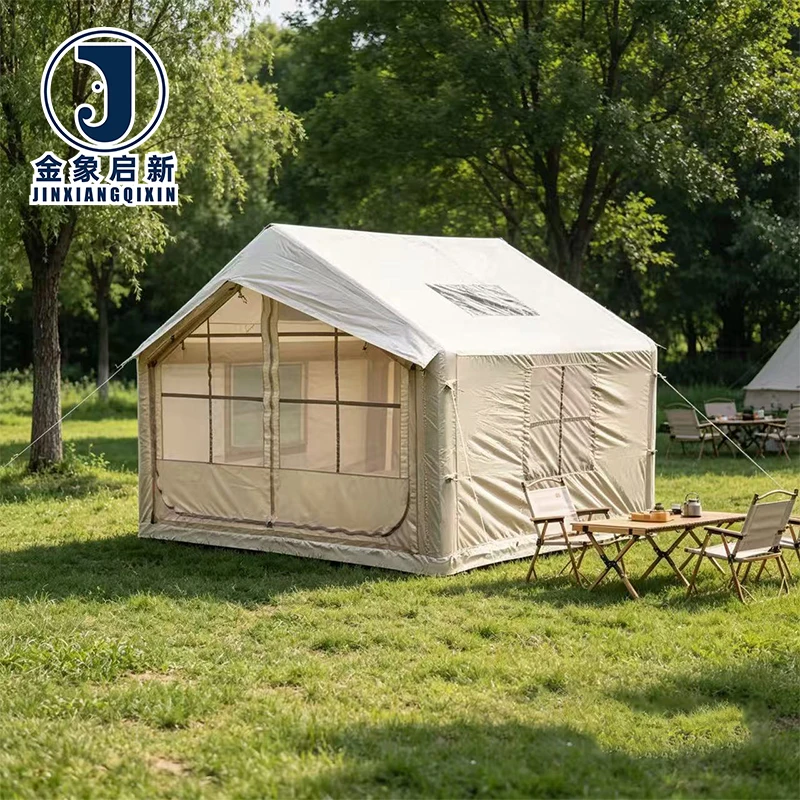
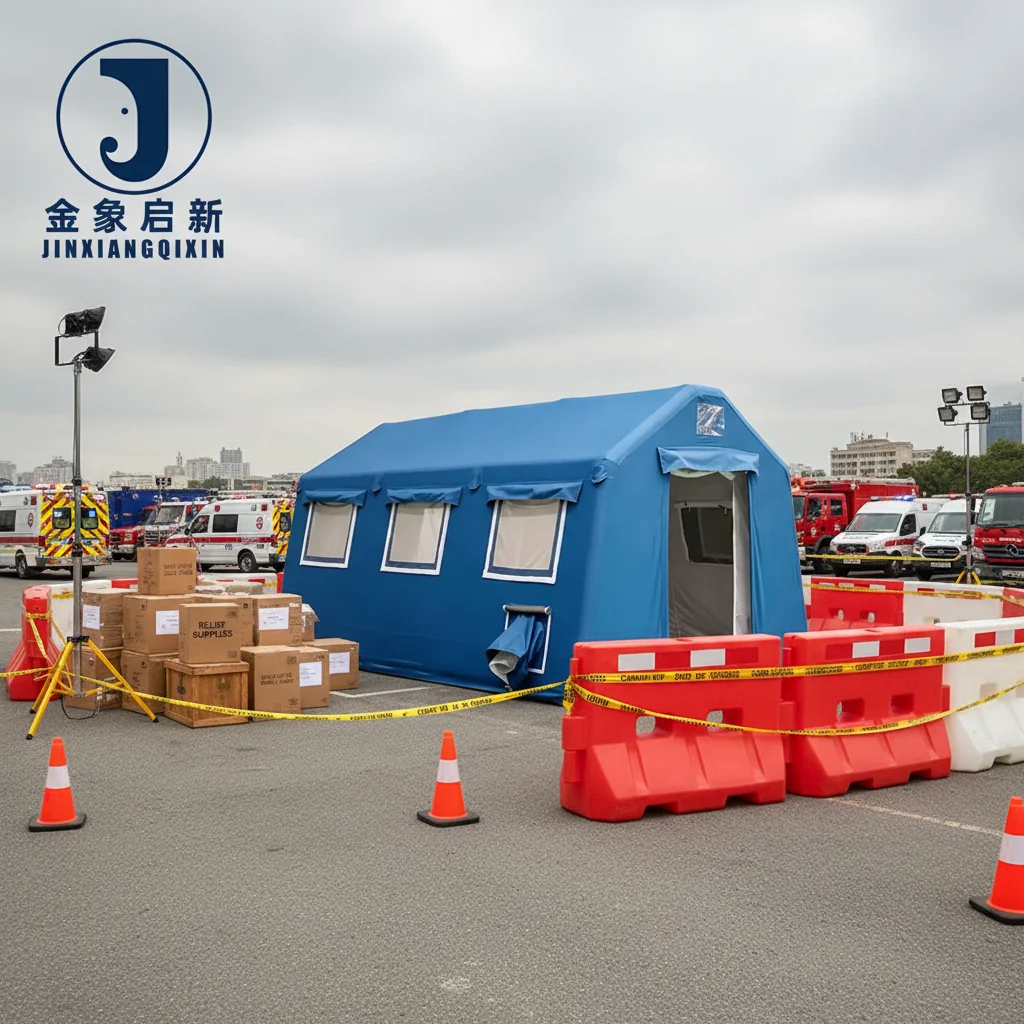
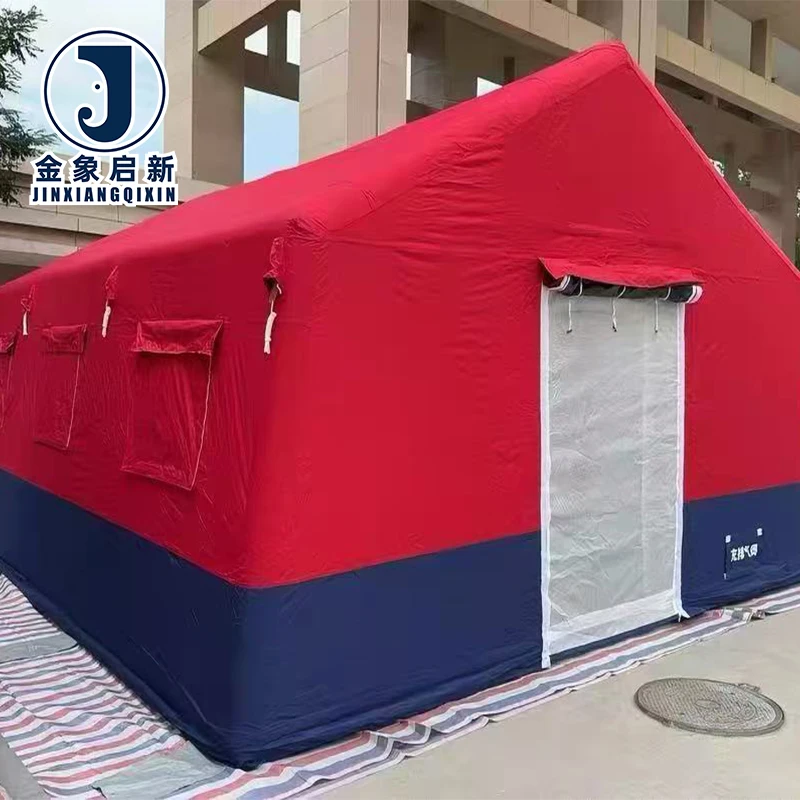
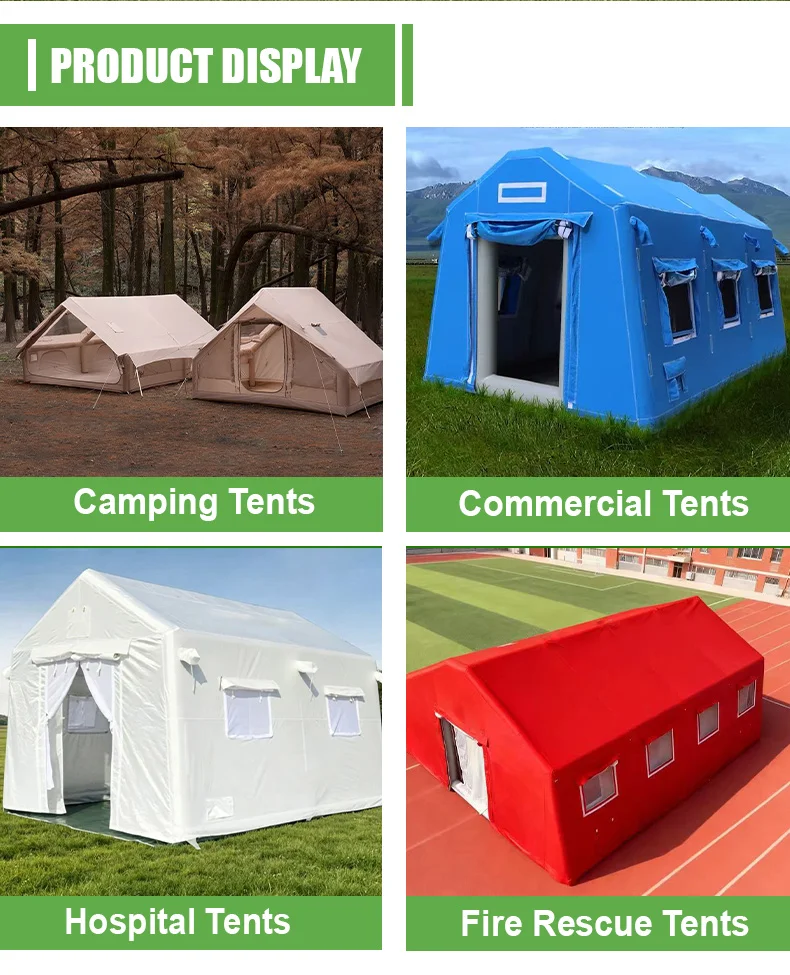
Deep Process Control Over Coated Fabric — 30 years of coating weight and adhesion expertise applied to every inflatable tent we manufacture, with batch-specific traceability from raw material to shipment.
Technical Specifications
| Parameter | Value |
|---|---|
| Product Type | Inflatable Tent |
| Core Material | PVC Tarpaulin |
| Construction | Single Layer |
| Key Performance | Waterproof, UV-Resistant (test basis not stated in source), Tear-Resistant |
| Deployment Method | Quick Automatic Opening |
| Seam Construction | High-Frequency Welding, Airtight Seams |
| Inflation Test | 24-Hour Under Controlled Conditions Before Shipment |
| Certifications | ISO9001, ISO14001, ISO45001, CE |
| Production Facility | 9,180 m² with 3 Full Production Lines |
| Processing Equipment | 36 Sets of Professional Equipment |
| R&D Team | 10 Technicians |
| Customization | OEM & ODM, Sample Customization, Pattern Printing |
Application Suitability
| Application | Exposure & Requirement |
|---|---|
| Temporary Site Offices at Remote Construction Projects | Wind loading, solar exposure, repeated inflation and deflation cycles, transport abrasion |
| Equipment Storage Facilities in Disaster Recovery Zones | Continuous weather exposure, rapid deployment urgency, ground moisture contact |
| Mobile Command Centers for Infrastructure Maintenance | High-frequency relocation, UV and rain exposure, interior climate retention |
| Temporary Warehousing During Logistics Operations | Large-span inflation stability, forklift proximity abrasion, dust and precipitation ingress |
| Commercial Emergency Preparedness Scenarios | Long-term storage compression, instant deployment reliability, multi-climate adaptability |
What Happens When an Inflatable Structure Fails on Site
Inflatable tent structures deployed in disaster recovery and remote construction zones face deployment conditions that expose material weaknesses within the first inflation cycle. Buyers who specify only by visual appearance or quoted thickness often discover that seam integrity, coating adhesion, and air retention separate functional shelters from costly failures.
A membrane structure that loses pressure during a storm does not just inconvenience the crew — it halts operations, damages stored equipment, and erodes confidence in the entire emergency preparedness inventory. We have seen inflatable shelters fail at the seam junctions long before the base fabric shows any sign of degradation. [NEED_CITE: high-frequency welding versus stitched seam performance in inflatable membrane structures] The root cause is almost always insufficient process control during manufacturing, not the raw material itself.
Engineering Airtight Performance for Rapid Deployment
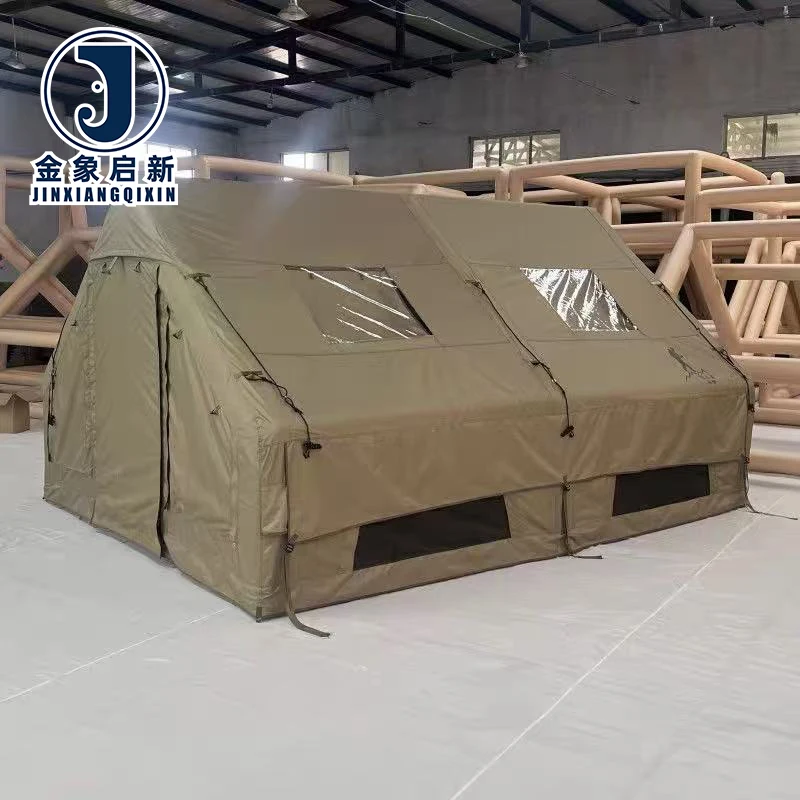
When an Inflatable Tent aftermarket supplier delivers a unit that requires extended manual intervention to seal properly, the time advantage of inflatable construction is eliminated entirely. Our quick automatic opening mechanism is paired with high-frequency welded seams that maintain airtight integrity under the sustained internal pressure required for single-layer structural stability. Each finished unit undergoes a continuous 24-hour inflation test under controlled conditions before dispatch, identifying micro-leaks and seam weaknesses that visual inspection alone cannot detect.
This testing protocol matters most when units are shipped to remote sites where repair resources are limited and replacement lead times are measured in weeks rather than days.
Balancing Structural Rigidity Against Transport Weight
Single-layer construction for inflatable tent applications demands that the PVC tarpaulin delivers sufficient tensile contribution to hold shape under internal pressure while remaining light enough for transport to areas with limited vehicle access. Our 10-technician R&D team evaluates base fabric denier and coating weight together — treating them as a system rather than independent specifications — to achieve this balance. UV-resistant PVC coating is formulated for prolonged solar exposure in open-air installations, though buyers should confirm the specific test basis applicable to their target climate zone.
The tear-resistant weave structure handles the mechanical stress of inflation, deflation, and folding without initiating tear propagation at fold lines. [NEED_CITE: tensile and tear test methods for coated fabrics per ISO 1421]
How Coating Method Influences Weld Behaviour and Air Retention
The PVC tarpaulin used in inflatable tent construction must satisfy competing demands simultaneously. Coating weight determines water resistance and surface durability, while the base fabric weave density governs how the material behaves when welded at high frequency. A heavier coating does not automatically produce a stronger weld — excessive coating thickness can cause uneven heat transfer at the seam interface, creating channels where air escapes under sustained pressure.
Single-layer inflatable construction amplifies this relationship because every seam carries full structural load. Unlike double-layer designs where an inner bladder holds pressure independently, our single-layer units depend entirely on the welded joint matching the parent material in strength and flexibility. The relationship between base fabric denier, weave density, and coating formulation must be evaluated as a unified system. [NEED_CITE: coating weight and adhesion standards for PVC coated technical textiles]
The Cost of Overlooking Seam Specification in Inflatable Procurement
Buyers who focus procurement evaluation exclusively on fabric weight and colour often discover seam failures during the first deployment cycle. A welded seam that separates under inflation pressure renders the entire structure unusable — the PVC tarpaulin panels may be intact, but without airtight joints the shelter collapses. In disaster recovery operations, this failure mode carries consequences far beyond material replacement cost.
Inflatable shelters that pass initial inflation but develop slow leaks over sustained use point to insufficient heat transfer during the welding process, often caused by inconsistent coating thickness across the roll. [NEED_CITE: failure analysis methodology for welded seams in inflatable membrane structures] Our pre-shipment 24-hour inflation test under controlled conditions is designed specifically to catch these delayed-release failures before units leave the factory.
Why Procurement Teams Source Inflatable Fabric From Jinxiang
Three full production lines and 36 sets of professional processing equipment support bulk order volumes while maintaining the process consistency that inflatable membrane structures demand across every welded seam.
Our 10-person R&D team develops pre-production samples for performance evaluation on custom inflatable structures, allowing buyers to validate deployment behaviour, air retention, and dimensional accuracy before committing to production runs.
Dedicated QA and QC staff conduct full-process quality inspection at every production stage — coating weight verification, seam strength validation, and dimensional checking — rather than relying solely on final-stage sampling.
ISO9001, ISO14001, ISO45001, and CE certifications provide the compliance framework that industrial procurement teams require for site audit documentation and tender submissions.
Pattern printing and OEM customisation services allow branding and identification graphics to be applied directly to the PVC tarpaulin surface during manufacturing.
Documentation & Verification
- Batch-specific quality inspection report covering dimensional verification, seam strength, and waterproof performance data
- Fire-retardant and anti-static test records accessible by referencing order number for site compliance audits
- Material specification sheet detailing PVC composition, coating weight, and operating temperature range
- Certificate of origin and customs documentation supporting export requirements
- Pre-shipment 24-hour inflation test record for each individual inflatable tent unit
Fabrication, Handling & Storage
- High-frequency welding parameters must be matched to PVC tarpaulin coating weight to ensure airtight seam integrity
- Store rolled single-layer inflatable fabric on horizontal racks to prevent permanent creasing at fold lines
- Allow compressed units to acclimatise before rapid inflation to reduce cold-temperature stiffness stress on welded seams
- Use mild detergent cleaning agents compatible with PVC coating surface to preserve UV-resistant treatment performance
- Field repair of minor punctures requires PVC-compatible adhesive and patch material matching the base fabric specification
What We Need to Prepare Your Quotation
Provide the intended deployment environment, including expected wind loading, temperature range, and duration of continuous inflation. Specify whether units require fire-retardant or anti-static certification for your site compliance framework. Confirm dimensional requirements, quantity per batch, and whether pattern printing or branding is needed on the PVC tarpaulin surface. Indicate if pre-production samples are required for deployment testing before full order commitment.
Frequently Asked Questions
Q: Which fire-retardant and anti-static certifications are available for inflatable tent structures?
A: Our inflatable tent fabric is available in fire-retardant grades — confirm the specific grade required for your market and site compliance framework. We supply batch-specific test reports and certification copies for full traceability. Contact our technical team with your target standard so we can match the appropriate formulation to your project requirements.
Q: How does the UV-resistant treatment perform in extended outdoor exposure across different climate zones?
A: The UV-resistant PVC tarpaulin is formulated for prolonged solar exposure in open-air installations. Test basis should be confirmed against your specific climate zone and expected deployment duration. Our R&D team can provide material samples for independent weathering evaluation before you commit to full production volumes.
Q: What is the sample development process for custom-sized inflatable structures?
A: Our 10-technician R&D team develops pre-production samples based on your dimensional specifications and performance requirements. Once you approve the sample after deployment testing, full production proceeds with the same material formulation and welding parameters. Pattern printing and branding options can be incorporated during the sample stage for evaluation.
Q: How do high-frequency welded seams compare to stitched seams for inflatable airtight performance?
A: High-frequency welding produces airtight seams essential for single-layer inflatable tent construction, where every joint must retain full internal pressure. Stitched seams create needle perforations that compromise air retention and require additional sealing treatment. Our 24-hour inflation test before shipment validates seam integrity under sustained pressure conditions that simulate actual field deployment.
Q: How is batch consistency maintained across multiple inflatable tent units in a single order?
A: Our full-process quality inspection system verifies coating weight, dimensional accuracy, and seam strength across every unit in a production batch. Each inflatable tent undergoes individual 24-hour inflation testing before dispatch. Batch-specific inspection reports accompany every shipment, providing traceability documentation for compliance audits and site inspection requirements.