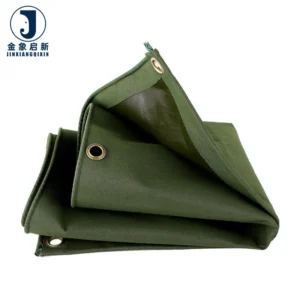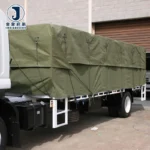


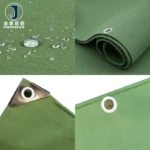
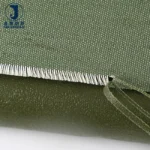

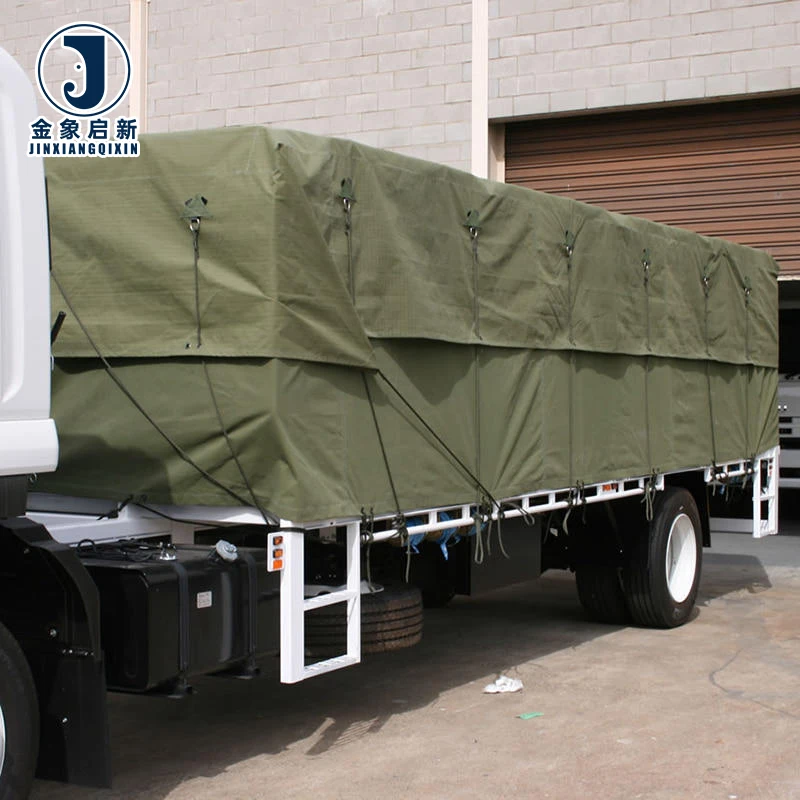
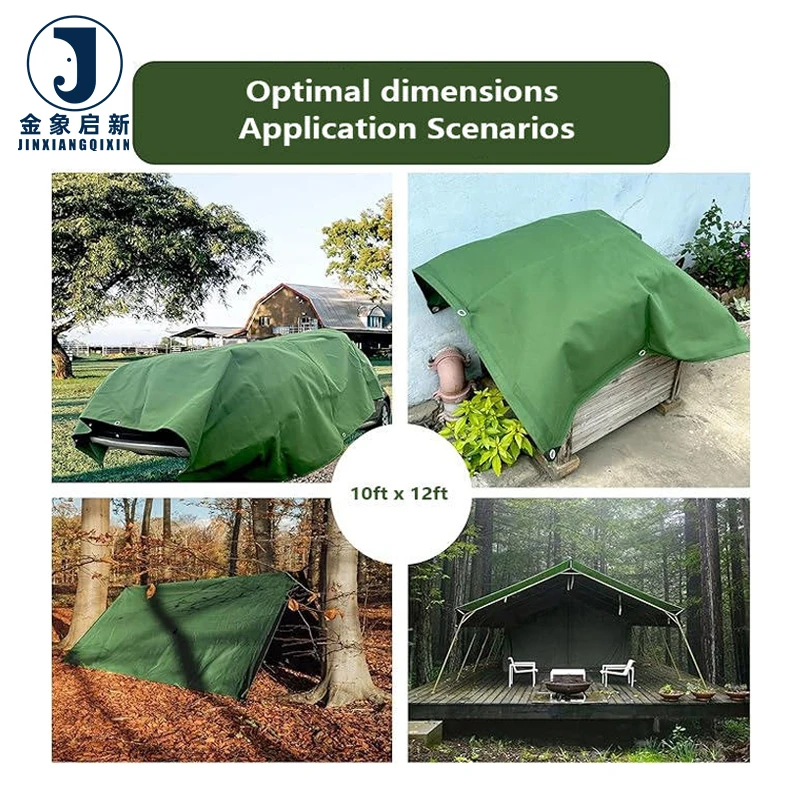

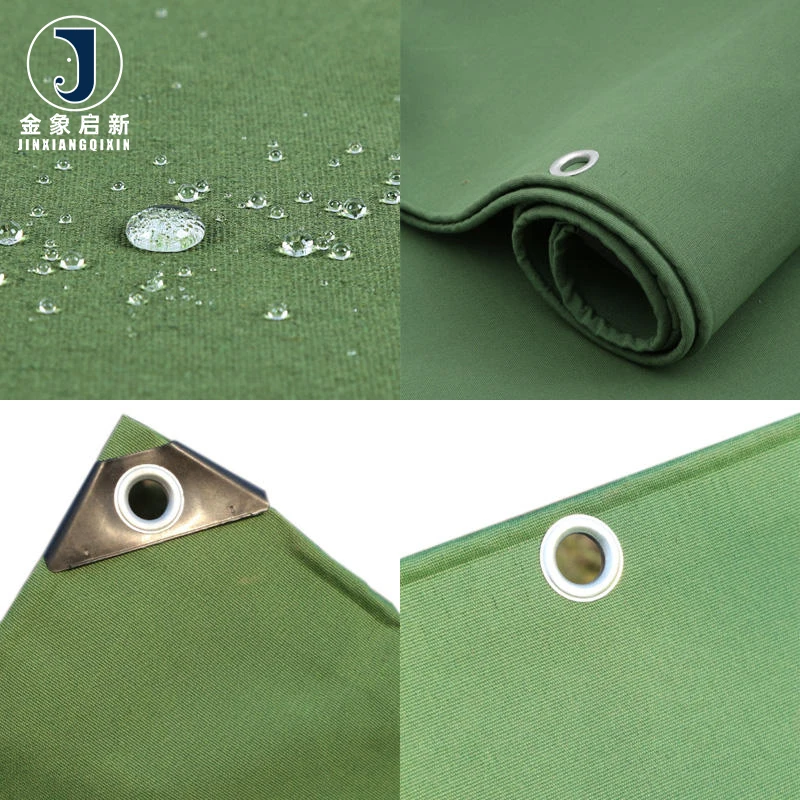
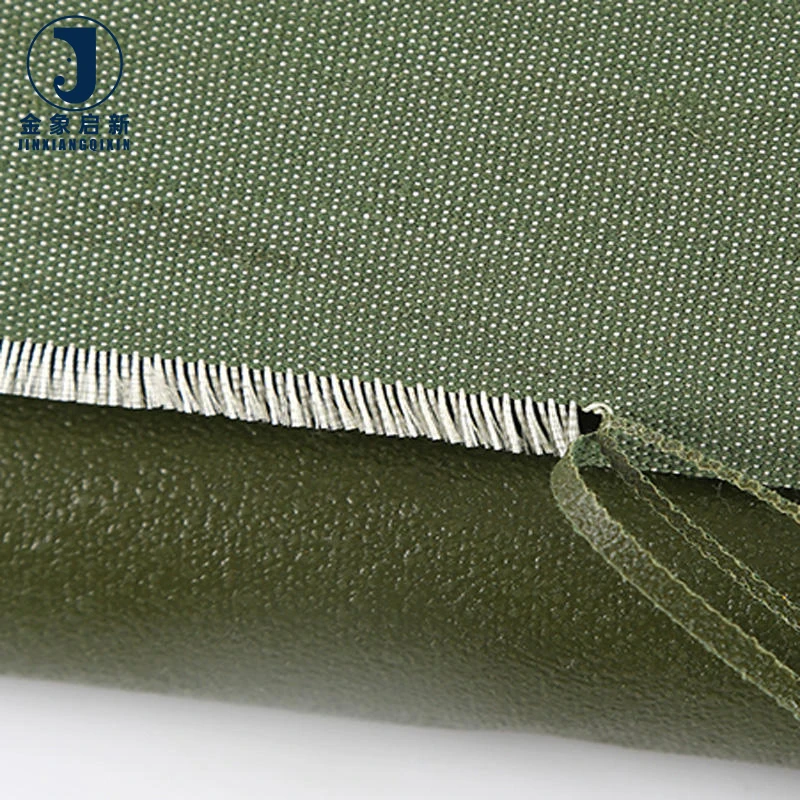
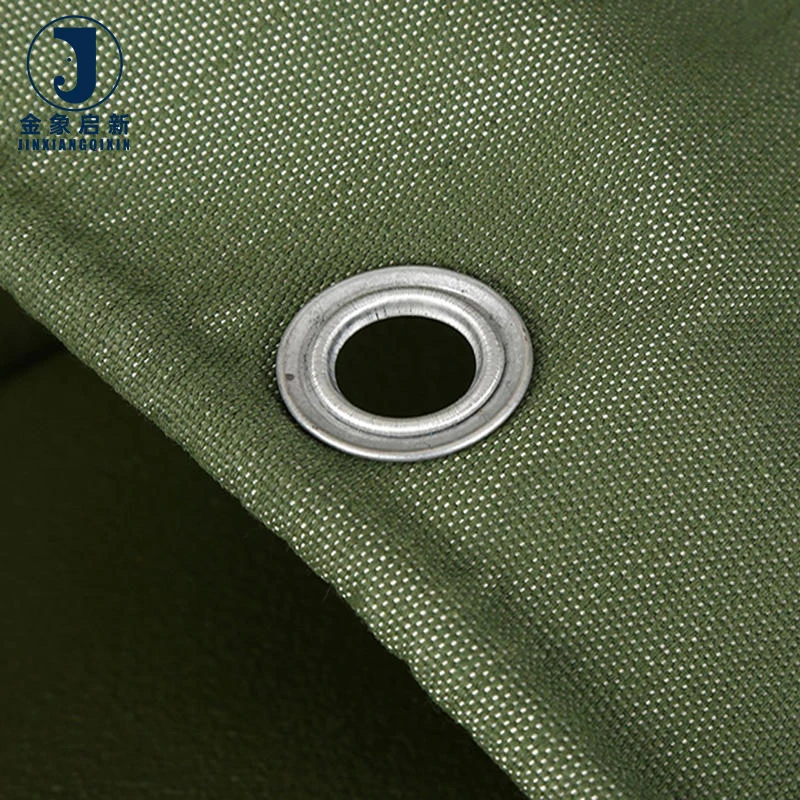
Process-Driven Coating Control — Three full production lines and 36 sets of professional equipment support bulk output of this PVC coated canvas tarpaulin with consistent coating weight and adhesion across every roll.
Technical Specifications
| Parameter | Value |
|---|---|
| Product Type | Canvas Tarpaulin |
| Base Fabric | Polyester cotton industrial textile with 8–12 strands of fine cotton yarn |
| Weight | 600gsm |
| Total Thickness | 0.5mm / 0.6mm / 0.7mm |
| Roll Width | 2m |
| Roll Length | 100m |
| Colour | Army Green Camouflage / Custom |
| Eyelet System | Rust-proof aluminum eyelets every 1 meter at corners and hem |
| Hem & Seam | Folded and sewn seams with poly ropes |
| Waterproof | Yes — fully waterproof coated construction |
| UV Resistance | Claimed UV resistant (test basis not stated — request report before specifying) |
| Flame Retardant | Available in flame retardant grades — confirm the grade required for your site compliance |
| Anti-Static | Not stated — request certification if your site mandates anti-static performance |
| Anti-Mildew | Claimed mold resistant (test basis not stated — verify with supplier documentation) |
| Certifications | CE, ISO (confirm exact standards applicable to your project) |
Application Suitability
| Application | Exposure & Requirement |
|---|---|
| Asphalt truck cover | High surface temperature from freshly laid asphalt, heavy abrasion from aggregate contact, repeated folding and tie-down stress |
| Mining and tunnelling site covers | Continuous moisture, dust ingress, strict fire-retardant and anti-static compliance on active sites |
| Construction equipment protection | Extended outdoor UV exposure, wind-driven rain, mechanical abrasion from shifting loads |
| Specialist membrane and inflatable structures | Air-holding integrity, seam welding strength, dimensional stability under tension |
| Temporary field shelters and tents | Weather cycling, ground moisture, structural load from snow or standing water |
Why "Flame Retardant" Means Nothing Without a Grade Behind It
Specifying a fire-retardant PVC coated canvas tarpaulin without naming the exact test standard is one of the most common procurement errors in industrial and mining ventilation adjacency projects.
Your site safety officer needs a certificate showing a specific classification — not a catalogue claim.
In mining and tunnelling, fire officers routinely reject covers and ducting that arrive with a generic "flame retardant" label but no test report tied to the local regulatory framework. The same applies to aviation ground-support covers and temporary structures on construction sites where building codes reference specific flame-spread classifications. When the documentation does not match the site requirement, the material is pulled from service and replaced at the contractor’s cost [NEED_CITE: fire classification standards for coated fabrics in mining ventilation applications]. The canvas tarpaulin on this page is available in flame retardant grades — confirm the exact classification your project demands before placing an order, and request the corresponding test report as part of your pre-shipment documentation package.
Ventilation Duct Adjacency and Technical Cover Demands
For mining and tunnelling contractors, the covers protecting ventilation equipment and adjacent infrastructure face the same compliance scrutiny as the ducting itself. A PVC coated canvas tarpaulin deployed alongside a fire-retardant or anti-static ventilation system must carry equivalent certification or the entire installation may be flagged during site inspection. This canvas tarpaulin can be supplied with test documentation covering flame retardancy — request the specific grade aligned with your site’s compliance framework before committing to volume.
Coating Adhesion Under Thermal Cycling
Asphalt transport covers experience extreme thermal swings between the hot load below and ambient air above. The PVC coating must remain bonded to the polyester-cotton base fabric through repeated expansion and contraction cycles. Coating adhesion depends on process control during lamination — specifically the temperature profile and dwell time at the coating head. When adhesion is insufficient, delamination appears first at the fold lines where the cover is repeatedly bent during loading and unloading [NEED_CITE: peel strength test methods for coated textile laminates].
Understanding the Weight and Weave Relationship
The 600gsm weight of this canvas tarpaulin results from the combination of the polyester-cotton base fabric and the PVC coating mass applied to each face. Weight alone does not define tensile or tear performance — the 8–12 strand fine cotton yarn construction contributes density and inter-yarn friction that resist tear propagation. A lighter coating on a tighter weave can outperform a heavier coating on a loose weave when the load is applied diagonally, which is exactly how most field failures initiate. The three available thickness options — 0.5mm, 0.6mm, and 0.7mm — correspond to different coating build levels, allowing you to balance abrasion resistance against flexibility for your specific covering application. Thicker builds suit static or semi-permanent covers where stiffness is acceptable, while thinner options are preferable for covers that are folded and deployed frequently.
The Cost of Specification Gaps at Delivery
When a ventilation duct or industrial cover arrives on a mining site without the fire-retardant or anti-static certification the safety plan requires, work stops until compliant material is sourced — often at emergency lead times and premium freight cost. Similarly, GSM stated on the quotation but not verified at the receiving dock means you may be installing a lighter fabric than you designed for, reducing service life under abrasion and wind load. Colour variation between rolls becomes visible once multiple panels are installed side by side on a large structure, triggering rework on projects where visual consistency matters. Welded seams failing before the fabric body is the hallmark of incorrect heat-setting parameters at the factory, leaving the weakest point exactly where the cover flexes most under load [NEED_CITE: common failure modes in coated fabric seam welding for industrial covers].
Why Technical Buyers Source This Fabric Here
The 10-person R&D team handles material selection, sample development, and custom sizing specific to your equipment dimensions, so you are not forcing a generic roll width onto a non-standard structure. Dedicated QA/QC runs at every production stage with 100% inspection before dispatch, catching coating-weight deviations and seam defects before they reach your site. Three full production lines provide the capacity to fulfil bulk roll orders with consistent lead times, reducing the risk of partial shipments disrupting your project schedule. Samples are developed within days for custom requirements including colour matching and treatment verification, letting you validate compliance before committing to a production run. Documentation packages ship with every order, including material specification sheets and test reports matched to your stated requirements.
Documentation & Verification
- Material specification sheet stating GSM, base fabric composition, and coating weight per roll
- Fire-retardant or anti-static test report where applicable to your site compliance framework
- Pre-shipment inspection record covering weight verification and visual defect check per roll
- Roll packing list with net weight, gross weight, and dimensions for customs clearance
- Certificate of origin and ISO/CE certificates supporting import documentation requirements
Fabrication, Handling & Storage
- Heat-weld seams at temperatures matched to the PVC coating thickness — verify with trial welds on offcuts before full production
- Position rust-proof aluminum eyelets to align with tie-down points, reinforcing each with a welded patch on the 600gsm canvas
- Store rolls upright on pallets in a shaded area to prevent compression flat spots on the coating surface
- Allow cold-stored rolls to reach ambient temperature before unrolling to avoid coating cracking at low temperature
- Use mild detergent for cleaning — aggressive solvents can degrade the PVC coating and any applied UV treatment
What to Include with Your Enquiry
Provide the specific fire-retardant or anti-static classification your site requires so the correct grade can be confirmed and documented. State your finished dimensions or confirm you need roll stock, along with the annual volume and target delivery schedule. If your project involves asphalt transport or mining ventilation adjacency, describe the operating temperature range and any chemical exposure so the coating formulation can be verified against those conditions. Request a sample with test reports before committing to production volume.
Frequently Asked Questions
Q: What fire-retardant or anti-static certifications are available for this canvas tarpaulin?
A: This PVC coated canvas tarpaulin can be supplied in flame retardant grades with supporting test reports. Anti-static certification is available on request. Confirm the exact classification your site safety plan requires — such as the standard referenced in your mining or tunnelling ventilation compliance documentation — so the correct grade and test report are included with your shipment.
Q: How is the 600gsm weight verified and how should I recheck on arrival?
A: The manufacturer runs weight checks during production and includes a pre-shipment inspection record with the dispatch documentation. On arrival, cut a measured sample from the roll and weigh it to confirm the GSM matches the quotation. Any discrepancy should be reported before installation so a replacement or credit can be arranged without delaying your project.
Q: What UV and weather-resistance test data supports outdoor use?
A: UV resistance is claimed for this canvas tarpaulin but the specific test basis is not stated in the standard product documentation. Request the UV test report before specifying the material for extended outdoor exposure. This lets you verify the treatment level matches the solar radiation conditions at your project location and the expected service duration.
Q: Can this fabric be used in mining or tunnelling environments with strict compliance requirements?
A: Yes, provided the correct fire-retardant or anti-static grade is specified and the corresponding test report is included in the shipment documentation. Mining and tunnelling sites typically require certification aligned with local safety regulations. State your site’s compliance framework in your enquiry so the manufacturer can supply the matching grade and paperwork.
Q: What custom sizing and reinforcement options are available?
A: Finished products can be manufactured to your exact dimensions with rust-proof aluminum eyelets at specified intervals and folded seams sewn with poly ropes for reinforcement. Roll stock is available at 2m width by 100m length for on-site fabrication. Provide your equipment or structure dimensions and tie-down layout so the manufacturer can confirm panel sizing and eyelet placement.