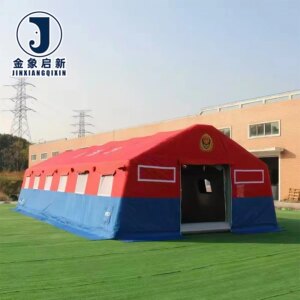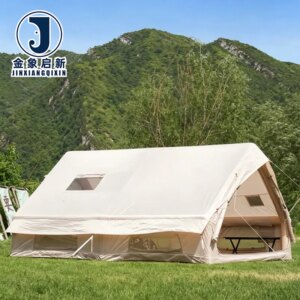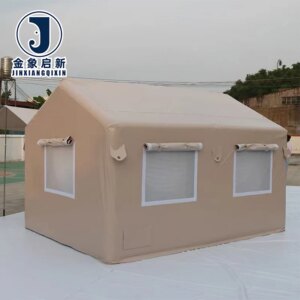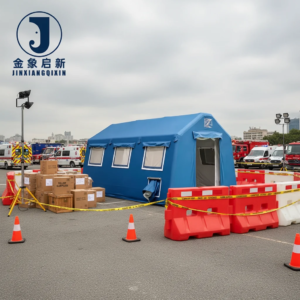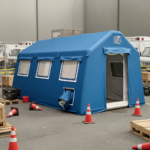
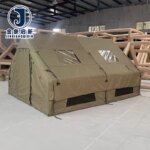
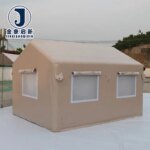
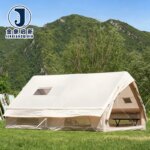
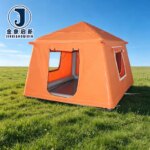
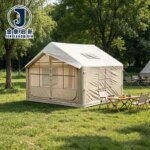
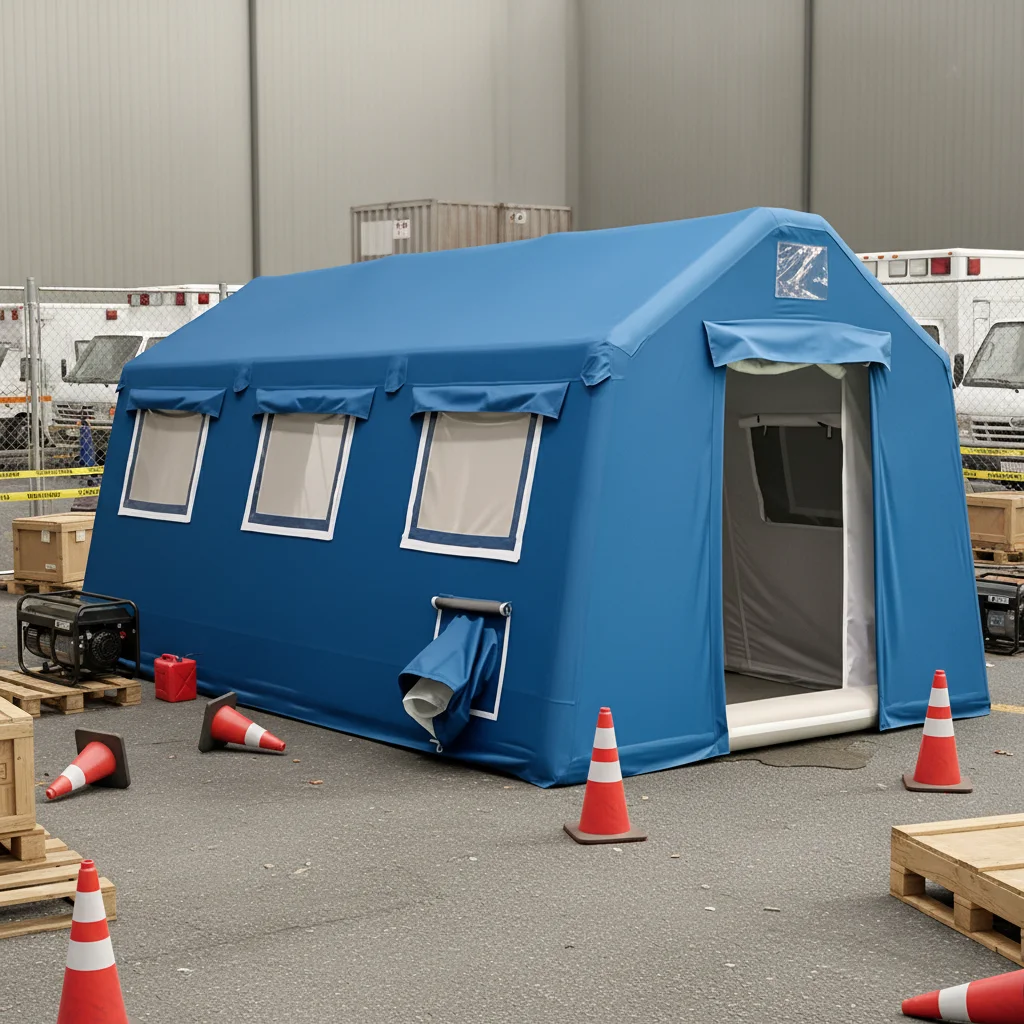
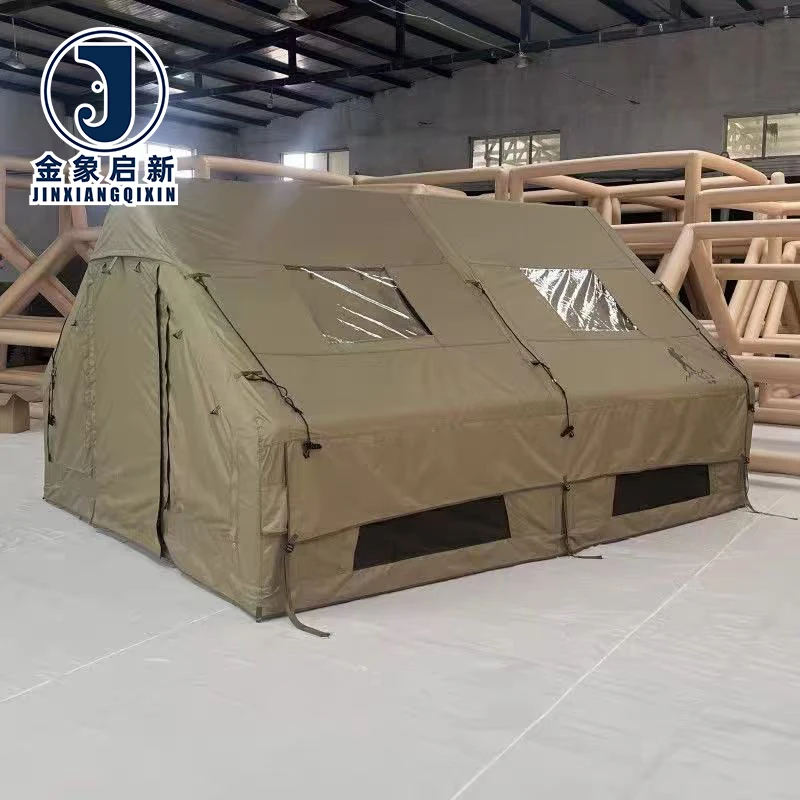
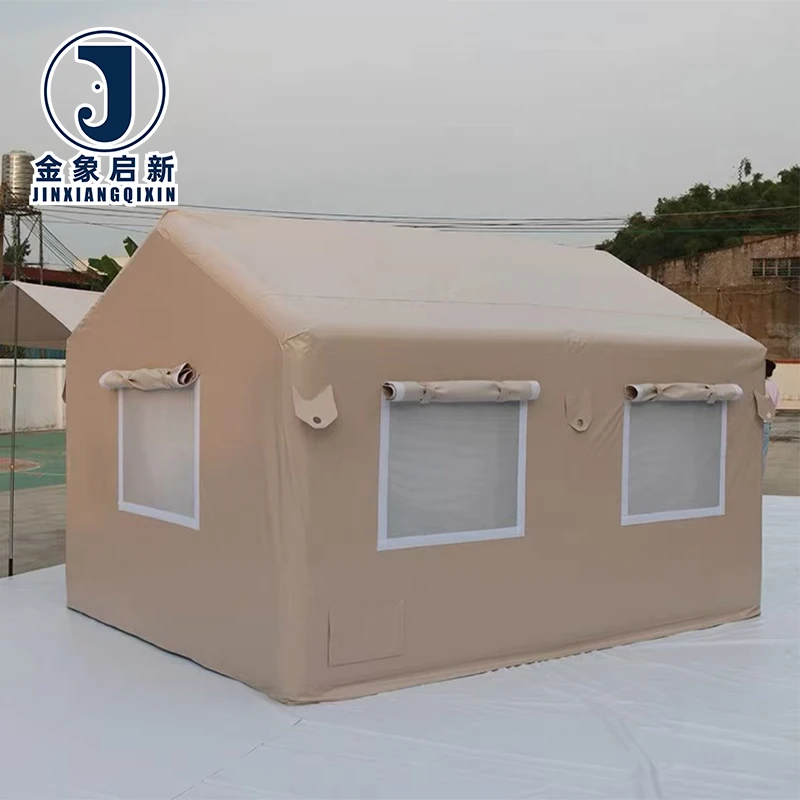
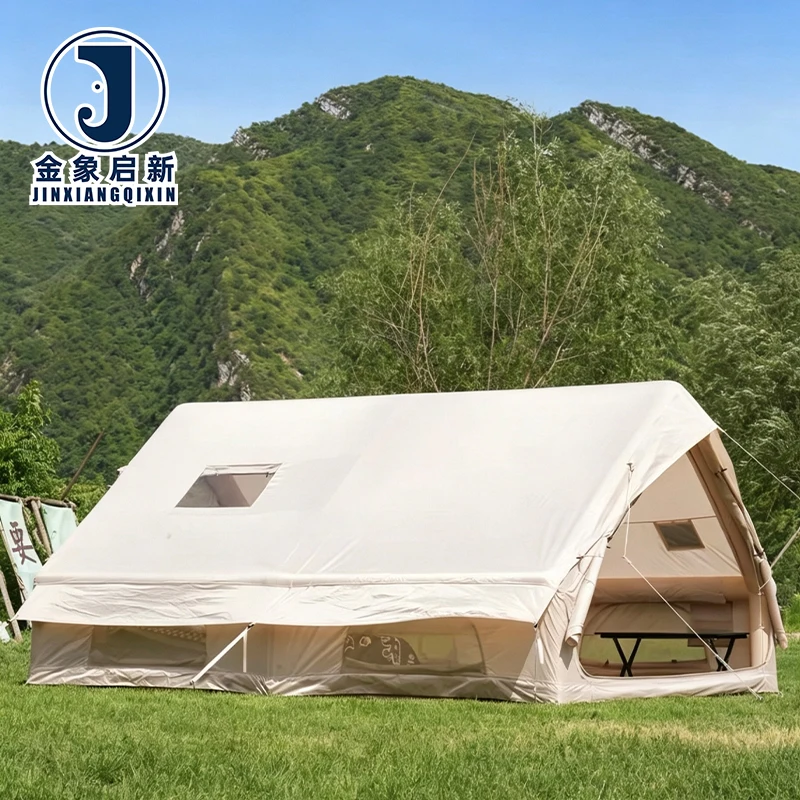
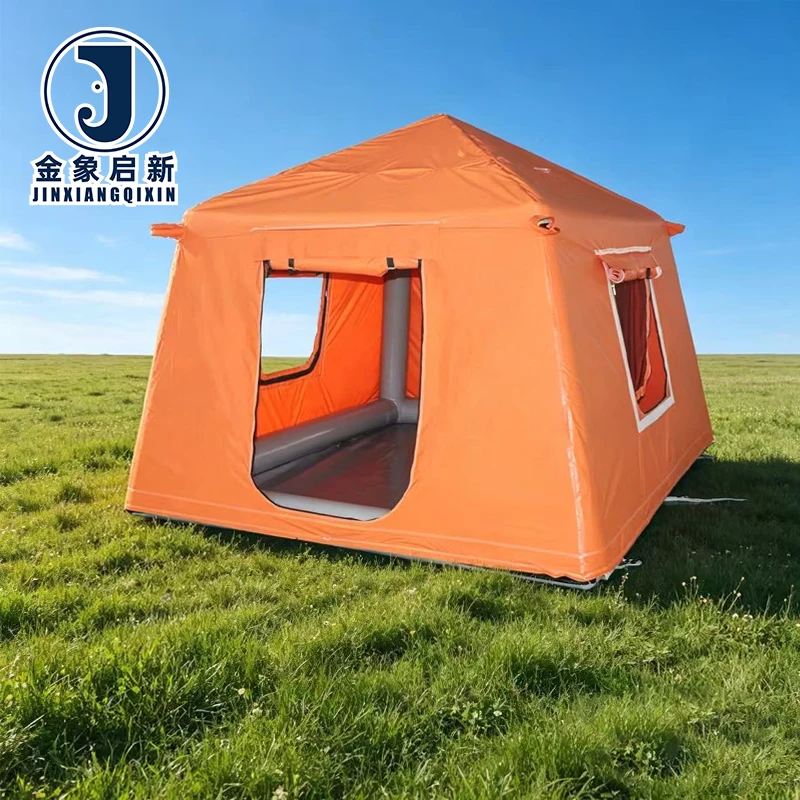
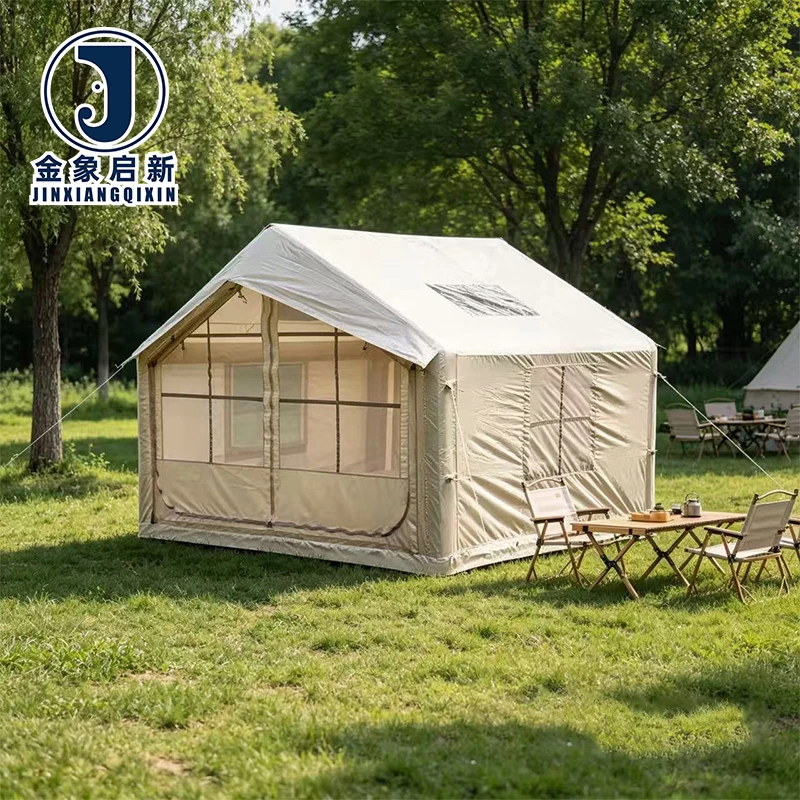
Coating Process Mastery — nearly three decades of PVC knife-coated fabric production ensuring consistent adhesion and controlled weight across every inflatable tent panel.
Technical Specifications
| Parameter | Value |
|---|---|
| Product Type | Inflatable Tent |
| Core Material | PVC tarpaulin (PVC knife-coated fabric) |
| Key Performance | Waterproof, tear-resistant |
| Flame Retardant | Fire-retardant properties claimed (grade not stated in source — confirm the grade required for your market) |
| UV Resistance | UV-resistant (test basis not stated in source — request test report) |
| Product Forms | Quick automatic opening, single layer construction, extended type |
| Season Rating | Four-season design |
| Customization | OEM & ODM, sample customization, pattern printing, size adjustments, color options, specialized access configurations |
| Quality Control | 24-hour minimum air pressure retention testing, seam tensile testing, temperature cycling, UV exposure environmental simulation |
| Certifications | ISO 9001, ISO 14001, ISO 45001, CE |
Application Suitability
| Application | Exposure & Requirement |
|---|---|
| Emergency response command centers | Rapid inflation, repeated deployment cycles, all-weather resistance, immediate occupancy compliance |
| Disaster relief temporary shelters | Continuous outdoor exposure, wind load on inflatable frame, occupant safety under fire codes |
| Mobile field operations bases | Frequent setup and teardown, abrasion from ground contact, UV exposure during extended staging |
| Infrastructure maintenance staging areas | Year-round outdoor deployment, waterproof integrity for stored equipment, regulatory fire safety documentation |
| Mining and tunnelling surface shelters | Dust, chemical exposure, fire-retardant and anti-static requirements for confined or hazardous zones |
When "Certified" on Paper Does Not Match the Site Inspector’s Checklist
An inflatable tent is only as compliant as the documentation that ships with it.
Mining, tunnelling and construction sites routinely reject temporary shelters at the gate because the fire-retardant grade on the quotation does not match what local safety regulations demand, or the anti-static certification the site engineer requires was never tested in the first place. We have seen project delays measured in days — not hours — because a supplier quoted "flame retardant" without specifying the classification, leaving the buyer to discover the gap during the pre-installation safety audit. [NEED_CITE: fire classification standards for temporary structures on industrial sites]
Engineered for Rapid Inflation and Sustained Air Pressure
The inflatable tent frame relies entirely on the integrity of welded seams and the dimensional stability of PVC knife-coated fabric under continuous internal pressure. Our production process includes a minimum 24-hour air pressure retention test on every unit before dispatch, verifying that inflation chambers hold pressure without bleed-down across the full seam network. This matters because a single under-welded joint can cause gradual deflation during an overnight emergency operation, compromising shelter function when conditions are at their worst.
Compliance Documentation That Closes the Gap at the Gate
Every PVC inflatable tent ships with batch-level inspection documentation covering material specifications, performance test results and certification status. For buyers operating under mining, aviation or construction regulatory frameworks, this means the fire-retardant and compliance paperwork is not an afterthought requested weeks later — it arrives with the product. Custom specification sheets confirm exact dimensions, material construction and performance parameters for each project order, giving site engineers the reference they need for pre-deployment safety sign-off. [NEED_CITE: ISO 9001 quality management documentation requirements for manufactured shelters]
Reading the Specifications Beyond the Surface Claims
PVC knife-coated fabric gains its tensile and tear performance from the interaction between base fabric denier, weave density and the coating weight applied during the knife-coating process. A heavier coating does not automatically produce a stronger panel — if the base fabric is loosely woven, the coating simply fills gaps without improving structural resistance. The knife-coating method itself produces a mechanical bond between coating and yarn that supports heat welding, which is critical for inflatable chamber construction where stitched seams would leak air.
UV resistance in PVC tarpaulin depends on the stabilizer package blended into the coating formulation, and the test basis determines whether the claim reflects weeks or years of simulated exposure. Fire-retardant performance varies across classification systems — what qualifies under one national standard may not satisfy the requirements of a different jurisdiction, making it essential to confirm the target grade before production begins.
The Hidden Cost of Undocumented Material Properties
When a PVC inflatable tent arrives at a disaster relief staging area and the fire-retardant certificate references a different product line, the entire deployment can stall while procurement scrambles for alternative shelter. Similarly, when seam tensile strength was not tested under conditions matching the deployment environment — such as cold-temperature flexibility — welded joints on inflatable frames can crack during inflation in winter operations. These are not theoretical risks; they represent project delays, rejected shipments and replacement orders that erase any savings from the initial purchase price. [NEED_CITE: seam failure modes in coated fabric inflatable structures]
Why Procurement Teams Source Inflatable Shelters Here
Our 10-person R&D team handles material selection, custom sizing and access configuration design specifically for inflatable tent applications — from emergency command layouts to equipment storage compartmentalization.
Three full production lines and 36 sets of professional processing equipment support project-volume output without subcontracting critical welding and inflation-testing stages to outside workshops.
Dedicated QA and QC staff conduct on-site inspection at every production stage, from raw PVC tarpaulin roll inspection through final inflation testing, rather than relying on post-production sampling alone.
Environmental simulation testing — including temperature cycling and UV exposure — verifies that inflatable tent panels and welded seams maintain performance across the four-season range claimed in the specification.
Custom sample development within days allows buyers to evaluate fabric hand, seam integrity and inflation behaviour before committing to full project quantities.
Documentation & Verification
- Material specification sheet stating base fabric construction, coating type and performance parameters per order
- Fire-retardant test report matching the grade specified for the buyer’s target market and regulatory jurisdiction
- Batch inspection record covering air pressure retention, seam tensile and environmental simulation results
- ISO 9001, ISO 14001, ISO 45001 and CE compliance certificates included with every shipment
- Raw material certificates and production process documentation available on request for regulatory submissions
- Custom specification confirmation sheet detailing exact dimensions, access configurations and material parameters
Fabrication, Handling & Storage
- Heat-weld seams on PVC knife-coated fabric at temperatures matching the coating formulation to prevent delamination at inflatable chamber joints
- Store rolled inflatable tent panels flat or on wide-diameter cores to avoid permanent creases in the PVC coating layer
- Deploy in sub-zero conditions only after allowing the PVC tarpaulin to acclimatize, reducing risk of coating crack during inflation
- Use PVC-compatible cleaners only — solvents can degrade the knife-coated surface and compromise waterproof integrity
- Field repair kits should include matching PVC tarpaulin patches and compatible adhesive for emergency seam or panel repair
- Plan cutting layout to minimize cross-grain panels in high-stress inflatable frame sections where tear propagation risk is highest
What We Need to Quote Your Inflatable Tent Project
Provide the intended application — whether emergency command, disaster relief shelter or industrial staging — along with the regulatory fire-safety classification your site requires. Specify target dimensions, access configuration needs and whether you need sample units for field evaluation before full production. Include your deployment environment details so we can confirm UV and temperature performance alignment.
Frequently Asked Questions
Q: What fire-retardant grades are available and do they match our local site regulations?
A: Our PVC inflatable tent fabric is produced with fire-retardant treatment, but the specific classification depends on the formulation applied during coating. Before ordering, share the fire safety standard your jurisdiction or site operator requires — such as a national building code classification or mining safety directive — so our technical team can confirm the matching grade and provide the corresponding test documentation with your shipment.
Q: Can we customize dimensions, access configurations and colors for a project order?
A: Yes. Our OEM and ODM service covers size adjustments, specialized access configurations such as partition walls and equipment entry points, color options and pattern printing. The R&D team develops a sample unit for approval before production begins, ensuring the inflatable frame geometry and panel layout meet your deployment requirements. Minimum order quantities apply based on the complexity of customization requested.
Q: How do we verify the PVC tarpaulin material quality when the shipment arrives?
A: Every shipment includes a batch inspection report and material specification sheet documenting the fabric construction and performance parameters. We recommend cross-referencing the received material against these documents and requesting the raw material certificates if your project requires full traceability. Our pre-shipment inspection covers every unit, but on-arrival verification provides an additional compliance checkpoint for your procurement records.
Q: Is there a test basis for the UV resistance claim on the inflatable tent fabric?
A: UV resistance is achieved through stabilizer additives in the PVC coating formulation, and we conduct UV exposure environmental simulation testing as part of our quality control process. The specific test duration and method can be confirmed for your order — request the UV test report during the inquiry stage so you can evaluate whether the exposure rating aligns with your expected deployment duration and climate conditions.
Q: Does the inflatable tent meet anti-static requirements for mining or tunnelling deployment?
A: Anti-static treatment is a separate specification from standard fire-retardant PVC tarpaulin and must be confirmed during the inquiry stage. If your deployment environment — such as an underground mine or confined tunnelling operation — requires anti-static certification, specify this requirement upfront so our technical team can confirm material availability and provide the relevant compliance documentation with your order.