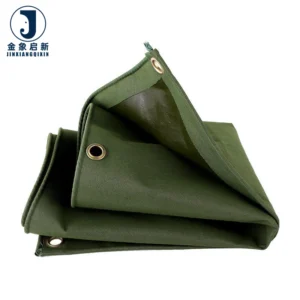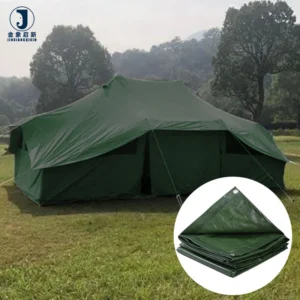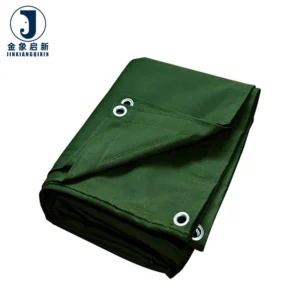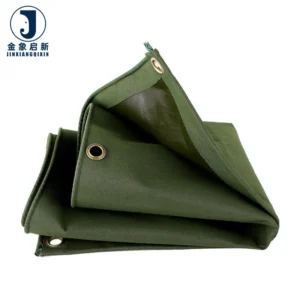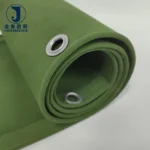
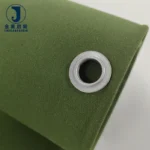


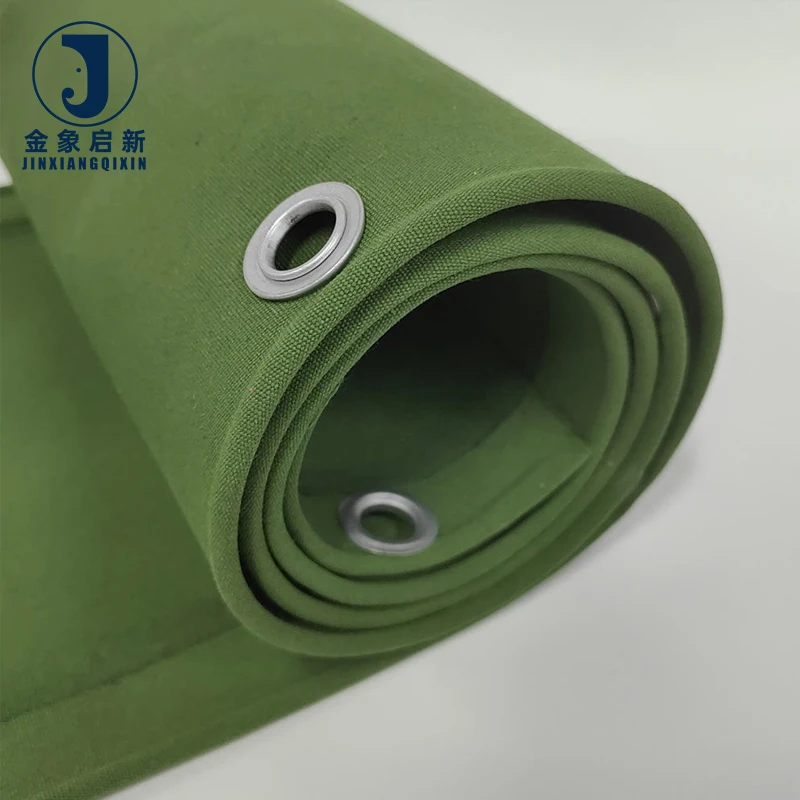
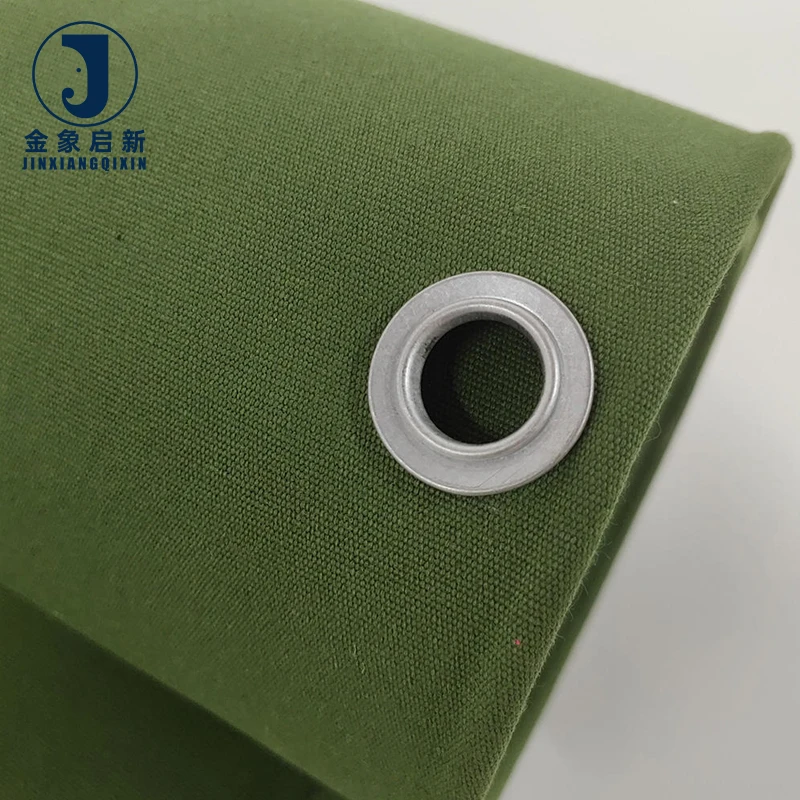
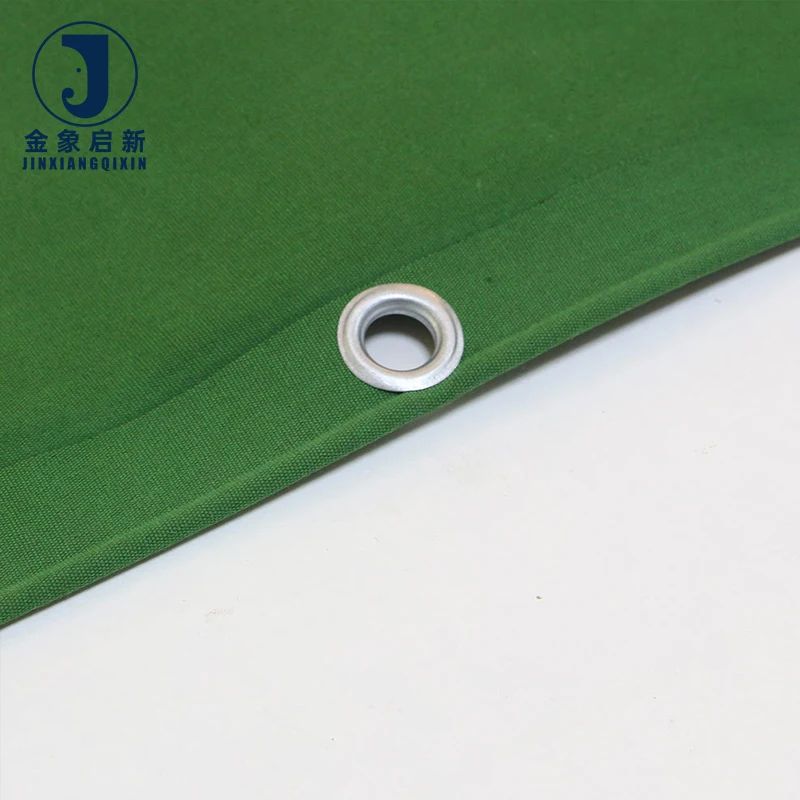
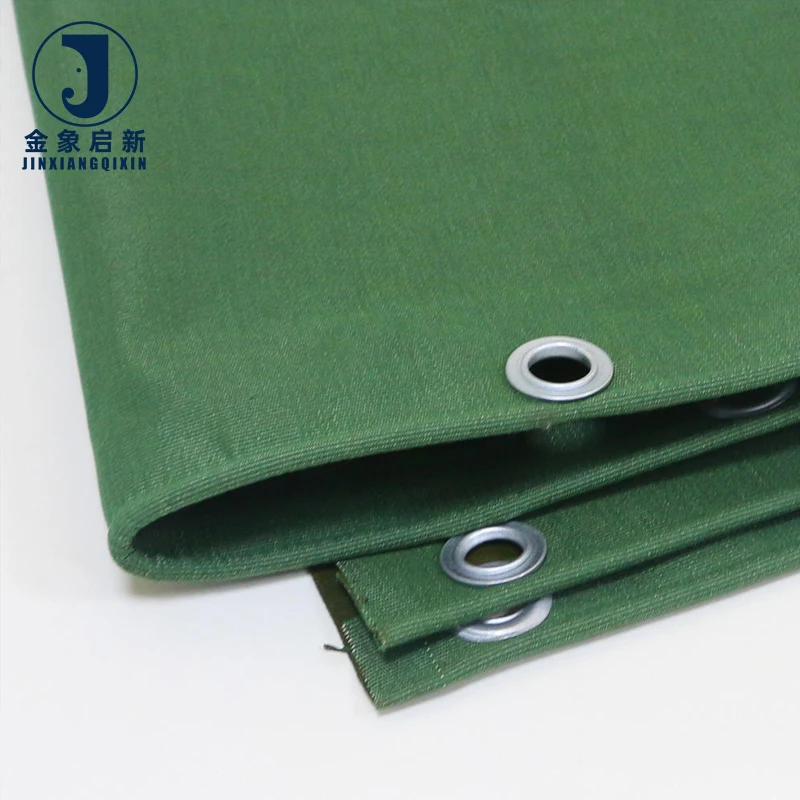
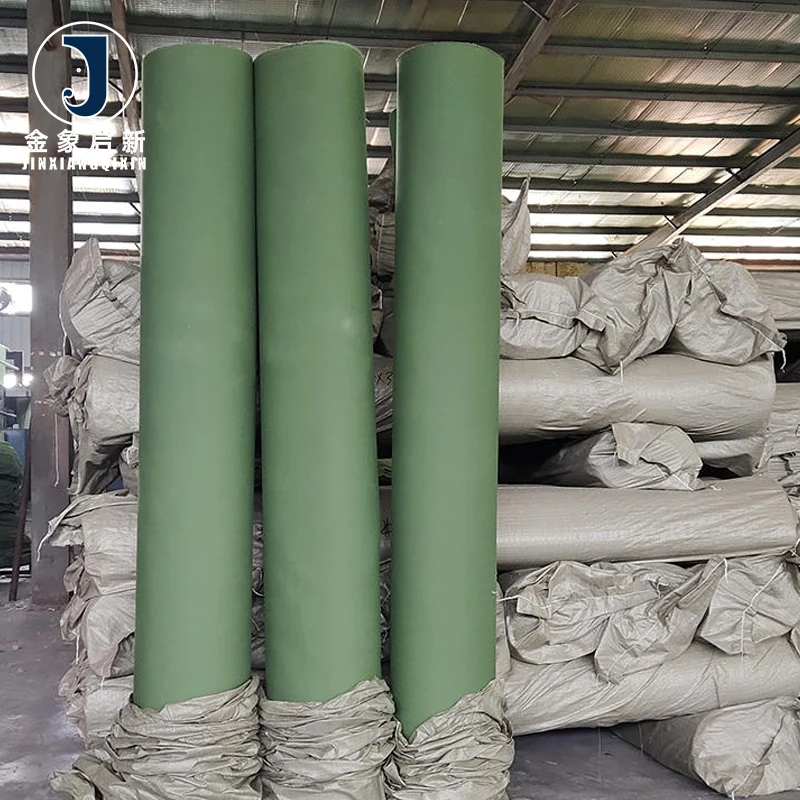
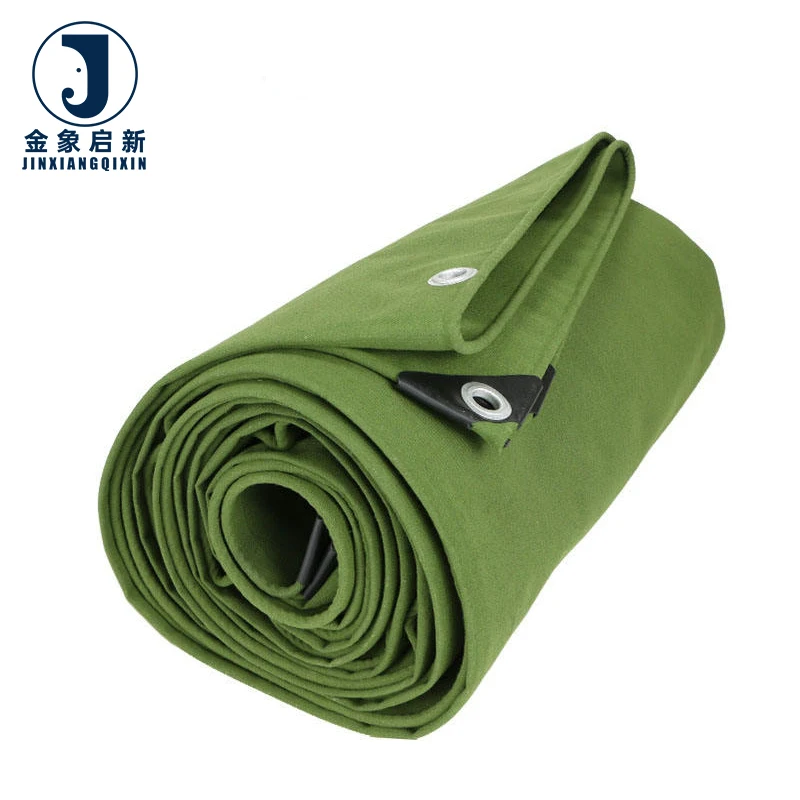
Process-Driven QA — Every production stage for this PVC laminated canvas is inspected against coating weight and dimensional tolerances before dispatch, ensuring the 600gsm specification holds across the entire roll.
Technical Specifications
| Parameter | Value |
|---|---|
| Product Type | PVC Coated Tarpaulin |
| Base Fabric | Polyester cotton industrial textile with 8–12 strands of fine cotton yarn |
| Fabric Weight | 600gsm |
| Thickness Options | 0.5mm / 0.6mm / 0.7mm |
| Coating Method | Laminated |
| Roll Width | 2m |
| Roll Length | 100m |
| Colour | Army Green Camouflage / Custom |
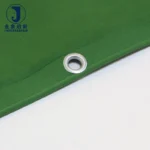
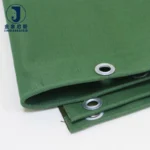
| Eyelet Spacing | Rust-proof aluminum eyelets every 1 meter at corners and hem |
| Seam Construction | Welded and sewn with poly rope reinforcement |
| Water Resistance | Waterproof (grade not stated) |
| UV Resistance | UV resistant (test basis not stated) |
| Flame Retardant | Available in flame retardant grades — confirm the grade required for your market |
| Anti-Mildew | Mold resistant (test basis not stated) |
| Temperature Resistance | High- and low-temperature resistant (range not stated) |
| Certifications | CE, ISO |
Application Suitability
| Application | Exposure & Requirement |
|---|---|
| Truck side curtain panels | Constant flexing at load points, road vibration, wind-driven rain, UV exposure |
| Mining ventilation ducts | Continuous airflow pressure, abrasive dust, confined-space handling |
| Construction site enclosure | Weather exposure, mechanical contact with scaffolding and equipment |
| Temporary specialist enclosures | Rapid deployment, membrane tension, temperature fluctuation |
| Aviation ground support ducting | Airflow management, ground handling abrasion, compliance requirements |
Why a Ventilation Duct Fails When the Fabric Specification Is Assumed Rather Than Verified
Compliance documentation must match the site’s regulatory requirement before the material is cut, not after installation.
Ventilation ducts deployed in mining and tunnelling environments operate under continuous internal pressure and abrasive particulate exposure. When the fabric arrives without a fire-retardant grade that aligns with the site’s safety specification, the entire duct run may be rejected at commissioning — regardless of how well the seams hold or how consistently the GSM was delivered [NEED_CITE: fire safety classification requirements for underground ventilation materials]. A Heavy Duty Laminated Canvas Tarpaulin fire retardant certified to the correct standard eliminates this compliance gap, but certification must be confirmed at the quotation stage, not assumed from a general product description.
Coated Fabric Performance Under Continuous Airflow Pressure
Ventilation ducts in mining and construction operate under sustained positive or negative pressure, placing constant tension on the fabric body and every welded seam. The 600gsm polyester cotton base with 8–12 strands of fine cotton yarn provides the tensile foundation for this application, while the laminated PVC coating adds waterproofing and surface protection against moisture and dust accumulation. For duct construction, the Heavy Duty Laminated Canvas Tarpaulin fire retardant certified specification must be verified against the project’s airflow and compliance requirements before fabrication begins.
Seam Integrity in Flexible Duct and Membrane Structures
Flexible ducts expand and contract with airflow changes, and membrane structures shift under wind load — both conditions concentrate stress at seam junctions. The welded-and-sewn construction with poly rope reinforcement addresses this by distributing load across both the thermal bond and the mechanical stitch line. Rust-proof aluminum eyelets at one-meter intervals along corners and hems provide secure attachment points that resist pull-through under dynamic loading [NEED_CITE: tensile and tear test methods for coated fabrics per ISO 1421]. For inflatable structures and temporary enclosures, seam performance determines the service interval far more than the base fabric itself.
Reading the 600gsm Specification in Context
Fabric weight alone does not define how a coated textile behaves under load. The 600gsm figure here combines the polyester cotton base fabric density with the laminated PVC coating mass — the ratio between them determines whether the material favours tensile strength or surface durability. A thicker coating adds waterproofing and abrasion resistance but increases stiffness, which matters when the fabric must flex repeatedly in a duct application. The available thickness options of 0.5mm, 0.6mm, and 0.7mm reflect different balances between these properties, and the correct selection depends on whether the end use demands maximum flexibility or maximum surface protection. Base fabric construction with 8–12 strands of fine cotton yarn contributes to tear propagation resistance, preventing small punctures from spreading across the panel under tension.
The Hidden Cost of Specifying Without Site Compliance Data
A ventilation duct installed underground without the correct fire-retardant certification creates a compliance failure that stops work until the ducting is replaced — the cost of downtime and reinstallation far exceeds the initial fabric savings. Similarly, if the delivered GSM does not match the quoted 600gsm, the fabric may lack the tensile capacity to sustain duct pressure, leading to seam separation or panel distortion under airflow [NEED_CITE: consequences of GSM deviation on coated fabric mechanical performance]. Colour inconsistency between rolls in the same order becomes visible once membrane panels are installed side by side, requiring panel replacement to restore visual continuity on architecturally exposed structures.
Why Fabrication Houses Source This Material Here
Nearly 30 years of focused coated fabric production provides process control over lamination consistency that newer operations cannot match — every 600gsm roll leaving the facility has passed through coating weight checks at multiple production stages. Three full production lines with 36 sets of professional equipment support bulk orders for ventilation duct and membrane projects with reliable on-time delivery across mining, aviation, and construction sectors. The 10-person R&D team handles custom width, colour, and finished-size requirements directly, developing samples within days for project-specific specifications. Dedicated QA/QC inspection at every stage — including seam weld verification and eyelet placement consistency — ensures the Heavy Duty Laminated Canvas Tarpaulin fire retardant certified material arrives matching the quotation. ISO and CE certification underpins documentation for international project compliance.
Documentation & Verification
- Material specification sheet confirming 600gsm, base fabric construction, and coating method for each roll
- Fire-retardant test report matching the grade specified for your site’s regulatory jurisdiction
- ISO and CE certificates with scope covering coated fabric for industrial ventilation applications
- Pre-shipment inspection record documenting seam weld integrity and eyelet placement consistency
- Roll packing list with individual roll weight and dimensions for customs clearance and receiving verification
Fabrication, Handling & Storage
- Heat-weld seams at temperatures calibrated to the laminated PVC coating to avoid delamination from the 600gsm base fabric
- Reinforce all eyelet positions with additional fabric patches to distribute tie-down loads across the polyester cotton weave
- Store rolls vertically on end caps to prevent flat-spot deformation of the 2m-wide laminated canvas
- Allow rolls to acclimatise to ambient temperature before unrolling to prevent low-temperature coating stiffness and cracking
- Clean surfaces with mild detergent only — solvent-based cleaners may degrade the laminated PVC coating layer
What to Include in Your Enquiry
To specify this Heavy Duty Laminated Canvas Tarpaulin fire retardant certified material accurately, provide the ventilation duct diameter or membrane structure dimensions, the fire-retardant grade required by your site’s safety regulations, and the total linear meterage needed. Specify whether you require rolls at 2m width for your own fabrication or finished panels cut to size with eyelets and reinforced hems installed. Include any colour requirements and whether batch-to-batch colour consistency is critical for architecturally exposed installations.
Frequently Asked Questions
Q: What fire-retardant grade is available for underground mining ventilation duct compliance?
A: Fire-retardant grades are available upon specification — confirm the grade required by your mine’s safety regulation (such as MSHA, EN, or local equivalent) at the enquiry stage. We supply the corresponding test report and certification documentation with the shipment to support site compliance verification.
Q: How is the 600gsm fabric weight verified before dispatch?
A: Every roll undergoes coating weight and total GSM inspection during production. The pre-shipment inspection record documents the verified weight per square metre, and you may request a sample cut from the production roll to conduct your own GSM verification against the material specification sheet.
Q: How do welded and sewn seams perform in flexible duct construction?
A: The dual construction — thermal welding combined with mechanical stitching and poly rope reinforcement — distributes stress across both bond types. This prevents seam failure at flex points where duct panels expand and contract under airflow pressure changes, extending service intervals in continuous-operation environments.
Q: Can custom widths and lengths be supplied for large-scale duct projects?
A: Custom widths and lengths are available through the R&D team, with samples developed within days for project approval. Specify your required dimensions and annual volume at enquiry to confirm production line allocation and lead time for your project schedule.
Q: Is batch-to-batch colour consistency maintained across multiple roll orders?
A: Colour consistency is controlled through coating formulation standardisation and in-process inspection. For projects requiring multiple roll batches installed side by side — such as membrane structures — flag this requirement at enquiry so that production scheduling keeps your order within a single coating batch where possible.