


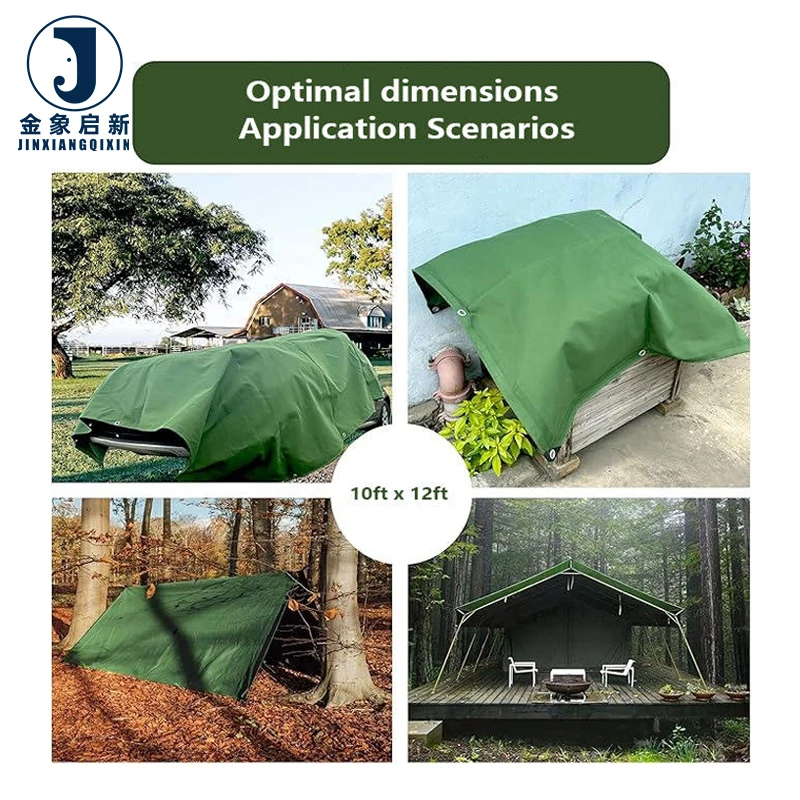
Specialist-Grade Construction — nearly 30 years of coating process control applied to ventilation-adjacent and heavy-duty industrial covers, delivering laminated fabric with full compliance documentation.
Technical Specifications
| Parameter | Value |
|---|---|
| Product Type | Laminated Tarpaulin |
| Base Fabric | Polyester cotton industrial textile with 8–12 strands of fine cotton yarn |
| Weight | 600gsm |
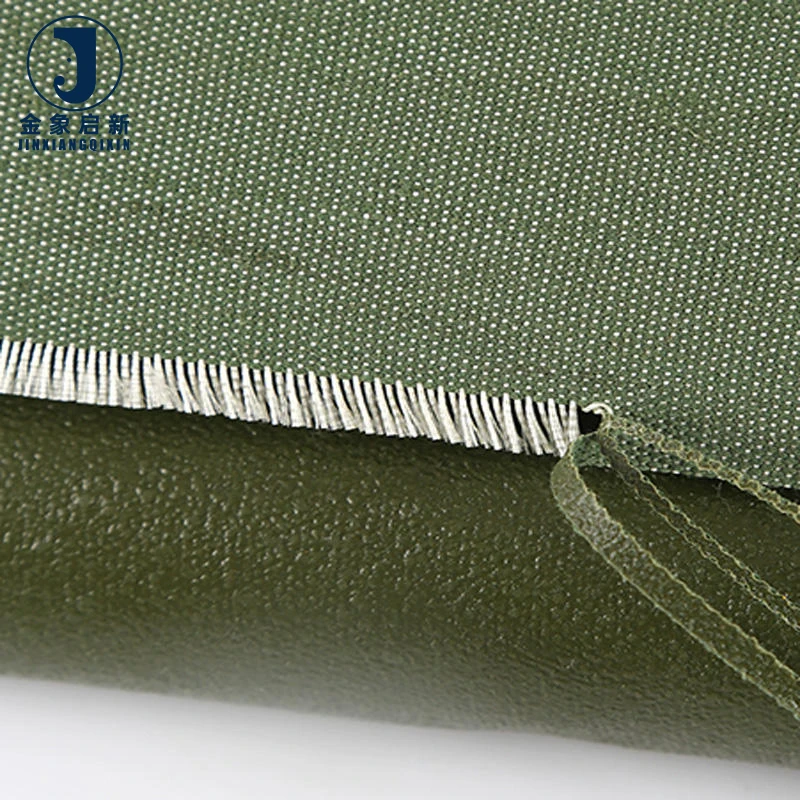
| Coating Method | Laminated (high-density woven upper layer and low-density reinforced laminated backing) |
| Total Thickness | 0.5mm / 0.6mm / 0.7mm |
| Roll Width | 2m |
| Roll Length | 100m |
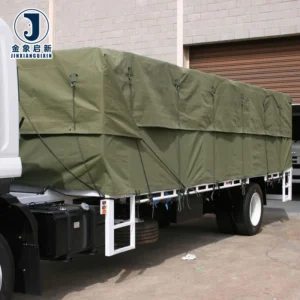
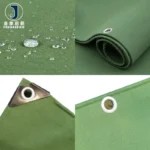
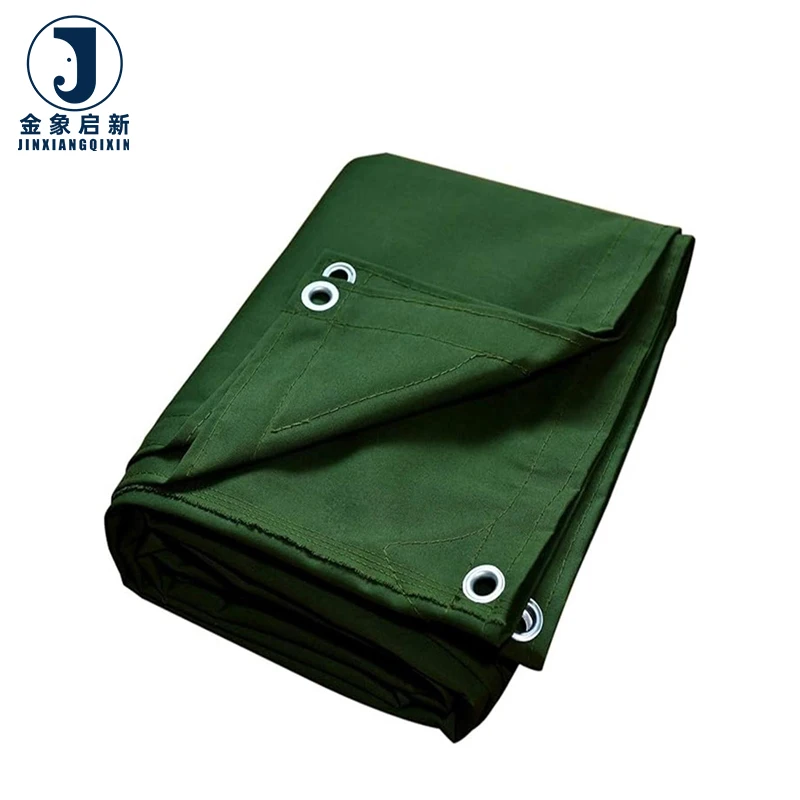
| Color | Army Green Camouflage / Custom |
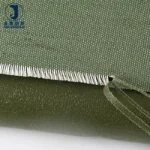
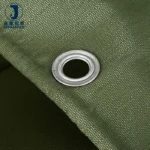
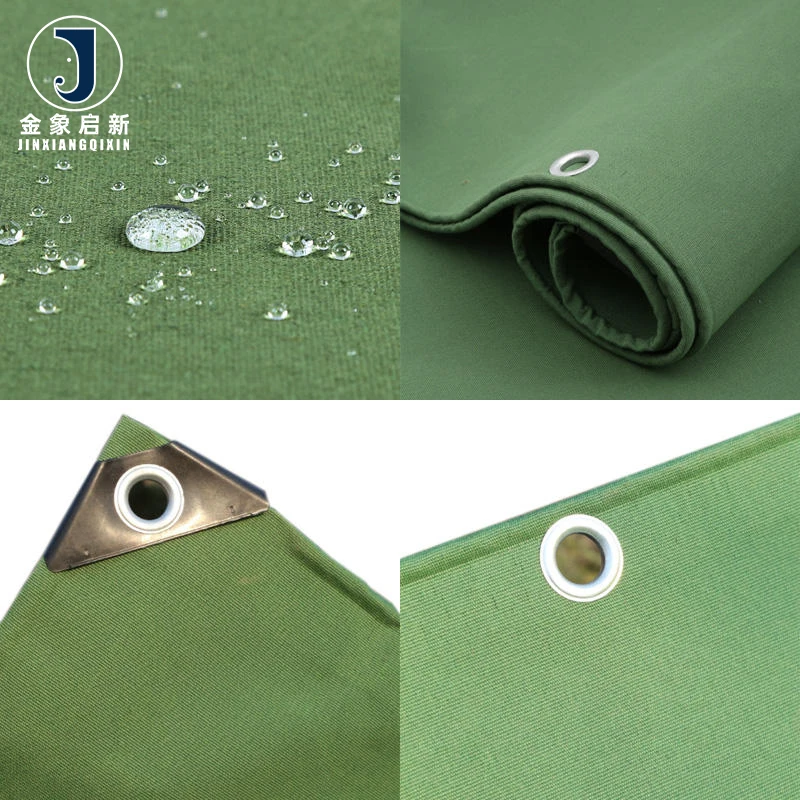
| Edge Reinforcement | Rust-proof aluminum eyelets every 1m at corners and hem; welded and sewn seams with poly rope |
| UV Treatment | Claimed UV resistant (test basis not stated) |
| Flame Retardant | Available in flame retardant grades — confirm the grade required for your site |
| Anti-Static | Available in anti-static grades — confirm compliance standard required |
| Waterproof Rating | Claimed waterproof (test basis not stated) |
| Anti-Mildew | Claimed mold resistant (test basis not stated) |
| Standards | CE, ISO |
Application Suitability
| Application | Exposure & Requirement |
|---|---|
| Mining and tunnelling ventilation duct covers | Constant abrasion against rock and steel, mandatory fire-retardant and anti-static certification underground |
| Aviation hangar temporary enclosures | Wide temperature swings, fuel and chemical exposure, flame-retardant compliance required by airport authority |
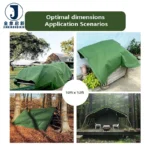
| Construction site equipment covers | UV exposure, wind-driven rain, dust and debris accumulation, frequent handling and repositioning |
| Specialist membrane and inflatable structures | Structural tensile loads, long-term UV exposure, seam integrity under cyclic inflation pressure |
| Heavy-duty truck and trailer covers | Highway wind flex, road spray, tie-down load at eyelet points, daily folding and unfolding |
Why Certification Gaps Cost More Than the Fabric Itself
When a ventilation duct or industrial cover arrives on site without the fire-retardant or anti-static certificate the inspector demands, the entire installation halts. Compliance documentation is not a nice-to-have — it is the difference between passing inspection and ripping the fabric down.
I have seen contractors forced to remove newly installed covers because the supplied material lacked the specific flame-retardant grade the site safety plan required. The replacement cost was never just the fabric. It included labour, downtime, and the schedule penalty from the project owner [NEED_CITE: fire classification requirements for temporary structures on mining and construction sites]. Sourcing a laminated tarpaulin fire retardant or anti-static grade without a matching test report is a procurement failure, not a material failure.
Ventilation-Adjacent Covers Where Compliance Is Non-Negotiable
In mining and tunnelling operations, the fabric surrounding ventilation ductwork faces the same fire and static discharge requirements as the duct itself. A laminated tarpaulin fire retardant grade must match the specific standard your site safety plan references — whether that is a regional mining code or an international classification. The 600gsm weight and laminated construction provide the structural body to hold shape around duct penetrations and access panels, while the high-density woven upper layer resists abrasion from equipment passing through the enclosure.
Matching Thickness to the Severity of the Installation
The 0.5mm, 0.6mm, and 0.7mm thickness options exist because not every cover faces the same mechanical stress. A temporary aviation hangar partition may perform well at 0.5mm, where wind load is moderate and handling is infrequent. A mining enclosure subjected to daily equipment contact and rock dust abrasion needs the 0.7mm option [NEED_CITE: relationship between coated fabric thickness and abrasion resistance in underground environments]. Specifying thickness against the actual exposure conditions avoids both under-protection and unnecessary material cost.
What the Base Fabric Construction Actually Controls
The polyester cotton industrial textile with 8–12 strand fine cotton yarn determines how the fabric behaves under load before the coating even enters the equation. Woven density and yarn count govern tensile strength in both warp and weft directions, while the laminated backing adds dimensional stability and tear propagation resistance. A 600gsm reading alone tells you the total mass per square metre — it does not tell you whether that mass sits in a tightly woven base or a loosely constructed scrim padded with filler yarn. That distinction matters when a tie-down strap pulls against an eyelet in high wind, concentrating force into a small area of fabric.
The laminated coating method — bonding a high-density woven upper layer to a low-density reinforced backing — creates a composite structure where each layer addresses a different failure mode. The upper layer handles surface abrasion and UV exposure, while the backing resists puncture and limits tear spread.
The Hidden Cost of Undocumented Performance Claims
When a supplier states "flame retardant" on the quotation but ships without a test report, the buyer discovers the gap at the worst possible moment — during the site safety audit. Similarly, anti-static claims without a measurement basis leave mining contractors exposed to ignition risk assessments they cannot satisfy [NEED_CITE: anti-static requirements for fabric used in explosive atmospheres underground]. UV resistance and mold resistance face the same verification problem. Without documented test methods, these remain marketing statements rather than engineering specifications that a project engineer can sign off on.
Why Procurement Teams Route Specialist Orders Here
Deep process control over coating weight and adhesion, built across nearly 30 years focused on coated fabric, means the 600gsm stated on the quotation is the 600gsm measured at pre-shipment inspection.
Three full production lines and 36 sets of professional equipment support roll stock availability and cut-to-size orders without extended delays on custom widths or colours.
A 10-person R&D team handles material selection and sample development for site-specific compliance requirements, delivering samples within days rather than weeks.
Dedicated QA/QC at every production stage with 100% inspection before dispatch catches seam defects, eyelet spacing errors, and colour inconsistencies before they reach the container.
ISO and CE certified operations with export documentation for cross-border projects, including certificate of origin and customs support.
Documentation & Verification
- Material specification sheet stating 600gsm, polyester cotton base fabric, laminated coating, and colour reference
- Flame-retardant and anti-static test reports matched to the compliance standard your site requires
- Pre-shipment inspection record with weight verification per roll before dispatch
- Roll packing list with dimensions, weight, and batch traceability for each roll
- Certificate of origin and customs documentation for international project delivery
Fabrication, Handling & Storage
- Weld seams at 0.5–0.7mm thickness require matched temperature and dwell time to achieve full bond without scorching the polyester cotton base
- Sewn seams with poly rope reinforcement should follow welded seams at high-flex points to distribute tie-down load across the 600gsm fabric
- Aluminum eyelets at 1m intervals need reinforced hem folds to prevent pull-through under wind load on 2m-wide panels
- Store rolls horizontally on racking to avoid compression marks on the laminated surface that may not recover
- Unroll in moderate temperatures to prevent cracking of the laminated backing in cold-condition transport
- Clean with mild detergent only — solvent-based cleaners may degrade the laminated coating bond over time
Request a Specification Match
Provide your site’s fire-retardant or anti-static compliance standard so we can match the correct grade and supply the corresponding test report. Confirm whether you need roll stock at 2m × 100m or finished panels cut to specific dimensions with eyelet layout to your drawing. Specify the thickness option — 0.5mm, 0.6mm, or 0.7mm — that aligns with your mechanical exposure conditions, and whether Army Green Camouflage or a custom colour is required.
Frequently Asked Questions
Q: What flame-retardant grade should I specify for a mining ventilation enclosure?
A: The required grade depends on your jurisdiction’s mining safety code and the specific section covering temporary fabric structures. We supply laminated tarpaulin in flame-retardant grades with test reports matched to the standard you reference. Share your site safety plan or the inspector’s specification, and we will confirm which grade applies and provide the documentation before production.
Q: How do I verify the 600gsm weight on arrival matches the quotation?
A: Every roll undergoes weight verification during our 100% pre-shipment inspection, and the inspection record accompanies the shipment. On arrival, cut a measured sample from any roll and weigh it on a calibrated scale. The polyester cotton base and laminated coating together should return a reading consistent with the stated specification across the entire batch.
Q: Can anti-static treatment be combined with flame-retardant grades on the same fabric?
A: Both treatments can be applied to the 600gsm laminated construction, but the specific combination depends on which standards your project requires. Anti-static and flame-retardant chemistries must be compatible with the laminated coating process. Provide both compliance standards at inquiry stage so we can confirm the treatment combination and supply test reports for each.
Q: What is the practical difference between the 0.5mm, 0.6mm, and 0.7mm thickness options?
A: Each thickness uses the same 600gsm polyester cotton base but varies in laminated coating build. The 0.5mm suits lighter-duty enclosures with minimal mechanical contact. The 0.6mm handles moderate abrasion in construction and transport covers. The 0.7mm is specified where equipment contact, rock dust, or high wind loads demand maximum coating protection against puncture and surface wear.