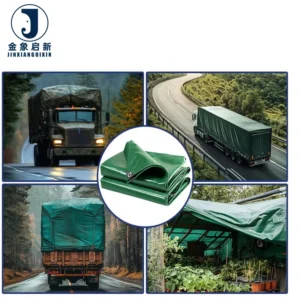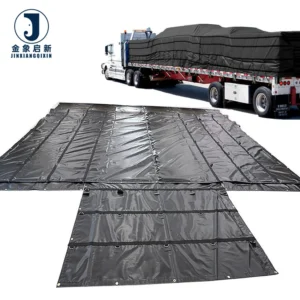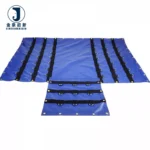
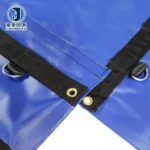

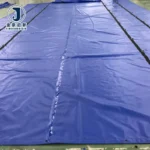
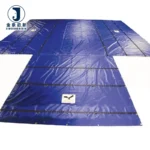
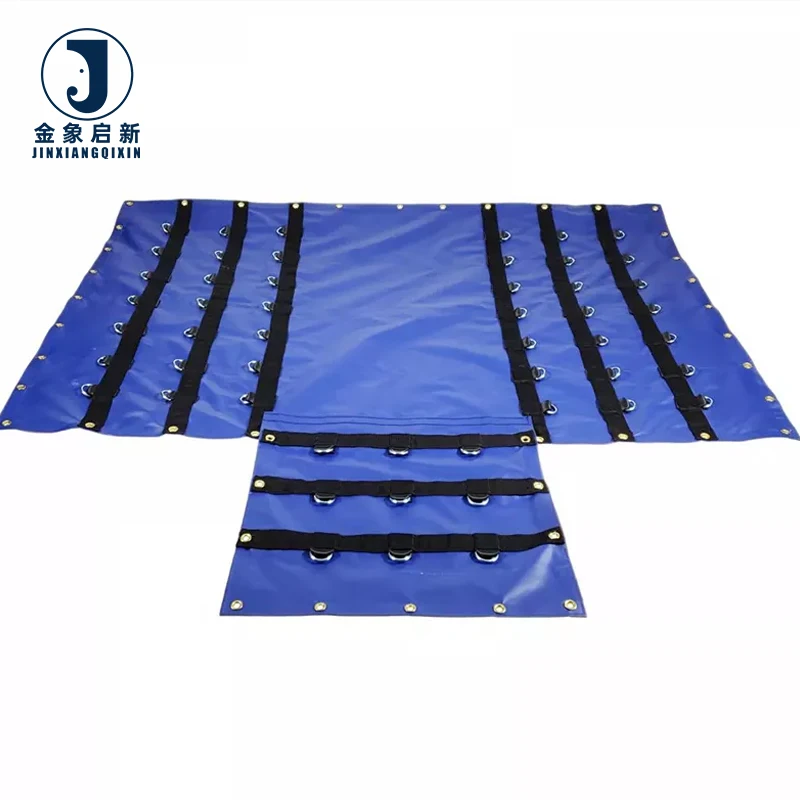
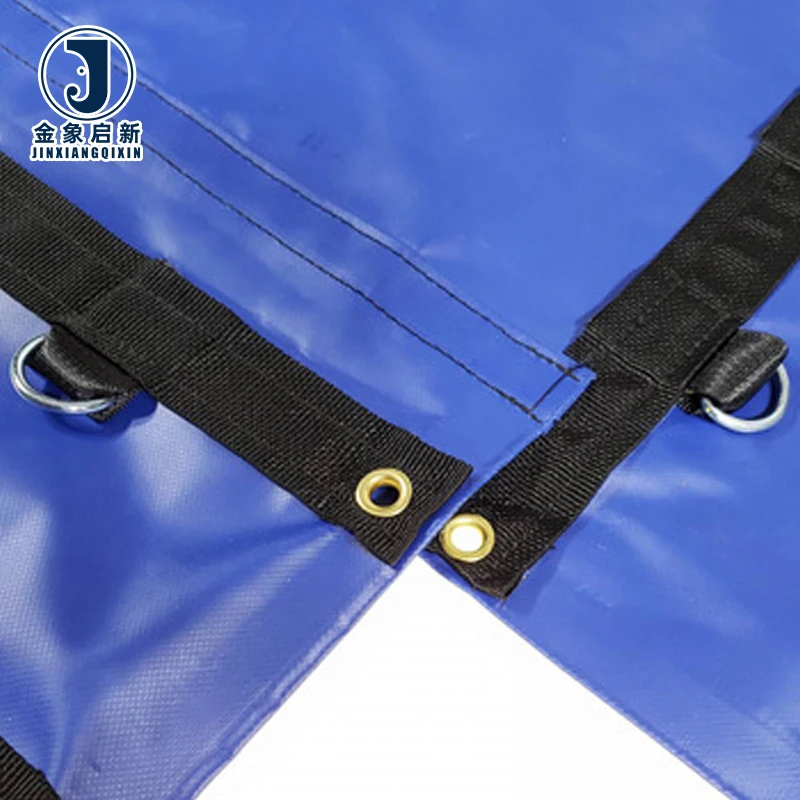
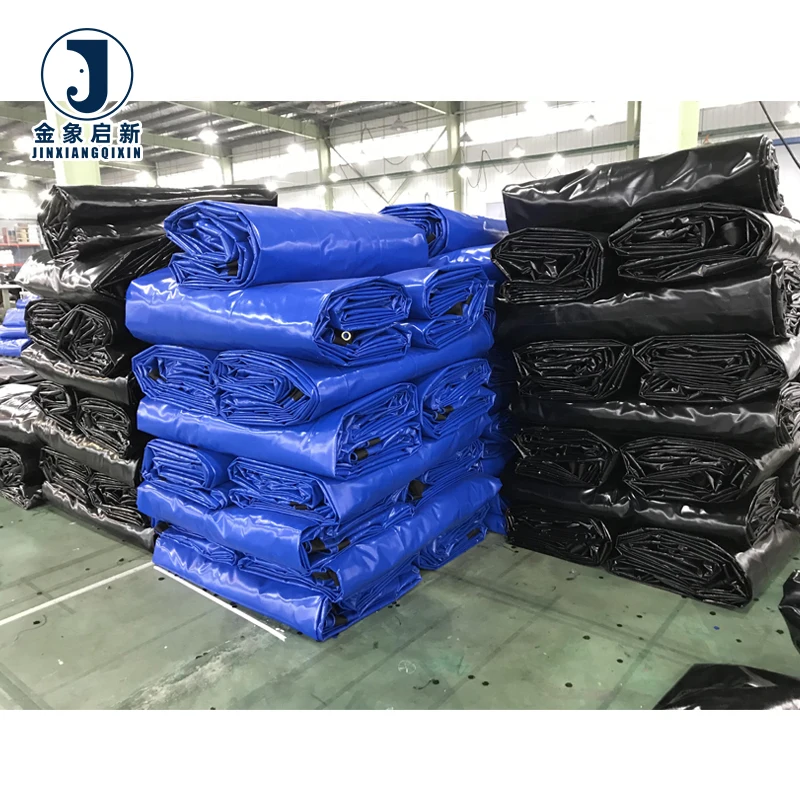
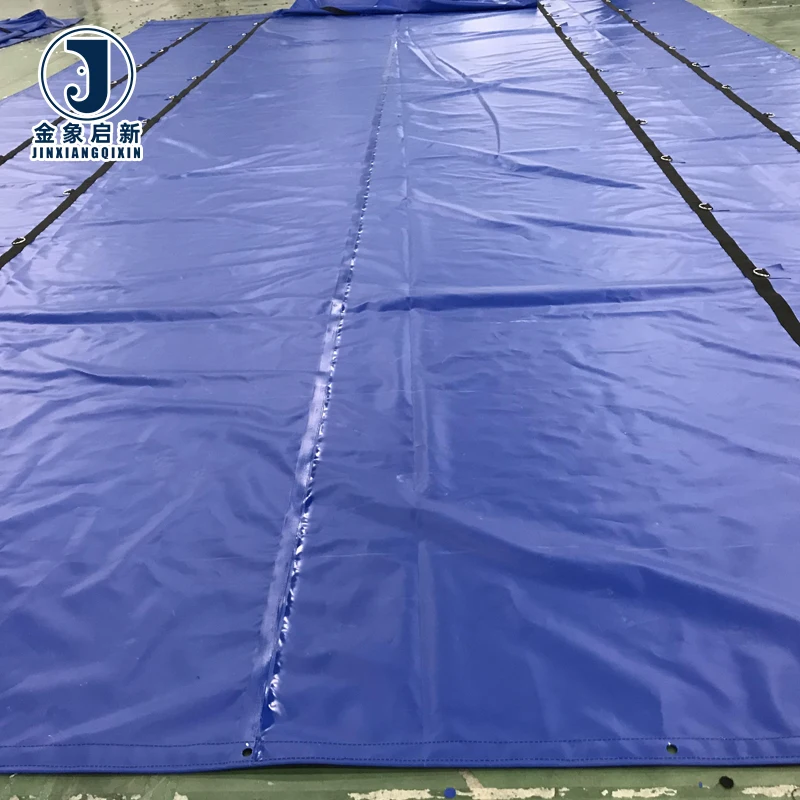
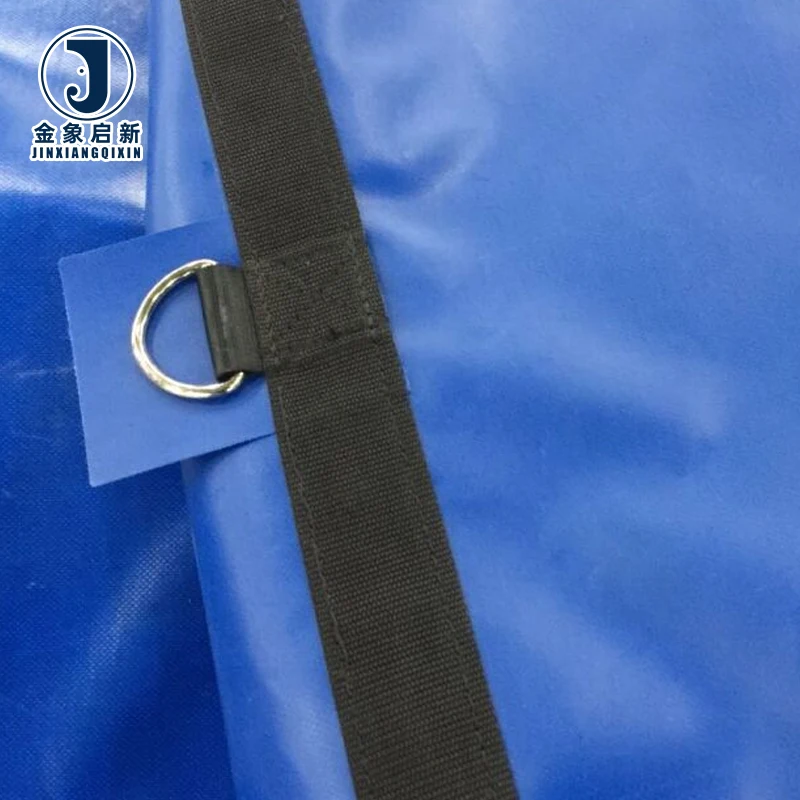
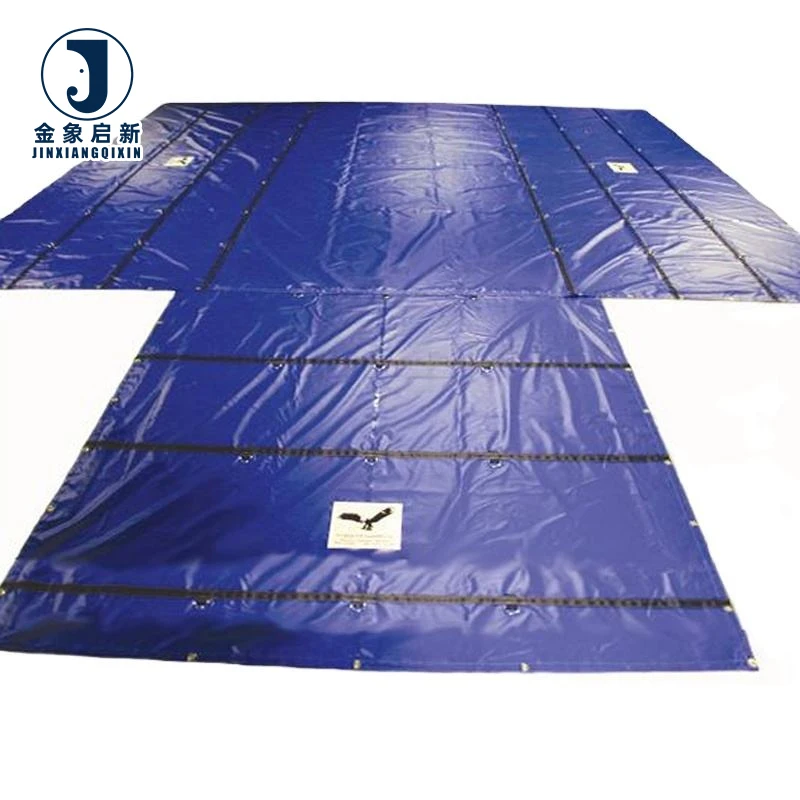
Coating Weight Verification — Every roll of this PVC lumber tarpaulin for flatbed truck is weighed and measured against the 610gsm specification before dispatch, ensuring the material you receive matches the quotation.
Technical Specifications
| Parameter | Value |
|---|---|
| Product Type | PVC Truck Cover |
| Base Fabric | 1000 × 1000D polyester |
| Mesh Count | 20×20 / 18×18 |
| Coating Material | PVC (polyvinyl chloride) |
| Coating Method | Knife coated |
| Weight | 610gsm (18 ounces) |
| Dimensions | 24′ × 27′ with 8 ft. drop |
| Hardware | 3 rows of D-rings |
| Temperature Range | -35 ~ 70 °C |
| Color Options | Black / Blue |
| Tail Wing | On 6′ and 8′ drops |
| Application Variant | Lumber tarp with end flap |
| Standards | ISO 9001, CE |
Application Suitability
| Application | Exposure & Requirement |
|---|---|
| Stacked lumber transport on flatbed trailers | Rainwater ingress, UV radiation, highway wind load, multi-point tie-down stress |
| Wall panel and building material haulage | Road debris impact, abrasion at load contact points, tall load enclosure |
| Long-haul flatbed logistics | Extended weather exposure, temperature fluctuation across climate zones, repeated tarp deployment |
| High-profile cargo coverage | Tall load sealing via 8 ft. drop, end flap protection against rear turbulence |
Why a 24′ × 27′ Tarp Fails When It Is Not Actually Sized for Your Flatbed
A PVC lumber tarpaulin for flatbed truck must match the trailer deck length and the loaded cargo height, not just a nominal size label.
Fleet operators repeatedly face the same problem: a tarp ordered at 24′ × 27′ arrives, fits the deck when empty, but leaves the rear 18 inches of a stacked lumber load exposed once the 8 ft. drop is deployed over cargo. The generic sizing assumes a flat load profile, while actual lumber stacks vary in height and length by several inches depending on the supplier and the dunnage used underneath. When the end flap cannot reach past the cargo edge, road spray and crosswinds force moisture directly into the load [NEED_CITE: flatbed cargo coverage gap measurements across common lumber stack configurations]. The result is water damage claims, rejected deliveries, and tarp replacement costs that compound across a fleet running dozens of trailers daily.
D-Ring Placement and Tie-Down Integrity Under Highway Loads
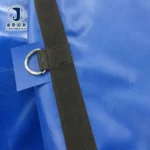
The 3 rows of D-rings on this PVC lumber tarpaulin for flatbed truck are positioned to align with standard flatbed stake pockets, distributing tie-down tension across multiple anchor points rather than concentrating stress at the hem. On long-haul routes, wind lift generates sustained upward force on the tarp surface, and a single row of D-rings would transfer that entire load to one line of stitching. Three rows spread the force, reducing the risk of D-ring pull-through at highway speeds.
End Flap Sealing for Tall and Long Cargo Profiles
The tail wing on the 8 ft. drop is designed to close the gap at the rear of the load where turbulence is highest. On flatbed trailers carrying lumber or wall panels, the rear of the cargo stack is exposed to a low-pressure zone created by the truck’s wake, which draws rain and road spray upward into any unsealed opening. The end flap overlaps the cargo edge and secures independently, maintaining enclosure even when crosswinds shift the tarp laterally [NEED_CITE: aerodynamic pressure zones on flatbed trailer cargo during highway transit].
How Base Fabric Denier and Mesh Count Determine Real-World Performance
The 1000 × 1000D polyester base at 20×20 or 18×18 mesh count defines the structural skeleton of this fabric. Denier indicates the yarn thickness in both warp and weft directions, and when both directions use 1000D yarn, the tensile strength is balanced rather than biased toward one axis. The mesh count — 20×20 or 18×18 threads per inch — determines how tightly those yarns are woven, which directly affects how the PVC coating penetrates and bonds to the base fabric. A tighter weave holds more coating weight in the interstices, improving peel strength at welded seams. This is why the 610gsm weight cannot be evaluated in isolation: a 610gsm fabric with a loose 12×12 mesh will have thicker coating but weaker base fabric adhesion than the same weight at 20×20, leading to delamination under repeated flexing at load contact points. The knife coating method used here forces PVC paste into the weave under blade pressure, achieving deeper penetration than dip coating and producing a more uniform surface weight distribution across the roll width.
What Happens When the Coating Weight Is Not Verified Before Dispatch
A tarpaulin quoted at 610gsm that arrives at 540gsm has lost nearly 12 percent of its material mass, and that deficit appears as thinner coating at the surface. Thinner coating means the base fabric yarns are more exposed to abrasion against rough cargo edges, and the heat-welded seams have less PVC material available to fuse together during fabrication. On a flatbed lumber tarp, the seams along the drop edges and the D-ring attachment zones are the first points to show coating wear, and when the coating is underweight, those seams fail before the base fabric does [NEED_CITE: seam peel strength reduction in underweight PVC coated tarpaulin batches]. The entire tarp must then be replaced mid-contract, disrupting fleet scheduling and exposing cargo to weather until a replacement arrives.
Why Procurement Teams Source This Tarpaulin From Jinan Jinxiang
Three full production lines with 36 sets of professional equipment ensure that bulk orders of this PVC lumber tarpaulin for flatbed truck maintain consistent coating weight and D-ring placement across every unit in the batch. The 10-person R&D team develops custom-sized samples within days when a fleet operator needs a tarp cut to a non-standard trailer length or drop height. Dedicated QA/QC runs at every production stage, with 100 percent pre-shipment inspection verifying D-ring count, hem reinforcement, and weight per square meter against the stated 610gsm specification. ISO 9001 and CE certified processes underpin the production workflow, and the company’s nearly 30 years of coated fabric experience translates to deep process control over coating adhesion and knife-coat weight uniformity. After-sales support covers field repair guidance and installation advice specific to flatbed tie-down configurations [NEED_CITE: ISO 9001 quality management requirements for coated fabric manufacturing].
Documentation & Verification
- Material specification sheet confirming 1000 × 1000D base fabric, 610gsm coating weight, and color reference per roll
- Pre-shipment inspection record verifying D-ring placement count across all 3 rows and hem reinforcement integrity
- ISO 9001 and CE certificates issued to Jinan Jinxiang for coated fabric production
- Roll packing list with individual roll dimensions and weight for container loading verification
- Certificate of origin and customs documentation supporting international flatbed fleet procurement
Fabrication, Handling & Storage
- Heat-weld the 610gsm PVC seams at temperature settings matched to knife-coated material to prevent coating scorch
- Reinforce each D-ring anchor point with a double-layer patch of 1000 × 1000D base fabric behind the ring
- Store rolled tarps upright on pallets to prevent flat-spot deformation of the PVC coating surface
- Deploy tarps above -35 °C minimum to avoid PVC stiffening and cracking at fold lines during unfolding
- Clean with mild detergent only; solvents will degrade the PVC coating surface on the black or blue finish
- Allow the tail wing to hang freely during storage to prevent permanent creasing at the flap fold line
Requesting a Quotation for Your Flatbed Fleet
Provide your trailer deck dimensions, loaded cargo height, and the number of units required so the correct drop height and D-ring row spacing can be confirmed. Specify any color requirements across your fleet to ensure roll-to-roll consistency, and indicate whether flame-retardant treatment is required for your operating region. Share your preferred tie-down hardware configuration if it differs from standard flatbed stake pocket spacing.
Frequently Asked Questions
Q: How is the 610gsm weight verified on arrival to match the quotation?
A: Every roll undergoes weight measurement during the 100 percent pre-shipment inspection. The inspection record documents the actual grams per square meter measured at multiple points across the roll width. This record ships with the documentation package, allowing you to cross-reference the stated 610gsm against the measured values before accepting delivery.
Q: What D-ring spacing options are available for different flatbed trailer models?
A: The standard configuration uses 3 rows of D-rings spaced to align with common flatbed stake pockets. For trailers with non-standard pocket spacing, the D-ring placement can be adjusted during fabrication. Provide your trailer’s stake pocket measurements, and a sample with revised D-ring positioning is developed within days for fitment verification.
Q: How are welded seams reinforced at flex points where the lumber load shifts?
A: Seams along the drop edges and D-ring zones receive double-layer reinforcement patches of the same 1000 × 1000D base fabric. The knife-coated PVC surface provides sufficient coating thickness for heat welding to achieve full fusion at these stress points, preventing seam failure before the main fabric body reaches its service limit.
Q: Can this tarp be custom-sized to fit specific trailer lengths and drop heights?
A: Yes. The 10-person R&D team produces custom-sized samples within days based on your exact trailer deck length, cargo height, and drop requirement. Once the sample is approved, production runs maintain the confirmed dimensions across all units, with 100 percent inspection verifying cut accuracy before dispatch.
Q: What after-sales support is available for field repair and installation?
A: The after-sales team provides guidance on heat-weld repair techniques for field damage to the PVC coating, D-ring replacement procedures, and best practices for tarp deployment and tie-down on flatbed trailers. Support covers both the initial installation phase and ongoing fleet maintenance requirements.