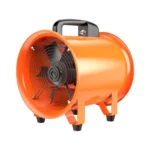
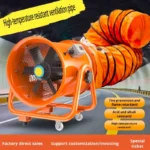
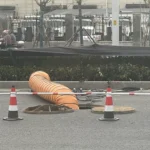

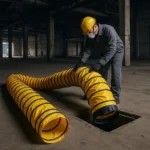

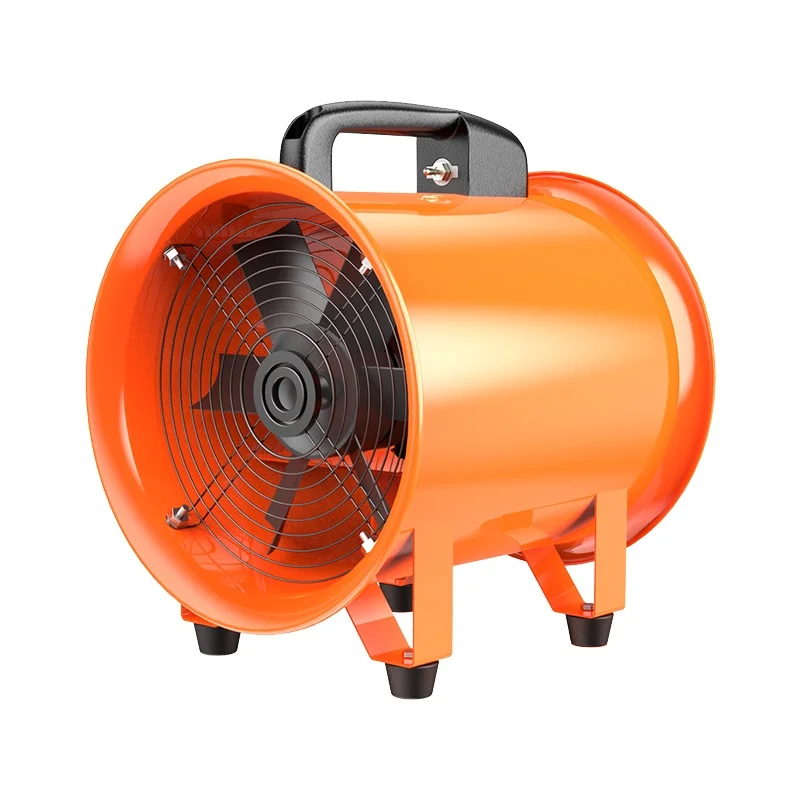

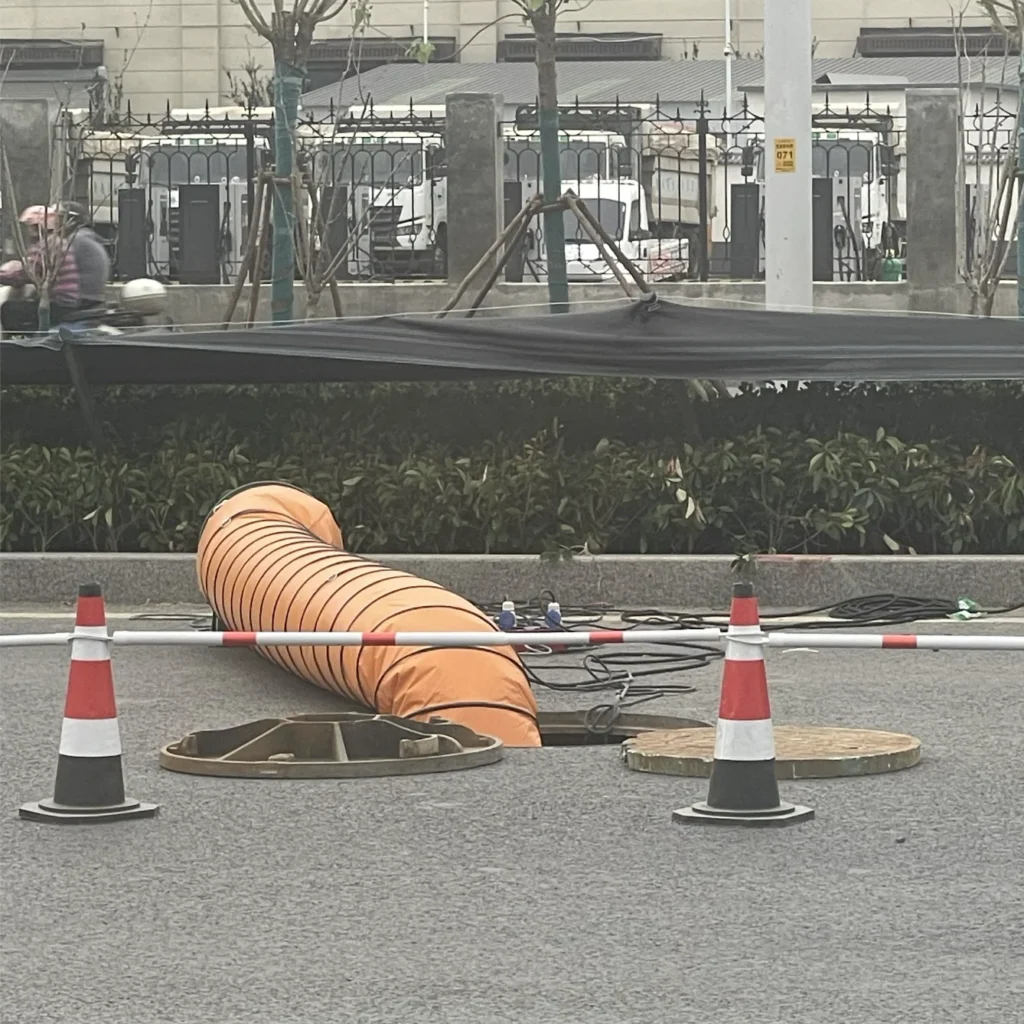
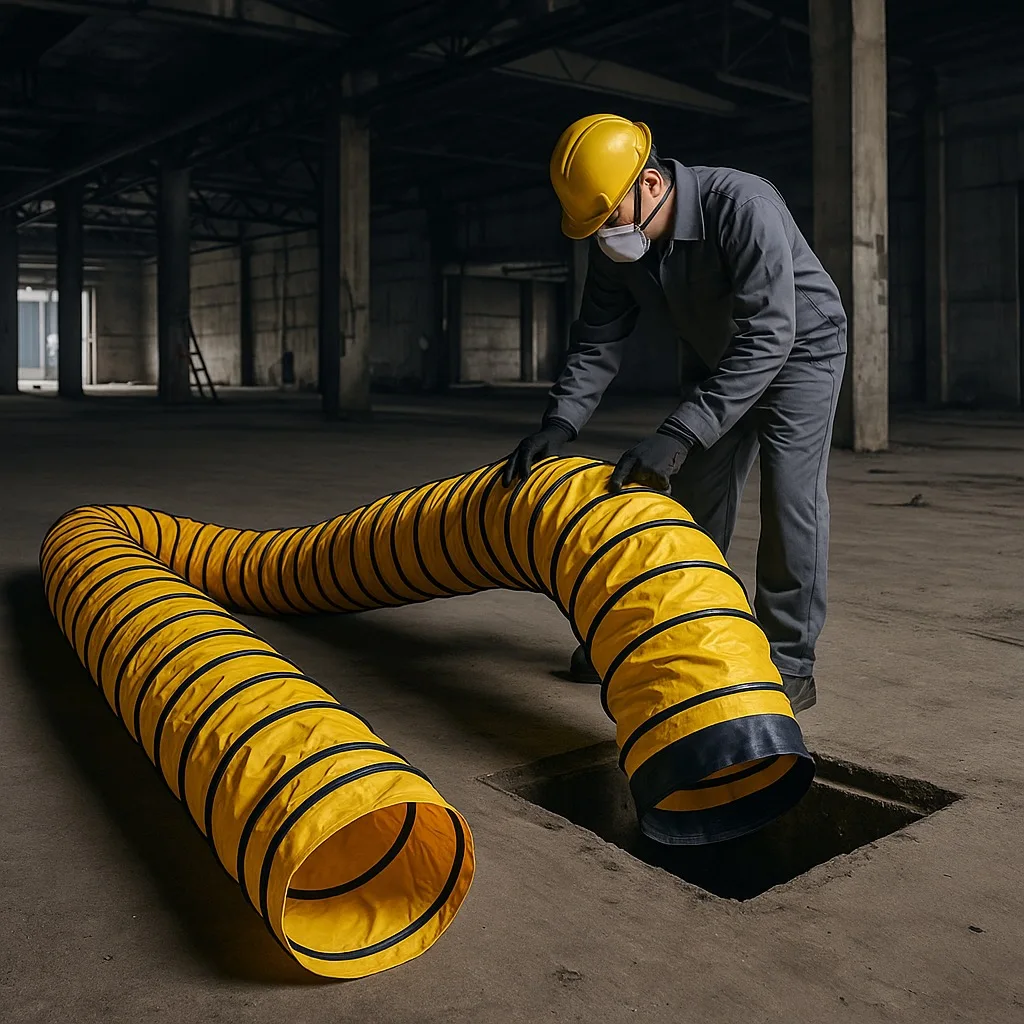

Precision Matched — Fan sizing selected to match duct diameter, friction loss and site airflow demand, verified before dispatch.
Technical Specifications
| Parameter | Value |
|---|---|
| Product Type | Axial Flow Exhaust Fan |
| Size Range | 200 mm to 900 mm |
| Power Range | 250 W to 5500 W |
| Air Volume Range | 1300 to 28000 m³/h |
| Total Pressure Range | 140 to 320 Pa (peak) |
| Voltage | 220V / 380V |
| Noise Level | 57 to 88 dB(A) depending on size |
| Bearing Type | Ball Bearing |
| Housing Material | Cast Iron |
| Customisation | ODM Available, Custom Printing and Colors Supported |
Application Suitability
| Application | Exposure & Requirement |
|---|---|
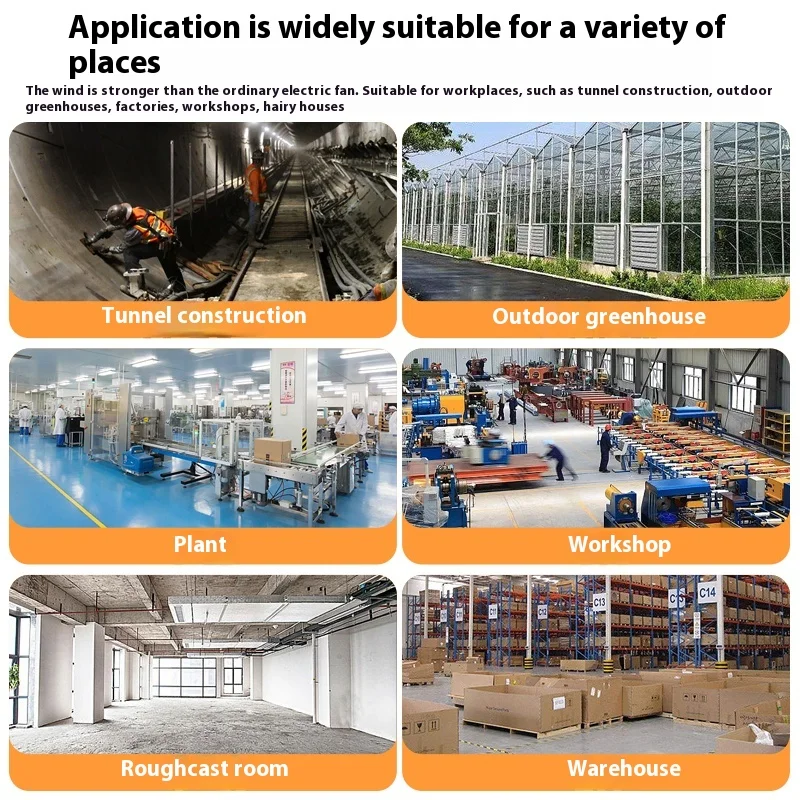
| Mining face ventilation | Dust-laden air, continuous duty, fire-retardant and anti-static duct compliance |
| Tunnelling exhaust | High static pressure over long duct runs, confined workspace, moisture exposure |
| Construction confined space | Intermittent use, variable duct lengths, fume and dust extraction |
| Aviation hangar fume extraction | Enclosed bay ventilation, chemical vapour, low-noise requirement near work crews |
| Tank and vessel ventilation | Restricted access, flexible duct connection, spot cooling or air exchange |
Why Airflow Rating Alone Does Not Guarantee Site Compliance
The right Axial Flow Exhaust Fan for Mining and Tunnelling Ventilation must deliver enough static pressure to overcome duct friction across the full run length, not just move air at the fan outlet.
A fan that meets the airflow figure on paper can still underperform once connected to 50 metres of flexible duct. Pressure drops accumulate at every bend, coupling and restriction, and the volume reaching the working face may fall well below what the site safety plan requires [NEED_CITE: ventilation pressure loss calculation methods for flexible duct systems]. Contractors frequently discover this mismatch only after the duct is deployed and air velocity at the face is measured.
Matching the fan curve to the duct system curve before procurement eliminates this risk.
Sizing the Fan to the Duct Run
Selecting an Axial Flow Exhaust Fan for Mining and Tunnelling Ventilation starts with the duct diameter and total run length. Each size in this range — from 200 mm to 900 mm — corresponds to a standard duct diameter, ensuring a direct connection without adapters that introduce turbulence and pressure loss. The 11 available sizes cover airflow from 1300 m³/h for small confined-space tasks up to 28000 m³/h for large tunnel sections, so the selection process focuses on matching static pressure output to the calculated friction loss of the installed duct.
Cast Iron Housing and Ball Bearing Durability
Underground and construction environments subject ventilation equipment to sustained vibration, dust ingress and thermal cycling. The cast iron housing provides mass and rigidity that dampens vibration transmitted from the motor and impeller, reducing fatigue at duct connection points. Ball bearing construction supports continuous-duty operation and handles the radial loads generated when the fan is repositioned or tilted on uneven ground [NEED_CITE: bearing selection criteria for industrial axial fans in dusty environments]. Together these features extend service intervals compared to lighter-housed alternatives.
Reading the Specification Table for Site Selection
Air volume and total pressure must be evaluated together. A 400 mm fan delivers 11000 m³/h at 320 Pa, making it suitable for longer duct runs where friction loss is significant, while a 650 mm fan moves 18700 m³/h at a lower 180 Pa — better for high-volume exchange over shorter distances. Voltage compatibility at 220V and 380V allows the same fan family to serve sites with single-phase or three-phase supply without external transformers. Noise levels scale with size and power, ranging from 57 dB(A) at the smallest unit to 88 dB(A) at the largest, so occupational exposure limits should guide selection where crews work near the fan intake.
The Cost of Underspecifying Static Pressure
When static pressure is underestimated, the fan cannot push the required volume through the full duct run. Air velocity at the working face drops, dust and fumes accumulate, and site safety audits flag the deficiency [NEED_CITE: confined space ventilation failure modes in tunnelling operations]. Correcting this after installation means adding booster fans, replacing the primary unit, or shortening the duct — all of which cost more than selecting the correct fan at the procurement stage.
Why Source This Axial Flow Exhaust Fan Here
Three full production lines and dedicated QA/QC at every stage mean each fan undergoes inspection before shipment rather than batch sampling. The 10-person R&D team handles ODM configuration including voltage, plug type, housing colour and branding, with samples developed within days for project-specific requirements. Pre-shipment inspection records cover bearing play, motor winding resistance and noise output, giving buyers a documented baseline. Documentation packages include specification sheets, compliance certificates and packing lists aligned with the fan and duct set being shipped.
Documentation & Verification
- Specification sheet listing fan size, motor power, voltage and noise level for the selected unit
- Bearing and motor winding inspection record completed before dispatch
- Fire-retardant and anti-static test certificates for paired ventilation duct where applicable
- Noise test report matched to the specific fan size for site exposure assessments
- Packing list itemising fan, duct and connection hardware by line item
Fabrication, Handling & Storage
- Mount the cast iron housing on a level surface to prevent bearing preload from uneven bolt torque
- Connect flexible duct using the matched diameter to avoid step transitions that cause pressure loss
- Store the fan upright in dry conditions to protect the ball bearing seals from moisture ingress
- Verify voltage selector position matches site supply before first energisation
- Inspect impeller clearance after transport to confirm no housing deformation occurred
- Use manufacturer-specified cleaning agents to avoid damaging motor winding insulation
What to Include in Your Enquiry
Provide the duct diameter, total run length and number of bends so the correct static pressure can be calculated. Confirm the site voltage supply and whether single-phase or three-phase power is available. Specify any ODM requirements such as housing colour, branding or plug type so these can be addressed during sample development.
Frequently Asked Questions
Q: How do I match fan airflow and static pressure to ventilation duct length?
A: Calculate the total friction loss across the full duct run including bends and couplings, then select a fan whose static pressure output exceeds that value at the required airflow. The 11 available sizes cover pressures from 140 to 320 Pa, accommodating short extraction runs and extended tunnel ventilation alike.
Q: What fire-retardant and anti-static certifications are needed for mining compliance?
A: Requirements vary by jurisdiction, but most mining regulations demand documented fire-retardant and anti-static test results for ventilation duct. Request the specific test certificates for the duct paired with your fan to confirm compliance before deployment on site.
Q: What ODM customisation is available for the fan?
A: ODM options include voltage configuration, plug type, housing colour and custom branding on the cast iron housing. Samples are developed within days for approval before production, and the scope of customisation is confirmed in writing at the quotation stage.
Q: What is the lead time for custom-configured fan and duct sets?
A: Lead times depend on the level of customisation and order volume. Standard configurations ship faster, while ODM builds with specific colour, branding or voltage requirements require additional time for sample approval and production scheduling. Confirm timing at the quotation stage.
Q: What after-sales support is provided for installation and maintenance?
A: Support covers installation guidance, bearing maintenance procedures and duct replacement compatibility. Pre-shipment inspection records provide a baseline for comparison during on-site commissioning, and the documentation package includes handling and storage recommendations.