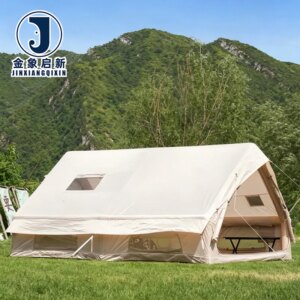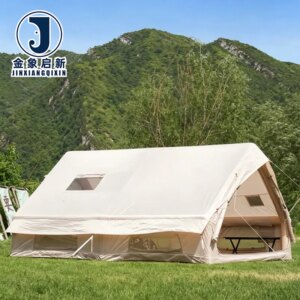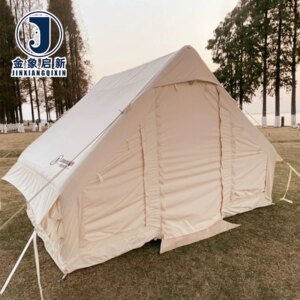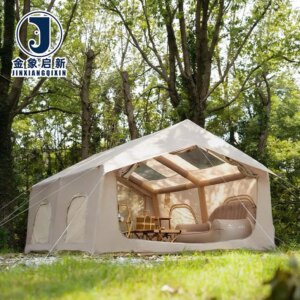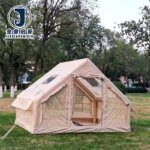
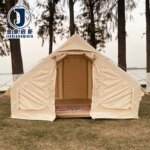
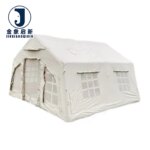
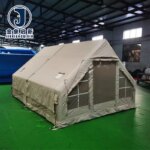

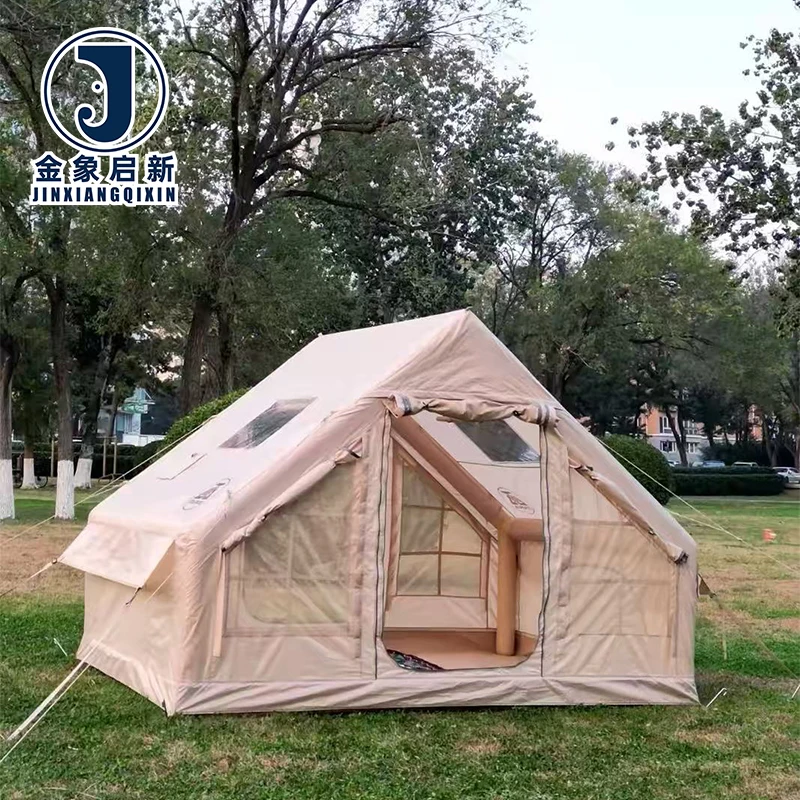
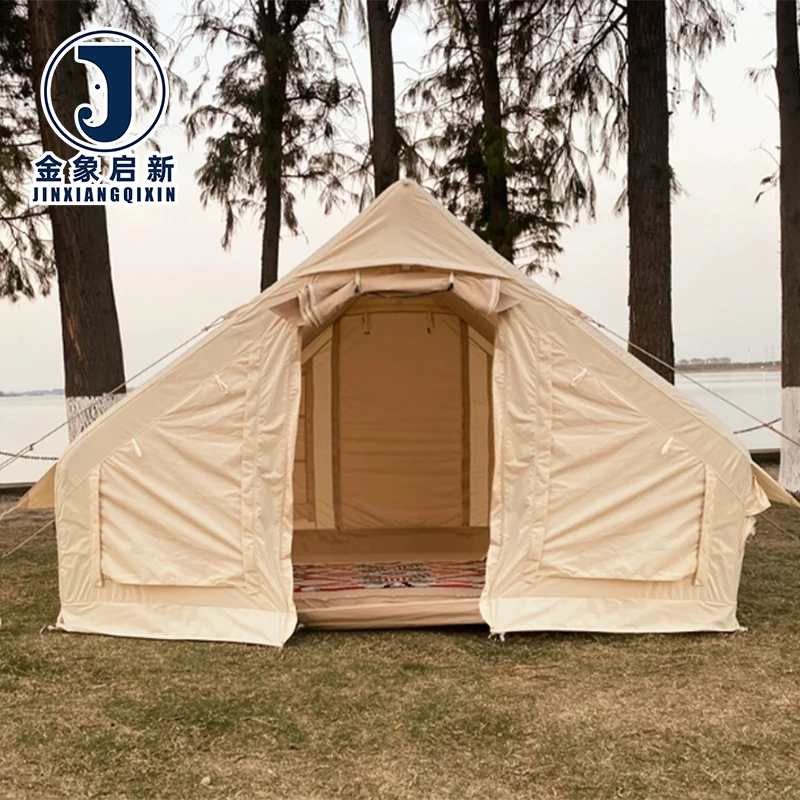
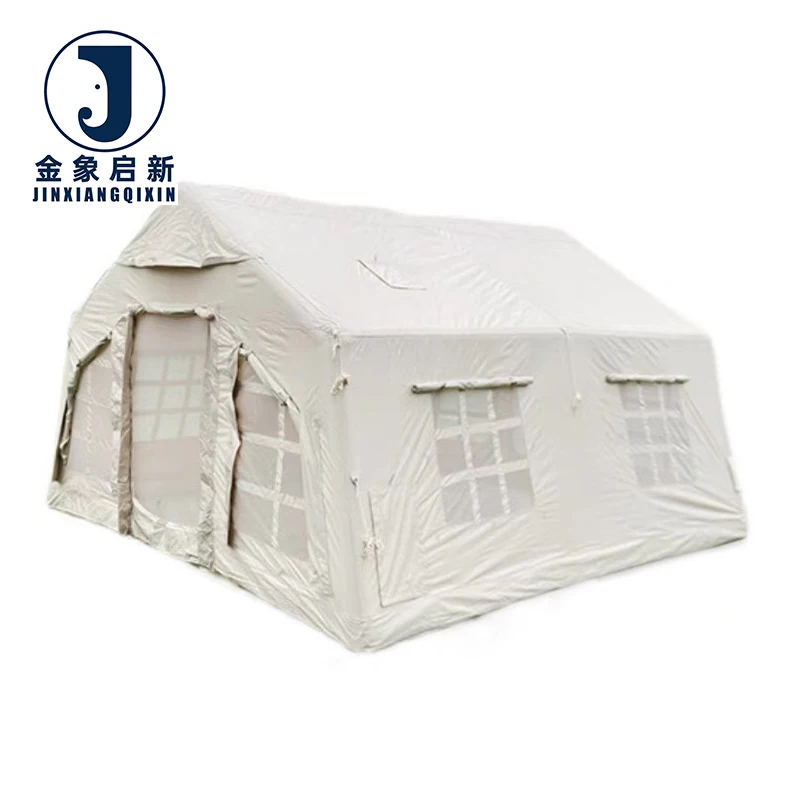
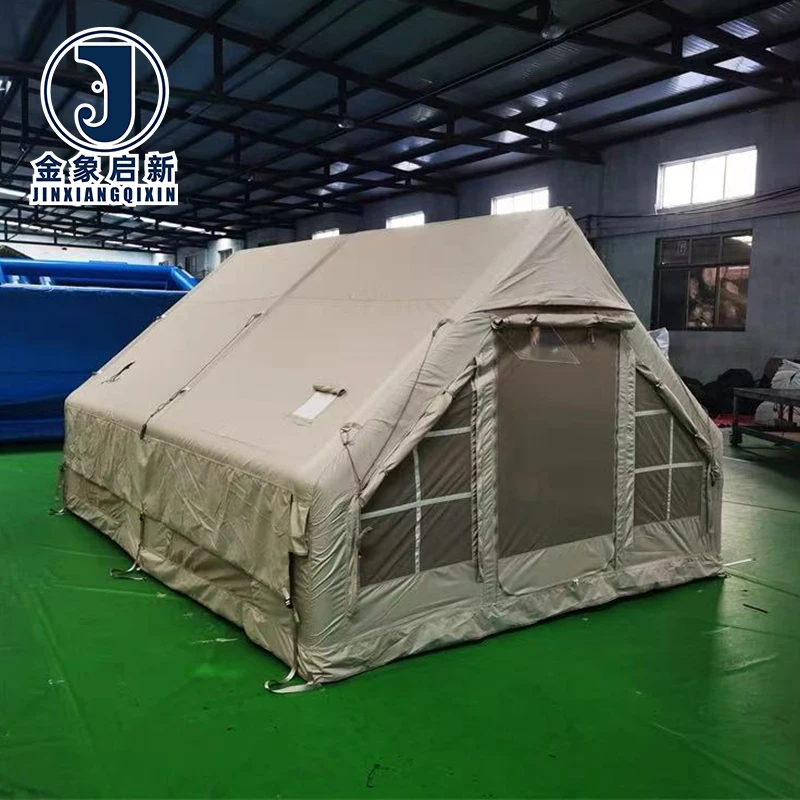
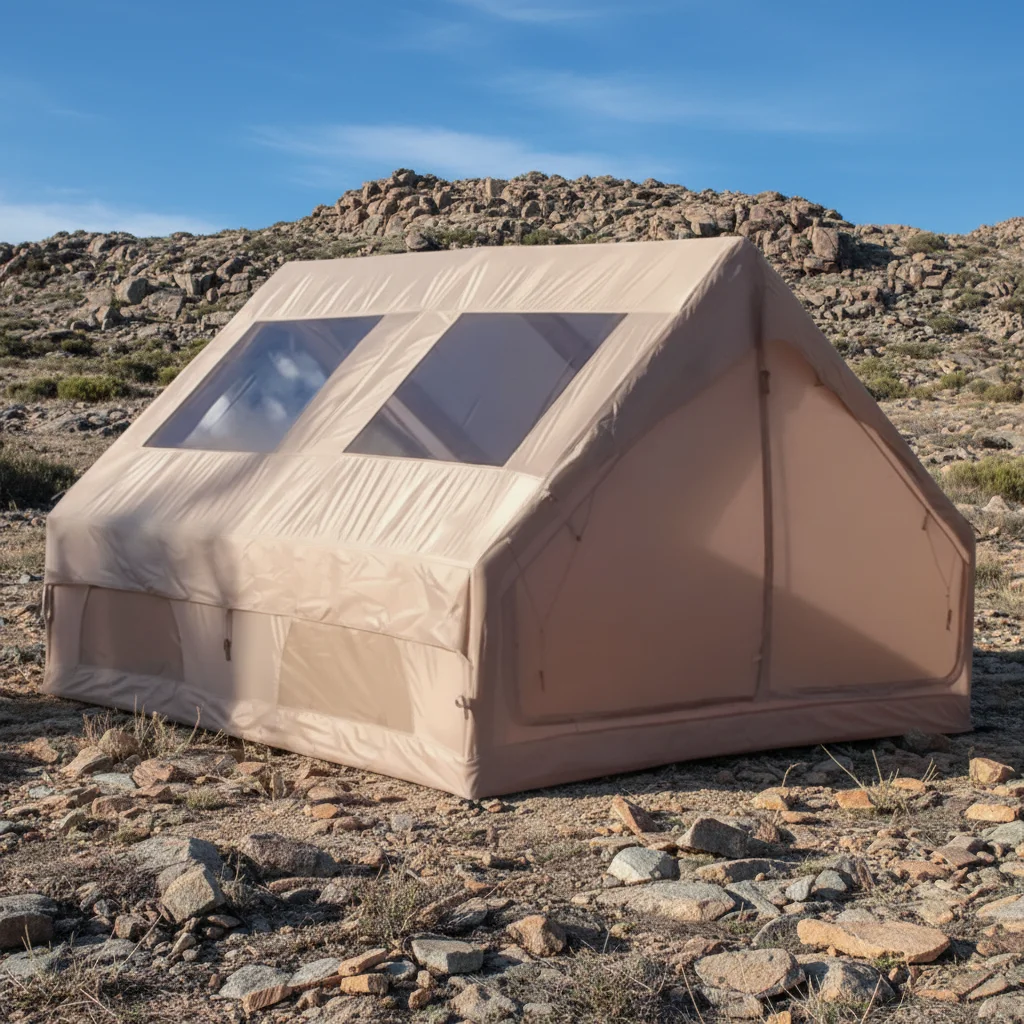
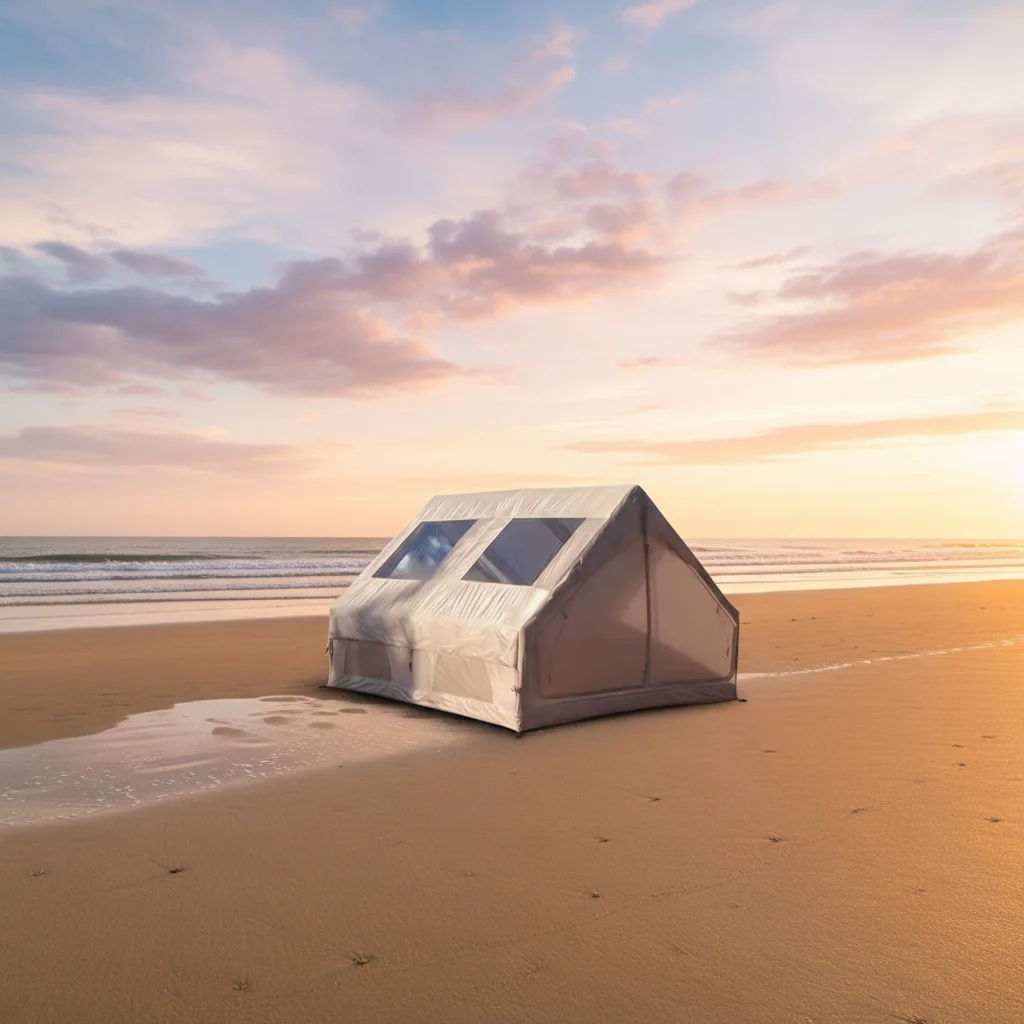
Technical Fabrication Focus — 36 sets of professional equipment dedicated to welding and shaping PVC inflatable structures, ensuring every seam holds under repeated deployment cycles.
Technical Specifications
| Parameter | Value |
|---|---|
| Product Type | Inflatable Tent |
| Core Material | PVC waterproof fabric |
| Key Performance | Waterproof, UV-resistant (test basis not stated), tear-resistant |
| Product Forms | Automatic opening, four-season design, single layer construction, extended type |
| Customization Service | OEM & ODM customization, sample customization, pattern printing |
| Fire Safety Options | Flame retardant grades available — confirm the grade required for your site |
| Anti-Static Options | Anti-static treatment available — specify compliance standard for mining or aviation |
| Certifications | ISO 9001, ISO 14001, ISO 45001, CE |
Application Suitability
| Application | Exposure & Requirement |
|---|---|
| Mining and tunnelling site shelters | Dust, ventilation adjacency, anti-static compliance, high mechanical abrasion |
| Disaster relief command centers | Rapid deployment demand, all-weather exposure, repeated inflation cycles |
| Construction site equipment storage | UV exposure, wind loading, puncture risk from sharp tools and materials |
| Aviation maintenance enclosures | Fuel vapour proximity, anti-static requirement, fire-retardant compliance |
Why Certification Claims Fall Short Without Test Documentation
A fire-retardant label means nothing at an audit if the test report does not match the standard your site demands.
Procurement teams on industrial sites frequently receive inflatable shelters with flame-retardant claims printed on the packaging but no traceable test certificate. When the site safety officer asks for proof of compliance, the supplier provides a generic material safety data sheet instead of a grade-specific test result. This gap delays project mobilisation and forces emergency re-sourcing. Inflatable tent manufacturer claims must be backed by standard-specific reports per DIN 4102, NFPA 701 or the local equivalent [NEED_CITE: fire classification standards for temporary industrial shelters].
Air Beam Welding Under Industrial Stress Cycles
Every time an inflatable shelter is deployed and packed, the air beam seams undergo flex and pressure loading. On a mining or tunnelling site, these structures may be inflated and deflated multiple times per week as the work face advances. The welded joints on this PVC inflatable tent are executed on dedicated high-frequency equipment that controls temperature and dwell time, producing a bond that matches the parent fabric in tear resistance. A custom inflatable tent deployed in these conditions requires seam integrity that survives not just the first inflation but hundreds of thermal and mechanical cycles.
Four-Season Fabric Behaviour Across Temperature Extremes
PVC-coated fabric stiffens in sub-zero conditions and softens under sustained high heat, directly affecting the structural rigidity of an air-beam shelter. The four-season specification of this industrial inflatable tent addresses the coating formulation to maintain usable flexibility in cold deployment and resist excessive softening when ambient temperatures rise. For construction contractors operating across seasonal swings, this means the shelter maintains its profile without requiring constant pressure top-ups or risking brittle failure during winter packing [NEED_CITE: PVC coating glass transition and cold-crack behaviour in coated fabrics].
Base Fabric Denier and Coating Weight Interaction
The tear resistance of an inflatable shelter depends on the interplay between the base fabric denier, the weave density, and the PVC coating weight applied to each side. A high denier yarn in the warp direction resists the longitudinal tearing force generated when an air beam bends under wind load, while the coating weight determines puncture resistance and waterproof integrity. Specifying GSM alone without reference to base fabric construction can result in a material that meets the weight target but tears along the weave line when stressed at the weld.
The Hidden Cost of Unverified Material Substitution
When a batch of PVC fabric arrives lighter than the quoted specification, the inflatable structure may hold air during the pre-shipment test but lose rigidity faster under operational wind loading. The coating thickness directly governs the air retention of the beam wall, and even a marginal reduction shortens the interval between pressure top-ups. On a disaster relief site where the shelter must remain standing unattended, this difference becomes a failure point [NEED_CITE: coating weight variance and its effect on inflatable structure air retention].
Why Sourcing From This Facility
Our 10-person R&D team develops each custom inflatable tent sample within days, allowing you to verify sizing, material hand-feel, and inflation behaviour before committing to production. The 9,180 m² facility runs 3 full production lines with 36 sets of processing equipment, supporting volume orders without subcontracting critical welding stages. Every unit undergoes a full inflation test and seam inspection before packing, and the QA team generates a batch-specific report covering waterproof rating and material composition. Fire-retardant and anti-static treatments are applied in-house with supporting test documentation when required.
Documentation & Verification
- Material specification sheet stating PVC coating weight, base fabric denier, and weave density
- Fire-retardant test report matching the grade specified for your site compliance standard
- Anti-static test certificate where mining or aviation deployment requires it
- Pre-shipment inflation test record confirming air retention and structural integrity
- ISO 9001, ISO 14001, ISO 45001, and CE certificates for procurement audit trail
- Deployment and maintenance instructions covering inflation pressure and repair procedures
Fabrication, Handling & Storage
- Use hot-air welding at manufacturer-recommended temperatures for PVC seam repairs in the field
- Store packed tents dry and off concrete floors to prevent moisture migration into the PVC coating
- Avoid dragging the inflatable structure over sharp aggregate during deployment on construction sites
- Clean PVC surfaces with mild detergent only; solvent-based cleaners degrade the coating plasticiser
- Inflate to working pressure before patching to ensure the repair sits flat against the beam curvature
Before You Request a Quote
Provide the intended deployment environment, including whether the site requires fire-retardant or anti-static compliance, and specify the operational footprint and internal clearance height needed. Indicate whether you require pattern printing or branding on the exterior surface and the estimated annual volume to determine production scheduling. If your application involves proximity to ventilation ducting or fuel storage, note the relevant safety standard so the correct treatment grade can be quoted.
Frequently Asked Questions
Q: What fire-retardant or anti-static certifications are available for site compliance?
A: We offer flame-retardant and anti-static PVC fabric grades for inflatable tents. The specific grade depends on your site requirements — mining operations typically need anti-static certification while construction and aviation sites require fire-retardant classification. Provide your compliance standard at inquiry stage so we supply the matching test report with your order.
Q: Can the tent be custom-sized to fit specific equipment or operational footprints?
A: Full OEM and ODM customization is available, including non-standard dimensions, extended configurations, and pattern printing. Our R&D team produces a sample unit within days for your approval before bulk production begins, ensuring the final inflatable shelter meets your spatial and operational requirements exactly.
Q: What documentation is provided with each shipment for compliance auditing?
A: Each order ships with a material specification sheet, applicable fire-retardant or anti-static test reports, a pre-shipment inflation test record, ISO and CE certificates, and a deployment instruction set. This documentation package supports safety audits and procurement verification on regulated industrial sites.
Q: How are welded seams tested to ensure durability under industrial conditions?
A: Every welded seam on the air beams undergoes visual inspection and is included in the pre-shipment inflation test. The tent is inflated to working pressure and held for a set duration to confirm no air loss at the weld lines. Units that do not pass are reworked before packing.
Q: What is the sample development process before committing to a bulk order?
A: Submit your size, material treatment, and printing requirements. Our 10-person R&D team develops a custom inflatable tent sample within days, which you evaluate for fit, inflation behaviour, and surface finish. Once approved, the sample specification is locked as the production benchmark for your full order.