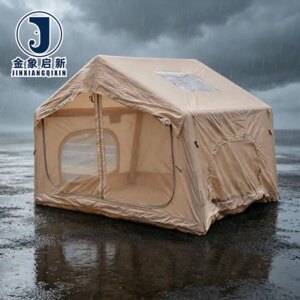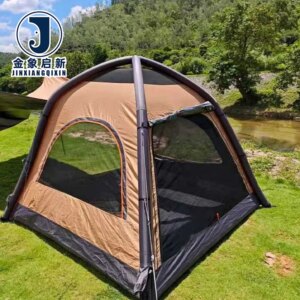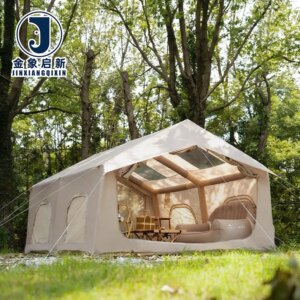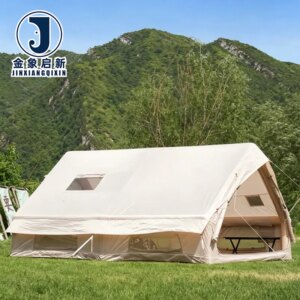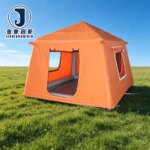


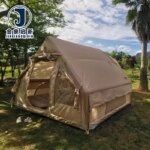
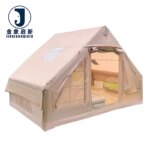
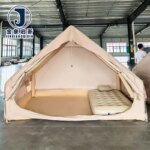
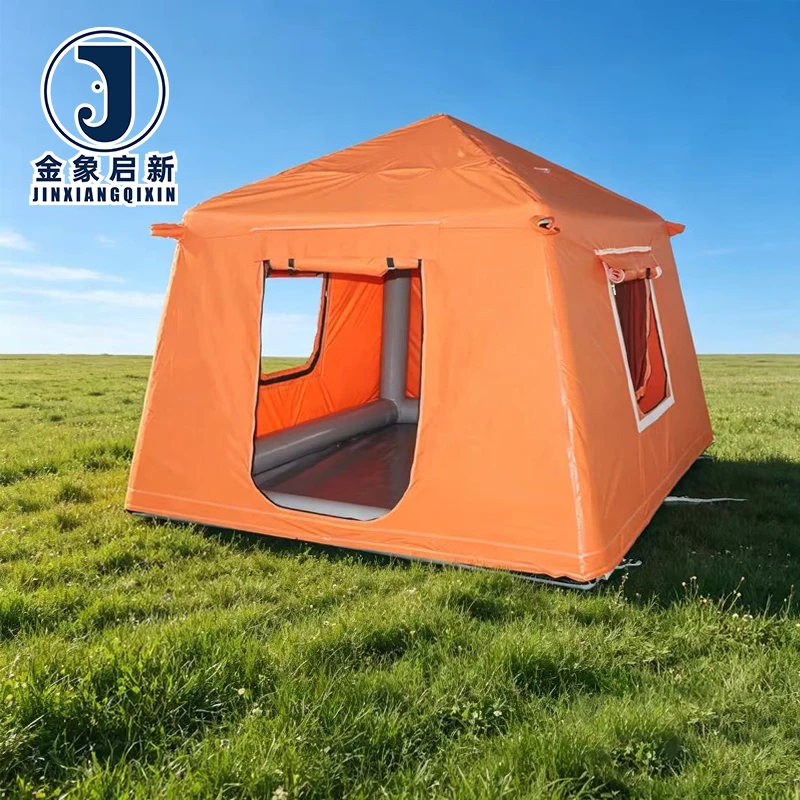
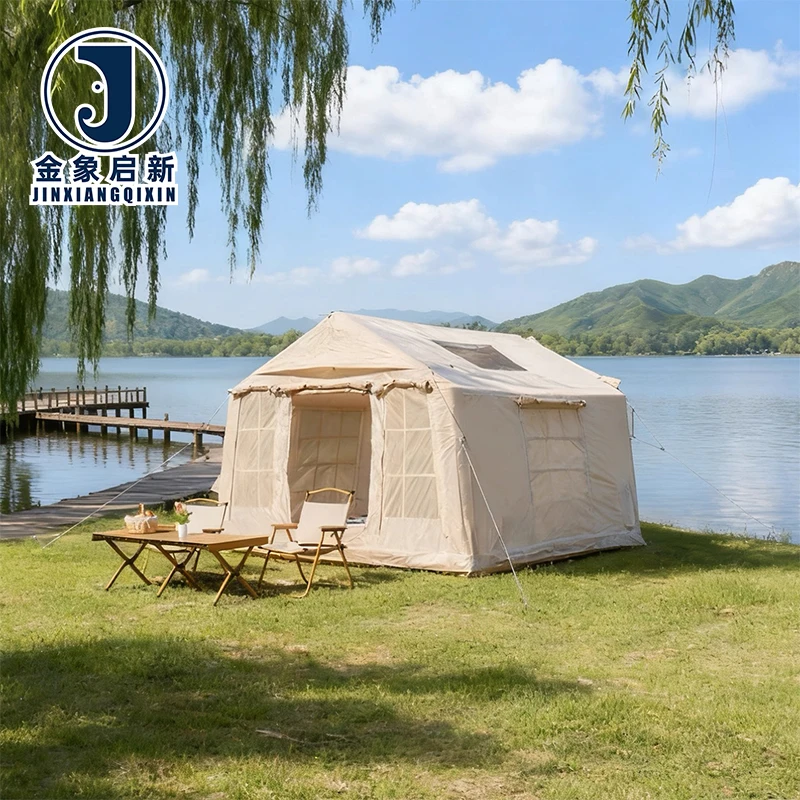
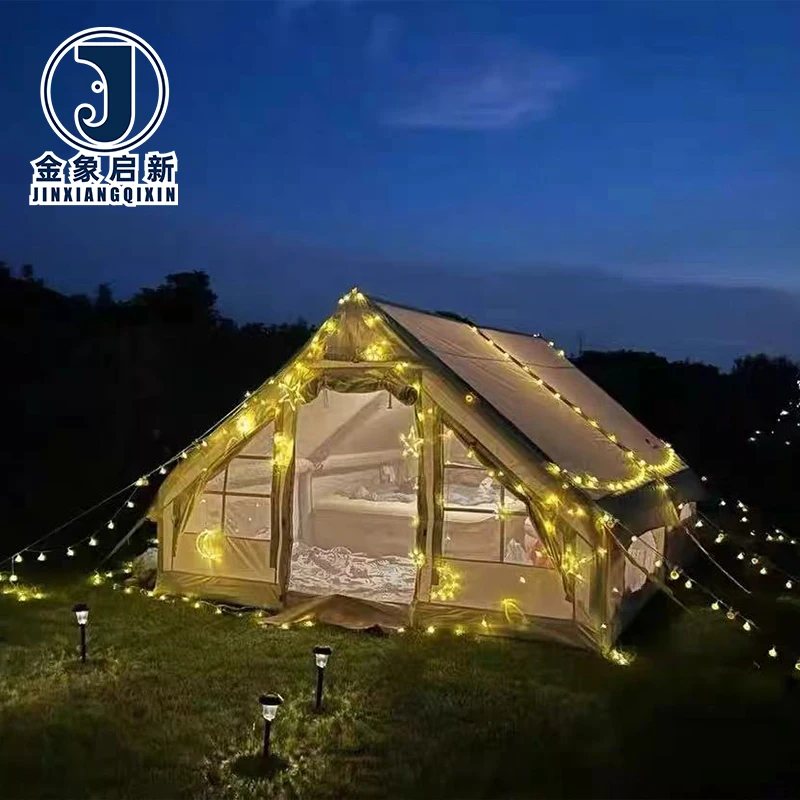
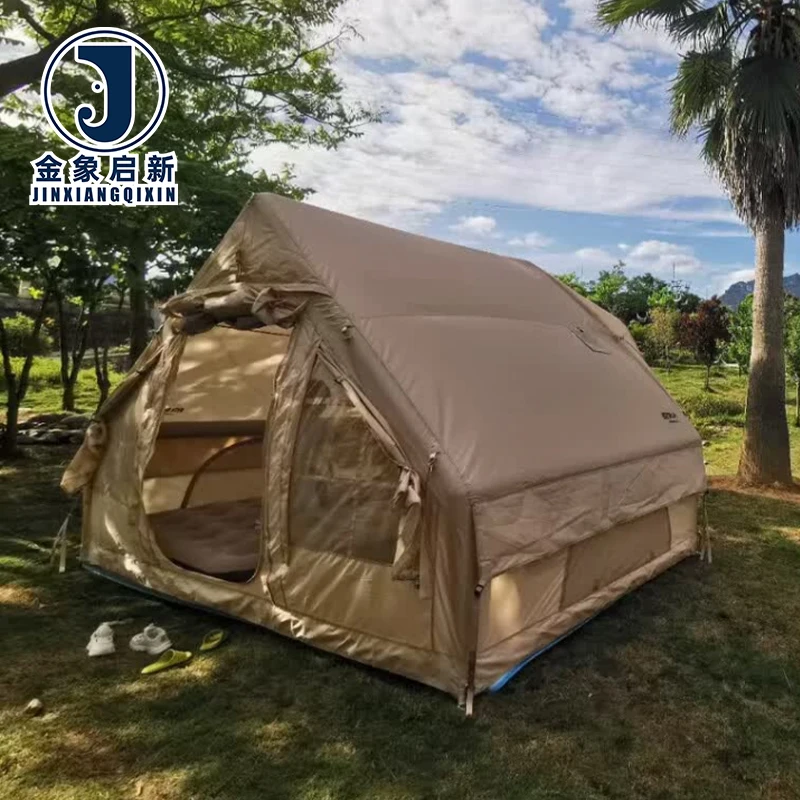
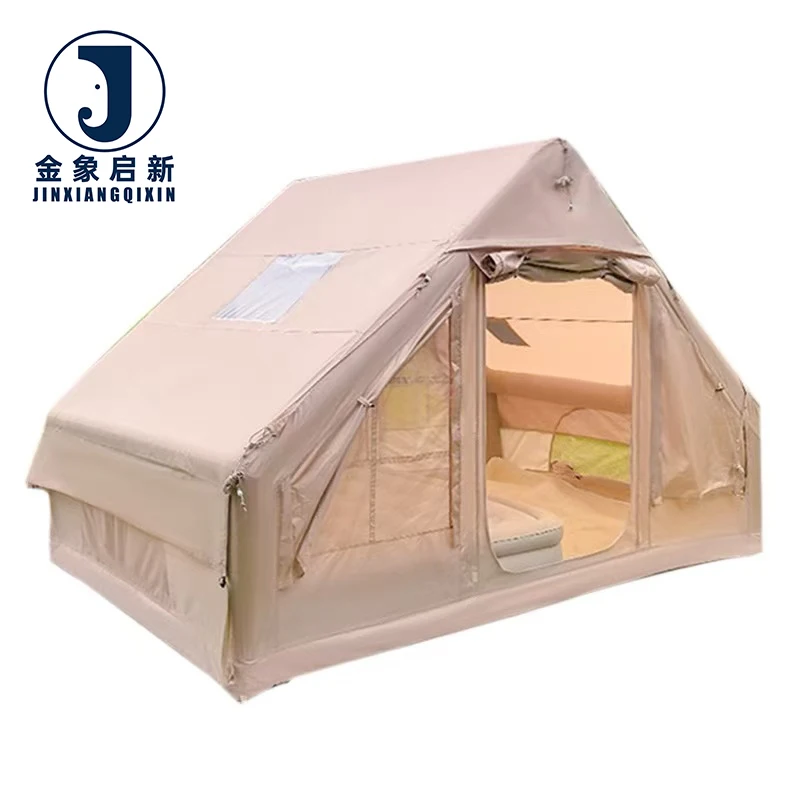
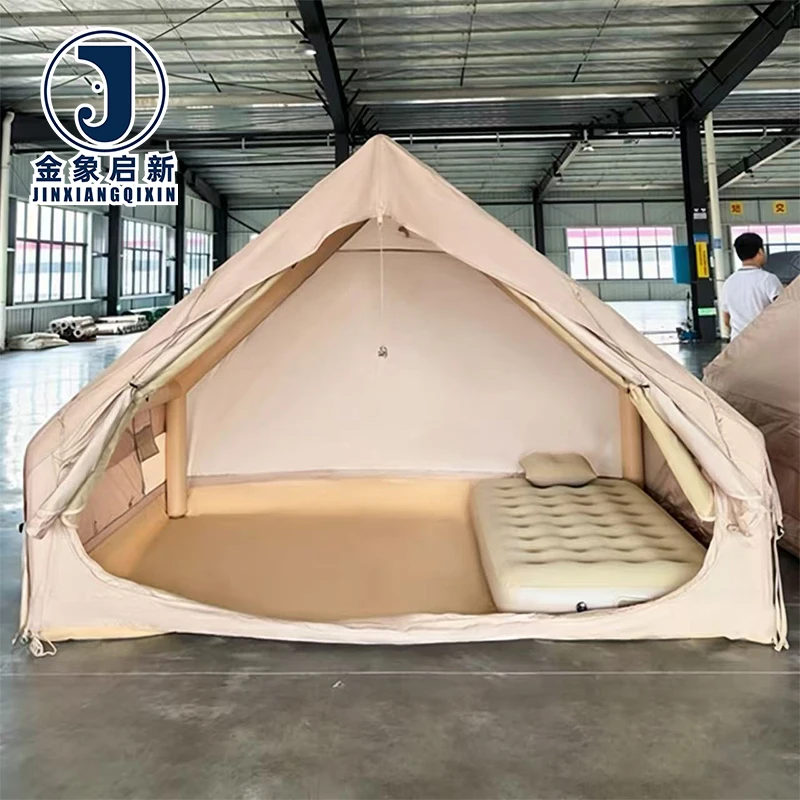
Batch-Consistent Coating Expertise — Every roll of inflatable tent material is verified against the batch reference to eliminate colour drift across your deployment.
Technical Specifications
| Parameter | Value |
|---|---|
| Product Type | Inflatable Camping Tent |
| Core Material | 420D Oxford |
| Capacity | 5-8 Person |
| Season Suitability | 4-Season |
| Opening Mechanism | Quick Automatic Opening |
| Construction Type | Single Layer |
| Design Type | Extended Type |
| Customization Service | OEM & ODM, Sample customization, Pattern printing |
| Flame Retardant | Available in flame retardant grades — confirm the grade required for your market |
| Anti-UV | Available in UV-stabilized formulations — confirm the test basis required for your region |
| Standards | ISO9001, ISO14001, ISO45001, CE |
Application Suitability
| Application | Exposure & Requirement |
|---|---|
| Emergency disaster relief shelters | Rapid deployment under severe weather, high visibility requirements, frequent setup and teardown cycles |
| Temporary construction site facilities | Dust, debris, abrasion from heavy equipment movement, prolonged outdoor weathering |
| Mobile logistics storage units | Repeated inflation and deflation, ground contact abrasion, wind load stress on seams |
What Happens When Seam Strength Is Overlooked in Inflatable Structures
Inflatable tent fabric must hold air pressure continuously at every welded joint — a single weak seam compromises the entire structure.
I have reviewed field failures where the fabric itself remained intact, but the seams split under sustained internal pressure during windy conditions. When procurement decisions focus exclusively on base fabric weight and ignore weld adhesion, the result is a structure that looks sound on day one but deflates unpredictably during critical operations [NEED_CITE: weld adhesion test methods for coated fabrics per ISO 1421]. This is particularly consequential for emergency relief deployments where re-inflation capacity may not be available on site.
Air Retention Demands on the Base Fabric Layer
The 420D Oxford construction provides a tear-resistant substrate that supports sustained internal pressure without propagating micro-tears at stress concentration points. Quick automatic opening mechanisms place sudden load on the fabric during inflation cycles, and the denier rating directly influences how well the material absorbs that transient force. Inflatable Tent Fabric manufacturer custom production runs can adjust the coating formulation to balance air retention with flexibility for repeated deployment.
Extended Design and Portability Trade-Offs
Single-layer extended type construction reduces total pack weight for transport, which matters when disaster relief organizations are moving hundreds of units to remote locations. The trade-off is that thermal insulation depends entirely on the enclosed air space rather than a multi-layer barrier. Construction and mining contractors using these as temporary site shelters should evaluate whether the 4-season rating aligns with the specific temperature extremes of their project geography.
How Base Fabric Density Interacts With Coating Weight
The 420D Oxford designation refers to the denier of the yarn in the base weave, which determines how much coating the fabric can carry without becoming overly stiff. Higher denier base fabrics can accept heavier coating applications, improving both air retention and abrasion resistance at ground contact points. However, the relationship is not linear — a tightly woven lower-denier fabric with optimized coating adhesion can outperform a loosely woven higher-denier alternative in tear propagation resistance. The coating method applied during Inflatable Tent Fabric manufacturer custom production also influences peel strength between layers, which directly affects how the material behaves when folded and refolded across multiple deployment cycles [NEED_CITE: coating adhesion and peel strength testing for technical textiles].
The Consequences of Inconsistent Coating Across a Batch
When coating weight varies roll-to-roll within the same purchase order, the inflation characteristics become unpredictable — some units require higher pressure to achieve rigidity while others stretch beyond their elastic recovery point. I have seen this inconsistency surface only after partial deployment at a project site, where side-by-side installation makes the variation immediately visible. For emergency response organizations, this translates into delayed deployment and the operational risk of mismatched shelter performance across a relief camp [NEED_CITE: batch consistency standards for coated fabric procurement].
Why Procurement Should Source From Here
The 10-person R&D team develops material samples within days, allowing buyers to validate 420D Oxford weight, coating adhesion, and colour consistency before committing to volume production. Dedicated QA/QC at every production stage includes 100% pre-shipment inspection, meaning every roll of inflatable tent material is checked against the batch reference before it leaves the facility. OEM and ODM customization covers material selection, size adjustment, and pattern printing to align with project branding and identification requirements. The production facility operates three full lines with 36 sets of professional equipment, supporting the volume throughput that large-scale disaster relief and construction programs demand without extended delays.
Documentation & Verification
- Material specification sheet confirming 420D Oxford base fabric and coating composition
- Batch-specific colour consistency report comparing each roll against the approved reference
- Pre-shipment inspection record documenting dimensional accuracy and surface integrity
- Test report for flame retardant and UV-stabilized grades where applicable to the order
- ISO9001, ISO14001, ISO45001, and CE certificates included with shipment documentation
Fabrication, Handling & Storage
- Heat weld parameters must account for the 420D Oxford coating thickness to achieve full seam adhesion
- Store rolls on their cores in a dry environment to prevent permanent creasing in the single-layer construction
- Avoid dragging the extended type fabric across abrasive ground surfaces during deployment
- Use compatible cleaning agents that do not degrade the coating surface or pattern printing
- Inspect inflation valve attachment points regularly as high-stress concentration zones
How to Structure Your Inquiry
Specify the environmental exposure conditions at your deployment sites, including temperature range and precipitation patterns, so the appropriate coating formulation can be recommended. Confirm whether your project requires flame retardant certification and which standard applies in your target market. Indicate your annual volume estimate and whether you need roll stock for in-house fabrication or finished units with pattern printing applied.
Frequently Asked Questions
Q: How is batch-to-batch colour consistency controlled across large-volume inflatable tent orders?
A: Every production run references an approved colour standard, and each roll is inspected against that reference before packing. A batch-specific consistency report ships with the documentation, so buyers can verify colour uniformity across the entire order prior to deployment.
Q: What customization options are available — sizing, pattern printing, and branding?
A: OEM and ODM services cover size adjustment, pattern printing, and branding application on the 420D Oxford substrate. The R&D team develops physical samples within days for buyer approval, ensuring the custom specifications meet deployment requirements before mass production begins.
Q: What certifications and supporting documentation ship with each batch?
A: Each shipment includes ISO9001, ISO14001, ISO45001, and CE certificates along with a material specification sheet, pre-shipment inspection record, and applicable test reports for flame retardant or UV-stabilized formulations where specified in the order.
Q: How does the sample approval process work before mass production?
A: Buyers submit application requirements including sizing and treatment preferences. The R&D team produces a physical sample for evaluation. Once the sample is approved, mass production proceeds with in-process QA checkpoints and final inspection before dispatch.
Q: What are the MOQ and lead time considerations for custom inflatable tent fabric orders?
A: Minimum quantities and lead times depend on the level of customization — standard specifications typically carry lower minimums and faster turnaround, while custom sizing, pattern printing, and specific treatment grades require additional production time for sample development and batch setup.