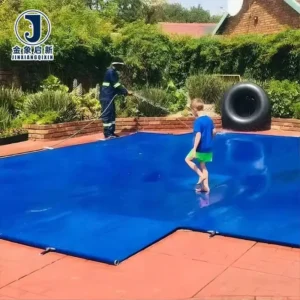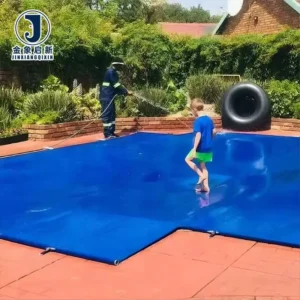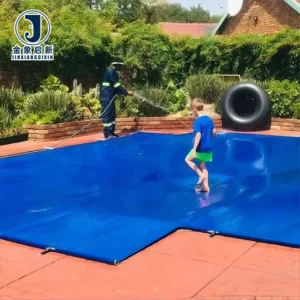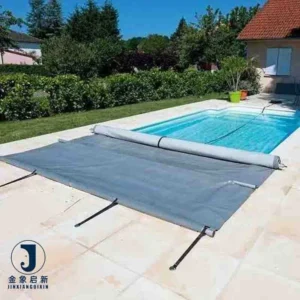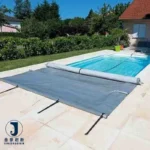
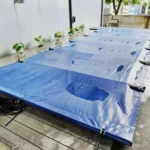
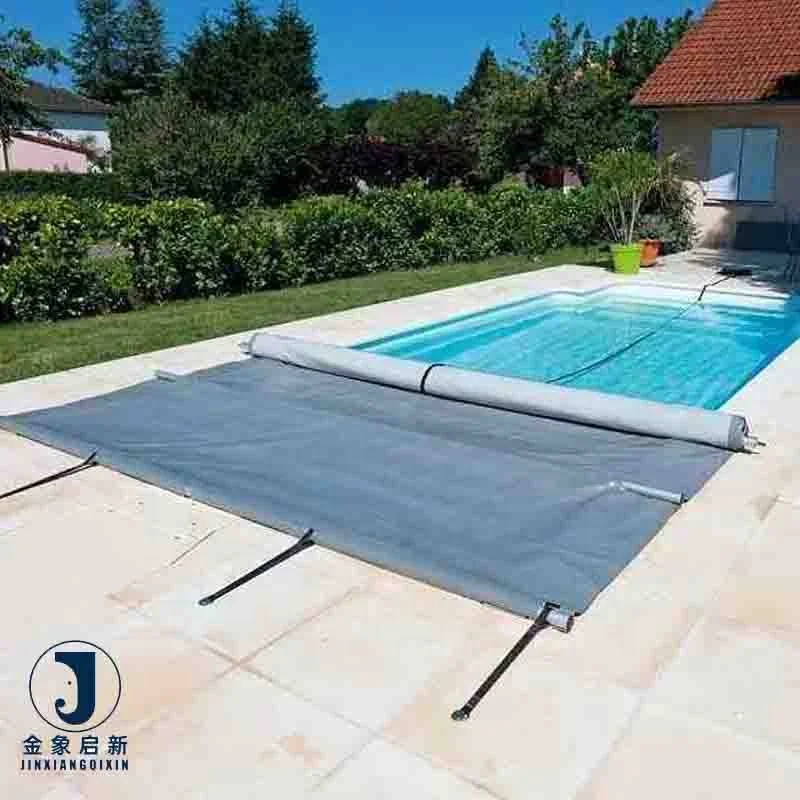
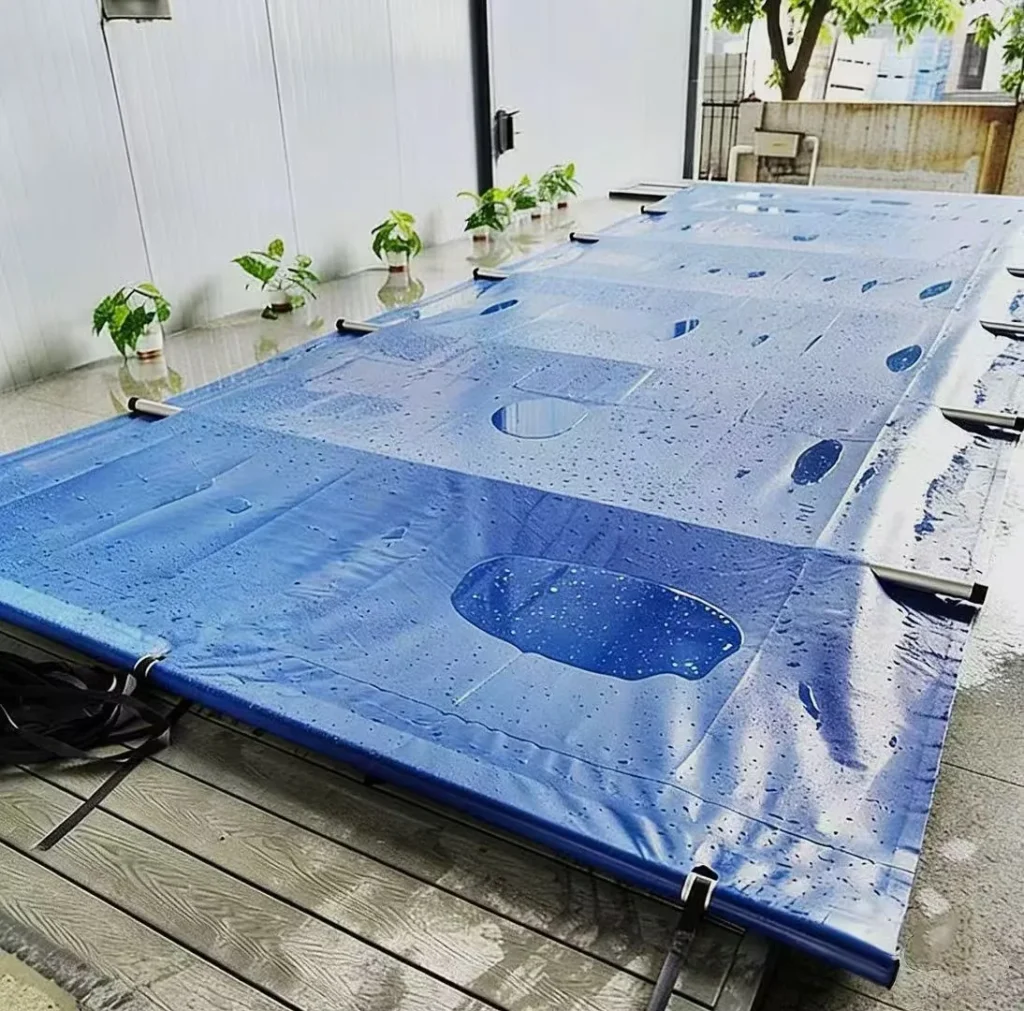
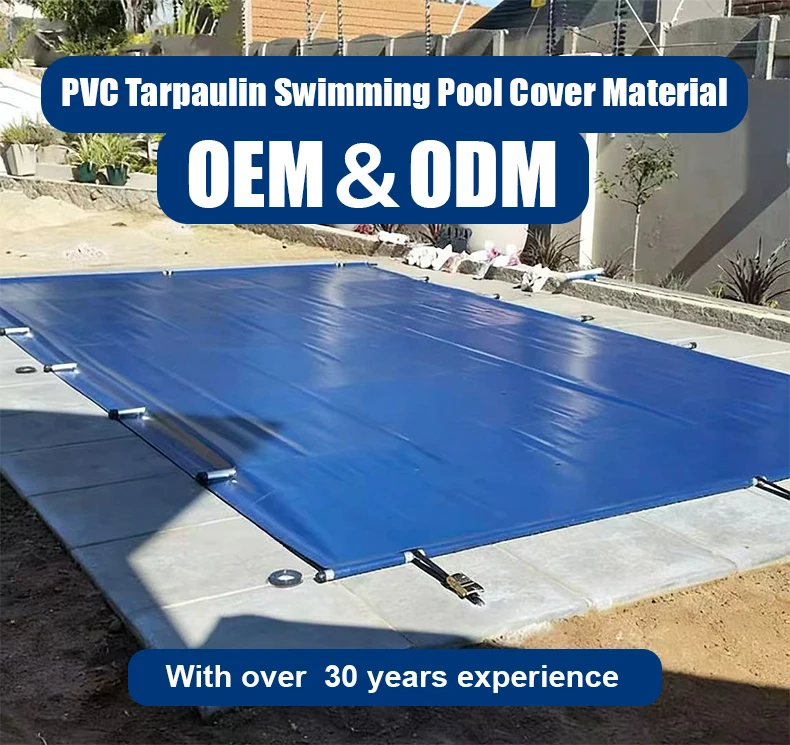
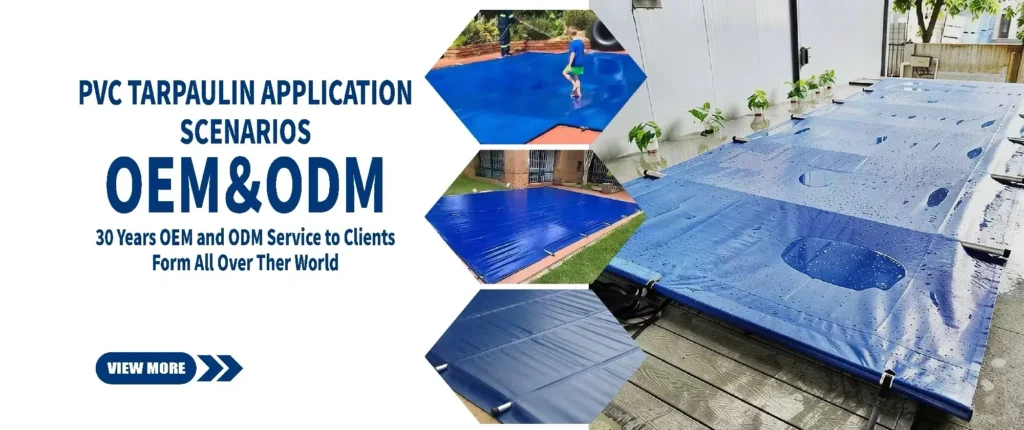
Process Control in Coating — Knife coating across three dedicated lines ensures consistent coating weight and adhesion for PVC pool cover fabric, verified roll by roll before dispatch.
Technical Specifications
| Parameter | Value |
|---|---|
| Product Type | PVC Coated Tarpaulin |
| Coating Method | Knife Coated |
| Coating Material | PVC |
| Waterproof Performance | 100% Waterproof |
| UV Resistance | UV Resistant (test basis not stated — request UV test report before committing) |
| Anti-Mildew | Yes |
| Weather Resistance | Rain, wind, snow, extreme temperatures |
| Tear Resistance | High strength and tear resistant |
| Custom Size | Available |
| Custom Color | Available |
Application Suitability
| Application | Exposure & Requirement |
|---|---|
| Residential pool winter cover | Extended UV and rain exposure, debris load, fold-line stress during seasonal removal |
| Hotel and resort pool cover | Consistent colour across large spans, frequent handling, chemical splash from pool treatment |
| Commercial aquatics facility cover | Year-round outdoor exposure, wind load on wide spans, abrasion from repeated roll-on/roll-off |
| Specialist indoor pool enclosure | Humidity and condensation, fire-retardant or anti-static compliance where site regulations demand |
Why "Waterproof" on the Label Is Not Enough for Pool Cover Fabric
A PVC pool cover tarpaulin aftermarket supplier must prove waterproof integrity at every weld and seam, not just on the flat sheet.
Pool operators regularly find that water ingress starts at the grommet line or a poorly welded corner long before the fabric itself breaks down [NEED_CITE: tensile and tear test methods for coated fabrics per ISO 1421]. Generic tarps marketed as waterproof often rely on surface coatings that delaminate once the cover is folded repeatedly in wet conditions. When you are specifying PVC pool cover fabric fire retardant / anti-static / certified for a regulated environment, flat-sheet data is only the starting point — seam behaviour under load and moisture exposure determines whether the cover survives its first winter.
Knife Coating Versus Dip Coating for Pool Cover Integrity
Knife coating forces PVC compound through the weave under controlled pressure, filling every gap between warp and weft yarns. This process produces a PVC pool cover tarpaulin aftermarket supplier can rely on for consistent coating weight across the entire roll, which directly affects how the material behaves when heat-welded at the seams. Dip-coated alternatives tend to leave micro-voids at yarn crossover points, and those voids become water channels once the cover sits under rain and debris load.
Anti-Mildew Formulation for the Underside Environment
The underside of a pool cover traps warm, moist air between the water surface and the fabric. Without an anti-mildew treatment integrated into the coating compound, biological growth colonises the inner face within weeks, staining the fabric and accelerating breakdown of the PVC layer. This PVC pool cover tarpaulin aftermarket supplier product addresses that exposure with an anti-mildew surface that inhibits mould formation, reducing cleaning frequency and extending service intervals.
Reading the Specification Sheet Beyond the Headline GSM
Coating weight and base fabric denier together determine how the cover handles wind load and point stress at anchor positions. A heavy coating on a loosely woven base fabric will crack at the fold lines before the coating itself fails, while a dense base with a thin coat may tear at the grommet holes [NEED_CITE: relationship between base fabric density and tear propagation in coated textiles]. Knife coating allows the manufacturer to pair a specific base fabric with a measured PVC build, so the structural balance matches the pool span and local wind conditions rather than relying on a single headline number. Surface finish — whether glossy or matte — further affects how dirt and pollen adhere, influencing how often the cover needs to be cleaned during the swimming season.
What Happens When Roll Consistency Is Overlooked
Facilities covering multiple pools with fabric from different production batches frequently report visible colour variation once the covers are installed side by side [NEED_CITE: batch-to-batch colour variation in PVC coated tarpaulins]. Beyond appearance, inconsistent coating weight between rolls can cause one cover to weld cleanly while the next requires rework at every seam. Pool operators replacing a single damaged cover in a matched set face the added cost of swapping adjacent panels to maintain visual uniformity, a problem that originates in inadequate batch control at the coating stage.
Why Source This PVC Pool Cover Material Here
Nearly three decades of focus on coated fabric production underpin every roll, with process control refined through continuous operation on knife coating lines. Three full production lines and 36 sets of professional equipment support bulk orders without sacrificing the coating consistency that pool cover fabrication demands. A 10-person R&D team develops samples in days when custom colours or dimensions are required for project-specific pool geometries. Dedicated QA/QC inspection covers every stage, with 100% pre-shipment checking ensuring that GSM, colour, and weld readiness match the purchase specification. ISO and CE certification accompanies shipments, providing the documentation trail that commercial and hospitality buyers need for compliance records.
Documentation & Verification
- Material specification sheet stating GSM, base fabric denier, and knife coating method for every roll
- UV test report provided for UV-resistant grades upon request before order confirmation
- Fire-retardant and anti-static test reports available where compliance is specified
- ISO and CE certificates included with each shipment for audit and regulatory purposes
- Pre-shipment inspection record verifying coating adhesion and roll consistency before dispatch
- Roll packing list with batch reference for traceability across multi-pool installations
Fabrication, Handling & Storage
- Heat-weld seams at temperatures matched to the PVC coating thickness to avoid scorching or weak bonds
- Reinforce grommet positions with welded patches to distribute point load across the knife coated surface
- Store rolls upright on a flat surface to prevent permanent creasing of the PVC coating layer
- Allow cold-stored rolls to reach ambient temperature before unrolling to prevent coating micro-cracking
- Use mild, non-solvent cleaners on the anti-mildew surface to preserve the treatment through repeated washes
- Plan cutting layout to minimise offcut waste, particularly on custom-width rolls ordered for large commercial pools
Requesting a Specification Match
Provide the pool dimensions, local wind load expectations, and whether the installation environment requires fire-retardant or anti-static certification. Confirm the colour reference — RAL or Pantone — and whether you need rolls or finished, hemmed covers with eyelets. State your annual volume and whether a sample roll is needed to validate weld parameters and colour approval before the production run begins.
Frequently Asked Questions
Q: What fire-retardant grade is available for regulated pool environments?
A: The fabric is available in flame retardant grades — confirm the grade required for your market and building code before ordering. Test reports documenting the specific classification can be supplied with the shipment once the target standard is identified during the enquiry stage.
Q: How is anti-static performance certified for specialist installations?
A: Anti-static surface resistance is available where site regulations specify it. The required resistance range and test standard should be stated at enquiry so the correct formulation is applied and a compliant test report is generated before dispatch.
Q: Can the fabric be welded into irregular pool shapes?
A: Yes, knife coated PVC tarpaulin welds cleanly using hot-air or high-frequency methods. Fabricators can cut and join panels to fit freeform pool geometries, provided weld temperature and speed are matched to the coating weight for full seam integrity.
Q: Are custom colours matched to RAL or Pantone references?
A: Custom colours are matched to buyer-supplied RAL or Pantone references. A sample swatch is produced for approval before the full production run, and roll-to-roll colour consistency is verified during pre-shipment inspection for multi-pool projects.
Q: What reinforcement options exist for grommet and hem areas?
A: Welded PVC patches are applied at grommet positions to spread anchor load across a wider fabric area. Hem edges are heat-welded or folded and sealed to prevent moisture ingress into the base fabric, matched to the cover span and expected wind uplift.