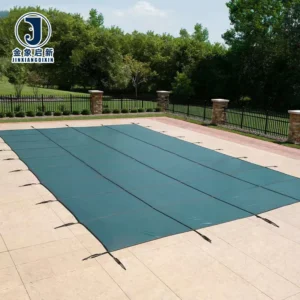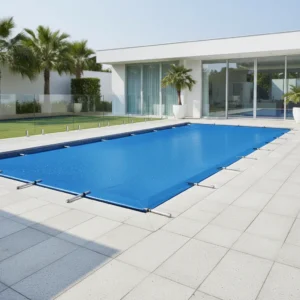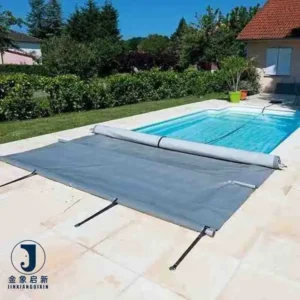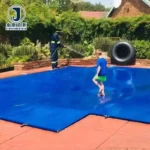
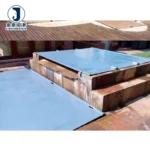
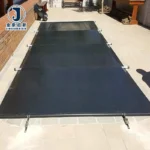
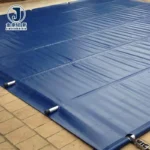
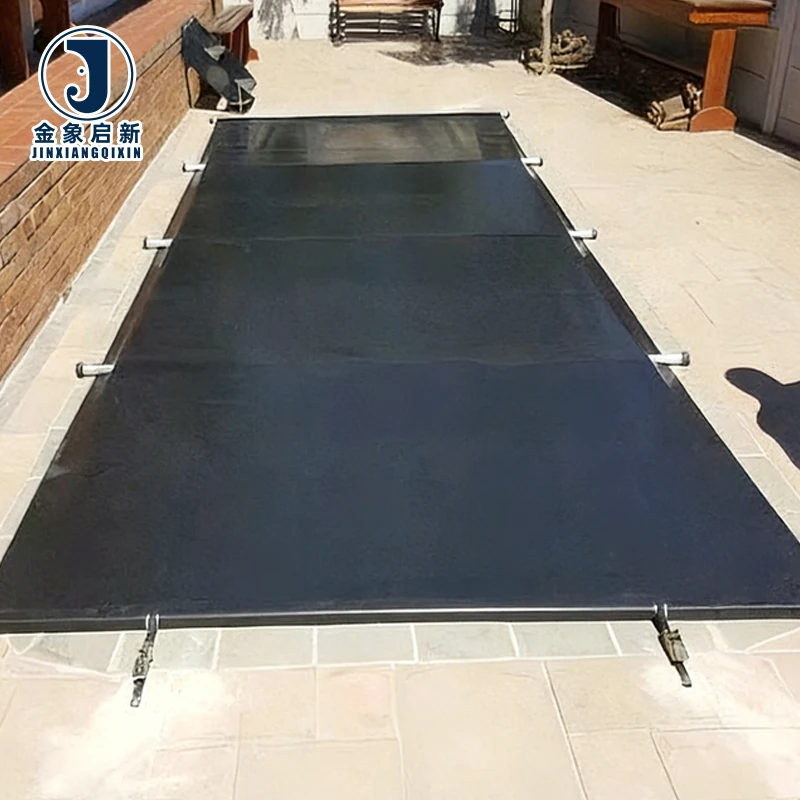
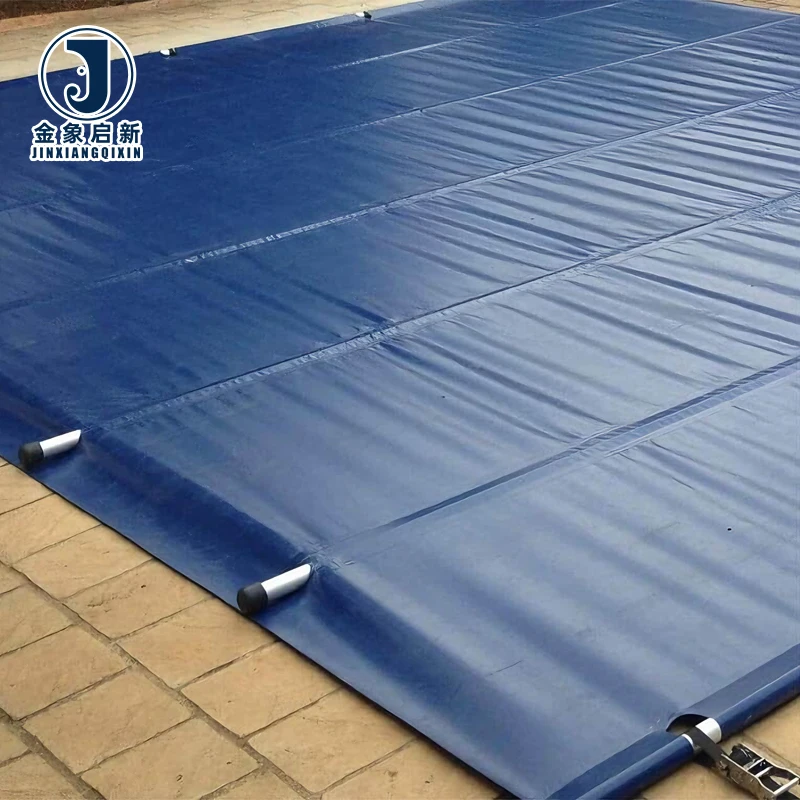
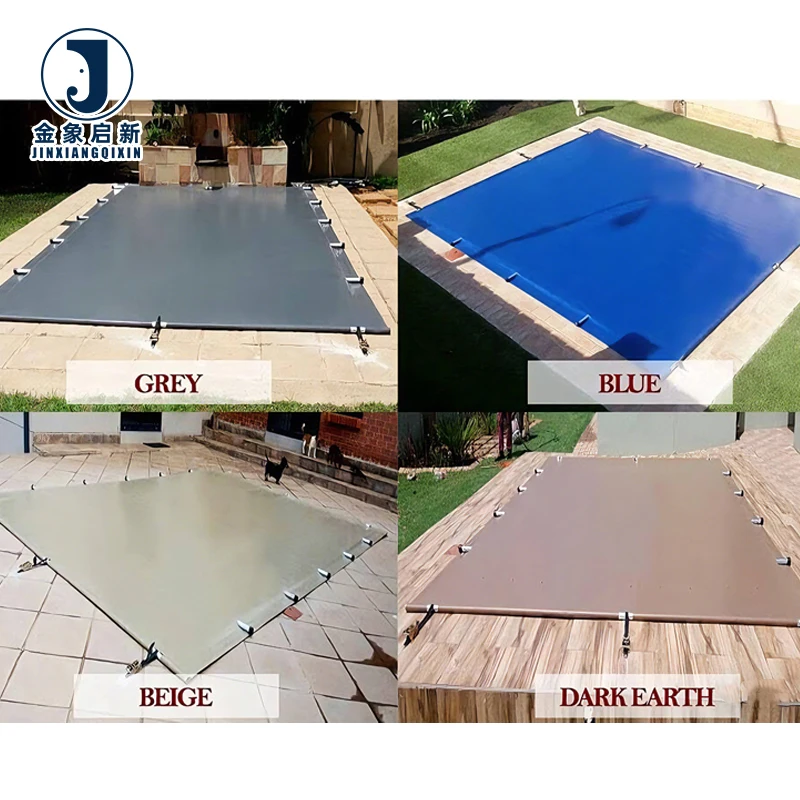
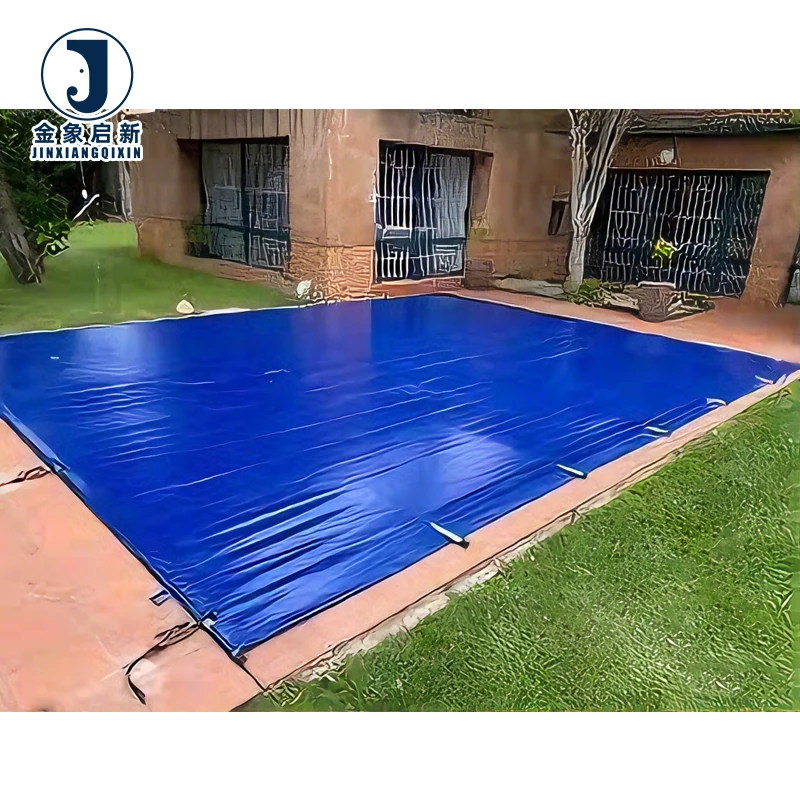
Specialist Fabric Compliance — fire-retardant and anti-static certifications are verified with documented test reports, not just claimed on a quotation sheet.
Technical Specifications
| Parameter | Value |
|---|---|
| Product Type | PVC Pool Cover |
| Base Fabric | High-strength polyester mesh fabric |
| Coating Material | PVC |
| Coating Method | Laminated technology & Hot-melt Coating technology |
| Weight Options | 350gsm / 420gsm / 500gsm / 550gsm / 600gsm / 750gsm |
| Thickness Range | 0.32mm / 0.35mm / 0.4mm / 0.45mm / 0.5mm / 0.65mm |
| Roll Width | 2m / 2.1m |
| Roll Length | 75m (2m width) / 50m (2.1m width) |
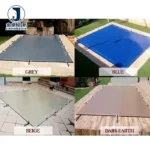
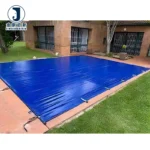
| Color Options | Blue / Red / Yellow / Light blue / Grey (Customized) |
| UV Treatment | Anti-UV (test basis not stated in source) |
| Anti-Static | Anti-Static treatment (standard not stated in source) |
| Flame Retardant | Available as special treatment (grade not stated in source) |
| Cold Crack Resistance | Yes |
| Anti-Mildew | Yes |
| Waterproof | Yes |
| Finish Product Size | Custom dimensions or inventory rolls |
Application Suitability
| Application | Exposure & Requirement |
|---|---|
| Commercial swimming pool covers | Permanent UV and moisture exposure; fire safety compliance for public venues |
| Indoor aquatic centres | Ventilation environments with static discharge risk; high humidity; chemical vapour from water treatment |
| Specialist membrane enclosures | Tension loading at aluminium bar and ratchet systems; wind uplift; structural welding integrity |
| Fish tank and pond liners | Constant water immersion; biological growth prevention; puncture resistance from substrate |
| Inflatable pool structures | Flex cycling at inflation seams; air retention; fire-retardant certification for temporary installations |
What "Certified" Means When Your Pool Cover Needs Fire and Static Compliance
A fire-retardant claim without a test grade is a liability, not a specification.
Public and commercial pool facilities operate under strict fire safety regulations. When a PVC Pool Cover Fabric fire retardant / anti-static / certified material arrives on site without a traceable test report, the entire installation can be halted by the building inspector. We see specifiers requesting "flame retardant" on the inquiry, but the standard required by their local authority is never named — and the fabric delivered carries no documentation to prove compliance. [NEED_CITE: fire classification standards for textile materials in public assembly buildings]
The same applies to anti-static performance. Indoor aquatic environments with recirculated air and chemical-laden humidity can accumulate surface charge on uncoated or untreated PVC membranes. Without a measured surface resistance value, there is no way to confirm the fabric will dissipate static before it becomes a hazard near electrical ventilation equipment.
Coating Adhesion and the Weld Line in Pool Cover Systems
Pool covers are tensioned structures. The PVC Pool Cover Fabric fire retardant / anti-static / certified range uses laminated and hot-melt coating technology to bond the PVC layer to the high-strength polyester mesh base. This bonding method directly affects how the material behaves at welded seams — the point where most structural failures originate when the cover flexes under wind load or tension from ratchet systems. [NEED_CITE: tensile and tear test methods for coated fabrics per ISO 1421]
Hot-melt coating penetrates the mesh structure rather than sitting on the surface, which gives the weld zone better peel strength compared to simple surface lamination. For aluminium bar fixing methods that apply continuous tension along the cover edge, this adhesion quality determines whether the seam holds or delaminates over repeated seasonal cycles.
Selecting Weight Grades for Span and Load Conditions
The available grades span from 350gsm for lighter temporary covers to 750gsm for permanent installations with wider unsupported spans. Higher GSM alone does not guarantee better performance — the base fabric denier and weave density work together with the coating weight to produce the final tensile and tear values. A 500gsm fabric with a tight mesh construction may outperform a 600gsm material with a loosely woven base.
Specify the exact grade based on the structural engineer’s load calculation for your pool geometry. Our R&D team can develop samples across multiple weight options so you can test weld behaviour and tension response before committing to a production run. [NEED_CITE: relationship between base fabric density and coated fabric tear propagation]
Reading the Spec Sheet Beyond the GSM Number
When reviewing a material specification for PVC pool covers, four parameters carry more weight than gsm alone. The coating method — laminated versus hot-melt — affects peel strength at welded joints, which is the most common failure point in tensioned covers. Base fabric denier and thread count determine how a tear propagates once initiated; a high-density mesh stops tear spread while an open weave allows it to run. The total thickness must be evaluated against the cold crack resistance requirement for your climate, since thinner coatings become brittle faster at low temperatures even if the gsm is adequate. Finally, the stated flame-retardant and anti-static treatments must be backed by a named test standard, not a generic claim, to pass site inspection.
The Hidden Cost of Specifying Pool Cover Fabric on Colour Alone
A specifier once selected a 550gsm material based on a colour sample that matched the facility’s branding. The flame-retardant treatment was assumed to be included because it appeared on the supplier’s general brochure. On arrival, the fabric had no fire test documentation and failed the site compliance audit, delaying the facility opening by several weeks while replacement material was sourced.
Batch colour variation is a second recurring issue. When multiple rolls arrive with visible shade differences and the pool cover is installed in panels side by side, the entire structure looks inconsistent. This forces contractors to either accept a substandard finish or reject the delivery and face project delays. [NEED_CITE: colour consistency standards for coated fabrics in architectural applications]
Why Procurement Teams Source This PVC Pool Cover Fabric Here
The coating process is controlled in-house across three full production lines, giving direct oversight of PVC adhesion weight and mesh penetration at every stage. This matters for pool covers where delamination at the weld line is the primary failure mode.
A dedicated 10-person R&D team handles custom colour matching, width requirements, and sample development within days rather than weeks — critical when your pool geometry does not match standard roll dimensions.
Every roll undergoes inspection before dispatch, with documented GSM verification against the quotation value. No shipment leaves without a pre-shipment inspection record that the buyer can cross-reference on arrival.
ISO and CE certifications are maintained for the production facility, with certificates of origin and customs documentation prepared for each export shipment. Fire-retardant and anti-static test reports are supplied when these treatments are specified, rather than claimed generically.
Documentation & Verification
- Material specification sheet stating exact GSM, base fabric denier, and coating weight for the selected pool cover grade
- Fire-retardant test report naming the specific grade and standard achieved for your jurisdiction
- Anti-static surface resistance measurement report documenting dissipation performance
- Anti-UV test documentation confirming treatment level for the specified product variant
- Pre-shipment inspection record with roll-by-roll GSM check and colour consistency verification
- Certificate of origin and customs documentation prepared for each export destination
Fabrication, Handling & Storage
- Hot-air welding temperatures must be calibrated to the laminated PVC coating thickness to avoid surface scorching or incomplete fusion at the joint
- Aluminium bar tension systems should distribute load across the full 2m or 2.1m hem width to prevent point stress on the polyester mesh
- Store rolls horizontally on padded racking to prevent permanent creasing through the PVC coating layers
- Allow cold-stored rolls to reach ambient temperature before unrolling to prevent cracking of the PVC surface in winter conditions
- Clean with pH-neutral detergents only — alkaline pool chemicals can degrade the anti-mildew treatment over repeated contact
- Repair minor punctures with PVC-compatible adhesive patches matched to the coating method of the original fabric
Requesting a Compliant Pool Cover Specification
To receive an accurate material recommendation and sample, share your pool cover application type — commercial, municipal, or private facility — along with the fire safety and static discharge standards required by your local building authority. Include the unsupported span dimensions, the fixing method you plan to use, and whether you need rolls in standard widths or custom-cut panels. Specify the colour reference and confirm whether you require certified fire-retardant and anti-static treatment so that test documentation can be prepared alongside your sample.
Frequently Asked Questions
Q: What fire-retardant grade is available for pool cover fabric and which test standard does it meet?
A: Fire-retardant treatment is available as a special option for this PVC pool cover range. The specific grade and test standard must be confirmed based on your market’s regulatory requirements — we need to know which standard your building inspector or fire authority requires so we can supply the correct test documentation with your order.
Q: How is anti-static performance measured and what surface resistance value can I expect?
A: Anti-static treatment reduces surface charge accumulation on the PVC coating. The exact surface resistance value depends on the treatment level applied to your selected grade. Request the anti-static test report during the sample stage so you can verify the reading meets your facility’s electrical safety specification before production begins.
Q: How do I verify the GSM on arrival matches the quotation?
A: We provide a pre-shipment inspection record documenting roll-by-roll GSM verification against the quoted value. On arrival, you can cross-check by cutting a measured sample from any roll and weighing it. Our inspection record gives you the baseline to confirm no material substitution has occurred during transit.
Q: What fixing method works best — hook system or aluminium bar with ratchet tensioner?
A: Hook systems suit smaller or temporary pool covers with lower tension requirements. Aluminium bar methods with ratchet tensioners are recommended for permanent commercial installations where consistent edge tension must be maintained across wider spans. The choice depends on your pool geometry, span dimensions, and the wind load conditions at your site.
Q: Can custom colours and widths be produced with the same fire-retardant certification?
A: Custom colours and widths are available across the PVC pool cover range. When fire-retardant treatment is specified, the certification applies to the treatment process itself and remains valid across colour variations within the same coating specification. Confirm your colour and width requirements at inquiry stage so sample documentation covers your exact order configuration.