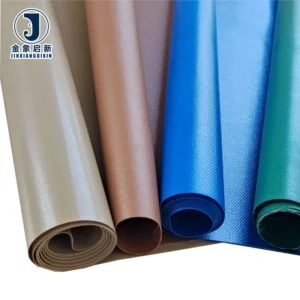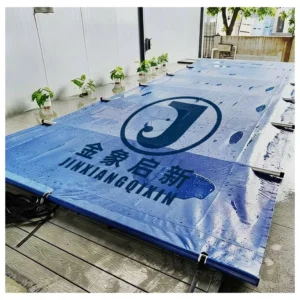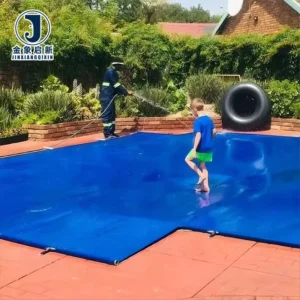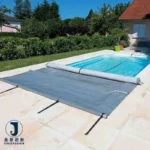
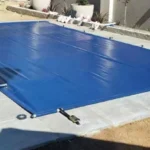
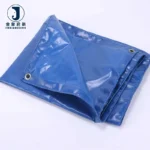
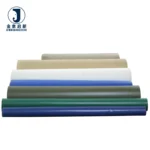
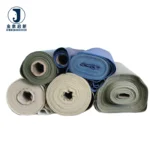
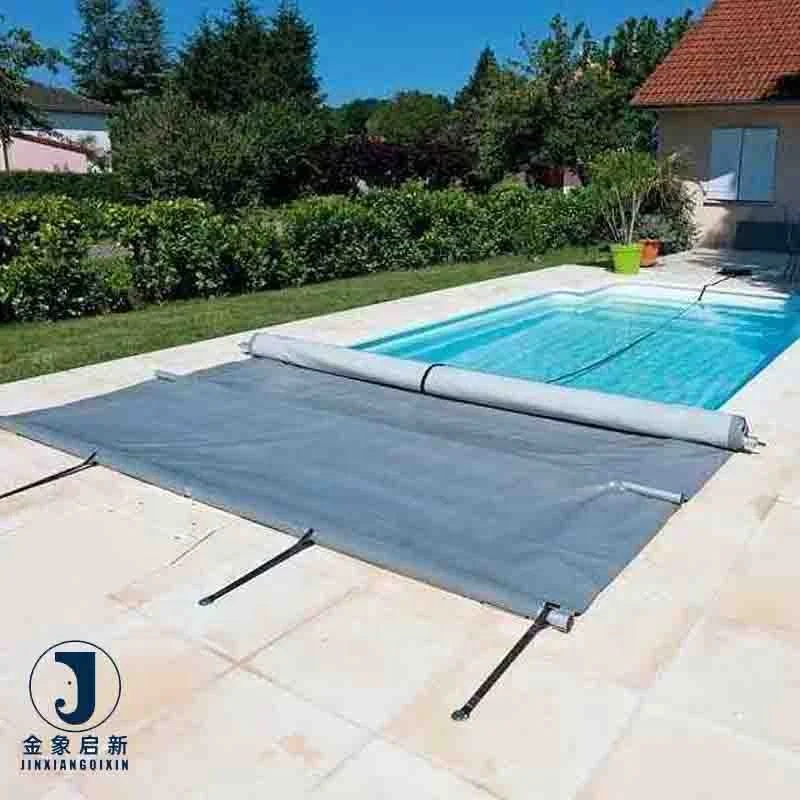
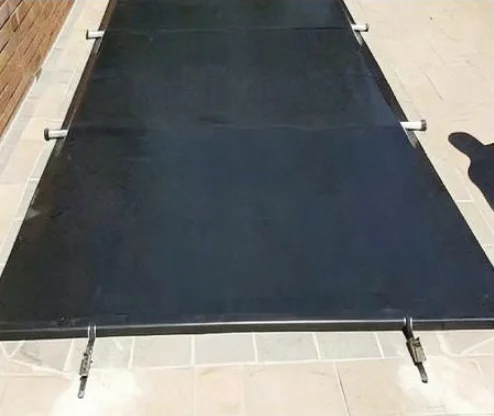
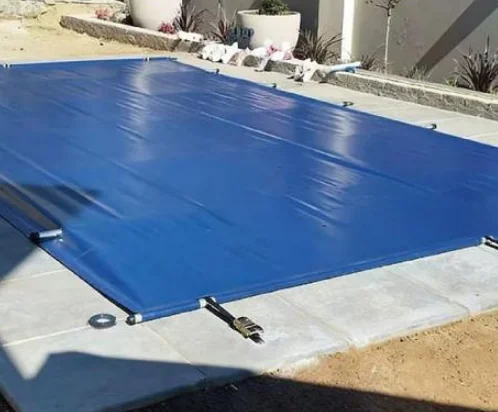
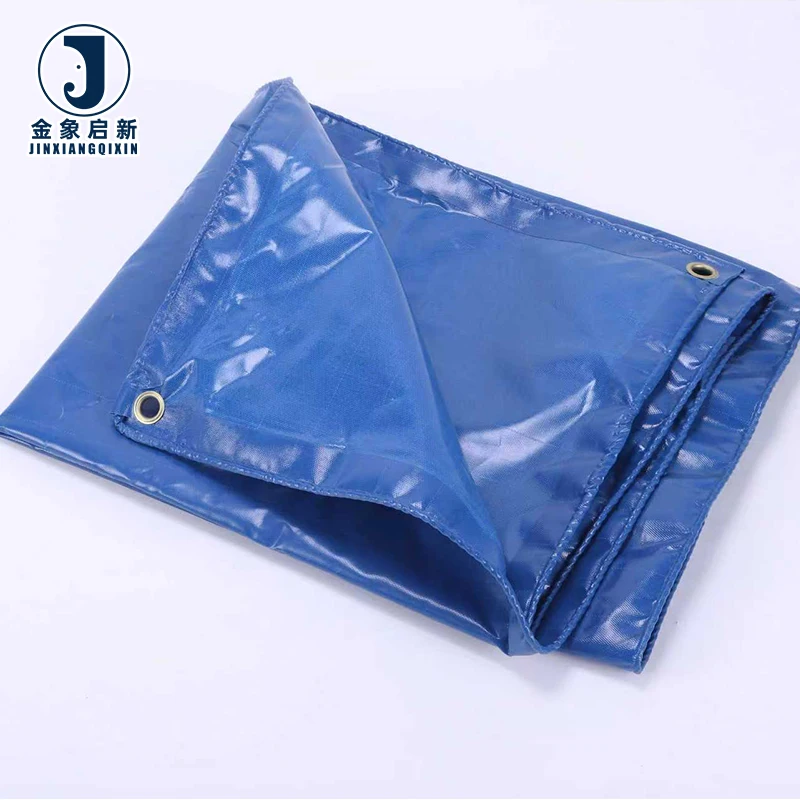
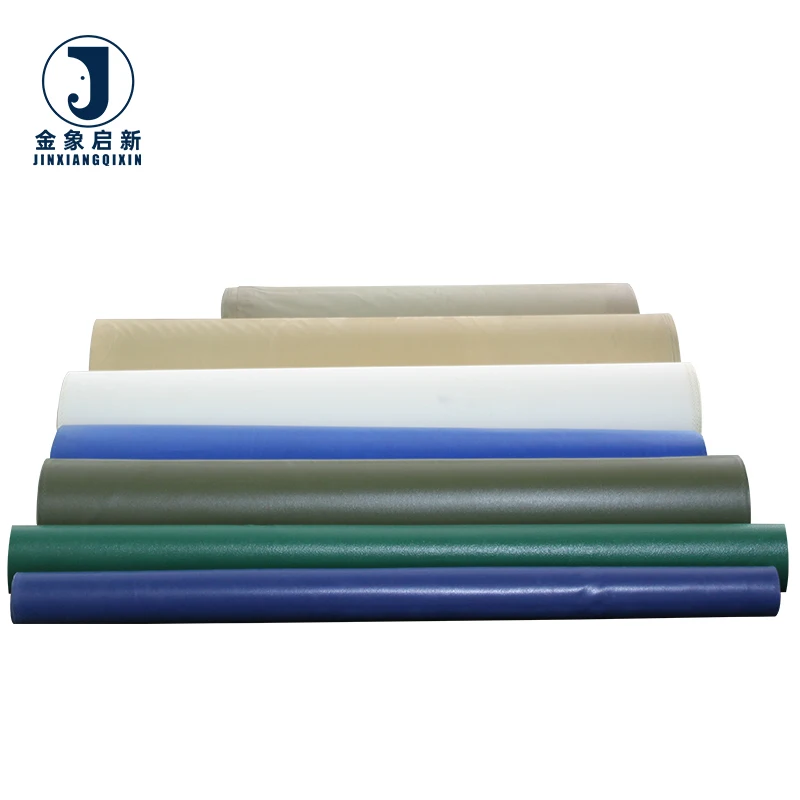
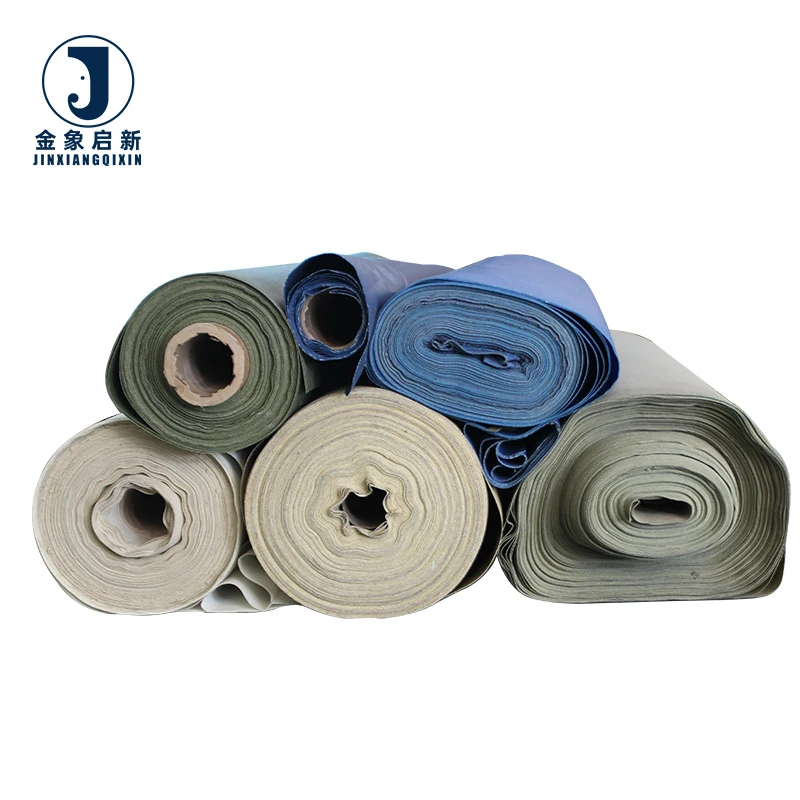
Deep Coating Process Control — Laminated and hot-melt coating lines maintain uniform adhesion across PVC pool cover tarpaulin rolls, ensuring consistent tear strength at every weld point.
Technical Specifications
| Parameter | Value |
|---|---|
| Product Type | Swimming Pool Cover Tarpaulin |
| Material | PVC + High-strength polyester mesh fabric |
| Coating Technology | Laminated technology & Hot-melt coating technology |
| Weight Options | 350gsm / 420gsm / 500gsm / 550gsm / 600gsm / 750gsm |
| Total Thickness | 0.32mm / 0.35mm / 0.4mm / 0.45mm / 0.5mm / 0.65mm |
| Roll Size | 2m × 75m / 2.1m × 50m |
| Finish Product Size | Custom cut-to-size or sold by roll inventory |
| Color Options | Blue / Red / Yellow / Light blue / Grey (Customized) |
| UV Treatment | Anti-UV (test basis not stated in source — confirm standard required) |
| Flame Retardant | Flame retardant available (grade not stated in source — confirm for your market) |
| Anti-Static | Anti-static treatment (surface resistance or standard not stated in source) |
| Anti-Mildew | Yes |
| Cold Crack Resistance | Yes |
| Waterproof | Yes |
| Service Life | 3–7 years under normal circumstances |
| Standards | ISO, CE |
Application Suitability
| Application | Exposure & Requirement |
|---|---|
| Commercial swimming pool safety cover | Continuous UV exposure, ratchet tension at anchor points, seasonal thermal cycling, debris load |
| Aquaculture fish tank and pond cover | Permanent water contact, algae and mildew environment, evaporation control |
| Residential pool winter cover | Snow load, ice formation, prolonged cold exposure, freeze-thaw stress |
| Water-feature membrane for specialist structures | Waterproof containment, tensioned membrane stress, UV and chemical splash exposure |
What Happens When Pool Cover Fabric Arrives Lighter Than Quoted
A quoted 550gsm PVC pool cover that measures 480gsm on arrival will fail at the weld long before the fabric body does.
Buyers specifying laminated PVC pool cover tarpaulin for tensioned safety covers frequently receive rolls that weigh less than the material specification sheet states. The shortfall comes from thinner PVC coating or a lighter base fabric substituted during production. The result is not a marginally weaker cover — it is a cover whose welded seams separate under ratchet tension while the field fabric remains intact. Across multiple pool cover fabrication shops, the most common warranty return traces back to a GSM discrepancy between the purchase order and the delivered roll [NEED_CITE: typical GSM verification methods for coated fabrics per ISO 3801]. When the coating weight is lower than specified, heat-weld parameters calibrated for the correct thickness overheat the thinner material, burning through the PVC layer and leaving a brittle weld line that cracks during the first winter freeze cycle.
How Laminated Coating Holds the PVC to the Polyester Mesh
The laminated and hot-melt coating process bonds the PVC film directly to the high-strength polyester mesh under heat and pressure. Unlike simple knife-over-edge coating, this method forces the PVC into the weave structure, producing a mechanical lock between coating and yarn. For a PVC pool cover that must withstand ratchet strap tension and flex at anchor points, the peel strength at this bond determines whether the cover delaminates after one season or holds for several. Every grade in this product family uses the same bonding principle, so peel performance remains consistent whether you select 350gsm for a lightweight debris cover or 750gsm for a heavy-duty winter safety cover.
Blackout Construction and Colour Consistency Across Rolls
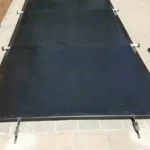
When two rolls of pool cover fabric are installed side by side on a commercial pool deck, even a slight colour shift is immediately visible in sunlight. The blackout formulation blocks light transmission through the material, which prevents algae growth beneath the cover and maintains a uniform appearance on the visible surface. Colour is matched at the compounding stage before coating, and dedicated QA inspection at each production stage catches variation before rolls are packed. Buyers ordering multiple rolls for a single installation receive material from matched production runs, reducing the risk of visible panel-to-panel differences that lead to site rejection [NEED_CITE: colour fastness testing for PVC coated fabrics per ISO 105 series].
Reading GSM, Thickness and Base Fabric Together
A common mistake in pool cover specification is treating GSM as the sole indicator of strength. A 550gsm fabric with a dense 1000-denier polyester base will resist tearing far better than a 550gsm fabric that achieves its weight through heavy PVC coating on a lighter yarn. The base fabric denier and weave density carry the tensile and tear loads; the coating provides waterproofing, UV screening and weld surface. Total thickness — ranging from 0.32mm to 0.65mm in this family — correlates with coating volume, which affects cold crack resistance and weld window width. Thicker coatings tolerate a broader heat-weld temperature range, giving fabricators more margin during production. Thinner grades demand precise weld settings but reduce roll weight and shipping cost. Selecting the right grade means matching base fabric strength to the mechanical load at the anchor points, then choosing enough coating thickness to protect the yarn from water ingress and UV degradation over the cover’s service life.
The Hidden Cost of Choosing the Wrong Weld Temperature
When a fabricator sets weld parameters for 600gsm stock but the delivered roll is a lighter grade, the hot wedge or hot air welder overheats the thinner PVC layer. The weld line becomes glassy and brittle rather than forming a flexible fused joint. In the field, the first strong wind event flexes the cover at the anchor bar, and the brittle weld cracks open along its full length — not at the fabric body but precisely at the seam. This failure pattern is almost impossible to repair on site because the damaged zone runs the entire welded edge. Fabricators who receive rolls with inconsistent coating thickness across the same order face unpredictable weld settings, slowing production and increasing scrap rates [NEED_CITE: hot wedge welding parameters for PVC coated fabrics].
Why Source Laminated Pool Cover Fabric Here
Nearly 30 years focused on PVC coated fabric means the compounding, coating and curing variables that control adhesion are managed in-house rather than outsourced. Three full production lines and 36 sets of professional equipment give capacity to fulfil container-load orders without splitting a single colour run across two machines — a practice that commonly introduces shade variation. The 10-person R&D team develops custom width, colour and print samples within days, allowing fabricators to validate weld parameters and tension behaviour before committing to bulk. Dedicated QA at every coating stage, with 100% pre-shipment inspection, catches GSM and colour drift before the roll leaves the factory, which is the stage where most competitors’ defects escape.
Documentation & Verification
- Material specification sheet stating exact GSM, base fabric denier and coating method for each roll
- UV and flame retardant test reports provided when the specified grade is confirmed at order stage
- Pre-shipment inspection record with weight verification per roll against quoted GSM
- ISO and CE certificates included with every dispatch package
- Certificate of origin and full customs documentation for cross-border shipment
- Roll packing list detailing roll number, colour batch and measured weight
Fabrication, Handling & Storage
- Hot wedge weld temperature must be calibrated to the specific thickness — 0.32mm and 0.65mm grades require different settings
- Reinforced hems should be folded at least twice on 550gsm and above to prevent edge curl under tension
- Store rolls upright on pallets in a dry environment; laying rolls flat causes permanent creases in the PVC coating
- Unroll cold-weather stock indoors and allow it to reach room temperature before cutting to avoid cold crack at the fold
- Clean installed covers with mild soap and soft brush; solvent-based cleaners attack the anti-UV surface treatment
How to Specify Your Pool Cover Fabric Order
Provide the pool dimensions or cover panel size, the anchor system type — ratchet strap, aluminium bar or cable-and-spring — and the climatic zone where the cover will be installed. State the fire-retardant or anti-static grade required by the site authority, the colour reference and whether you need finished panels with hems and eyelets or raw roll stock for your own fabrication line. If you are evaluating this PVC pool cover tarpaulin for the first time, request a sample roll cut in the target GSM so you can validate weld settings before placing the production order.
Frequently Asked Questions
Q: How do you verify the GSM matches the quotation on arrival?
A: Every roll is weighed during 100% pre-shipment inspection, and the measured GSM is recorded on the packing list. On arrival, you can cut a measured sample from the roll edge, weigh it on a calibrated scale, and compare the result against the material specification sheet shipped with your order. Any discrepancy beyond normal tolerance is addressed through our after-sales process.
Q: Can you supply anti-UV and flame retardant test reports with the shipment?
A: Yes — when you confirm the specific UV or flame retardant grade at the order stage, the corresponding test reports are compiled and included in the documentation package. If your site authority requires a particular standard such as a national fire code, state this at inquiry so the correct grade is produced and documented.
Q: What is the colour consistency tolerance across rolls in the same order?
A: Rolls for a single order are produced from the same colour compound batch and pass through dedicated QA inspection at every coating stage. Matched production runs ensure that panels installed side by side show no visible shade difference. We record batch numbers on the roll packing list for full traceability.
Q: Do you offer custom sizing and reinforced finishing for aluminium bar pool cover systems?
A: Custom cut-to-size panels are available with reinforced hems, eyelet placement and edge finishing matched to your tensioning system. Specify the aluminium bar profile and anchor spacing at inquiry, and the R&D team will develop a sample panel for fitment and weld validation before bulk production.