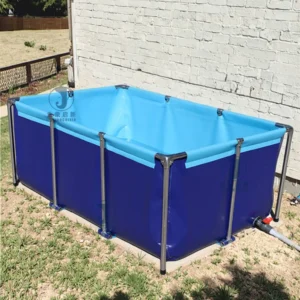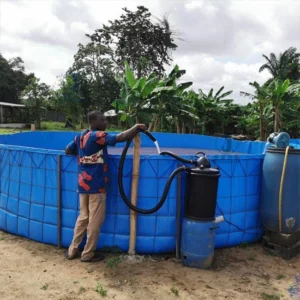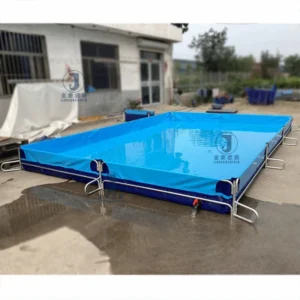
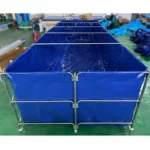
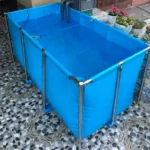

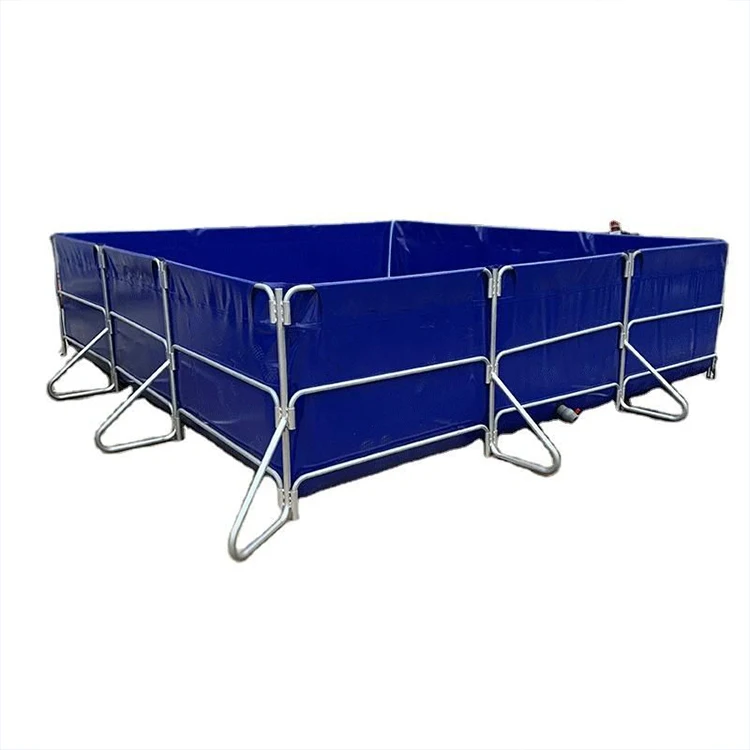
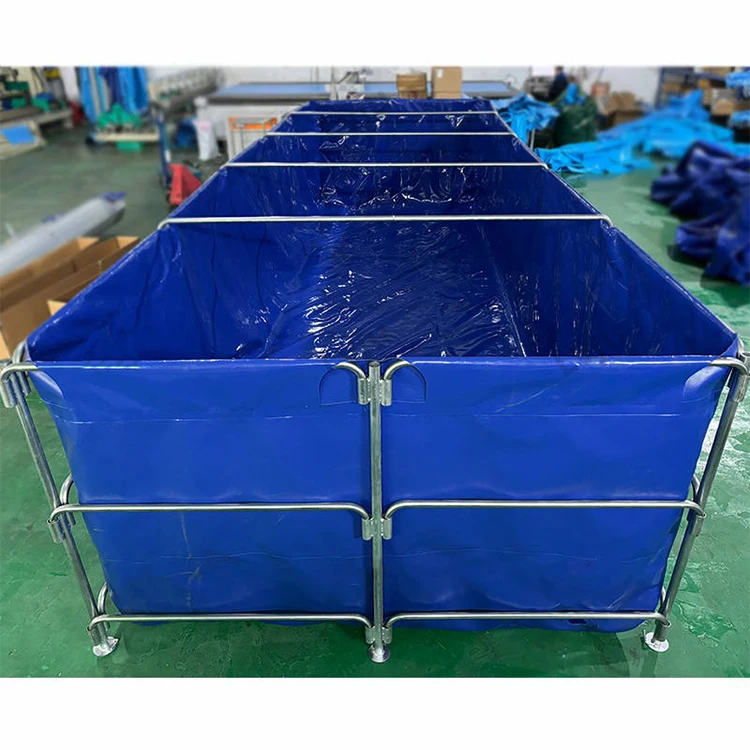
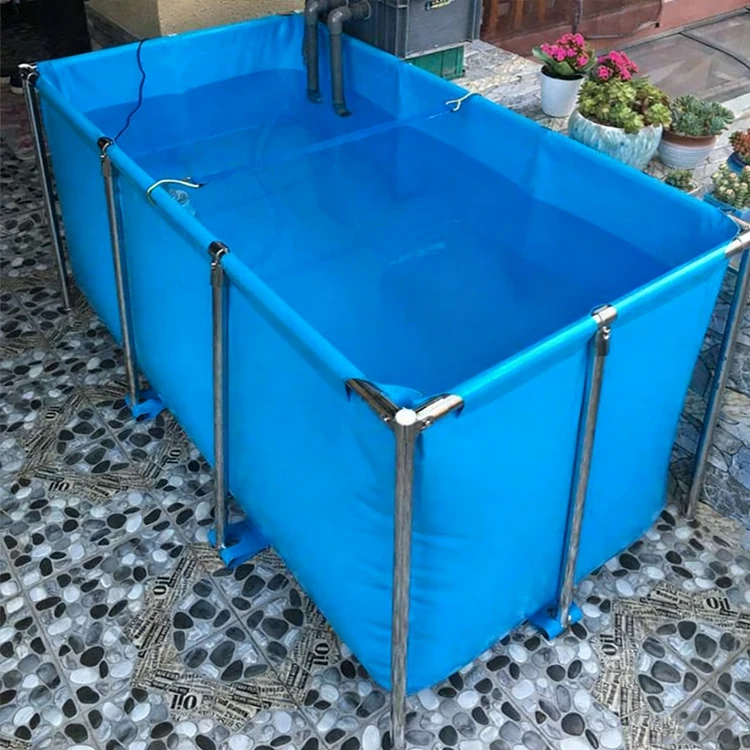
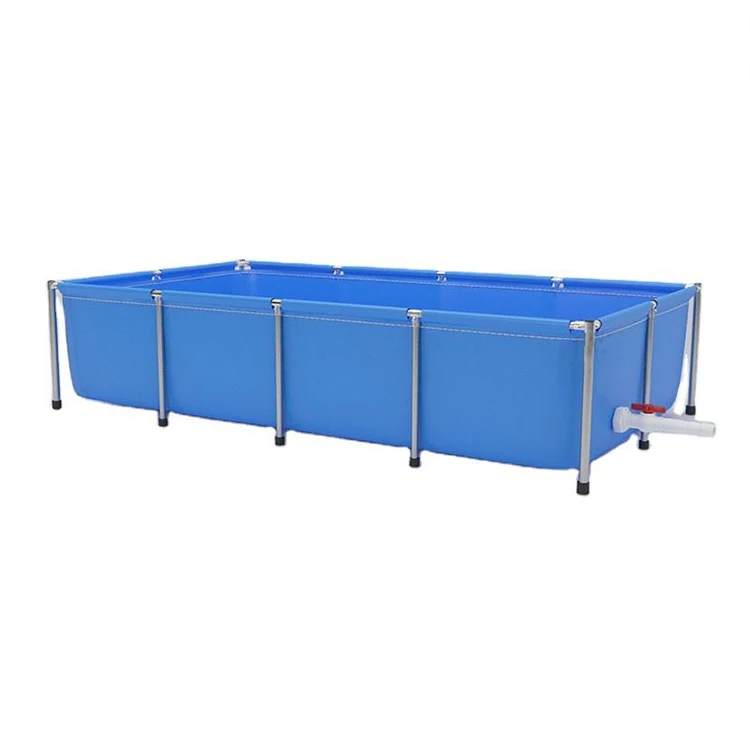
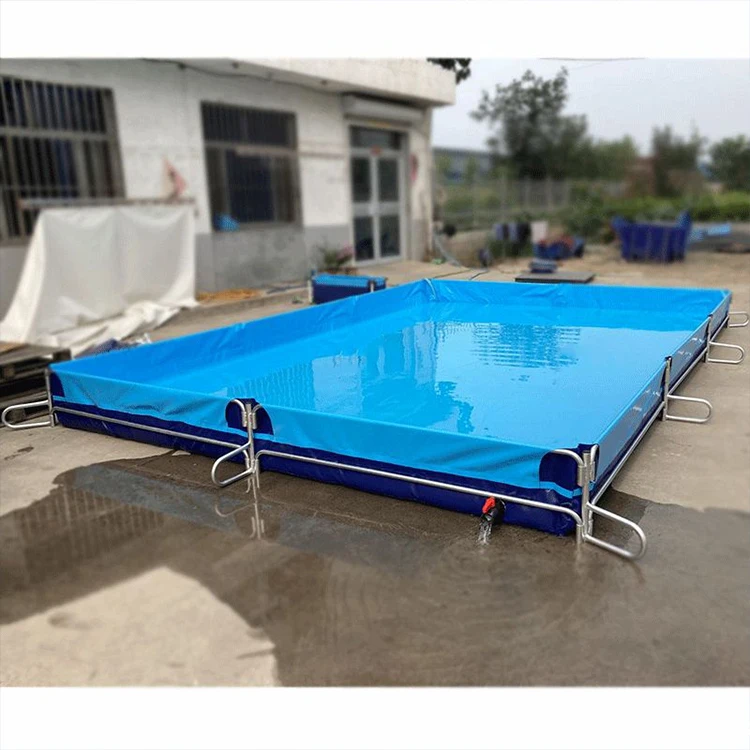
Process-controlled coating adhesion — Every pond liner we produce undergoes 100% pre-shipment inspection to verify seam weld integrity before it leaves the facility.
Technical Specifications
| Parameter | Value |
|---|---|
| Product Type | PVC Tarpaulin Fish Pond Liner |
| Shape Options | Circular / Rectangular |
| Material | PVC Tarpaulin |
| Design Feature | Foldable |
| Application | Fish Tank / Fish Pond |
| Anti-UV Treatment | Available in specific grades — confirm the grade required for your market |
| Flame Retardant | Available in flame retardant grades — confirm the grade required for your market |
| Certifications | ISO, CE |
Application Suitability
| Application | Exposure & Requirement |
|---|---|
| Commercial fish farming ponds | Permanent water contact, hydrostatic pressure on seams, prolonged UV exposure in outdoor basins |
| Hatchery and breeding basins | Controlled water containment, chemical exposure from water treatments, frequent cleaning cycles |
| Agricultural water storage reservoirs | Soil chemistry interaction, puncture risk from subgrade, seasonal filling and draining |
| Temporary aquaculture setups for seasonal stocking | Repeated folding and unfolding, transport abrasion, rapid deployment on uneven ground |
| Ornamental pond and reservoir lining | Aesthetic surface consistency, long-term water retention, exposure to biological growth |
Why Welded Seams Fail Before the Fabric Does in Water Containment
Seam integrity depends on coating adhesion and heat welding parameters matched to the specific PVC formulation, not on fabric weight alone.
When a pond liner is filled, the greatest stress concentrates at the seams where panels join. The fabric itself may hold, but a poorly controlled weld peels apart under hydrostatic load. We have traced liner failures in the field back to welding temperatures that were set for a different PVC coating grade — the seam delaminates while the surrounding material remains intact [NEED_CITE: tensile and tear test methods for coated fabrics per ISO 1421]. This is why matching weld parameters to the exact coating formulation matters more than simply choosing a heavier PVC tarpaulin fish pond liner.
Coating Adhesion as the Foundation for Liner Longevity
The bond between the PVC coating and the base fabric determines how well the material withstands constant water immersion. In aquaculture ponds, the liner is never dry — water pressure pushes against every square metre of surface continuously. Our production lines control coating weight and adhesion through dedicated process stages, ensuring the PVC layer does not separate from the base fabric under prolonged hydrostatic stress. This process control is what allows each PVC tarpaulin fish pond liner to maintain structural integrity across full production cycles.
Custom Sizing to Match the Actual Pond Footprint
Generic pond liner dimensions force aquaculture operators to fold, overlap, or cut material on-site — creating unsealed edges and stress points that leak. We produce circular and rectangular pond liners to the exact dimensions specified by the buyer, eliminating field modifications. The foldable design allows efficient container loading and straightforward on-site deployment, even for large-diameter circular configurations that would otherwise be impossible to ship flat.
Reading Between the Specs: What Material Properties Mean for Pond Liners
The base fabric denier and weave density work together with the PVC coating weight to determine how the liner resists puncture and tearing. A heavier coating alone does not guarantee a stronger liner — if the base fabric has a loose weave, the coating fills the gaps without adding meaningful tear resistance. Conversely, a tightly woven high-denier base with a thinner coating can outperform a heavier but loosely constructed alternative in puncture resistance [NEED_CITE: relationship between base fabric construction and coated fabric tear propagation].
The coating method — whether knife-over-edge, calendering, or lamination — directly affects peel strength at welded seams. Knife-coated fabrics typically achieve higher adhesion values because the PVC penetrates the base fabric rather than sitting on the surface, which translates to stronger heat-welded joints. For pond liners where seam failure means total water loss, this distinction matters at the procurement stage.
Anti-UV treatment, where specified, slows polymer degradation under direct sunlight. Outdoor aquaculture ponds in tropical or subtropical climates experience intense solar exposure that breaks down untreated PVC over time, causing surface chalking and embrittlement. Anti-UV grades are available — buyers should confirm the treatment level required for their installation environment.
The Hidden Cost of Specifying Pond Liners on Price Per Square Metre
Buyers who select pond liners based on the lowest quoted cost per square metre often encounter failures that compound far beyond the material savings. A liner that arrives lighter than the stated GSM loses water through micro-tears within weeks of stocking, destroying an entire production cycle. Welded seams that were not tested against the actual hydrostatic pressure of the filled pond separate at the panel joins, requiring emergency draining and repair. Batch-to-batch colour variation across rolls may not affect performance, but it signals inconsistent coating formulation — and inconsistent formulation means inconsistent weld behaviour [NEED_CITE: coating weight variance and its effect on heat weld consistency in PVC tarpaulins].
Why Aquaculture Operators Source Pond Liners Through This Facility
Our 10-person R&D team handles material selection, custom dimensioning, and sample development in-house, meaning pond liner specifications are reviewed by technicians who understand coating behaviour rather than sales intermediaries.
Three full production lines and 36 sets of professional equipment support bulk orders of PVC tarpaulin fish pond liners with reliable on-time delivery across multiple container loads.
Dedicated QA/QC operates at every production stage, with 100% inspection before shipment — every pond liner is verified for seam weld quality and dimensional accuracy prior to dispatch.
Custom samples are developed within days, allowing buyers to verify material grade, coating feel, and weld compatibility before committing to a production run.
Nearly 30 years of focused coated fabric production provides the process knowledge required to match PVC formulation to the specific demands of permanent water containment.
Documentation & Verification
- Material specification sheet stating GSM, base fabric denier, and coating type for the pond liner grade ordered
- Pre-shipment inspection record confirming seam weld quality and dimensional accuracy per piece
- ISO and CE certificates available for verification by importing authority or third-party auditor
- Anti-UV and flame retardant test reports supplied where specific treatment grades are specified
- Roll or cut-size packing list matched to the buyer’s pond layout plan for site verification
Fabrication, Handling & Storage
- Heat-weld all panel joins at temperatures matched to the PVC coating grade — generic weld settings cause delamination at seam edges
- Store folded pond liners flat and avoid stacking heavy items on top to prevent permanent crease marks in the coating
- Deploy on a cleared, smooth subgrade free of sharp stones to protect the PVC tarpaulin surface from puncture during filling
- Clean biological growth from liner surfaces with neutral pH cleaners only — solvent-based products degrade the PVC coating layer
- Repair minor field damage with compatible PVC adhesive patches cut to overlap the tear by a minimum margin on all sides
What to Include in Your Pond Liner Enquiry
To receive an accurate specification recommendation and sample, please provide the intended pond dimensions (diameter and depth for circular, length, width and depth for rectangular), the water volume the liner must contain, and the climate conditions at the installation site. Specify whether the pond liner will be installed in direct sunlight or partially shaded, as this determines the anti-UV treatment grade. If you require finished liners with reinforced hems or anchor points, include the installation method so we can engineer the edge detailing accordingly. Confirm your target market so that any fire safety or environmental compliance requirements can be addressed at the quotation stage.
Frequently Asked Questions
Q: How is seam weld strength verified before each pond liner ships?
A: Every pond liner undergoes 100% pre-shipment inspection where seam welds are checked for adhesion and continuity. Our QA team tests weld integrity at stress points where water pressure concentrates, and inspection records documenting these checks ship with the order. This process-controlled approach prevents the common field failure where seams separate before the fabric itself is compromised.
Q: Can pond liners be custom-cut to non-standard circular or rectangular dimensions?
A: Yes. We produce PVC tarpaulin fish pond liners to the exact dimensions specified by the buyer, including non-standard diameters for circular ponds and custom length-to-width ratios for rectangular basins. The R&D team reviews dimensional requirements during the enquiry stage and develops samples within days so buyers can confirm fit and material grade before production begins.
Q: What anti-UV treatment grade is appropriate for tropical climate installations?
A: Anti-UV treatment is available in multiple grades suited to different solar exposure levels. For tropical or subtropical aquaculture sites with year-round direct sunlight, a higher treatment grade is typically recommended. Buyers should confirm the specific UV grade required for their market and installation environment — we provide test reports supporting the treatment level specified.
Q: Is the GSM stated on the quotation independently verifiable on receipt?
A: Yes. Each pond liner order ships with a material specification sheet stating the exact GSM, base fabric construction, and coating type. Buyers can verify the quoted weight against the physical material on arrival. Our pre-shipment inspection records also document weight verification, providing traceable evidence that the product matches the agreed specification.
Q: What documentation accompanies a pond liner shipment for customs clearance?
A: Standard documentation includes the material specification sheet, packing list with piece-level detail, certificate of origin, ISO and CE certificates, and pre-shipment inspection records. Additional test reports for anti-UV or flame retardant grades are included where applicable. All documents are prepared to support customs clearance in the destination market.