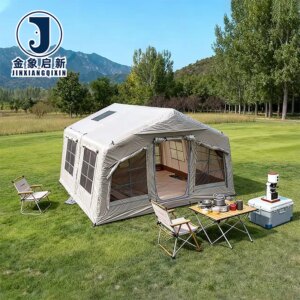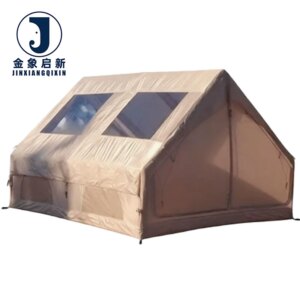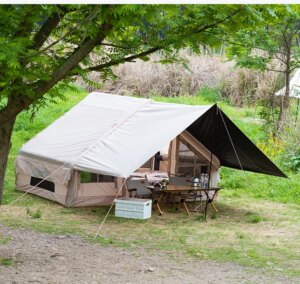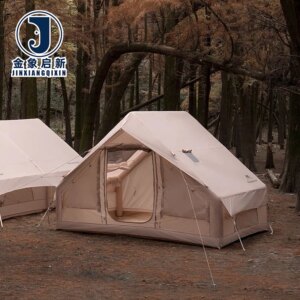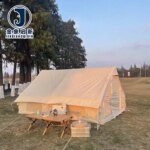

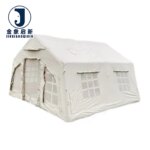
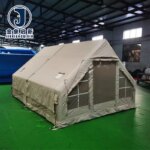
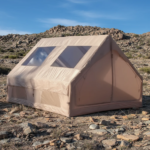

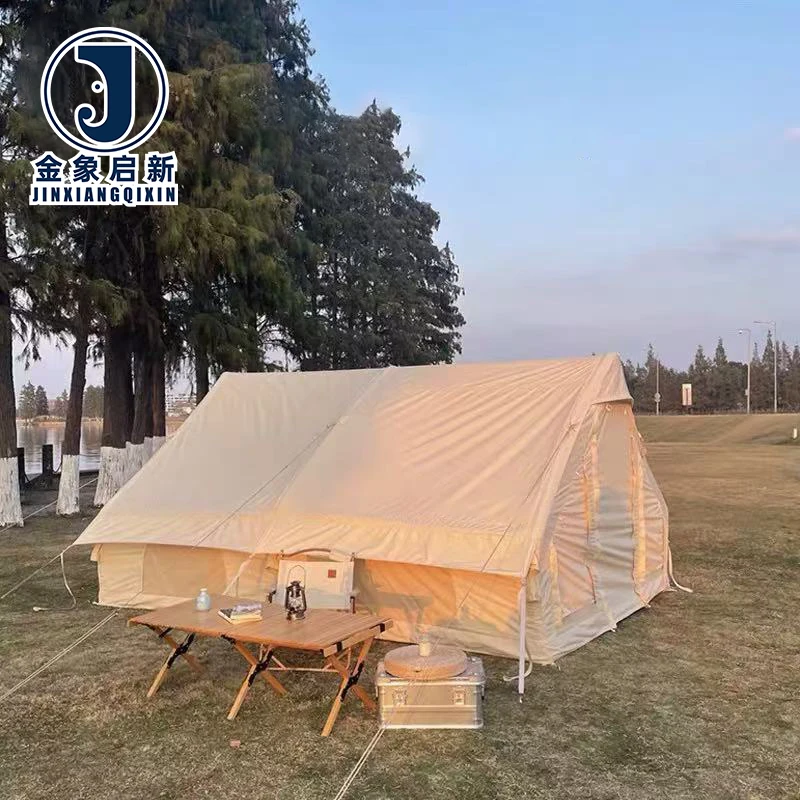
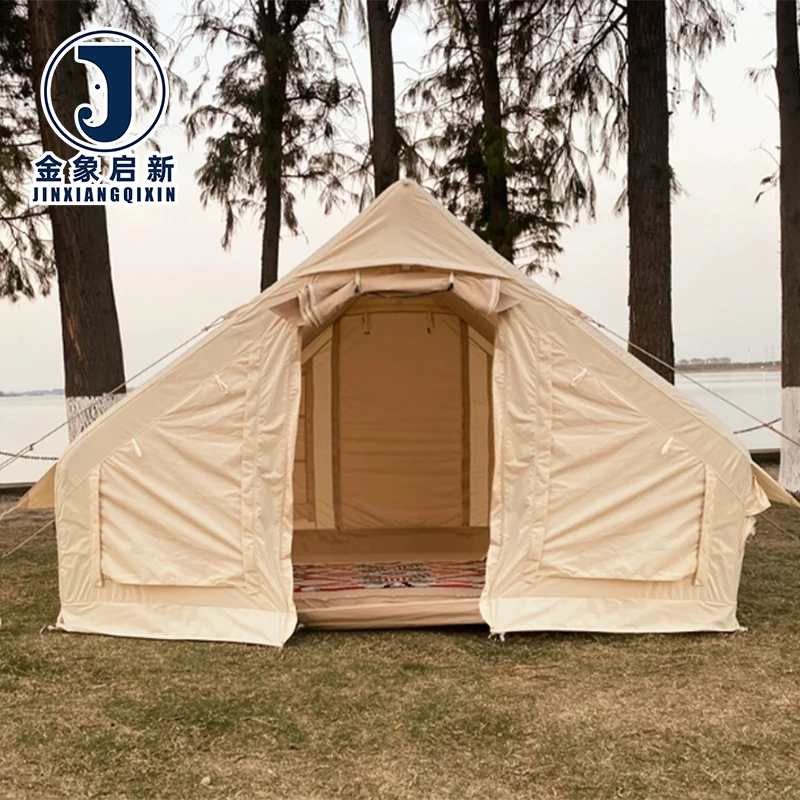
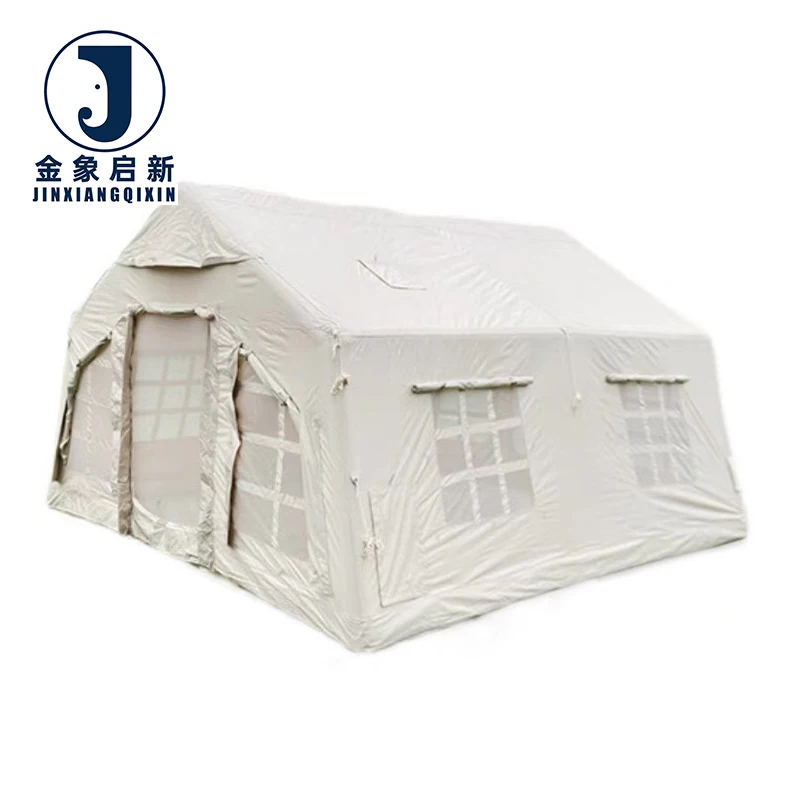
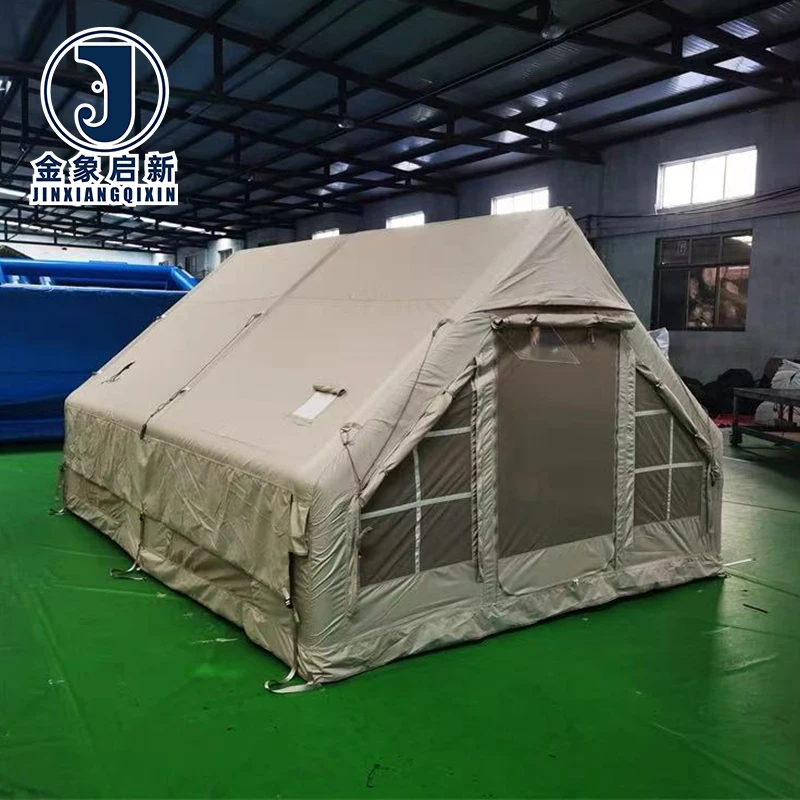
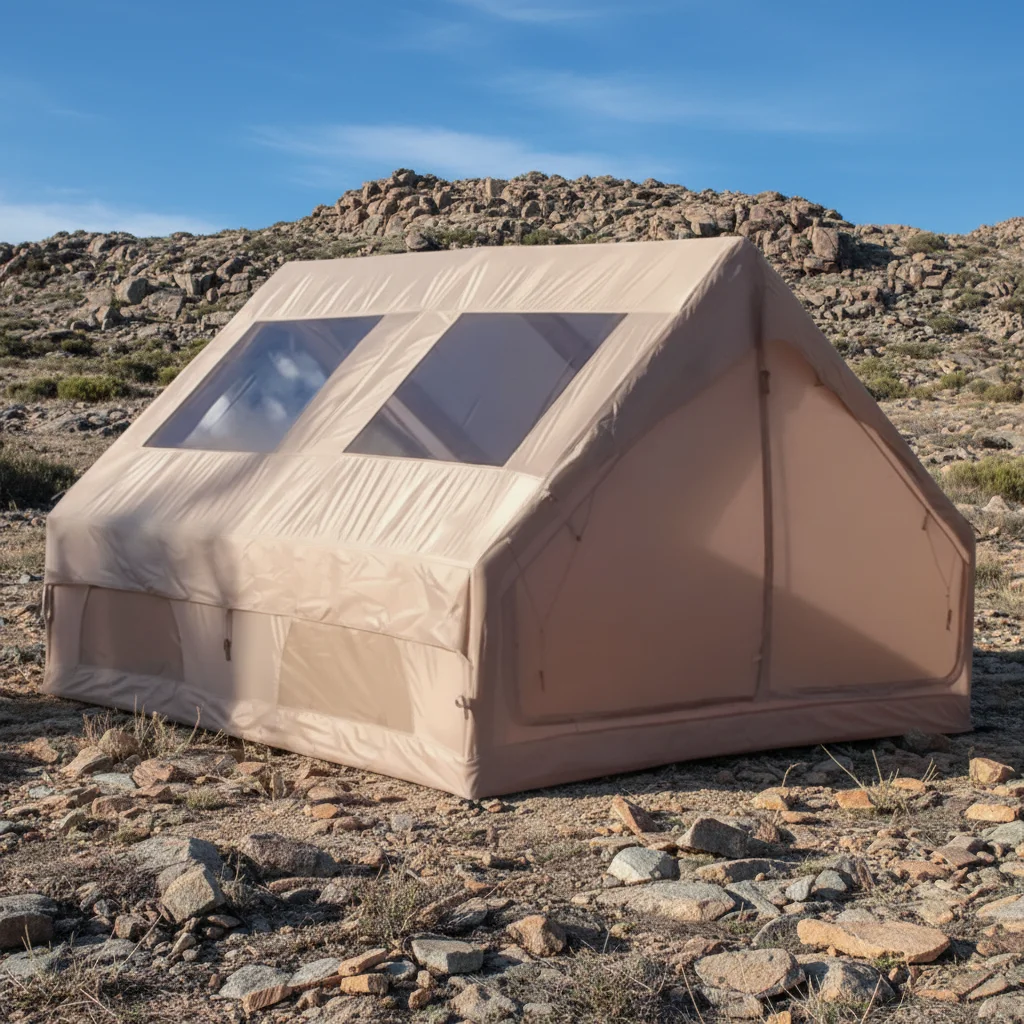

Deep process control over coating adhesion — every roll of PVC glamping tent fabric undergoes coating weight verification and peel testing at each production stage before release.
Technical Specifications
| Parameter | Value |
|---|---|
| Product Type | Inflatable Tent |
| Core Material | PVC Tarpaulin |
| Waterproof | Fully waterproof coated construction |
| UV-resistant | Available with UV treatment — confirm test basis for your market |
| Tear-resistant | Tear performance dependent on base fabric specification |
| Fire-retardant | Available in fire-retardant grades — confirm the grade required for your market |
| Anti-static | Available with anti-static treatment — verify surface resistance standard for site compliance |
| Product Forms | Single Layer Construction, Extended Type |
| Customization | OEM & ODM, sample customization, pattern printing |
| Standards | ISO 9001, ISO 14001, ISO 45001, CE |
Application Suitability
| Application | Exposure & Requirement |
|---|---|
| Commercial glamping facilities | Year-round weather exposure, guest safety compliance, aesthetic consistency across units |
| Large-scale event accommodation | Rapid deployment cycles, fire safety standards for public assembly, UV and rain resistance |
| Industrial temporary shelters | Harsh site conditions, wind loading on inflatable frames, fire-retardant and anti-static mandates |
| Inflatable membrane structures | Continuous internal pressure, seam integrity under flex, coating adhesion at weld lines |
What "Fire-Retardant Certified" Actually Means for an Inflatable PVC Glamping Tent
Certification is only as credible as the test report that backs it — a claim without a standard is just a word on a label.
Commercial outdoor hospitality operators routinely receive tent fabric described as fire-retardant, only to discover at site inspection that no test report matching the local authority’s accepted standard accompanies the shipment. For an inflatable PVC glamping tent deployed across a commercial venue, this gap between marketing language and documented compliance can halt operations. [NEED_CITE: fire classification standards for temporary structures and membrane fabrics] When a site inspector asks for the test certificate, the supplier must produce a report referencing a specific grade tested against a named standard — not a generic statement of compliance.
Coating Adhesion and Weld Integrity in Inflatable Structures
An inflatable PVC glamping tent operates under continuous internal air pressure, meaning every welded seam carries a sustained load that fabric-only applications never experience. The coating must bond to the base fabric strongly enough that the heat applied during welding fuses both layers without delamination. Our 10-technician R&D team adjusts coating weight and plasticiser balance specifically for inflatable membrane applications, ensuring that the weld line does not become the failure point once the structure is pressurised.
Anti-Static Treatment for Specialist Environments
When an inflatable tent is deployed on a mining lease, aviation facility or industrial zone where combustible dust or flammable vapours may be present, anti-static performance moves from an optional feature to a regulatory requirement. The surface resistance value must fall within the range accepted by the site safety officer. [NEED_CITE: anti-static surface resistance testing for coated fabrics in hazardous environments] We supply anti-static PVC glamping tent fabric with test data documenting the measured surface resistance — confirm which standard your project specifies so the correct treatment grade is applied during coating.
Decoding the Specification Sheet for Tent Fabric Buyers
GSM alone does not determine whether an inflatable tent fabric will hold up through four seasons of commercial use. The base fabric denier and weave density govern how the material resists tear propagation — a lighter but tighter weave can outperform a heavier loose weave in tear tests. Coating method matters equally: knife-coated PVC delivers higher peel strength at the weld line compared to laminated alternatives, which directly affects long-term seam reliability under constant inflation pressure. Fire-retardant additives interact with the coating formulation, sometimes reducing flexibility at low temperatures; this trade-off must be balanced during compounding to suit the deployment climate. Surface finish — glossy or matte — influences both cleanability in guest-facing applications and print adhesion for branded event installations.
The Cost of Undocumented Compliance on Site
A commercial glamping operator who accepts a tent shipment without verifying fire-retardant test documentation may face an enforcement notice once the local fire authority inspects the installation. The entire fleet of tents could be pulled from service until compliant material is sourced and replacements are fabricated. Anti-static fabric installed in a mining camp without a matching surface resistance report creates the same exposure — the site safety officer can refuse sign-off, leaving shelters unusable during a critical project window. Batch-to-batch colour variation discovered after installation forces either an aesthetic compromise visible to guests or a costly re-order of matching units. [NEED_CITE: batch colour consistency testing methods for coated PVC fabric]
Why Technical Buyers Source Inflatable Tent Fabric Here
Three full production lines and 36 sets of processing equipment give us the capacity to fulfil multi-unit commercial glamping orders on a single production run, maintaining batch consistency across every roll. Our dedicated QA and QC staff inspect coating weight, weld peel strength and colour uniformity at every stage — not just at final packing. The 10-technician R&D team develops samples for OEM and ODM projects, adjusting fire-retardant grade, anti-static treatment and pattern printing to match project specifications before bulk production begins. Pre-shipment inspection records ship with every consignment, providing the documentation trail that site compliance officers require. Nearly 30 years of focused coated fabric production means the process controls behind every PVC glamping tent roll are grounded in accumulated production data, not guesswork.
Documentation & Verification
- Material specification sheet stating coating type, fire-retardant grade reference and treatment details
- Fire-retardant test report naming the specific standard and grade achieved per batch
- Anti-static surface resistance test data matched to the site compliance standard
- Pre-shipment inspection record covering coating weight, colour and weld peel strength
- Roll packing list with batch traceability for each inflatable tent fabric consignment
- ISO 9001 and CE certificates available for regulatory submission
Fabrication, Handling & Storage
- Heat-weld PVC tarpaulin seams using temperature settings matched to the fire-retardant additive package to avoid delamination
- Store single layer and extended type rolls vertically on cores to prevent flat-spot creases in the coating
- Use compatible PVC cleaners only — solvent-based products can degrade the anti-static surface treatment
- Allow cold-weather rolls to acclimatise before unrolling to prevent coating micro-cracking at low temperatures
- Plan cut layouts for inflatable panel shapes to minimise welded seams across pressure-bearing zones
- Repair field punctures with matching PVC tarpaulin patches heat-welded to the original coating grade
Preparing Your Specification Enquiry
To move from enquiry to sample efficiently, share the inflatable structure dimensions, target deployment climate and any fire-retardant or anti-static standards your local authority requires. Specify whether you need single layer or extended type construction, and indicate if pattern printing or branded panels are part of the project scope. Confirm your target roll width, colour reference and approximate annual volume so we can align production scheduling and sample development to your timeline.
Frequently Asked Questions
Q: What fire-retardant grade does the inflatable tent fabric carry and which test standard applies?
A: Our PVC glamping tent fabric is available in fire-retardant grades suitable for commercial and industrial applications. The specific grade and test standard depend on your market’s regulatory requirements. Request a test report referencing the exact standard before confirming your order, and our team will match the formulation to deliver the documented grade you need.
Q: Is anti-static performance certified and what surface resistance value is achieved?
A: Anti-static treatment is available for inflatable tent fabric destined for mining, aviation or industrial sites. The surface resistance value depends on the treatment grade applied. We provide test data with the measured value — share your site’s required standard so we confirm compatibility before production.
Q: Can the tent fabric be supplied with test reports acceptable for mining or aviation site compliance?
A: Yes. We supply fire-retardant and anti-static test reports, material specification sheets and pre-shipment inspection records with every shipment. Confirm which specific standards your site safety officer requires, and the documentation package will be prepared to match before dispatch.
Q: What OEM customisation is available for pattern printing, sizing and membrane structure integration?
A: Our R&D team supports OEM and ODM projects including custom pattern printing, panel sizing for inflatable membrane structures and colour matching. Samples are developed for approval before bulk production, ensuring print sharpness, coating compatibility and dimensional accuracy meet your project specification.
Q: How is batch consistency and colour uniformity verified across large commercial glamping orders?
A: Every production run undergoes in-process QA checks for coating weight, colour uniformity and surface finish. A pre-shipment inspection record documents the results per roll. Multi-unit glamping orders are produced on a single run wherever possible to maintain roll-to-roll consistency across the entire installation.