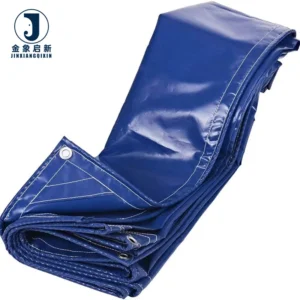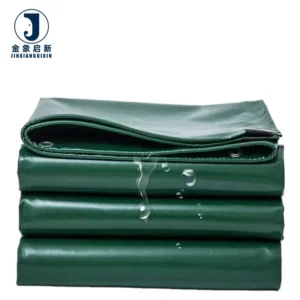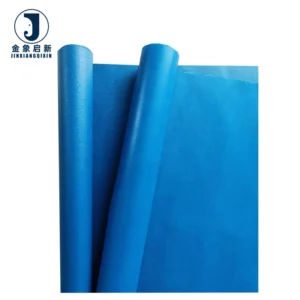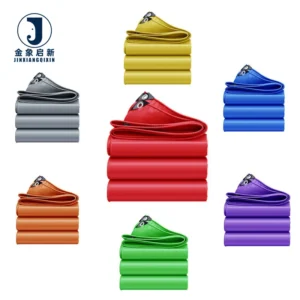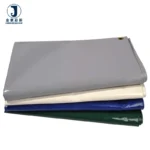
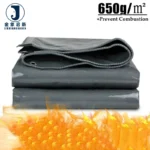
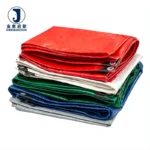
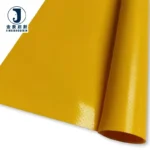
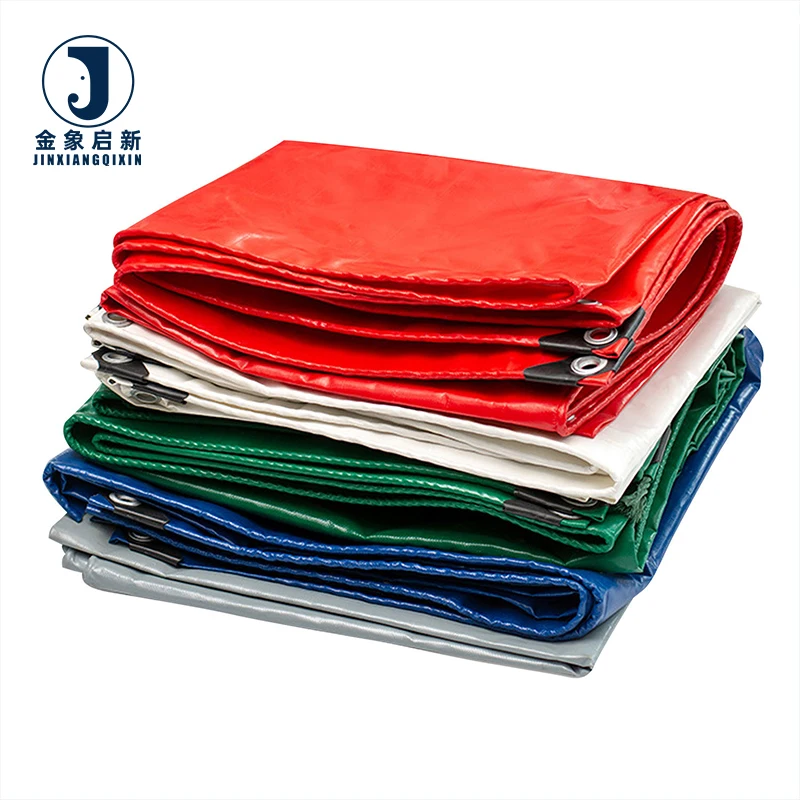
Flame-Retardant PVC Coated Tarpaulin 420~1000g/m² – Certified Grade
Proven Coating Adhesion — Three dedicated production lines control PVC coating weight and bond integrity across every roll, ensuring consistent material behaviour during hot-air welding and fabrication of specialist ventilation structures.
Technical Specifications
| Parameter | Value |
|---|---|
| Product Type | PVC Coated Tarpaulin |
| Base Fabric Material | Polyester |
| Yarn Count Options | 500D×840D, 500D×1000D, 1000D×1000D, 1000D×1300D, 1300D×1300D, 1000D×2000D |
| Weight (GSM) | 350, 400, 420, 500, 600, 650, 750, 900 g/m² |
| Total Thickness | 0.29 / 0.32 / 0.38 / 0.44 / 0.46 / 0.55 / 0.65 mm |
| Tensile Strength Warp | 1650 / 1800 / 1850 / 2050 / 2500 / 2550 / 2750 / 3900 N |
| Tensile Strength Weft | 1600 / 1700 / 1750 / 1900 / 2200 / 2250 / 2850 / 3500 N |
| Mesh Count | 30×19, 20×20, 30×15 (varies by GSM grade) |
| Coating Material | PVC |
| Flame Retardancy | Available in flame retardant grades — confirm the grade required for your market |
| Anti-UV Treatment | Available — test basis to be confirmed per specification |
| Water Resistance | Water resistant coated construction |
| Brittle Temperature | ≤ -50 to -60 °C |
| Softening Temperature | ≥ 80 °C |
| Melting Point | 212 °C |
| Key Features | Water resistant, flame retardant treatment available, anti-UV treatment available |
Application Suitability
| Application | Exposure & Requirement |
|---|---|
| Inflatable mining shelters | Sustained internal air pressure, rapid deployment, fire compliance in confined underground zones |
| Ventilation duct outer jackets | Continuous airflow vibration, flex fatigue at bends, mandatory fire-retardant certification on site |
| Membrane structure covers | Biaxial tension loading, solar UV exposure, long-term tensile stability |
| Tunnelling site enclosures | Ground moisture, chemical-laden dust, mechanical impact from equipment movement |
| Temporary construction shelters | Wind uplift, rain ingress, frequent dismantling and redeployment cycles |
What Fire Ratings Actually Mean for Ventilation Fabric
Sourcing PVC Coated Tarpaulin fire retardant fabric without a documented test standard is one of the most common compliance gaps on industrial sites.
Flame-retardant grade must match the specific regulation enforced at your project location.
Mining ventilation ducts and temporary membrane structures operate under strict fire-safety oversight. A supplier statement claiming flame retardancy carries no weight at site inspection without a test report referencing the applicable standard. Contractors who accept undocumented material risk failing compliance audits after installation is already complete. [NEED_CITE: fire classification frameworks for coated fabrics used in ventilation and temporary structures] The cost of ripping out non-compliant ductwork far exceeds the lead time of ordering tested material.
Matching Denier to Airflow Pressure and Structural Load
The base fabric denier directly determines how PVC coated tarpaulin performs under sustained mechanical stress in duct and membrane applications. Lower denier counts such as 500D×840D suit lightweight inflatable structures where internal pressure remains moderate and flexibility during deployment matters. Heavier configurations including 1300D×1300D and 1000D×2000D deliver the warp and weft tensile figures needed for long-span membrane roofs and high-pressure ventilation duct sections. Selecting denier based on actual load calculations rather than generic duty labels prevents under-engineering.
Coating Integrity at Weld Lines and Flex Points
Ventilation ducts experience repeated flex cycles at every bend and junction. The PVC coating must maintain adhesion to the polyester base fabric through thousands of these micro-deformations without delamination. Coating weight and application method govern this behaviour as much as the base weave does. Poorly bonded coating lifts at heat-welded seams, exposing bare yarn to moisture and chemical dust common in mining and tunnelling environments. [NEED_CITE: coating adhesion test methods for industrial PVC coated polyester]
Reading Tensile Figures Beyond the Data Sheet
Tensile strength values expressed in Newtons per five centimetres describe how the PVC coated tarpaulin resists pulling forces in each direction. Warp and weft figures differ because the weaving process places yarns under different tensions. For duct sections subject to unidirectional airflow pressure, the warp tensile figure becomes the governing parameter. Membrane structures loaded biaxially require balanced warp and weft values. The jump from 1650 N to 3900 N warp across the grade range illustrates why selecting the correct denier directly determines structural safety margins.
The Cost of Under-Specifying Fire Performance
Accepting PVC coated fabric with an undocumented flame-retardant claim exposes the entire installation to regulatory rejection. Underground mining regulations in most jurisdictions specify exact fire classifications for ventilation materials. A duct jacket that arrives without a matching test report cannot be signed off by the site safety officer, halting ventilation commissioning. [NEED_CITE: underground mining ventilation fire safety requirements for duct materials] Rework delays cascade through every downstream trade on the project. Procurement teams who request the test report before placing the production order eliminate this risk entirely.
Why Ventilation Contractors Source This Material Here
A 10-person R&D team develops samples within days when your project demands a specific width, colour, or fire-rating combination for duct fabrication.
Three full production lines with 36 sets of professional equipment maintain consistent coating weight across every roll in a bulk order.
Dedicated QA/QC at every production stage includes 100 percent inspection before shipment, catching coating inconsistencies that batch-sampling misses.
Material specification sheets accompany each dispatch, stating GSM, base fabric denier, coating weight, and the flame-retardant grade with supporting test documentation.
ISO and CE certified production processes provide the traceability framework that major infrastructure projects require in their vendor documentation packages.
Documentation & Verification
- GSM weight verification recorded per roll against the stated specification before dispatch
- Flame-retardant test report referencing the applicable standard supplied with shipment
- Base fabric denier and mesh count confirmed on the material specification sheet
- ISO and CE certificates included in the project documentation package
- Pre-shipment inspection record covering coating adhesion and surface consistency
- Certificate of origin provided for customs and procurement compliance
Fabrication, Handling & Storage
- Hot-air welding temperature must suit the PVC coating thickness to avoid burning through lighter GSM grades
- Seam overlap width should increase for heavier denier fabric to distribute flex stress across the weld zone
- Store rolls vertically on pallets to prevent flat-spot creasing that transfers into duct panels during fabrication
- Allow cold-stored rolls to reach ambient temperature before unrolling to prevent coating micro-cracking
- Cut patterns should follow warp direction on high-pressure duct sections to align tensile strength with airflow load
- Surface cleaning requires mild detergent; solvent-based products can soften the PVC coating at concentrations above recommended levels
Requesting a Specification Match
Provide the airflow pressure, duct diameter, and fire classification standard enforced at your project site so we can align the denier, GSM, and treatment grade to your exact compliance requirement. If your application involves membrane structures rather than ducts, share the span dimensions and expected biaxial load figures. Specify whether you need roll stock for in-house fabrication or pre-cut panels with edge finishing.
Frequently Asked Questions
Q: Which flame-retardant standards can the fabric meet, and is a test report included?
A: The fabric is available in flame retardant grades. The specific standard — such as M2, B1, NFPA 701, or DIN 4102 — must be confirmed against your project requirement before production. A test report referencing the applicable standard ships with your order. State your target market regulation at inquiry stage to ensure alignment.
Q: What hot-air welding settings work best for joining this PVC coated fabric in duct fabrication?
A: Welding temperature and speed depend on the specific GSM and coating thickness you select. Lighter grades require lower temperatures to prevent burn-through, while heavier denier constructions need higher heat input to achieve full coating fusion at the seam. We provide recommended parameters with each sample dispatch to support your fabrication trials.
Q: Can anti-static treatment be applied for underground mining ventilation compliance?
A: Anti-static treatment is available for PVC coated fabric destined for underground ventilation applications. The achievable surface resistance depends on the treatment formulation selected for your compliance requirement. Confirm the specific resistance range mandated by your mining safety authority so we can match the formulation during production.
Q: What roll widths are available for duct fabrication and membrane cutting patterns?
A: Custom widths are available subject to production line capacity and minimum order requirements. Providing your duct circumference or membrane panel dimensions at inquiry stage allows us to recommend a roll width that minimises off-cuts and weld seams in your fabrication process. Samples in your required width can be developed for cutting pattern validation.