

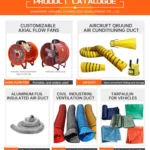

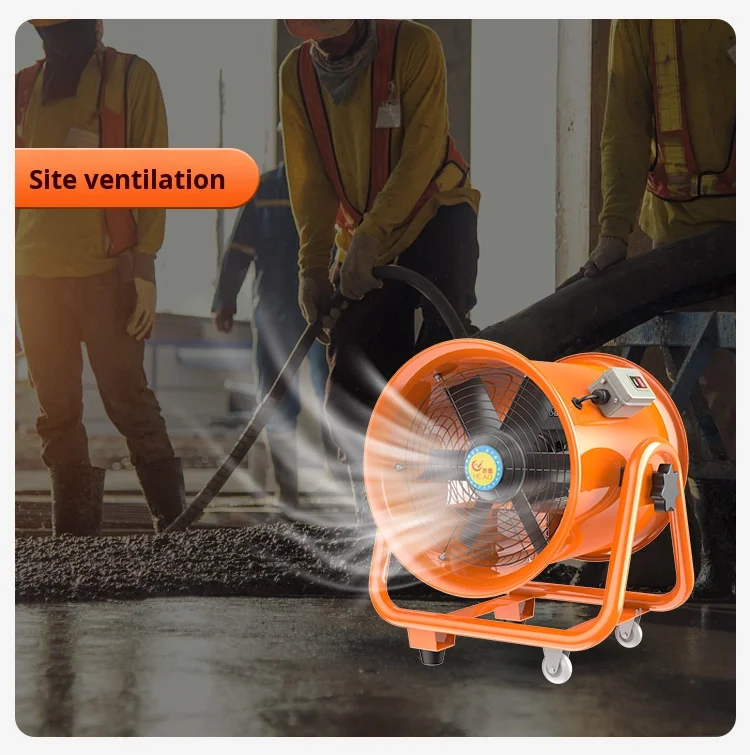
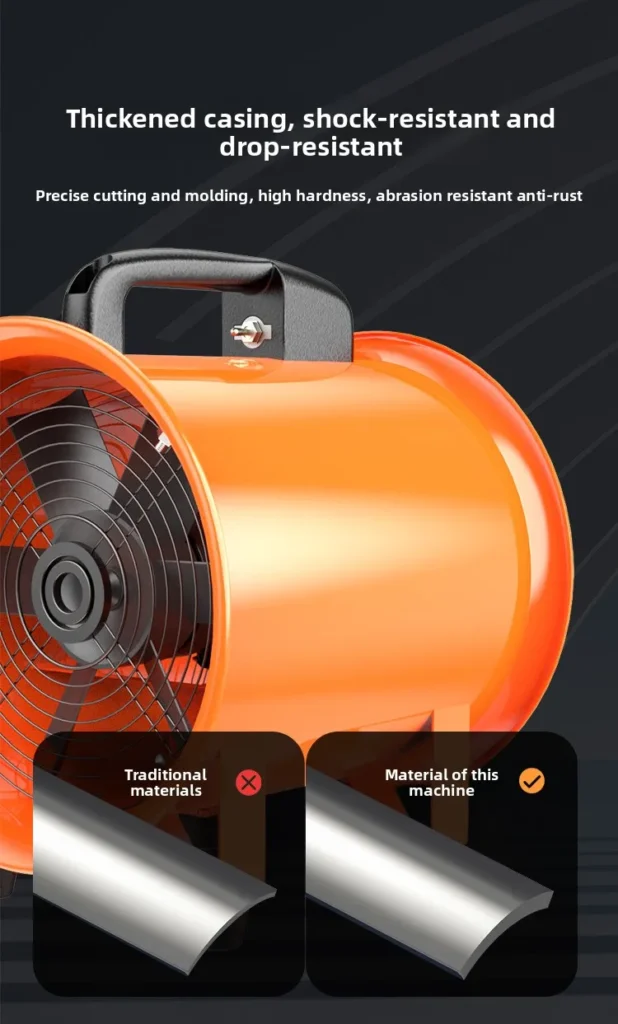
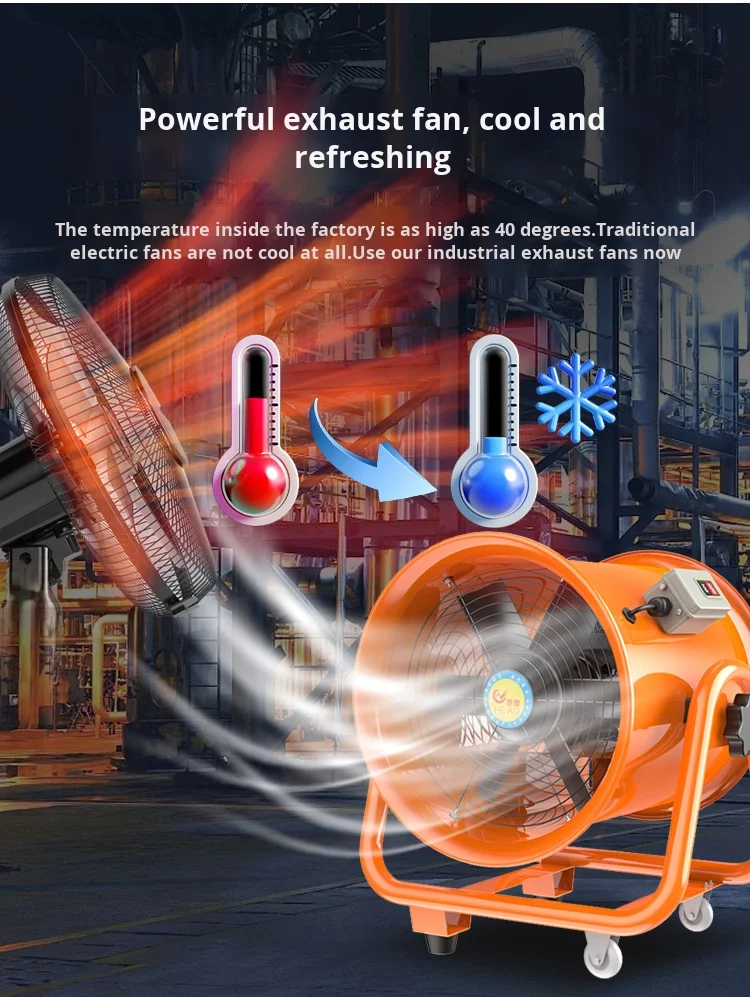

Proven Process Control — Every fan and duct assembly undergoes full pre-shipment inspection matched to the fire-retardant and anti-static grade your project specification demands.
Technical Specifications
| Parameter | Value |
|---|---|
| Product Type | Industrial Axial Flow Fan |
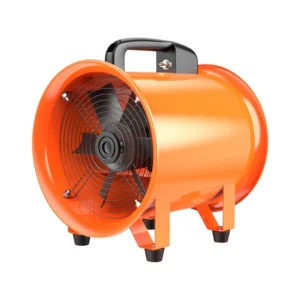
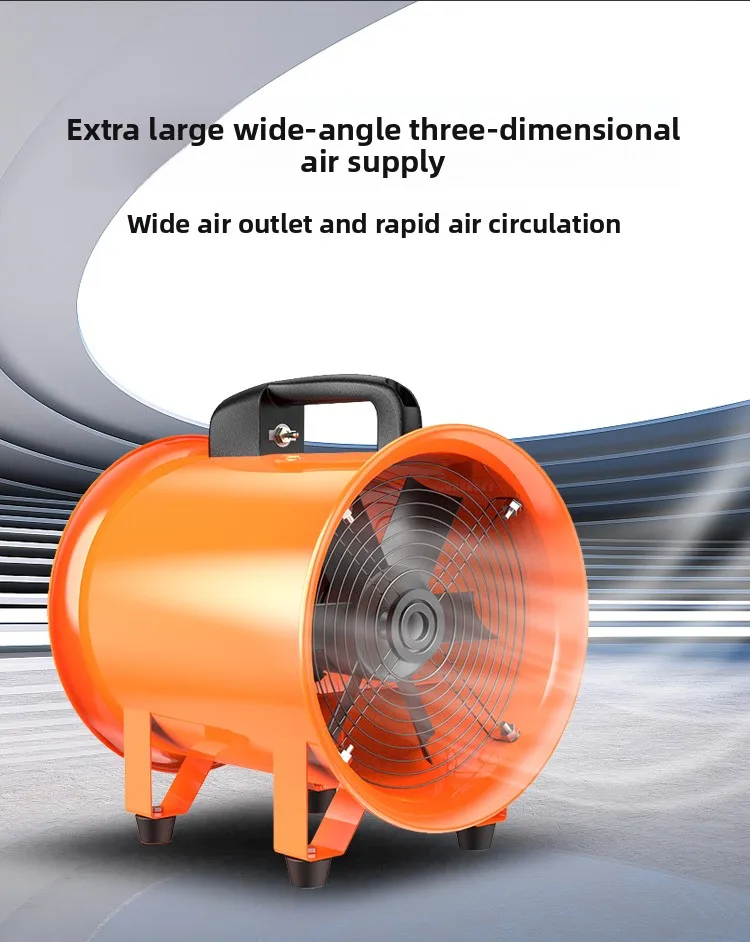
| Fan Type | Handheld axial flow fan |
| Size Options | 200mm / 250mm / 300mm / 350mm / 400mm / 450mm / 550mm / 650mm / 750mm / 850mm / 900mm |
| Power Range | 250W to 5500W |
| Air Volume Range | 1300 m³/h to 28000 m³/h |
| Total Pressure Range | 140 Pa to 320 Pa |
| Voltage | 220V / 380V |
| Noise Level | 57 dB(A) to 88 dB(A) depending on size |
| RPM | 3000 RPM |
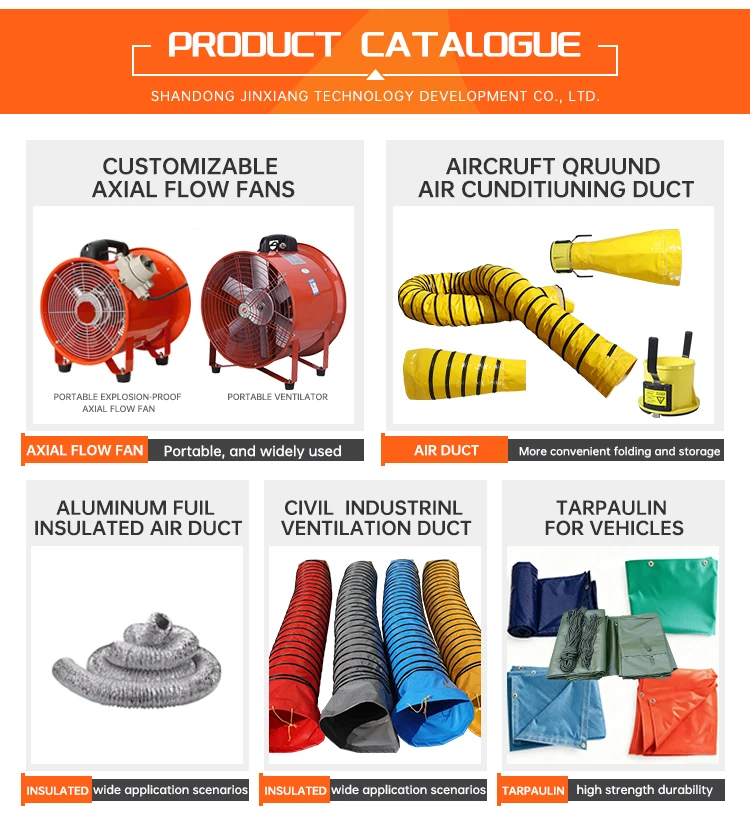
| Accessory | Flexible duct hose |
| Standards | ISO, CE |
Application Suitability
| Application | Exposure & Requirement |
|---|---|
| Underground mining and tunnelling | Forced ventilation to working faces through flexible duct runs; fire-retardant and anti-static compliance mandatory |
| Construction site confined-space extraction | Shaft, trench and basement dewatering and fume clearance; portable setup with rapid deployment |
| Industrial factory exhaust | Localised pollutant and heat extraction with flexible duct routing to filtration or external discharge |
| Aviation maintenance bay ventilation | Fume extraction during painting and chemical treatment; duct fabric meeting aviation fire-safety requirements |
Why Ventilation Ducts Fail Compliance Audits Before They Fail Physically
Certification paperwork must match the regulatory standard enforced on your site, not a generic claim printed on a data sheet.
An Industrial Axial Flow Fan with Flexible Ventilation Duct system moves air reliably, but if the duct fabric carries a flame-retardant rating that your local mining inspector does not recognise, the entire setup is rejected at the pre-start audit. We have seen contractors lose weeks of production because the duct certificate referenced a standard from a different jurisdiction [NEED_CITE: mining ventilation compliance standards by region]. The fan performs, the duct holds air, yet the site is shut down until compliant documentation arrives.
The same applies to anti-static requirements in gassy underground environments. A surface resistivity figure means nothing unless the test method is the one your safety regulator cites. Procurement teams often discover this mismatch only when the ventilation engineer reviews the file on-site, not at the quotation stage where it should be caught.
Matching Airflow Demand to Duct Diameter and Run Length
Selecting the correct Industrial Axial Flow Fan size starts with the required face velocity at the working face and the total duct run length including every bend. A 200mm fan delivering 1300 m³/h serves short extraction runs in confined maintenance bays, while a 900mm unit pushing 28000 m³/h supports long flexible duct strings in tunnelling. Undersizing the fan forces the motor to work against static pressure it cannot overcome, reducing actual delivered volume below what the duct run demands.
Fire-Retardant and Anti-Static Grades Must Align with Site Regulation
The flexible duct hose in this system is available with fire-retardant and anti-static treatments, yet the applicable grade depends entirely on the destination market and the specific regulation enforced underground. A mine in Western Australia references a different standard than a tunnelling project in Scandinavia [NEED_CITE: fire-retardant test methods for ventilation duct fabric]. Confirm the exact standard your safety authority requires before placing the order, so that the test report shipping with the duct matches what the inspector expects to see.
Reading Fan and Duct Specifications Beyond the Catalogue Number
Total pressure range from 140 Pa to 320 Pa determines how much duct resistance the fan can overcome before airflow drops off. Longer flexible duct runs with multiple bends accumulate friction loss quickly, so a higher-pressure fan model is necessary even if the air volume rating seems adequate on paper. Voltage selection between 220V and 380V depends on whether the site runs single-phase portable generators or three-phase underground distribution. Noise levels spanning 57 dB(A) to 88 dB(A) dictate whether hearing protection zones must be established around the fan intake, a factor often overlooked until the occupational hygienist conducts the first survey.
What Happens When Duct Fabric Specifications Are Wrong
Ordering duct fabric without confirming the anti-static surface resistance threshold means the material may pass a general flame test yet still fail the specific conductivity requirement for explosive atmospheres. The duct is physically sound but legally unusable underground. Similarly, specifying a duct diameter that mismatches the fan outlet forces a field-made adaptor that disrupts airflow and becomes the first point to tear under vibration [NEED_CITE: duct-to-fan connection failure in portable ventilation systems]. These errors surface on-site, not in the warehouse, which is why verification before dispatch matters far more than expedited production.
Why This Supplier Supports Your Ventilation Compliance
Three full production lines and 36 sets of professional equipment mean duct fabrication and fan assembly happen under one quality system, so the test reports covering both components ship together. The 10-person R&D team handles material selection for fire-retardant and anti-static grades, developing samples within days when a project specifies a non-standard certification. Dedicated QA/QC runs at every production stage with full pre-shipment inspection, so fan motor performance and duct seam integrity are verified before packing. Nearly 30 years focused on coated fabric gives the production team deep process control over coating adhesion at flex points, which is where duct seams experience the highest cyclic stress.
Documentation & Verification
- Material specification sheet stating duct fabric grade, fire-retardant and anti-static test basis, and fan motor rating
- Test report for fire-retardant classification matched to the standard your project specification requires
- Anti-static surface resistance test report where underground or explosive-atmosphere regulations apply
- Pre-shipment inspection record covering fan motor performance and duct seam integrity
- ISO and CE certificates, certificate of origin, and customs support documentation
Fabrication, Handling & Storage
- Heat-weld duct seams using temperature settings matched to the fire-retardant coating grade to avoid delamination at flex points
- Inspect flexible duct hose connection collars before each deployment to ensure the fan-to-duct seal remains airtight under vibration
- Store rolled duct sections on pallets in dry conditions to prevent compression marks that weaken the coating layer
- Select 220V or 380V fan configuration based on available site power before dispatch to avoid field rewiring
- Clean duct fabric with pH-neutral detergent only; aggressive solvents degrade the anti-static surface treatment
Before You Enquire, Prepare These Details
Provide the exact fire-retardant and anti-static standard your site safety authority enforces so the correct duct fabric grade is quoted from the start. Share the total duct run length, number of bends, and required face velocity so the fan size can be calculated rather than guessed. Indicate whether you need complete fan-and-duct assemblies or replacement duct sections only, and confirm the voltage available at the installation point.
Frequently Asked Questions
Q: What fire-retardant grade does the duct fabric carry, and does it meet my country’s mining or tunnelling standard?
A: The duct fabric is available in multiple fire-retardant grades. The specific classification — such as M2, B1, NFPA 701, or DIN 4102 — must be confirmed against the standard your safety regulator enforces. Share your project specification so we supply the matching test report with the shipment.
Q: Is the duct material anti-static certified for use in explosive or gassy underground environments?
A: Anti-static treatment is available with a surface resistance test report. The acceptable resistance threshold varies between jurisdictions and between coal, metal, and civil tunnelling applications. Provide your site regulation reference so we match the test method and value accordingly.
Q: How do I select the correct fan size and duct diameter for my required airflow and duct run length?
A: Fan selection depends on the total duct run length, number of bends, and target face velocity at the working face. Share these three figures and we calculate the required air volume and total pressure, then recommend the fan size from the 200mm to 900mm range that delivers the necessary output.
Q: Can duct length, diameter, and colour be customised, and what is the minimum order?
A: Custom duct diameter, length, and colour are available. Minimum order depends on the specific diameter and fabric grade selected. Request a sample for colour and weld-seam approval before the full production run to verify the material meets your site requirements.
Q: What documentation ships with the equipment?
A: Each shipment includes a material specification sheet, fire-retardant and anti-static test reports where applicable, pre-shipment inspection record, ISO and CE certificates, packing list, and certificate of origin. Additional customs or project-specific documentation can be prepared on request.