


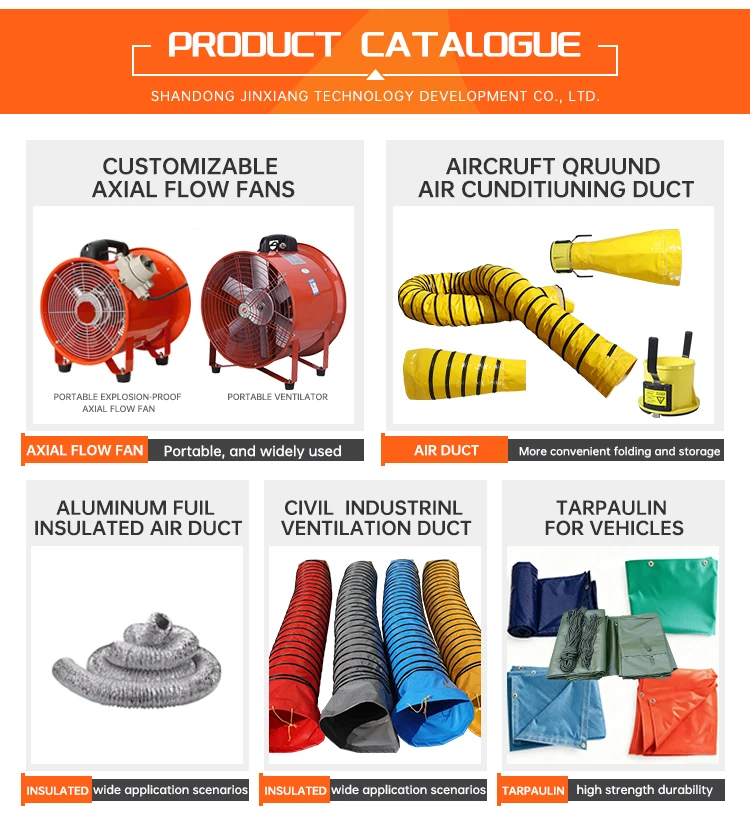

Specialist Duct Engineering — nearly 30 years of coated-fabric and industrial air duct production with dedicated QA at every stage ensures each Portable 3000RPM Axial Flow Fan with Flexible Duct Hose leaves the factory verified, not assumed.
Technical Specifications
| Parameter | Value |
|---|---|
| Product Type | Axial Flow Fan |
| Available Sizes | 200 mm, 250 mm, 300 mm, 350 mm, 400 mm, 450 mm, 550 mm, 650 mm, 750 mm, 850 mm, 900 mm |
| Power Range | 250 W to 5500 W |
| Air Volume Range | 1300 m³/h to 28000 m³/h |
| Total Pressure Range | 140 Pa to 320 Pa |
| Voltage | 220 V / 380 V |
| Noise Level | 57 dB(A) to 88 dB(A) (source value — verify against manufacturer catalog) |
| RPM | 3000 RPM |
| Configuration | Portable / Handheld |
| Duct Compatibility | Flexible duct hose (grade not stated) |
| Certifications | ISO, CE |
Application Suitability
| Application | Exposure & Requirement |
|---|---|
| Mining and tunnelling ventilation | Underground confined spaces requiring certified airflow, dust and fume extraction, fire-retardant and anti-static duct compliance |
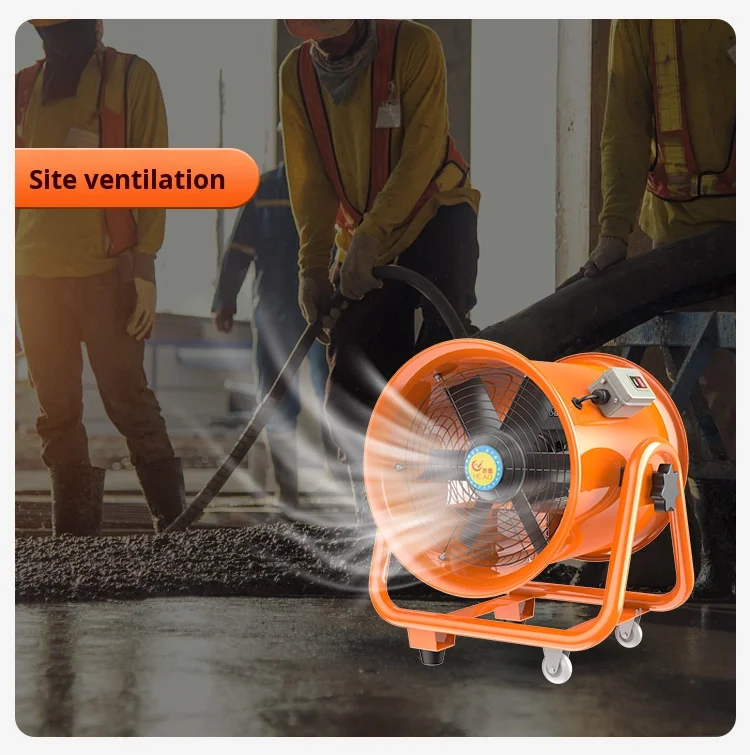
| Construction site exhaust | Enclosed work areas with welding fumes, cutting dust, and solvent vapours needing temporary high-volume extraction |
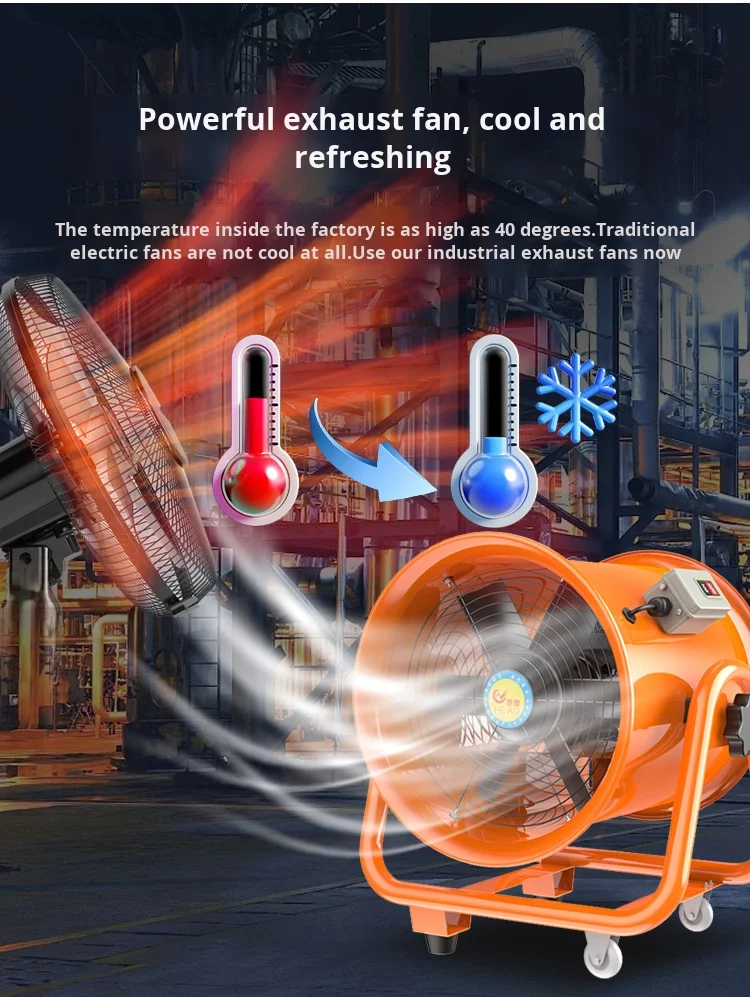
| Factory floor exhaust and fresh-air supply | Continuous operation in welding bays, paint booths, and chemical process zones with heat and particulate load |
| Confined space entry ventilation | Manholes, tanks, and vessel interiors where forced-air supply is a safety prerequisite before entry |
Why Ventilation Duct Certification Matters More Than Airflow Numbers
Specifying an Industrial Axial Flow Fan and Ventilation Duct without verifying fire-retardant and anti-static certificates is a compliance risk that surfaces only at site inspection.
Ventilation ducts deployed in mining, tunnelling, or confined-space construction must carry documentation that matches the site’s safety audit requirements. A fan that moves sufficient air volume but is paired with uncertified duct material can halt an entire operation when the safety officer requests paperwork. The duct material must demonstrate fire-retardant behaviour and anti-static surface resistance to the standard enforced in that jurisdiction — [NEED_CITE: fire-retardant and anti-static requirements for underground ventilation ductwork]. When documentation is missing or mismatched, the fan and duct sit idle while replacements are sourced, causing project delays that dwarf the cost of getting the specification right at the inquiry stage.
Sizing the Fan and Duct to the Actual Site Layout
An Industrial Axial Flow Fan and Ventilation Duct system performs only as well as the match between fan pressure capability and the duct run it serves. Longer runs with multiple bends generate friction losses that reduce delivered airflow at the working face. Selecting a fan diameter and total pressure rating based solely on the required volume — without accounting for duct length and routing — results in underperformance where it matters most. Each fan size in this range pairs with a corresponding flexible duct hose diameter to maintain airflow velocity and prevent collapse under negative pressure sections.
Dual Voltage Compatibility Across Diverse Site Power
Site power supply varies significantly between surface construction, underground mining, and factory environments. The 220 V / 380 V dual voltage design allows the same fan family to serve single-phase temporary power on a building site and three-phase industrial supply in a processing plant. Confirming available voltage at the installation point before ordering prevents motor rewinding delays or transformer additions on site — [NEED_CITE: voltage compatibility considerations for portable industrial ventilation equipment]. Matching the correct voltage configuration also ensures the motor delivers rated RPM and pressure without thermal overload.
Reading Air Volume and Pressure Against Duct Run Requirements
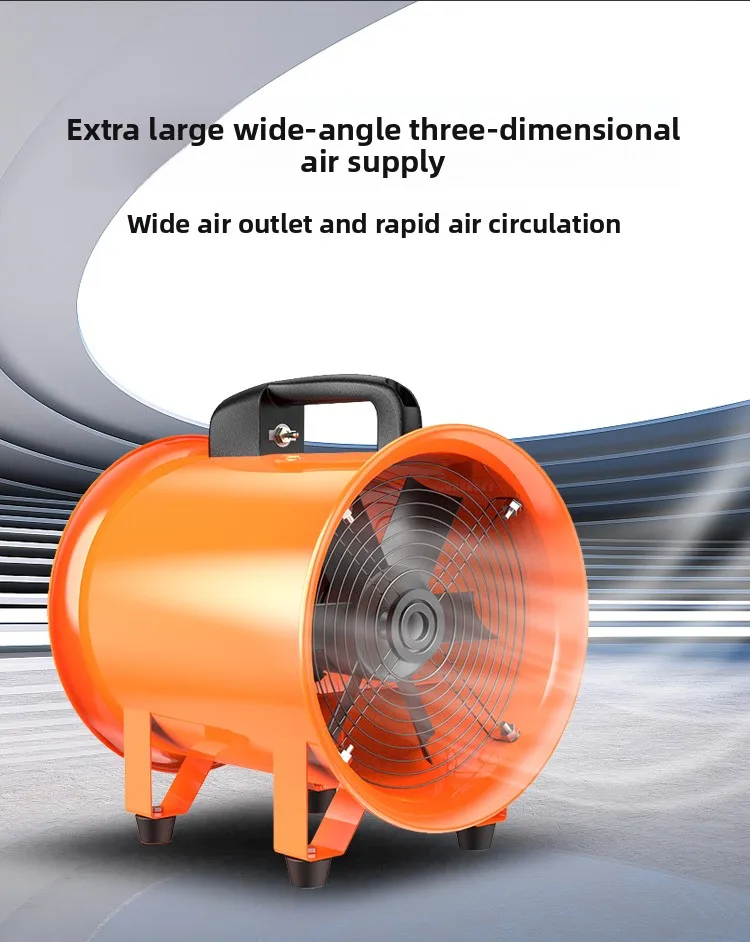
The relationship between air volume and total pressure defines what actually reaches the working face. A fan rated at high volume but low pressure will deliver diminishing returns through long or convoluted duct runs, as friction consumes the available pressure head. Conversely, higher-pressure units maintain airflow over extended distances with multiple bends, which is typical in tunnelling and mining layouts. The 3000 RPM axial flow design generates the pressure needed to push air through restrictive paths while maintaining volume. Duct diameter selection must align with fan outlet size to avoid turbulence losses at the coupling point, and flexible duct routing should minimise sharp bends that increase resistance and reduce effective delivery.
What Happens When Duct Specification Is Left Unchecked
Duct material delivered without the fire-retardant grade or anti-static certification required on site creates a binary outcome: either the safety team rejects the installation, or it passes initial use but fails an audit weeks later. In both cases the duct is removed and replaced while the project waits. Colour or surface inconsistency between duct rolls installed side by side signals batch control issues that extend beyond appearance — they may indicate uneven coating weight that affects fire performance. Welded seams on flexible duct that fail before the fabric itself indicate insufficient heat-seal process control, leaving joints as the weakest link in the entire ventilation run [NEED_CITE: seam failure modes in flexible ventilation ducting].
Why Procurement Verification Belongs Before Shipment
Sourcing an Industrial Axial Flow Fan and Ventilation Duct system from a facility with three full production lines and 36 sets of professional equipment means capacity is available for bulk orders without compromising lead reliability. A 10-person R&D team handles duct material selection, custom sizing, and sample development within days when site requirements deviate from standard offerings. Dedicated QA/QC runs at every production stage with 100 percent inspection before dispatch, so each fan and duct roll is verified against its specification — not sampled. Nearly 30 years focused on coated fabric and industrial duct manufacturing provides the process depth needed to control coating adhesion, fire-retardant treatment consistency, and anti-static surface resistance across every unit produced.
Documentation & Verification
- Material specification sheet stating duct diameter, material grade, and fire-retardant or anti-static classification where applicable
- Test report for fire-retardant and anti-static performance matching the grade required by the site safety specification
- ISO and CE certificates confirming management system and product compliance
- Pre-shipment inspection record with full coverage of fan units and duct rolls before dispatch
- Roll packing list with dimensions and quantities for customs clearance and receiving verification
- Certificate of origin supporting trade documentation requirements
Fabrication, Handling & Storage
- Flexible duct hose coupling diameter must match fan outlet flange size to prevent air leakage at the connection point
- Store duct rolls horizontally on pallets in covered, dry conditions to prevent coating surface damage before deployment
- Unroll duct material fully before installation to release packing compression and restore circular cross-section profile
- Avoid dragging duct sections across abrasive surfaces during site routing to protect the coated outer layer
- Inspect welded seam lines along duct length for continuity before connecting to the fan unit
- Cut duct to required run length using sharp tools to produce clean edges that seal properly at couplings
How to Structure Your Inquiry
Provide the application environment — mining, tunnelling, construction, or factory — along with duct run length and number of bends so fan diameter and pressure can be matched accurately. Specify the fire-retardant grade and anti-static standard your site safety plan requires, as these determine which duct material is supplied. Indicate available voltage at the installation point and confirm whether duct sections should be supplied in continuous lengths or pre-cut segments with coupling joints.
Frequently Asked Questions
Q: What fire-retardant grade and anti-static certification does the flexible duct carry?
A: Fire-retardant and anti-static grades vary by duct material specification. Request the test report and surface resistance certificate for the specific duct grade being quoted before confirming the order, ensuring documentation matches your site compliance requirements.
Q: How do I match fan diameter and total pressure to the duct run length and bends on site?
A: Longer duct runs and additional bends increase friction losses, requiring higher total pressure to maintain airflow at the working face. Provide your layout details — run length, bend count, and required volume — so the correct fan size and pressure rating can be selected.
Q: Is the duct material compatible with standard mine and tunnelling ventilation compliance requirements?
A: Underground compliance standards vary by jurisdiction and mining authority. Confirm the specific fire-retardant and anti-static standards enforced at your site, then request matching certification documentation before shipment.
Q: What documentation is supplied with the fan and duct for customs and site safety audit?
A: Dispatch documentation includes ISO and CE certificates, material specification sheets, test reports for applicable fire-retardant or anti-static grades, pre-shipment inspection records, packing lists, and certificates of origin.
Q: Can the duct be custom-cut to length and are flame-retardant joints available?
A: Custom-cut duct lengths and joint configurations are available through the R&D team. Provide required segment lengths and coupling specifications during inquiry so samples can be developed and approved before production.