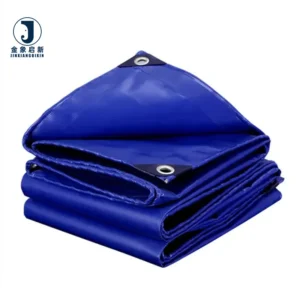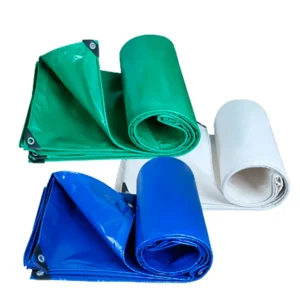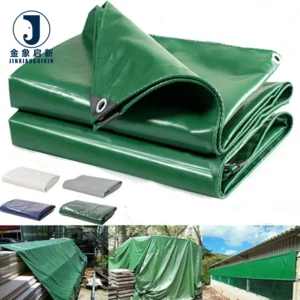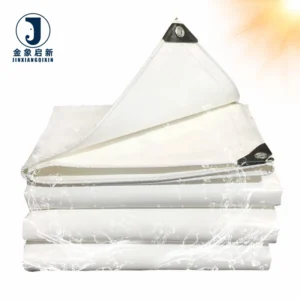
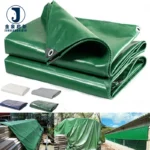
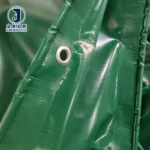
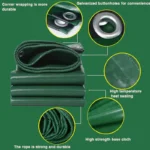

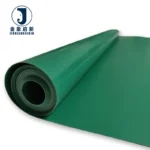
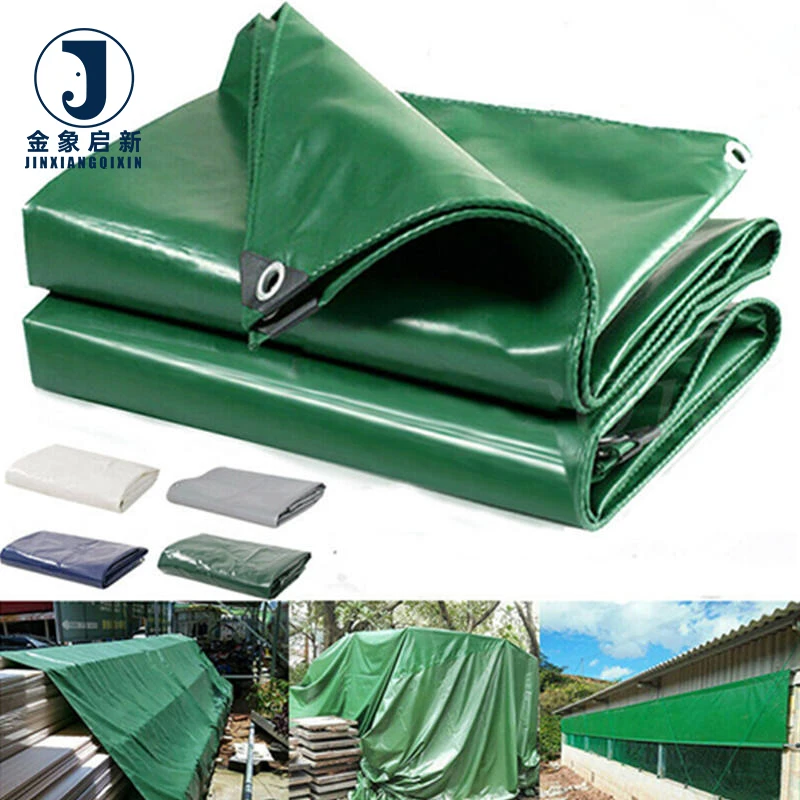

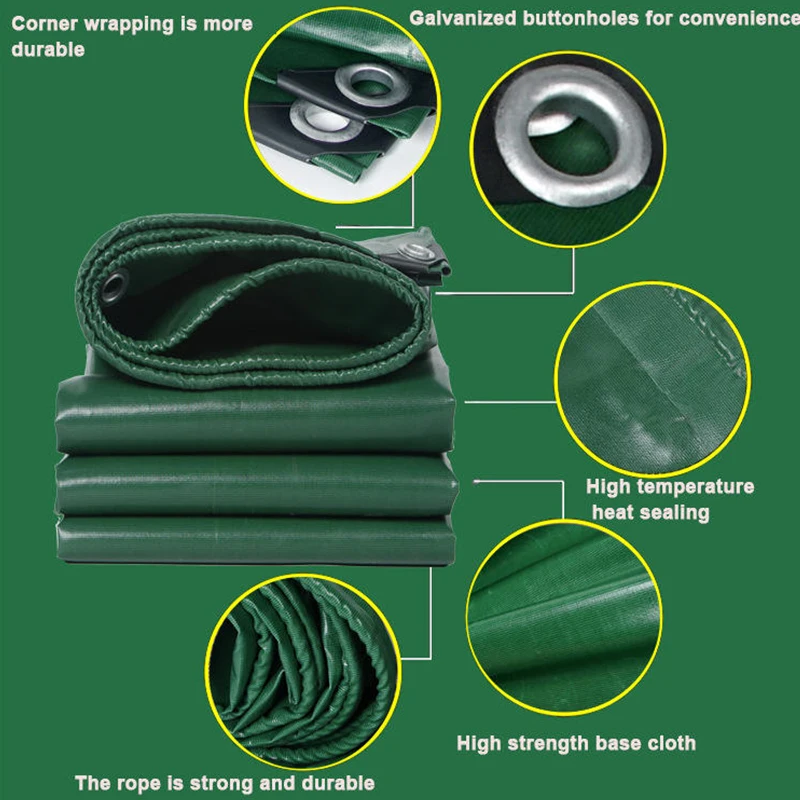
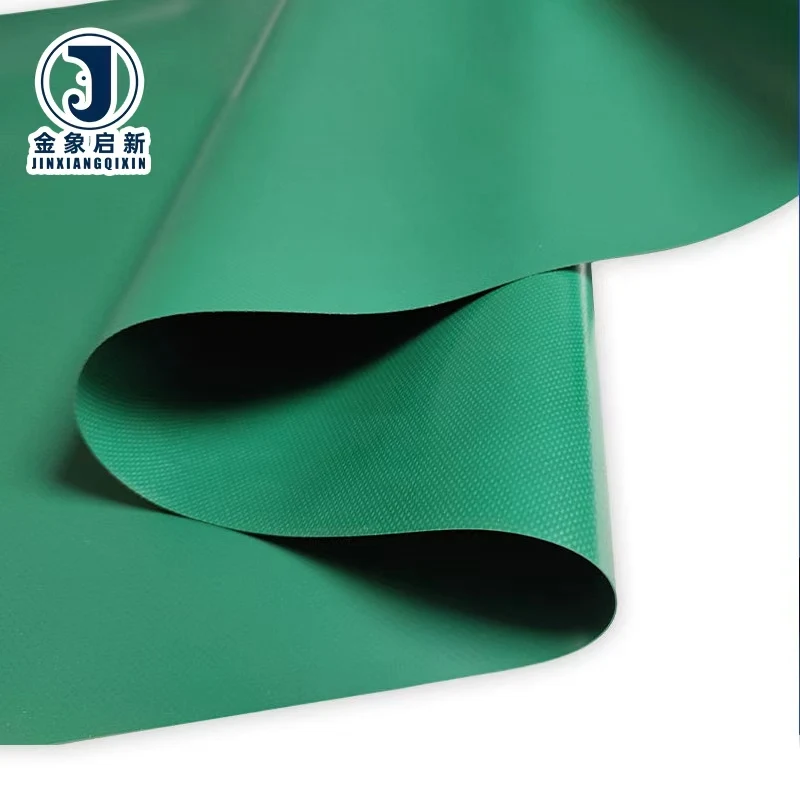
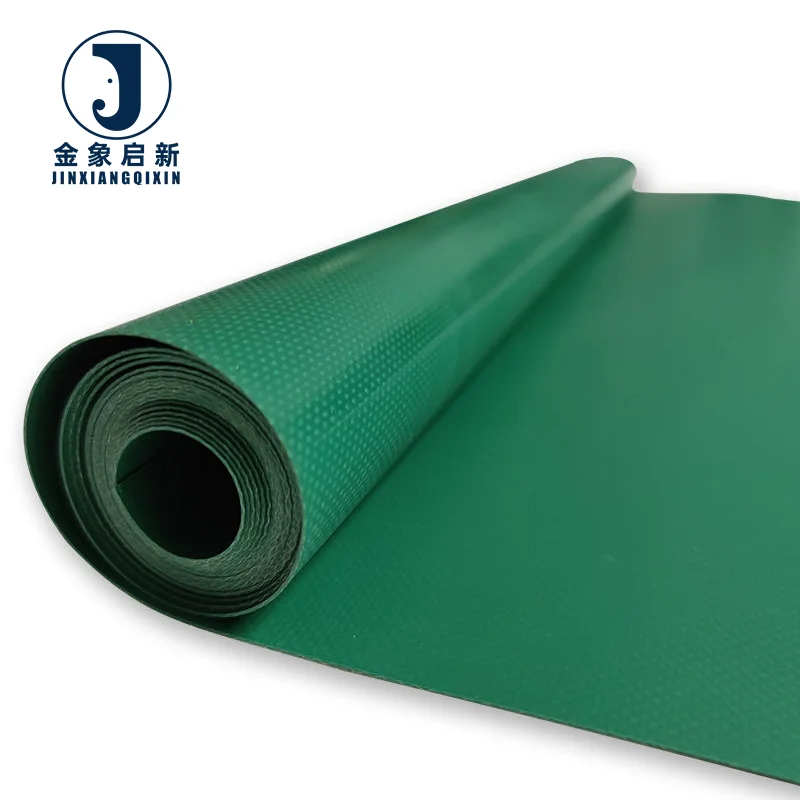
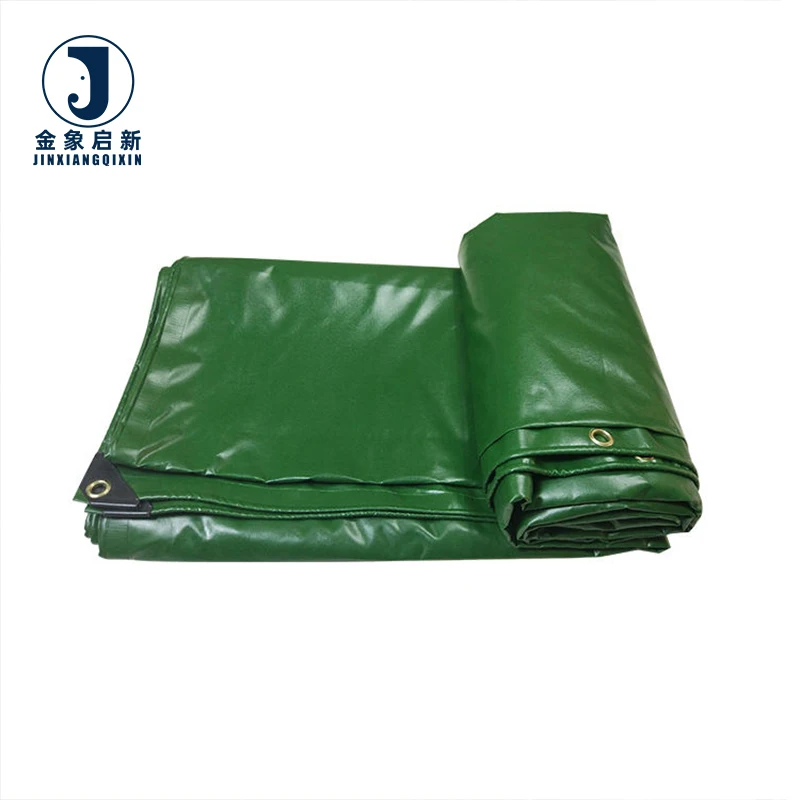
Coating Weight Mastery — Nearly three decades of PVC knife-coated fabric production, with process control over coating adhesion and GSM verification across membrane and ventilation grades.
Technical Specifications
| Parameter | Value |
|---|---|
| Product Type | PVC Coated Tarpaulin Fabric |
| Coating Method | Knife-coated PVC on polyester base |
| Base Yarn Denier | 500D – 2000D |
| Thickness Range | 0.35 mm – 1.5 mm |
| Weight Range (GSM) | 400 g/m² – 1500 g/m² |
| Tensile Strength (Warp) | 1500 N/5cm – 3000 N/5cm |
| Tensile Strength (Weft) | 1200 N/5cm – 2800 N/5cm |
| Surface Finish | Available in glossy or matte finish |
| UV Treatment | Available — confirm UV test basis for your application |
| Flame Retardant Treatment | Available in flame retardant grades — confirm the grade required for your market |
| Roll Width Options | 2 m / 4 m / 6 m and custom widths |
| Roll Length Options | 100 yards / 100 meters and custom lengths |
| Colour Options | Blue, Blue/Orange, Green, Grey, Black, Clear, Grey/Green, Orange, or custom |
| Standards | ISO, CE |
Application Suitability
| Application | Exposure & Requirement |
|---|---|
| Tensile membrane structures | Sustained tension loads, wind uplift cycles, UV and thermal cycling — requires dimensional stability and certified flame retardant grade for building codes |
| Mining and tunnelling ventilation ducts | Continuous airflow, abrasive dust contact, confined-space fire safety compliance — requires anti-static and fire-retardant certification |
| Inflatable and air-supported structures | Repeated inflation cycles, internal pressure stress, joint integrity at weld seams |
| Industrial pipe and equipment canopy covers | Outdoor weather exposure, chemical-laden atmosphere near processing plants |
| Aviation ground ventilation systems | Regulatory compliance for airside operations, low-smoke and flame-retardant requirements |
| Construction site temporary enclosures | Wind loading, mechanical impact from site traffic, rapid deployment and teardown cycles |
Why Certified PVC Knife-Coated Fabric Matters More Than the GSM Number
A 900 g/m² roll without a verifiable flame retardant grade is useless on a membrane structure that must pass building code inspection.
Technical buyers sourcing ventilation duct or membrane structure fabric face a recurring problem: the quotation states a GSM and claims fire-retardant treatment, but the roll arrives with no test report matching the site’s required standard. The fabric may weigh what was ordered, yet fail the compliance check because the flame retardant chemistry was never validated against DIN 4102, NFPA 701, or the local mining safety regulation. PVC knife-coated tarpaulin fabric performs across ventilation, membrane, and heavy-duty cover applications only when the specification includes a traceable test basis for every claimed property. [NEED_CITE: fire classification standards for coated fabrics in building and mining applications]
Coating Adhesion and Delamination Control
When PVC knife-coated tarpaulin fabric is used in tensile membrane or ventilation duct construction, the bond between coating and base fabric determines long-term serviceability more than the base yarn strength alone. Knife coating forces PVC paste into the interstices of the woven polyester under controlled blade pressure, creating mechanical interlock rather than surface lamination. This process yields higher peel strength at the coating-to-yarn interface, which matters when the fabric flexes repeatedly under wind load or internal duct pressure. Poor adhesion shows up as coating blister or peel at high-stress zones — typically near clamping rails, weld seams, or duct branch junctions.
Fire Safety Compliance for Confined and Public Environments
Mining tunnels, aviation hangars, and public-access membrane structures each impose distinct fire performance requirements on the fabric. A ventilation duct operating underground must meet anti-static and flame propagation standards specific to mining safety authorities, while a tensile roof over a commercial atrium must satisfy building material fire classification. [NEED_CITE: test methods for flame retardant coated textiles per DIN 4102 and NFPA 701] The PVC formulation can be compounded with flame retardant additives to meet different grades, but the critical step is matching the grade to the regulation your project must satisfy. Confirming the required classification before production avoids costly material rejection at site inspection.
How Base Fabric and Coating Weight Interact
The 500D to 2000D base yarn range and 400 g/m² to 1500 g/m² coating weight range together define the mechanical envelope of the finished PVC knife-coated tarpaulin fabric. A heavier coating does not automatically deliver higher tensile strength if the base fabric denier is low — the coating adds mass and weather resistance, but the yarn count and weave density carry the structural load. For membrane structures subject to sustained biaxial tension, a higher denier base fabric in the 1000D to 2000D range provides the dimensional stability needed to resist creep and panel distortion. Thicker coatings in the 0.70 mm to 1.5 mm range add puncture resistance and extend the service interval before recoating or replacement. Glossy finishes shed dust and dirt more readily in polluted environments, while matte finishes reduce glare on large membrane installations. [NEED_CITE: tensile and tear test methods for coated fabrics per ISO 1421]
The Cost of Specification Mismatch on Technical Projects
When a ventilation duct is installed underground without the fire-retardant certification the mine safety authority requires, the entire run may be ordered removed before commissioning. Similarly, membrane structure fabric that arrives with colour variation between rolls forces the contractor to either accept a visibly inconsistent façade or reorder at project delay cost. Weld seam failures at high-flex zones on inflated structures often trace back to coating formulations that soften or degrade under repeated thermal cycling at the joint, rather than to the base fabric itself. [NEED_CITE: common failure modes in welded seams of PVC coated technical textiles]
Why Technical Buyers Source This Fabric Here
Deep process control over coating weight and adhesion ensures that the PVC knife-coated tarpaulin fabric leaves the production line with verified GSM and consistent coating bond strength across every roll. The ten-person R&D team develops material samples matched to your specific ventilation duct diameter, membrane panel geometry, or inflatable structure profile before bulk production begins. Dedicated quality control runs at every stage — base fabric inspection, coating weight check, and finished roll verification — with 100% inspection before dispatch. Three full production lines and 36 sets of professional equipment support bulk volume commitments without compressing lead times on custom widths or flame retardant grades. Material specification sheets, test reports for UV and flame retardant grades, ISO and CE certificates, and pre-shipment inspection records ship with every order.
Documentation & Verification
- Material specification sheet confirming GSM, base denier, coating weight, and colour reference per roll
- Flame retardant test report matched to the grade specified for your ventilation or membrane project
- UV stability test documentation when anti-UV treatment is included in the order
- Pre-shipment inspection record with measured values against the quoted specification
- ISO and CE certificates included with dispatch documentation
- Roll packing list with individual roll weights and dimensions for customs clearance
Fabrication, Handling & Storage
- Heat welding parameters should be adjusted for the specific coating thickness — heavier 1.0 mm to 1.5 mm grades require longer dwell times at lower temperatures to achieve full seam fusion
- Store rolls upright on pallets in covered areas to prevent flat-spot deformation on the PVC coating surface
- Unroll and allow fabric to acclimatise before welding in cold conditions, as stiff coating below recommended temperature increases crack risk at fold lines
- Use compatible PVC-based repair patches and solvent cements for field repairs on membrane and duct installations
- Plan cutting layouts to maximise yield from standard 2 m, 4 m, or 6 m roll widths and minimise transverse weld seams in high-tension zones
- Avoid dragging rolls on unprotected ground to prevent coating abrasion on the outer layers before fabrication
Request a Technical Specification
Provide your application type — ventilation duct, membrane structure, inflatable, or industrial cover — along with the compliance standards your project must meet. Specify the roll width, target GSM or thickness range, and whether you need flame retardant or anti-static certification for your market. If your project requires custom colour matching or finished panel fabrication rather than roll stock, include the panel dimensions and seam configuration so the sample development process addresses your exact requirements.
Frequently Asked Questions
Q: Can you supply PVC coated fabric with fire-retardant and anti-static certification for mining ventilation?
A: Yes. We formulate PVC knife-coated tarpaulin fabric with flame retardant and anti-static additives matched to the certification standard your mine safety authority requires. Provide the specific regulation or test method your project must comply with, and we will develop a sample with supporting test documentation before bulk production begins.
Q: How do you verify that the GSM on the roll matches the quotation?
A: Every roll undergoes weight verification during pre-shipment inspection. The measured GSM is recorded on the inspection report that ships with your order. Our coating process controls paste application weight at the knife blade, and dedicated QC checks confirm the finished coating mass aligns with the specification agreed at order confirmation.
Q: What test reports come with UV-treated and flame-retardant grades?
A: When you order UV or flame retardant treatment, we include the relevant test report stating the test method, result, and classification achieved. The specific standard referenced depends on the grade confirmed during sample approval — confirm your market requirement so the correct test basis is applied.
Q: How do you ensure colour consistency across multiple rolls in one order?
A: Colour matching is controlled during PVC paste compounding, and each production batch is checked against the approved colour reference before coating begins. Rolls within the same order are produced from the same compounded batch to maintain visual consistency across the installation, reducing the risk of visible variation when panels are installed side by side.
Q: Can you develop custom samples for membrane structure or ventilation duct projects?
A: Yes. Our R&D team produces samples to your specified GSM, base denier, coating thickness, colour, and treatment requirements within days. Sample approval locks the specification before full production, ensuring the bulk order matches the validated material for your membrane, duct, or inflatable structure application.