Tarpaulin Repair vs Replacement: When Is It Cheaper to Buy New from a Chinese Manufacturer?
Most B2B tarpaulin buyers assume repair is always the lower-cost option, but this common assumption ignores hidden operational expenses that often make new purchases a far better financial choice. If you regularly source tarps for fleets, construction sites, aquaculture operations or wholesale resale, you have likely encountered the recurring dilemma of whether to patch damaged stock or order replacement units, and the upfront price of local repair services rarely tells the full story.
For bulk tarpaulin buyers and long-term operational users, replacing heavily damaged products via a reliable Chinese industrial fabric supplier is consistently more cost-effective than repeated repairs when you account for hidden labor costs and downtime risks.
We have supported more than 200 global B2B tarpaulin purchasers across North America, Europe and Southeast Asia over the past decades, and the pattern holds across almost every use case: the total cost of ownership, not the upfront repair quote, is the only reliable metric to compare the two options [NEED_CITE: Total cost of ownership, not upfront repair price, is the correct metric to compare tarpaulin repair and replacement for bulk buyers]. Most teams only calculate the hourly labor charge for patch work, and completely overlook the revenue lost while your assets sit idle waiting for repairs to be completed.
Below we break down clear decision rules, real-world case data and actionable steps to help you pick the right option for every damaged tarp in your inventory.
How to Calculate the True Cost of Tarpaulin Repair vs Replacement
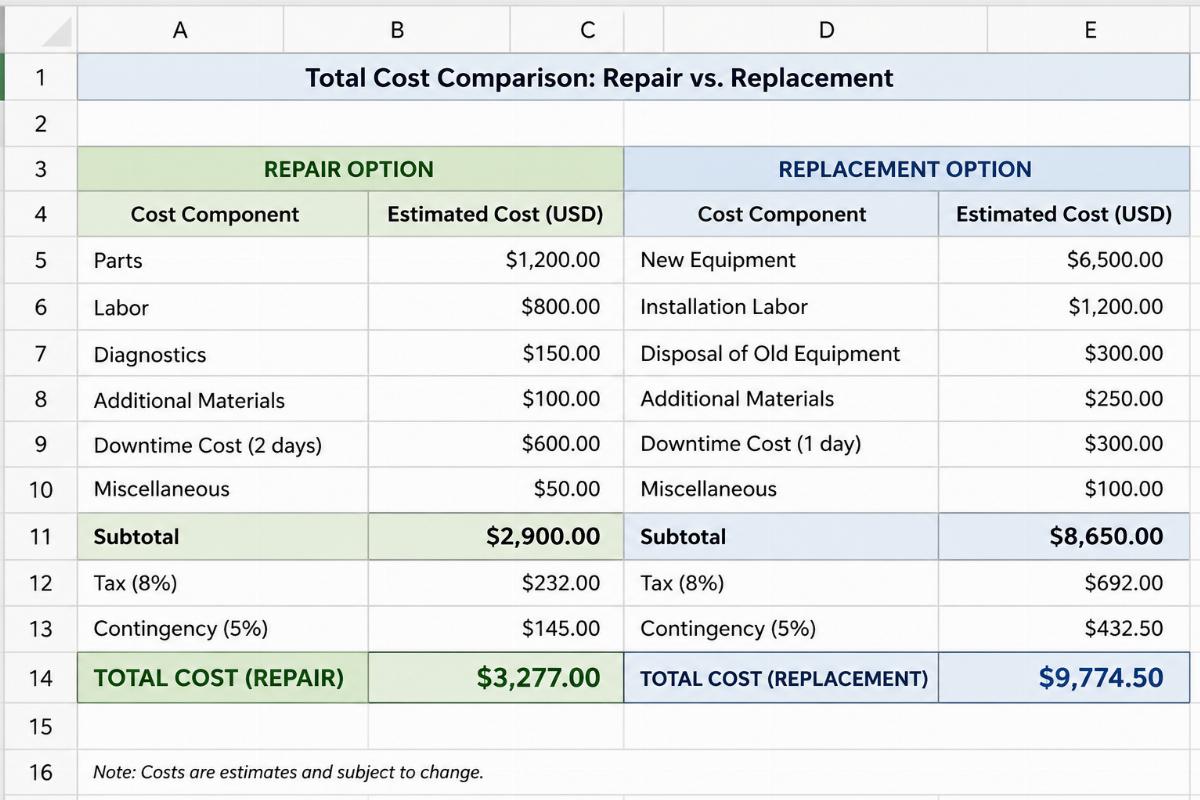
You only need a simple 2-part formula to compare total costs, no complex accounting required. To avoid hidden surprises, add up both the direct costs of repair labor and the indirect costs of lost operational time, then compare that total to the all-in cost of ordering replacement units including shipping. This eliminates the common mistake of only looking at the immediate out-of-pocket cost of patching, which is almost always a fraction of the real expense your business incurs.
| Cost Factor | Common Miscalculation | Correct Calculation Method |
|---|---|---|
| Direct Expense | Only quote local repair shop hourly rates | Multiply total required repair labor hours by local hourly service rate [NEED_CITE: The full total of repair labor hours multiplied by local hourly rates is the correct direct cost base for repair] |
| Indirect Expense | Ignore downtime entirely or only count partial idle time | Multiply hours of operational downtime by your average hourly revenue generated from the asset |
| Replacement Cost | Only count unit list price | Add unit wholesale price plus shipping and lead time related holding costs |
A North American tarpaulin wholesaler that ordered a 20ft container of 30,000 square meters of PVC truck covers found this out firsthand after a severe storm damaged 15% of their stock. They initially planned to send all torn units to a local repair shop, but ran the number and discovered that replacing the heavily damaged stock via a Chinese supplier cost 22% less than paying for full patching, even before accounting for the 3 full days of warehouse downtime they would have incurred while waiting for repairs to finish.
- Gather Labor Rate Data – Pull the last 6 months of local repair service invoices to confirm your standard hourly charge for tarp patching work.
- Calculate Hourly Revenue Per Asset – Divide the average monthly revenue generated by each of your assets (trucks, fish ponds, construction sites) by the number of operating hours per month.
- Run a 3-Column Comparison – List repair cost, downtime cost and total replacement cost for every batch of damaged tarps before making any decision.
What Damage Types Make Tarpaulin Replacement a Better Financial Choice
Not all tarp damage is equal, and certain damage patterns will never deliver a positive return on investment from repair work. There are three clear, objective criteria you can use to immediately sort damaged units into “repair” or “replace” piles, no guesswork required. Any tarp that meets even one of these criteria should be sent for replacement directly, as repeated patching will only waste your budget and lead to earlier failure.
| Damage Type | Common Repair Approach | Recommended Action |
|---|---|---|
| Tears larger than 10cm on heavy-duty PVC | Apply overlapping patch layers to cover the tear | Replace the unit immediately, as large tears reduce UV resistance by 40% within 6 months [NEED_CITE: Tears larger than 10cm on heavy-duty PVC reduce UV resistance by 40% within 6 months even after patching] |
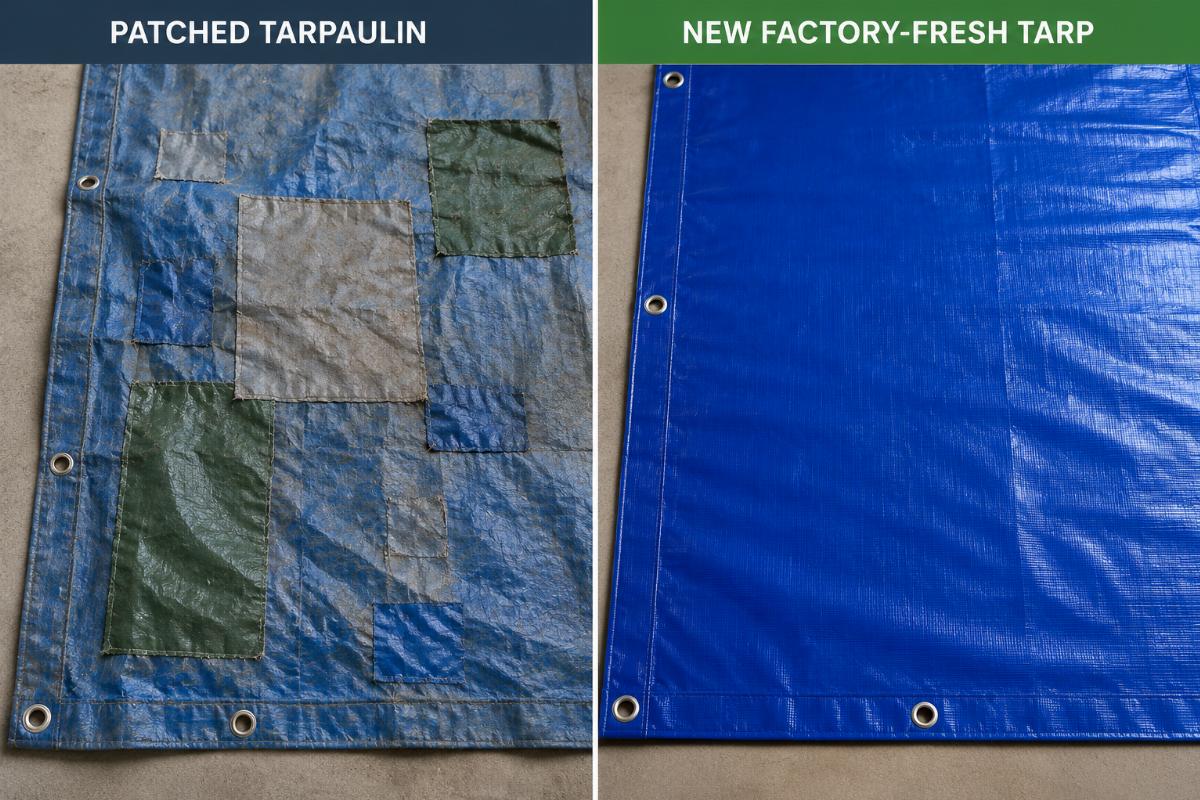
| Existing 2 or more prior patches | Add another patch layer to the existing damage | Replace, as multiple patches create weak points that will fail under regular operational stress |
| Fire-retardant or anti-UV layer damage | Patch only the visible torn area | Replace fully, as the protective layer can not be repaired after it is compromised |
A European logistics fleet operating 120 heavy-duty trucks used to send their custom-fitted cargo covers for on-site repair whenever they developed rips, until they tracked their downtime and found they were losing 18 hours of operating time every week waiting for repair technicians to arrive and complete work. When they switched to keeping a small stock of pre-ordered replacement units from a Chinese manufacturer, they cut all that downtime immediately and generated $1,200 in monthly operational savings from extra runs they were able to complete.
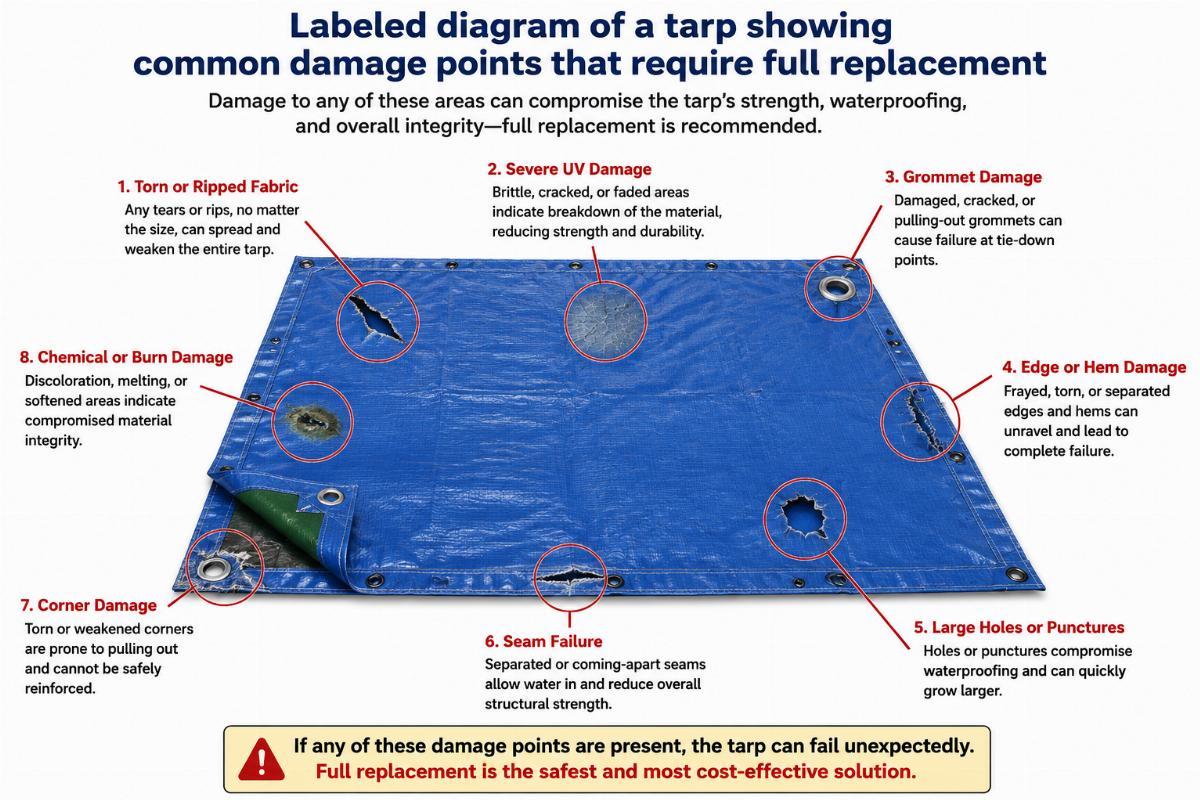
- Measure Tear Length First – Sort all incoming damaged units by tear size, and pull any unit with a rip longer than 10cm for the replacement queue.
- Count Existing Patches – Reject any unit that already has 2 or more patch marks for further repair work.
- Test Protective Coating – Run a quick UV resistance spot test if you suspect the protective layer has been compromised, and replace if performance is below standard.
How to Cut Replacement Costs Without Sacrificing Durability
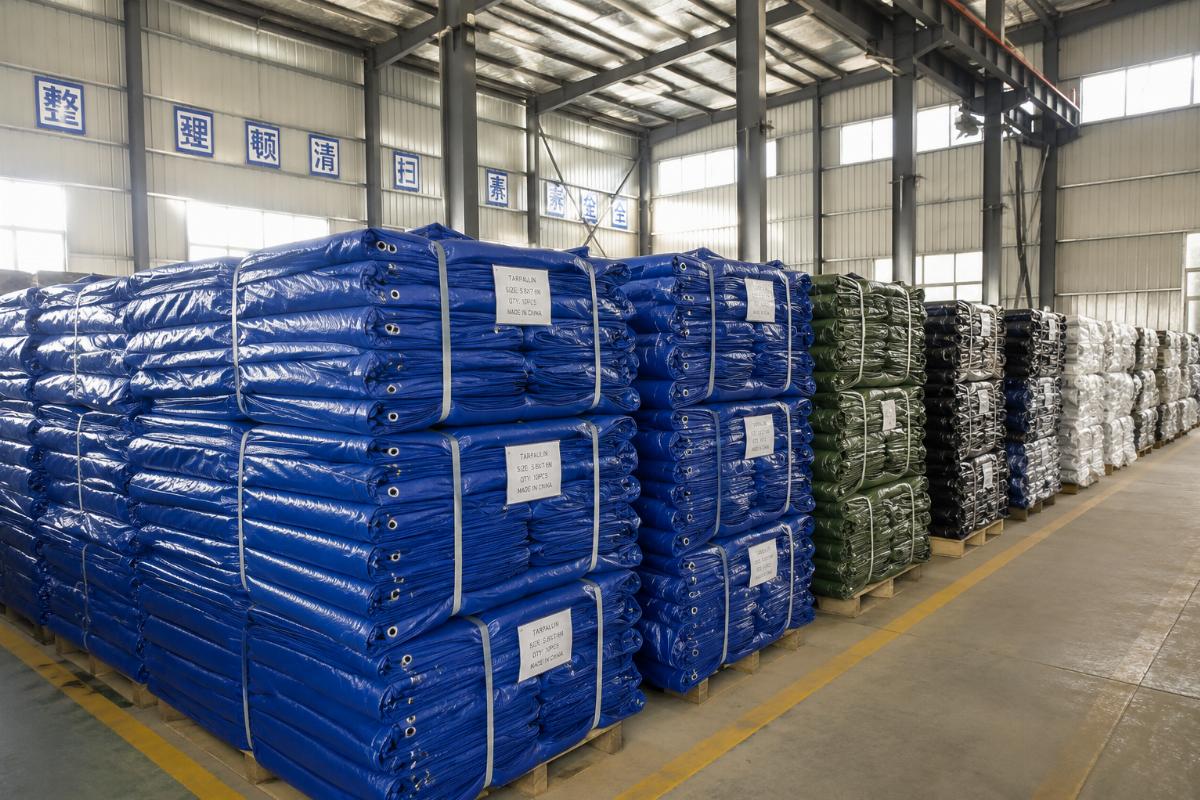
Sourcing directly from factory-backed Chinese tarpaulin manufacturers eliminates middleman markup and cuts replacement unit prices by 25-35% for almost all order sizes. One of the most persistent myths among small to mid-sized buyers is that only large bulk orders from Chinese factories deliver meaningful cost savings, but modern flexible minimum order policies make even small replacement runs more affordable than local repair work. Many factories operating in the Shandong industrial cluster have 30+ years of production experience, hold full ISO and international safety certifications, and can deliver consistent quality at price points local suppliers can not match.
A Southeast Asian aquaculture operator learned this lesson when a storm damaged a 5,000 square meter section of their fish pond liner. Their local service provider quoted them for 4 separate patching visits over a 6 week period, which would have left the liner leaking and ineffective for almost 3 months, leading to massive lost yield. Instead they ordered a replacement liner directly from a Chinese manufacturer, installed it in 2 days, and avoided all of the projected lost fish revenue entirely.
- Verify Factory Certifications – Confirm any potential supplier holds ISO 9001, ISO 14001 and relevant product specific safety certifications before placing an order.
- Negotiate Flexible MOQ Terms – Ask for small batch minimum order terms for replacement stock, as most factories will accommodate orders as small as 50 units [NEED_CITE: Flexible MOQ options from Chinese tarpaulin manufacturers make even 50 unit replacement orders 30% cheaper than local repair services].
- Keep a Small Buffer Stock – Pre-order a 5-10% buffer of your most commonly used tarp types to eliminate lead time wait times when damage occurs.
Conclusão
Tarpaulin repair is only ever cost effective for minor surface scratches and small pinholes with a total all-in cost under $50. For every other type of damage, running the simple total cost of ownership calculation will almost always show that replacement via a reliable Chinese supplier delivers a better financial outcome, especially when you factor in the downtime and performance degradation that comes with repeated patching. The three clear damage criteria and low-lift steps above remove all the guesswork from this decision, so you can stop wasting budget on unnecessary repair work and allocate your procurement funds to assets that will deliver consistent performance for years.