

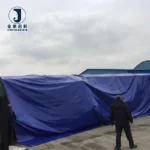
Specialist Grade Coating Control — Nearly 30 years focused on coated fabric with deep process control over coating weight, adhesion and compliance documentation for industrial and ventilation applications.
Technical Specifications
| Parameter | Value |
|---|---|
| Product Type | PVC Coated Tarpaulin |
| Material | PVC coated polyester fabric (100% PES dipping coating process) |
| Base Fabric Construction | Knitting and plain weave types available |
| Thickness (medium / heavy-duty / super heavy) | 0.35–0.45 mm / 0.70–1.0 mm / 1.2–1.5 mm |
| Weight Range (medium / heavy-duty / super heavy) | 400–500 g/m² / 700–1000 g/m² / 1100–1500 g/m² |
| Yarn Denier | 500D (medium) / 1000D (heavy-duty) / 500D–2000D (super heavy) |
| Tensile Strength — Warp | 1500–2000 N/5cm (medium) / 2000–2500 N/5cm (heavy-duty) / 2500–3000 N/5cm (super heavy) |
| Tensile Strength — Weft | 1200–1800 N/5cm (medium) / 1800–2200 N/5cm (heavy-duty) / 2200–2800 N/5cm (super heavy) |
| Roll Width Options | 6 ft, 8 ft, 10 ft, 12 ft / 2 m, 4 m, 6 m |
| Roll Length Options | 100 yards, 100 meters, or custom |
| Waterproof | Yes — fully coated construction |
| UV Treatment | Available (test basis not stated in source) |
| Flame Retardant Grade | Not stated in source — confirm grade required for your market |
| Anti-Static | Not stated in source — confirm certification required for your site |
| Mildew Proof / Anti-Aging | Claimed (test basis not stated in source) |
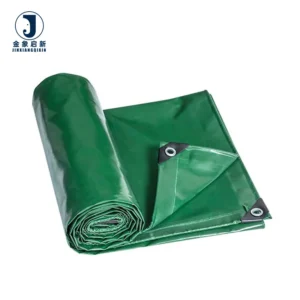
| Edge Reinforcement (finished panels) | PP rope in hem on all four edges |
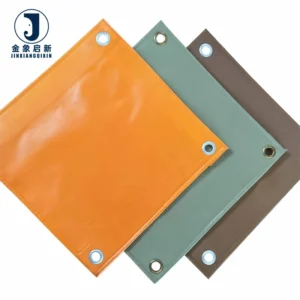
| Eyelet Specification (finished panels) | Galvanized eyelets every 3 ft or 1 m interval |
| Corner Reinforcement (finished panels) | Reinforced plastic corners |
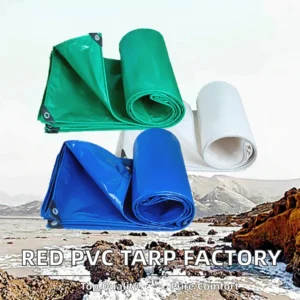
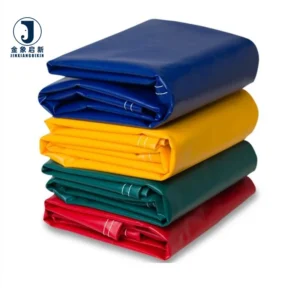
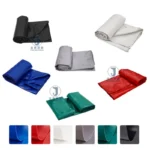
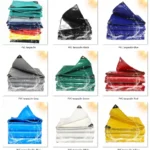
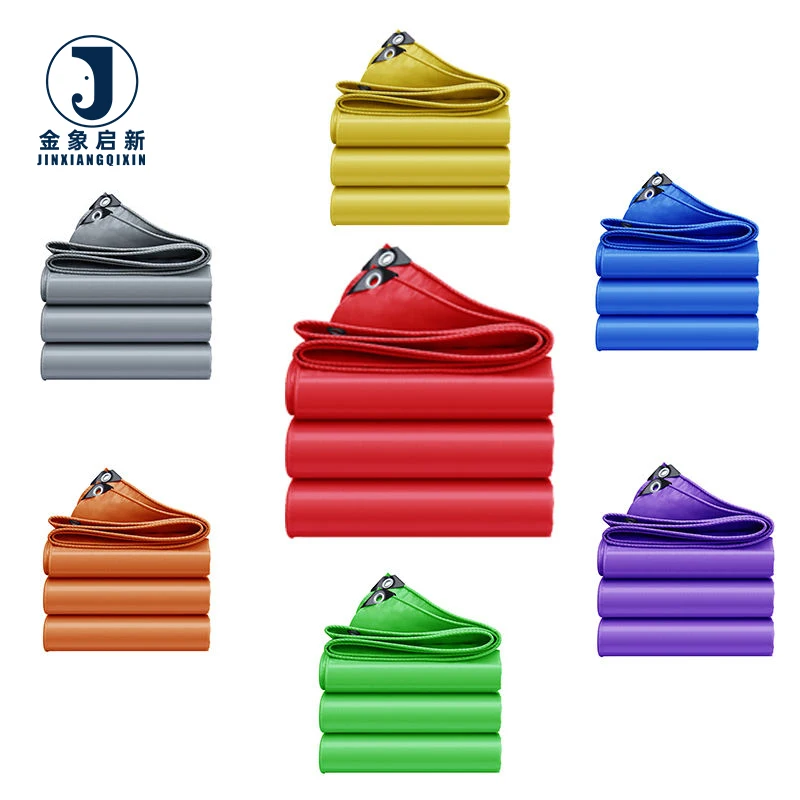
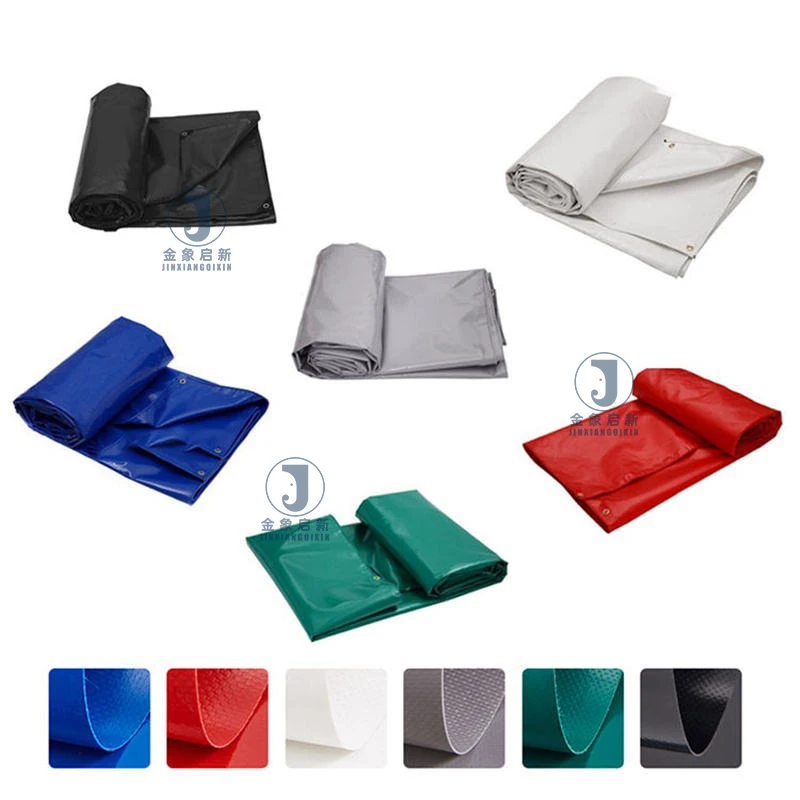
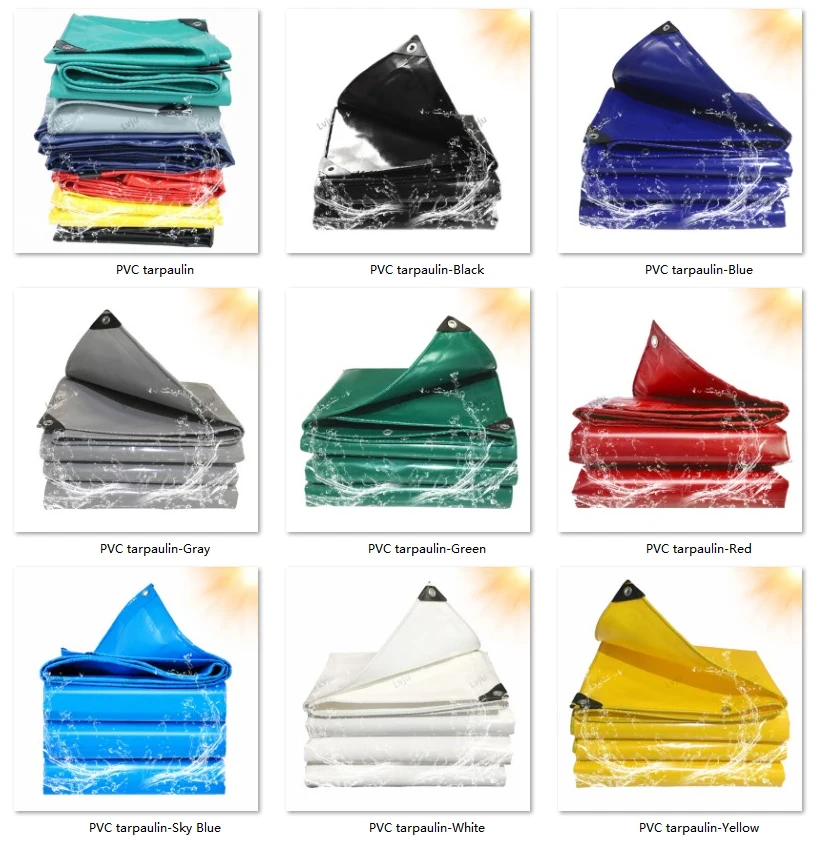
| Color Options | Blue, Blue/Orange, Green, Grey, Black, Clear, Grey/Green, Orange, or custom |
| Industrial Sewing Services | Lumber Tarps, Steel Tarps, Coil Tarps, Snow Tarps, Mesh Tarps |
| Certification | ISO, CE (company-level) |
Application Suitability
| Application | Exposure & Requirement |
|---|---|
| Mining and tunnelling ventilation ducts | Continuous airflow, fire-retardant and anti-static compliance mandatory, mechanical abrasion from rock dust and equipment contact |
| Tensioned membrane structures and temporary shelters | Sustained tensile load at anchor points, wind uplift, UV exposure, waterproofing under rain and snow load |
| Industrial pipe canopy and site infrastructure covers | Weather exposure, chemical splash risk, puncture from handling, long-term UV degradation |
| Aviation ground support enclosures | Flame-retardant requirements per airfield regulations, wind load on tensioned fabric, frequent setup and teardown |
| Inflatable structures and specialist fabrications | Air-holding integrity, coating adhesion under internal pressure, seam strength at curved welds |
What Compliance Gaps in Ventilation Fabric Actually Cost on Site
Specifying a grade without a test report attached means the inspector fails the duct before it runs.
Mining and tunnelling contractors routinely face a scenario where the PVC coated tarpaulin arrives on site with a data sheet that claims fire resistance or anti-static performance, but no third-party test report matching the standard the site safety officer requires. The duct hangs uninstalled while procurement scrambles for documentation, delaying ventilation commissioning and exposing the contractor to contractual penalties. [NEED_CITE: fire-retardant and anti-static compliance requirements for underground ventilation per regional mining regulations] This is not a material failure — it is a documentation failure that could have been caught at the quotation stage by requesting the exact test standard and verifying it against site requirements before the order is confirmed.
Base Fabric Denier and Weave Selection for Structural Loads
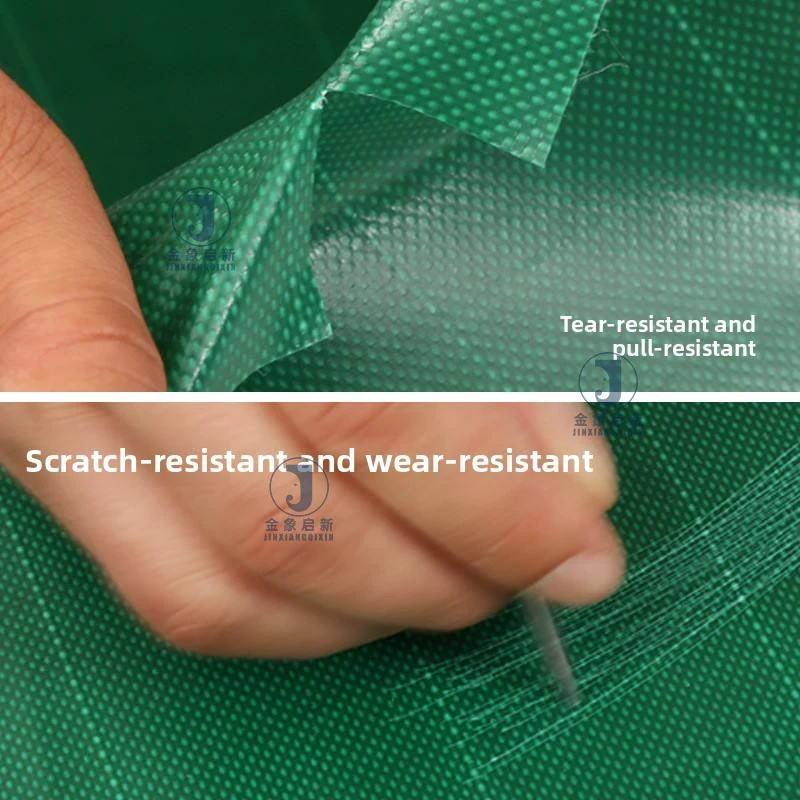
The mechanical behaviour of PVC coated tarpaulin under tension is governed primarily by the base fabric denier and weave construction rather than coating weight alone. A 500D base in plain weave provides adequate strength for lightweight engineering covers, while the 1000D and 2000D options in knitting or plain weave constructions are specified for tensioned membrane structures where anchor-point loads are concentrated. The knitting weave type offers multidirectional stability suited to curved duct sections and inflatable forms, while plain weave delivers predictable linear tensile values for flat canopy panels.
Coating Weight and Adhesion Integrity at Weld Seams
The dipping coating process applied to 100% PES base fabric produces a coating bond that directly determines how welded seams perform under flex and load. Heavier coating weights in the 1100–1500 g/m² range provide the material thickness needed for hot-air or wedge welding on structural panels and duct joints, but the weld temperature and dwell time must be matched to the specific coating formulation. [NEED_CITE: hot-air welding parameters for PVC coated polyester fabrics in structural membrane applications] A weld that burns through the coating or fails to fuse fully will separate before the base fabric reaches its rated tensile limit — a failure mode that is invisible until the structure is loaded.
Reading the Specification Sheet Beyond the GSM Number
The weight of a PVC coated tarpaulin roll tells you how much material is on the fabric, but not how that material is distributed between base yarn and coating layers. A 700 g/m² fabric built on a 1000D base with a thinner coating will have higher tear resistance than a 700 g/m² fabric built on a 500D base with a heavier coating layer, because tear propagation is arrested by yarn density rather than coating thickness. The tensile strength values listed — ranging from 1500 N/5cm in the warp direction at medium weight up to 3000 N/5cm at super heavy — reflect this interaction between base fabric construction and total system weight. Specifiers for membrane structures and ventilation ducts should request the base fabric denier and weave type alongside the GSM to confirm the mechanical profile matches the engineering calculation, rather than relying on weight as a single performance indicator.
When Grade Substitution Reaches the Site Inspector
A recurring issue on industrial and mining projects is PVC coated tarpaulin that arrives lighter than the GSM stated on the quotation, with coating weight reduced to cut material cost. On a ventilation duct, this shows up as a fabric that feels thinner at the weld line and tears more easily during installation around bends and transitions. For membrane structures, an underweight roll may pass visual inspection but fail the tensile test when the engineer pulls a coupon from the delivered batch. [NEED_CITE: pre-shipment inspection practices for verifying coating weight and base fabric denier on coated fabric rolls] Batch-to-batch colour variation between rolls in the same shipment compounds the problem when panels are installed side by side on a visible structure — a cosmetic defect that triggers rejection even when mechanical properties are within tolerance.
Why This Product Source Fits Specialist Fabrication Requirements
Deep process control over coating weight and adhesion comes from nearly 30 years focused exclusively on coated fabric production, which matters when you need consistent weld performance across an entire duct run or membrane installation. Three full production lines and 36 sets of professional equipment support the volume needed for large-scale ventilation and structural projects without splitting orders across subcontractors. A 10-person R&D team handles material selection and sample development, producing samples within days so you can test weld parameters and seam strength before committing to a production run. Dedicated QA/QC at every production stage with 100% pre-shipment inspection means coating adhesion, weight consistency and dimensional accuracy are verified before rolls leave the facility. ISO and CE certified production underpins the documentation package that site inspectors and compliance officers require for mining, tunnelling and aviation installations.
Documentation & Verification
- Material specification sheet stating exact GSM, base fabric denier and coating type for each roll in the shipment
- Fire-retardant and anti-static test reports supplied where grades are specified — confirm the standard your site requires before ordering
- Pre-shipment inspection record covering coating adhesion, weight verification and dimensional accuracy per roll
- ISO and CE certificates included with dispatch documentation
- Packing list, certificate of origin and customs support documents provided with each shipment
Fabrication, Handling & Storage
- Hot-air welding temperature and speed must be matched to the specific coating weight — test on a sample piece from the delivered roll before production welding
- Finished panels with PP rope reinforced hems and galvanized eyelets should be stored flat or loosely rolled to avoid permanent creasing at reinforcement points
- Rolls in widths up to 6 m should be stored horizontally on racking to prevent edge compression damage that affects downstream cutting accuracy
- Cold-weather handling requires allowing rolls to reach ambient temperature before unrolling to avoid coating cracking at fold lines, particularly on heavier grades above 1000 g/m²
- Cut-to-size panels for membrane structures should be laid out using nesting software to maximise yield from the available roll width and minimise welded seam count
What to Include With Your Enquiry
Provide the specific application — whether ventilation duct, membrane structure, or industrial canopy — along with the exposure conditions and any fire-retardant or anti-static standards your site requires. Specify the roll width, colour and whether you need roll stock for your own fabrication or finished cut-to-size panels with hems and eyelets. If your project demands a particular base fabric denier or tensile strength profile, include those values so the correct grade can be matched from the available range. Requesting a sample at this stage allows you to verify weld parameters and coating behaviour before production begins.
Frequently Asked Questions
Q: What fire-retardant grades are available for mining and tunnelling ventilation duct applications?
A: Flame-retardant grades are available across the PVC coated fabric range, but the specific grade and test standard must be confirmed against your site’s compliance requirements before ordering. Different jurisdictions mandate different classifications for underground ventilation materials. Request the applicable standard during the enquiry stage so the correct test report can be supplied with the shipment documentation.
Q: How is anti-static performance verified for ventilation ducts in hazardous environments?
A: Anti-static treatment is available as an option, but the surface resistance value and test method must match the specification your site safety officer requires. Confirm the exact standard and acceptable resistance range during quotation, and request the test report before production begins to avoid compliance delays when the duct arrives on site.
Q: How do I verify the GSM of delivered rolls matches what was quoted?
A: Every shipment is accompanied by a material specification sheet stating the exact GSM, base fabric denier and coating weight for each roll. A pre-shipment inspection record documents weight verification at the facility. On receipt, you can cut a measured sample from the roll edge and weigh it to confirm the delivered material matches the stated specification before fabrication begins.
Q: Can you supply a specific base fabric denier and weave for a tensioned membrane structure?
A: Base fabric options span 500D to 2000D in both knitting and plain weave constructions, each producing different tensile and tear behaviour. Provide your engineering tensile requirements and the intended panel geometry so the correct denier and weave combination can be recommended. Samples are developed within days for testing weld parameters and mechanical performance.
Q: What are the lead times and minimums for custom widths, colours or treatment grades?
A: Lead times and minimum order quantities vary depending on the specific width, colour and treatment combination requested. Custom requirements outside standard stock grades typically involve dedicated production runs. Submit your specification during the enquiry stage to receive a confirmed lead time and minimum order value matched to your project schedule.