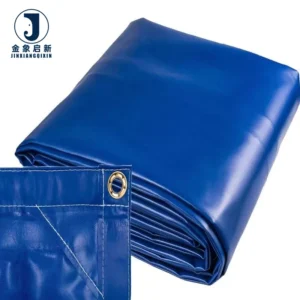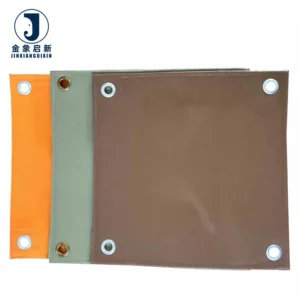
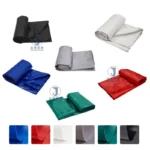
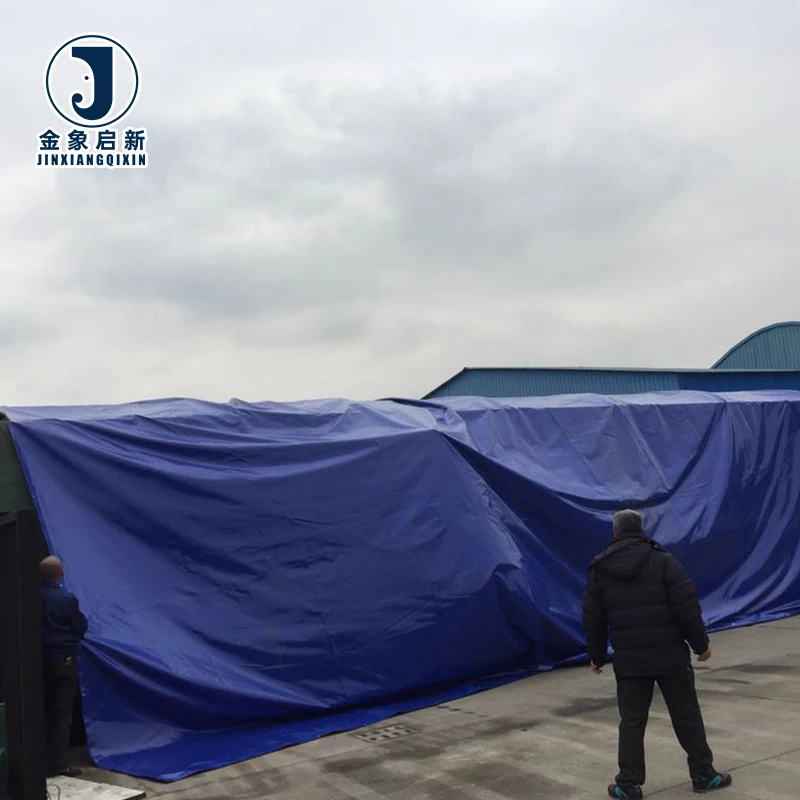
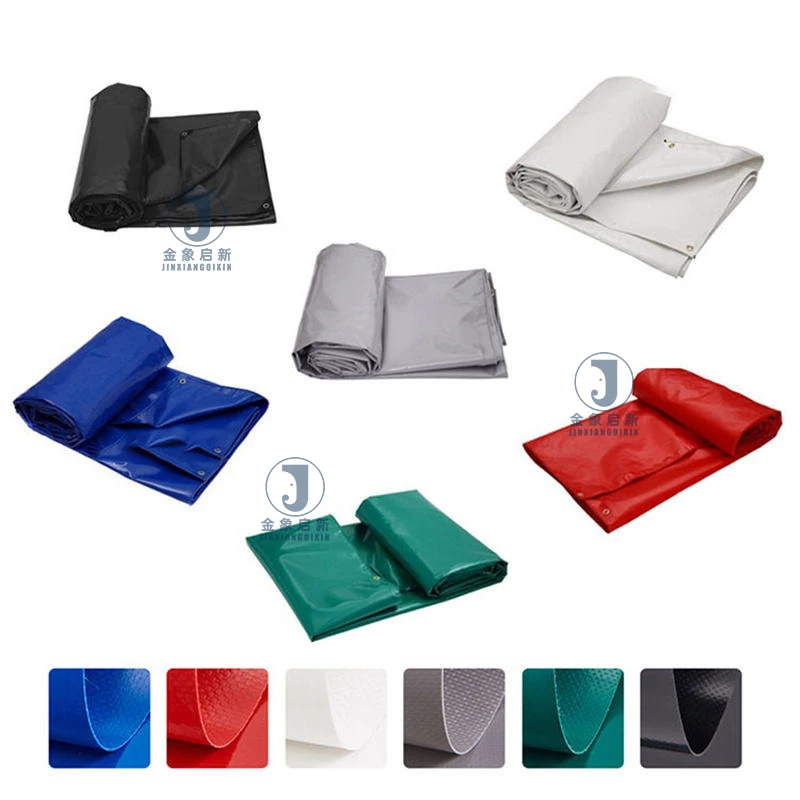
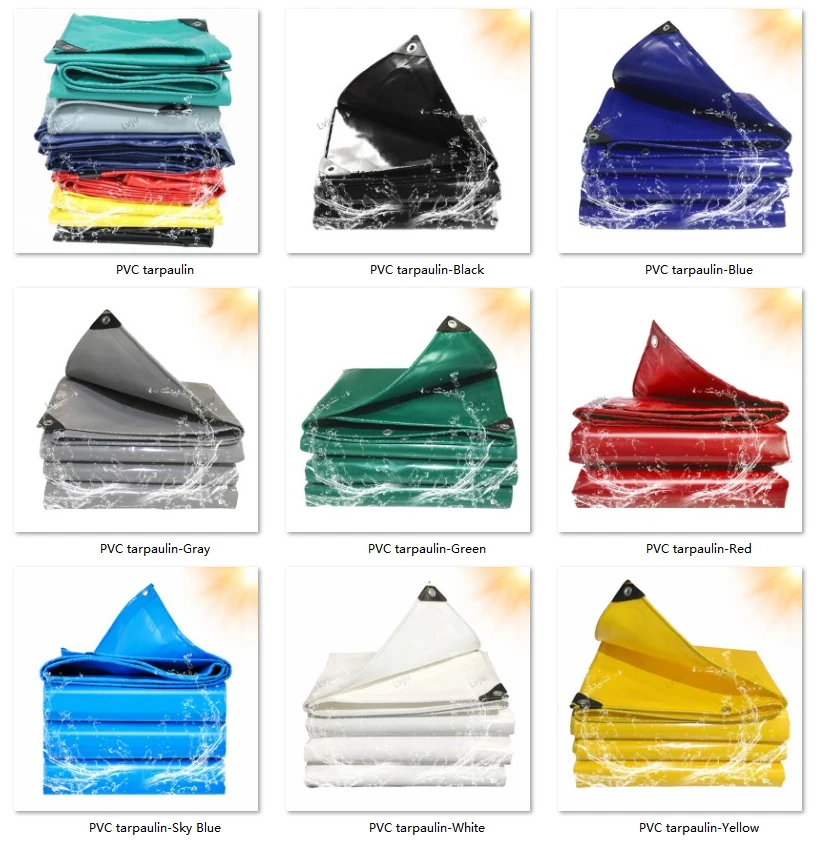
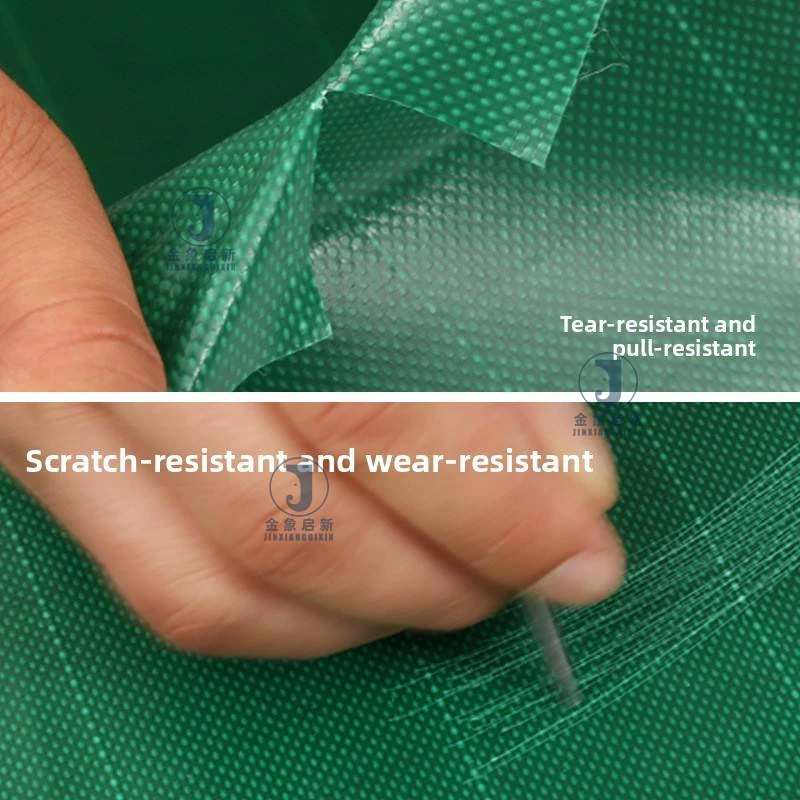
Proven coating control — Deep process expertise over dipping coating weight and adhesion ensures PVC coated tarpaulin fire retardant / anti-static / certified grades meet strict mining and tunnelling compliance demands.
Technical Specifications
| Parameter | Value |
|---|---|
| Product Type | PVC Coated Tarpaulin |
| Coating Material | PVC |
| Base Fabric | 100% PES (Polyester) |
| Coating Method | Dipping coating process |
| Weave Construction | Knitting and plain weave options |
| Base Fabric Denier | 500D / 1000D / 500D–2000D |
| Weight Range | 400–500 g/m² (medium) / 700–1000 g/m² (heavy-duty) / 1100–1500 g/m² (super heavy) |
| Total Thickness | 0.35–0.45 mm / 0.70–1.0 mm / 1.2–1.5 mm |
| Tensile Strength (N/5cm) | Warp 1500–3000 / Weft 1200–2800 (grade dependent) |
| Waterproof | Yes |
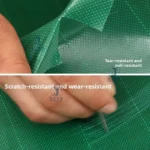
| Tear Resistance | Tear resistant (grade not stated) |
| UV Treatment | Available (test basis not stated) |
| Flame Retardant | Available in flame retardant grades — confirm the grade required for your market |
| Anti-Static | Available — confirm surface resistance certification required for your site |
| Anti-Mildew | Yes |
| Anti-Aging | Yes |
| Roll Widths | 2m / 4m / 6m (6ft / 8ft / 10ft / 12ft) |
| Roll Lengths | 100 yards / 100 meters or custom |
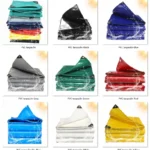
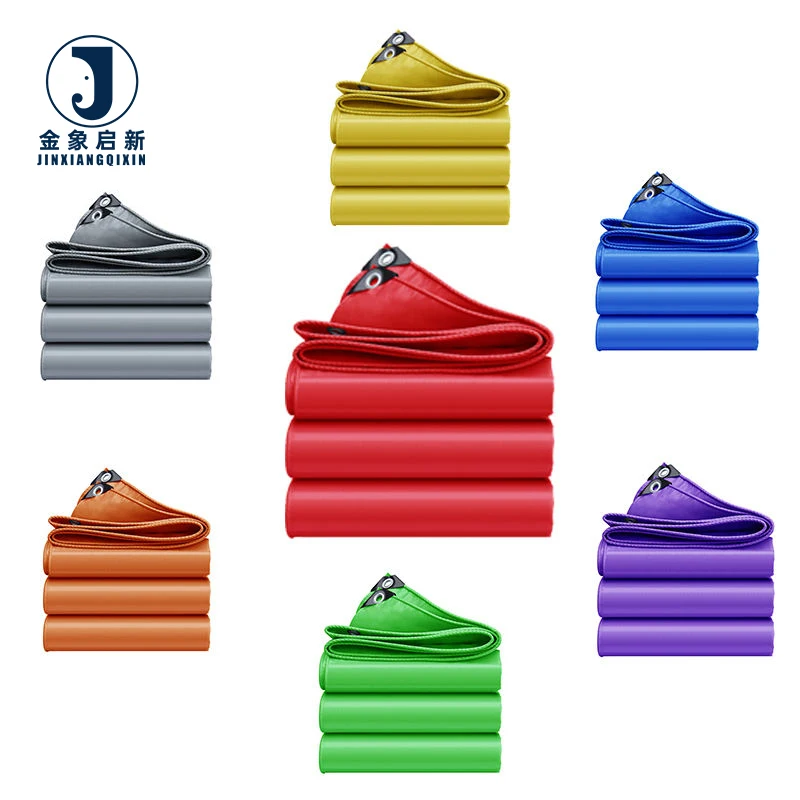
| Surface Finish | Glossy and matte options |
| Edge Reinforcement | PP rope reinforced hem on all four edges (finished tarps) |
| Eyelets | Galvanized eyelets every 3ft or 1m (finished tarps) |
| Corner Reinforcement | Reinforced plastic corners (finished tarps) |
| Certification | ISO and CE |
Application Suitability
| Application | Exposure & Requirement |
|---|---|
| Mine and tunnelling ventilation ducts | Continuous airflow, abrasive dust, strict fire-retardant and anti-static compliance for underground safety |
| Aviation and construction temporary ventilation | High-velocity air movement, frequent relocation, duct flex at joints and bends |
| Tensioned membrane structures | Sustained tensile load, wind uplift, UV exposure, long-term weathering |
| Inflatable fabric applications | Internal air pressure, repeated inflation cycles, seam stress at curved panels |
| Industrial pipe canopies | Chemical exposure, condensation, mechanical impact from maintenance access |
Why Certified Fire-Retardant PVC Coated Tarpaulin Fire Retardant / Anti-Static / Certified Matters Underground
A ventilation duct without the correct fire classification is a compliance failure before it is even installed.
Site inspectors in mining and tunnelling operations reject duct fabric that lacks documented proof of its fire-retardant grade. The quotation may state "flame retardant," but without a test report referencing a recognised standard such as DIN 4102 or NFPA 701, the material cannot be approved for underground use. We have seen entire duct runs stripped and replaced because the supplier shipped fabric with no traceable certification behind the claim. [NEED_CITE: DIN 4102 fire classification for building materials]
When a project specification calls for anti-static surface resistance, the test report must state the measured value and the standard applied. Verbal assurance from a sales representative does not satisfy a mine safety auditor. PVC coated tarpaulin fire retardant / anti-static / certified grades must carry documentation that names the grade, the test method, and the result.
Airflow Engineering and Duct Construction Demands
Ventilation ducts in underground environments operate under sustained negative or positive pressure, and the fabric must resist collapse, flutter and abrasion against rock bolts and steel supports. The base fabric denier and weave construction determine how the duct holds its shape under load. A plain weave PES base at 1000D or higher provides dimensional stability, while the dipping coating process locks the yarns in place and prevents air leakage through the weave.
Selecting the correct GSM grade is critical. Medium-weight fabric may suffice for short-run temporary ventilation in surface construction, but underground mainline ducts typically require heavy-duty or super heavy grades to withstand the mechanical abuse of a working mine environment.
Seam Integrity at Flex Points and Duct Junctions
The most frequent failure point in a ventilation duct is not the body fabric but the welded seam where sections join or where the duct flexes around a bend. The PVC coating must be formulated to accept heat welding at temperatures that fuse the seam without degrading the base fabric. Dipping-coated PVC on a PES base generally delivers strong weld adhesion when the correct temperature and dwell time are applied. [NEED_CITE: tensile and tear test methods for coated fabrics per ISO 1421]
Fabricators building ducts for mining ventilation should request weld peel test data and confirm that the seam strength specification matches the operating pressure and flex cycle count of the installation.
Reading the Specification Sheet Beyond GSM
Weight in g/m² tells you how much material is present per square metre, but it does not directly predict tensile or tear performance. A 900 g/m² fabric woven from 500D yarn with a heavy coating may weigh the same as a 900 g/m² fabric woven from 1000D yarn with a lighter coating, yet the latter will deliver substantially higher tear resistance because the base fabric carries the structural load.
The dipping coating process used on this PVC coated tarpaulin fire retardant / anti-static / certified range penetrates the PES mesh and encapsulates individual yarns, which improves coating adhesion and weld strength compared to laminated constructions. Thickness values from 0.35 mm to 1.5 mm correlate with the coating weight applied, but buyers should always cross-reference thickness with base fabric denier and stated tensile values to confirm the grade suits the mechanical demands of the duct or membrane structure.
Roll widths up to 6 m allow fabricators to produce large-diameter ducts with fewer longitudinal welds, reducing both fabrication time and potential leak paths. Custom roll lengths minimise end-of-roll waste on high-volume duct production runs.
The Hidden Cost of Specifying on Price Alone
Underground ventilation projects operate under strict safety oversight, and fabric that fails a site inspection halts production and triggers a replacement order at emergency lead times. A duct fabric that arrives without the specified fire-retardant test report cannot be hung, regardless of how competitive the unit price was. The cost of a compliance shutdown dwarfs the savings on the original purchase. [NEED_CITE: mining ventilation compliance requirements for fire-retardant duct materials]
Colour inconsistency between rolls matters when duct sections are visible to inspectors or when membrane panels are installed side by side on a tensioned structure. Batch variation that is invisible in a sample swatch becomes obvious across a 200-metre run. Requesting roll-to-roll colour consistency confirmation before production prevents costly rejection at the site.
Why Technical Buyers Source This Range Here
Three full production lines and 36 sets of professional equipment support bulk duct fabric orders with consistent output across long production runs, reducing batch-to-batch variation that undermines certification integrity.
A dedicated 10-person R&D team handles material selection for specific fire-retardant and anti-static requirements, developing samples within days so buyers can validate compliance before committing to full production volume.
Dedicated QA and QC at every production stage with 100% inspection before shipment means each roll is checked against the stated GSM, thickness and coating adhesion specification, not spot-sampled from a batch.
Nearly 30 years of focused experience in coated fabric production provides deep process control over dipping coating weight, which directly affects weld strength and long-term coating adhesion in demanding duct and membrane applications.
Documentation & Verification
- Material specification sheet stating GSM, base fabric denier, coating method and weight per roll
- Fire-retardant test report citing the applicable standard and measured classification grade
- Anti-static surface resistance test result matched to mining or tunnelling site requirements
- Pre-shipment inspection record confirming 100% roll inspection before dispatch
- Certificate of origin and customs documentation for cross-border project supply
Fabrication, Handling & Storage
- Heat weld temperature and dwell time must match the dipping-coated PVC formulation to achieve full seam adhesion on heavy-duty and super heavy grades.
- Store rolls upright on pallets in a dry, shaded area to prevent flat-spotting and surface marking on the 0.70–1.5 mm thickness range.
- Allow cold-stored rolls to reach ambient temperature before unrolling to avoid cracking the PVC coating at low temperatures.
- Use compatible PVC-based repair patches and solvent cement for field repairs on duct seams and puncture damage.
- Plan cutting layouts around the 2 m, 4 m or 6 m roll width to minimise offcuts and welded joints in large-diameter duct fabrication.
Specifying the Right Grade for Your Project
Provide the duct diameter, operating pressure, and the fire-retardant or anti-static standard required by your site jurisdiction so we can recommend the correct GSM grade and base fabric denier. Confirm whether you need roll stock for your own fabrication or finished ducts with welded seams and flanges. If your project demands a specific colour or surface finish for architectural membrane work, request a sample for approval before full production.
Frequently Asked Questions
Q: Which fire-retardant standard applies to my mining or tunnelling project?
A: The required standard depends on your project jurisdiction and the specifying engineer. Common classifications include DIN 4102 (B1 or B2), NFPA 701, and M2. We supply PVC coated tarpaulin fire retardant / anti-static / certified fabric with test reports matched to the grade your site demands — provide your specification and we will confirm the applicable test report before production.
Q: How is anti-static surface resistance measured and certified?
A: Anti-static performance is measured as surface resistance in ohms, typically tested to standards relevant to mining ventilation compliance. We supply the test result and the standard applied with the shipment. Confirm the required surface resistance range with your site safety officer so we can match the formulation to your specification.
Q: Can I verify the GSM and tensile strength when the rolls arrive?
A: Every roll is inspected against the material specification sheet before dispatch, and we provide a pre-shipment inspection record. On receipt, you can verify weight by cutting a measured sample and weighing it, and tensile strength can be confirmed through independent lab testing per ISO 1421 or equivalent methods.
Q: What custom duct diameters and roll lengths are available?
A: Roll widths are available in 2 m, 4 m and 6 m, and roll lengths can be produced to custom order. For finished duct fabrication, provide the required diameter, section length and joining method. Our R&D team will develop a sample within days to confirm fit, weld performance and compliance before full production.
Q: How do welded seams perform at flex points in duct installations?
A: Dipping-coated PVC on a PES base fabric generally delivers strong heat-weld adhesion when correct welding parameters are applied. Seam performance at flex points depends on weld temperature, dwell time and the radius of the bend. Request weld peel test data for the specific GSM grade you are specifying to confirm suitability for your duct layout.