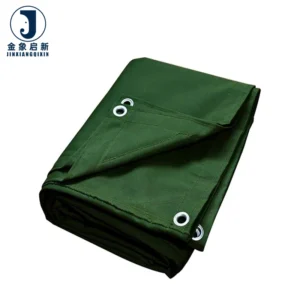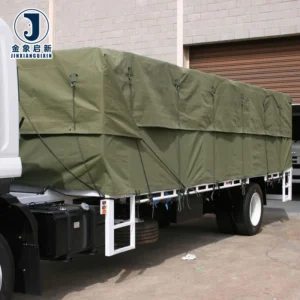

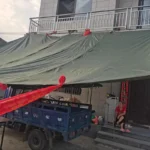


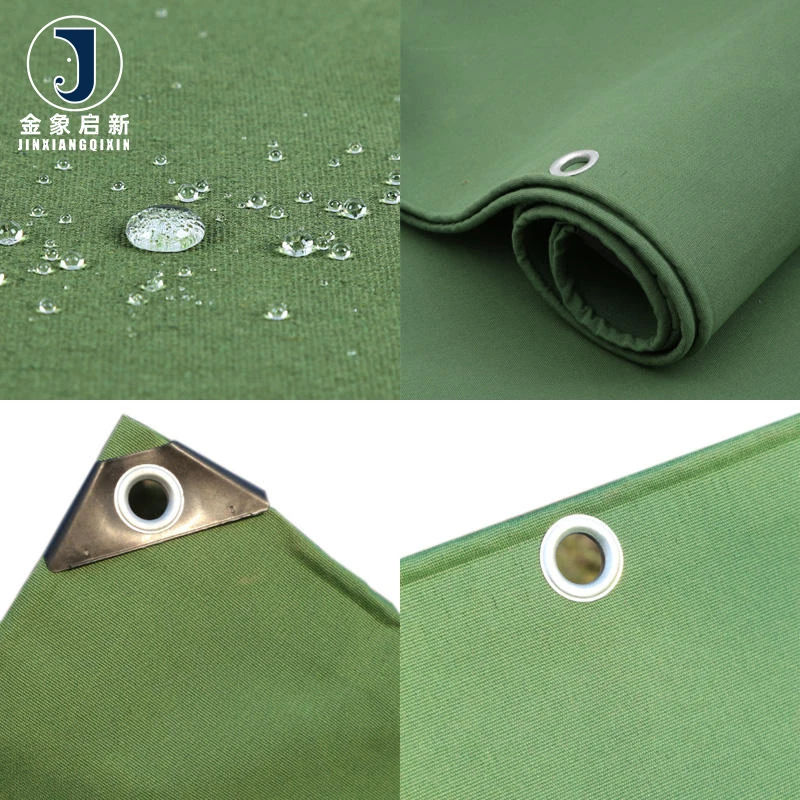
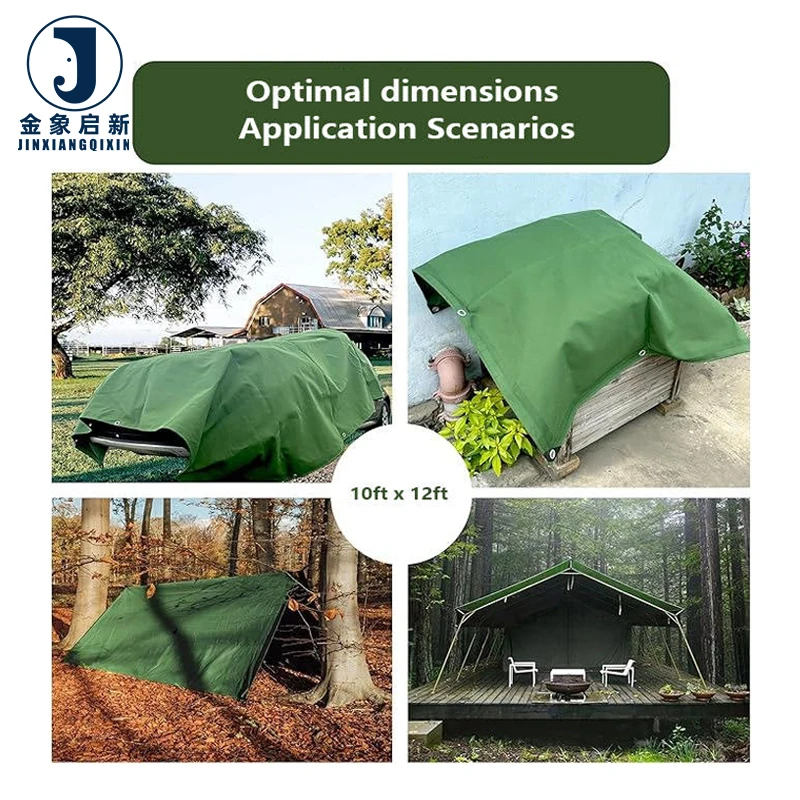
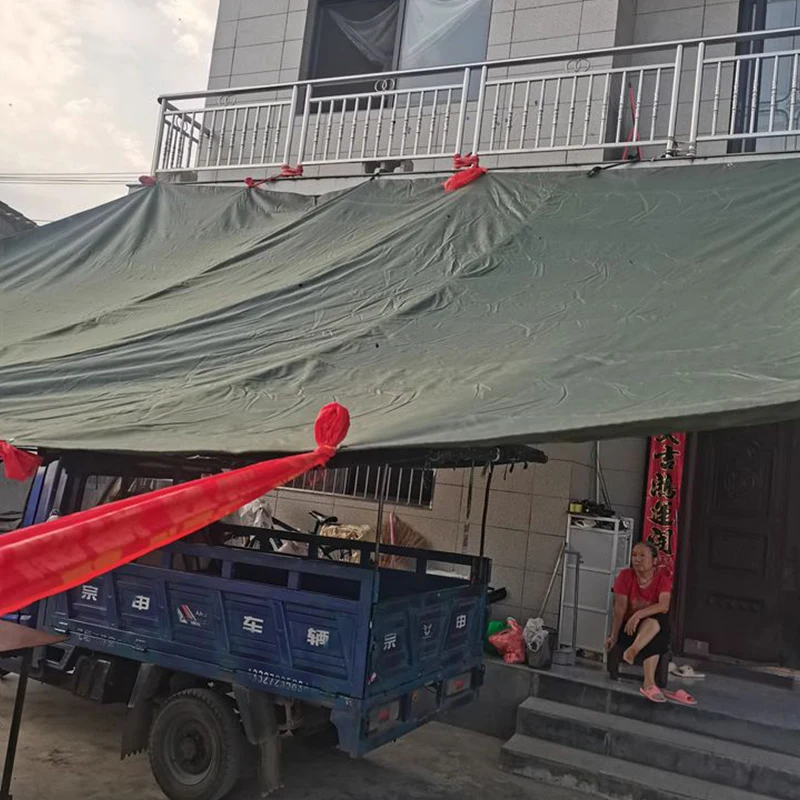

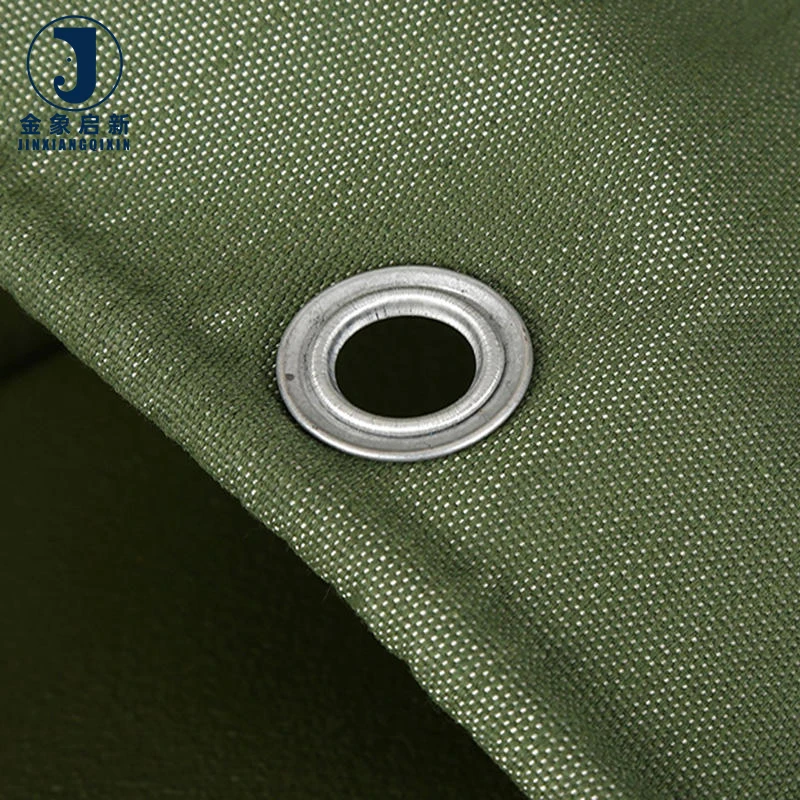

Specification Integrity — Every roll of 600gsm canvas tarpaulin is verified against stated GSM and coating weight at each production stage, with inspection records matching the specific ventilation-adjacent or structural application it is destined for.
Technical Specifications
| Parameter | Value |
|---|---|
| Product Type | Canvas Tarpaulin |
| Base Fabric | Polyester cotton industrial textile, 8–12 strands fine cotton yarn |
| Weight | 600gsm |
| Coating Material | Silicone canvas |
| Total Thickness | 0.5mm / 0.6mm / 0.7mm |
| Roll Width | 2m |
| Roll Length | 100m |
| Finish Product Size | Custom cut sizes or sold by roll inventory |
| Color | Army Green Camouflage / Custom |
| Edge Reinforcement | Rust proof aluminum eyelets every 1 meter at corners and hem; folded and sewn hems with poly rope insertion, seams welded and stitched |
| Key Features | Wear-resistant, corrosion-resistant, tensile-resistant, high- and low-temperature resistant, mold resistant, UV resistant (test basis not stated in source), waterproof (rating not stated in source) |
| Fire Retardant Grade | Available in flame retardant grades — confirm the grade required for your market |
| Anti-Static | Available with anti-static treatment — confirm the surface resistance value required for your project |
| Standards | CE, ISO |
Application Suitability
| Application | Exposure & Requirement |
|---|---|
| Mining ventilation ducting | Continuous airflow, dust loading, fire compliance underground — fabric must hold certified fire behaviour documentation for site inspection |
| Tunnel construction ventilation | High humidity, mechanical abrasion from duct flexing, regulatory demand for anti-static compliance in confined zones |
| Membrane and inflatable structures | Dynamic wind loading on seams, long-term UV exposure, documented fire classification for public or industrial occupancy |
| Aviation ground support covers | Proximity to jet exhaust heat, chemical exposure from de-icing fluids, requirement for certified flame behaviour |
| High-temperature industrial covers | Contact with hot surfaces or exhaust ductwork, need for thermal stability beyond standard PVC operating range |
What "Certified" Means When the Inspector Asks for the Test Report
A Canvas Tarpaulin fire retardant or anti-static claim only holds weight when the test report travels with the roll.
Ventilation duct and technical structure projects frequently stall at the inspection stage because the fabric arrived without the fire-retardant or anti-static documentation the site regulator requires. The supplier states the treatment was applied, but the certificate references a different batch, a different standard, or does not exist at all [NEED_CITE: fire classification documentation requirements for industrial ventilation fabric]. For mining, tunnelling and aviation-adjacent applications, the gap between a verbal claim and a verifiable test result is the difference between commissioning and shutdown. This silicone-coated Canvas Tarpaulin is supplied with batch-matched test reports, ISO and CE certificates, and a pre-shipment inspection record so the documentation package is complete before the roll leaves the factory.
Silicone Coating Where PVC Cannot Reach
Standard PVC tarpaulin softens and loses dimensional stability as temperatures rise near exhaust ductwork, engine bays or industrial heat sources. The silicone coating on this canvas maintains structural integrity across a wider thermal range, making it the appropriate choice for ventilation-adjacent covers and duct construction where ambient or contact heat exceeds the operating envelope of conventional plastisol-coated fabrics. The polyester-cotton base provides the tensile platform; the silicone layer provides the thermal boundary.
Seam and Edge Engineering for Dynamic Loads
Ventilation ducts flex with every pressure cycle, and membrane structures move under wind load. The failure point is almost always the seam, not the field of the fabric [NEED_CITE: tensile and tear test methods for coated fabrics per ISO 1421]. This Canvas Tarpaulin addresses that with folded hems sewn over inserted poly rope, then welded for a dual-lock construction. Rust proof aluminum eyelets placed at one-meter intervals distribute tie-down and suspension loads across the reinforced edge rather than concentrating stress at a single grommet point.
Reading the Specification Sheet Beyond GSM
The 600gsm weight tells you the mass per square metre but not how that mass is distributed between the polyester-cotton base fabric and the silicone coating. A higher base-fabric proportion with a thinner coating will tear differently than a lighter base with a heavier coat, even at identical GSM. The 8–12 strand yarn count in the weave determines how a tear propagates once initiated — tighter strand counts resist tear spread but reduce fabric drape. The three thickness options (0.5mm, 0.6mm, 0.7mm) allow specification matching: thinner gauges for duct sections requiring flexibility, thicker gauges for covers and membrane panels subject to puncture or abrasion. The silicone coating method also governs how the fabric accepts heat-welded seams versus stitched-and-sealed construction, a decision that affects both field repairability and long-term seam strength.
When the Wrong Specification Costs More Than the Fabric
A ventilation duct installed underground without the correct anti-static surface resistance reading will fail the safety audit, pulling the entire duct run down for replacement — labour, downtime and re-certification costs that dwarf the material price [NEED_CITE: anti-static compliance standards for underground mining ventilation]. A membrane structure specified with a flame-retardant grade that does not match the local building code faces the same rejection. Colour inconsistency across rolls in a single order becomes visible once panels are installed side by side, forcing selective replacement. These are not material defects; they are specification mismatches that a thorough pre-order technical review prevents.
Why Source This Canvas Through Jinxiang
Three full production lines and 36 sets of professional equipment allow this 600gsm silicone-coated canvas to be produced in volume without compressing lead times for custom widths or colours. A dedicated 10-person R&D team handles material selection, fire-retardant and anti-static treatment matching, and sample development for project-specific requirements — samples are typically developed within days. Quality assurance is applied at every production stage, not only at final inspection, so GSM and coating weight are verified in-process. The 100% pre-shipment inspection covers dimensional accuracy, eyelet placement consistency and seam integrity, documented in a record that ships with the order.
Documentation & Verification
- Material specification sheet stating verified 600gsm weight, polyester-cotton base, silicone coating method and colour reference
- Fire-retardant and anti-static test reports matched to batch and aligned with the compliance standard your project site requires
- ISO and CE certificates included in the shipment documentation package
- Pre-shipment inspection record confirming roll dimensions, eyelet spacing and seam construction
- Roll packing list with gross and net weights for customs and logistics coordination
- Certificate of origin supporting import duty classification
Fabrication, Handling & Storage
- Heat-weld silicone-coated seams using temperature and dwell settings matched to the 0.5–0.7mm thickness range to avoid coating degradation
- Stitched hems should use UV-stable thread compatible with the silicone surface to prevent wicking at needle holes
- Store 2m-wide rolls upright or on cantilever racks to prevent flat-spot deformation of the canvas core
- Allow rolls to acclimatise before unrolling in cold conditions; silicone-coated canvas stiffens at low temperatures and may crack if forced open
- Clean with mild detergent only — solvents and alkaline cleaners can compromise the silicone coating bond
- Field repairs on 600gsm canvas require compatible silicone-based sealant, not standard PVC repair cement
Preparing Your Enquiry
To match the correct thickness, treatment and cut size, provide the end-use application, the fire-retardant or anti-static standard your site inspector will enforce, and whether you need full 100m rolls or finished panels with eyelets and hems. Include target colour and any project-specific width requirements beyond the standard 2m roll. If certification documentation must align with a particular regional code, state that at enquiry stage so the test report scope is confirmed before production begins.
Frequently Asked Questions
Q: What fire-retardant grade can you certify for this canvas, and which test standard applies?
A: Fire-retardant treatment is available in grades matched to your market requirement. Confirm the specific standard — such as the classification required for mining ventilation or building membrane use — at enquiry stage so the correct additive package is applied and the test report is generated against that standard before shipment.
Q: How is anti-static performance measured, and what surface resistance value is reported?
A: Anti-static treatment is applied and measured per the standard relevant to your application, typically surface resistance in ohms. State the target value required by your site specification at enquiry so the treatment concentration and test method are aligned, and the result is documented on the batch test report.
Q: Can the 600gsm canvas be supplied with a custom fire-retardant or anti-static treatment to meet mining or aviation standards?
A: Yes. The 10-person R&D team formulates treatment blends to meet specific regulatory frameworks for mining, tunnelling or aviation-adjacent applications. Provide the target standard and any third-party certification body requirements early so sample development and testing align with your project timeline.
Q: What documentation accompanies each roll for site inspection and regulatory compliance?
A: Each shipment includes a material specification sheet, batch-matched fire-retardant or anti-static test reports where applicable, ISO and CE certificates, a pre-shipment inspection record, roll packing list and certificate of origin. This package is assembled to satisfy site inspector documentation requests without delay.
Q: How does silicone coating affect heat resistance compared to standard PVC for ventilation-adjacent applications?
A: Silicone coating maintains dimensional stability and coating adhesion at temperatures where PVC begins to soften and lose tensile performance. For covers and duct sections positioned near exhaust outlets, heat exchangers or industrial process equipment, the silicone-coated canvas provides a wider operating envelope and reduces the risk of thermal degradation at the coating layer.