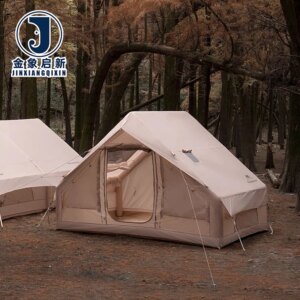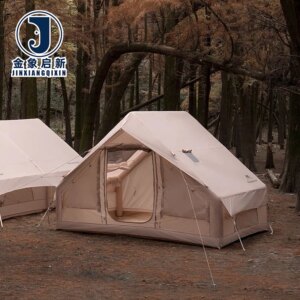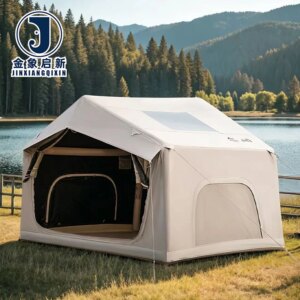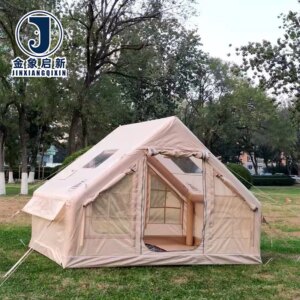
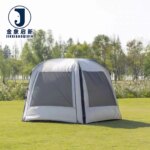

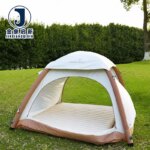

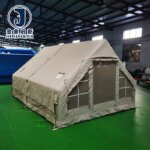
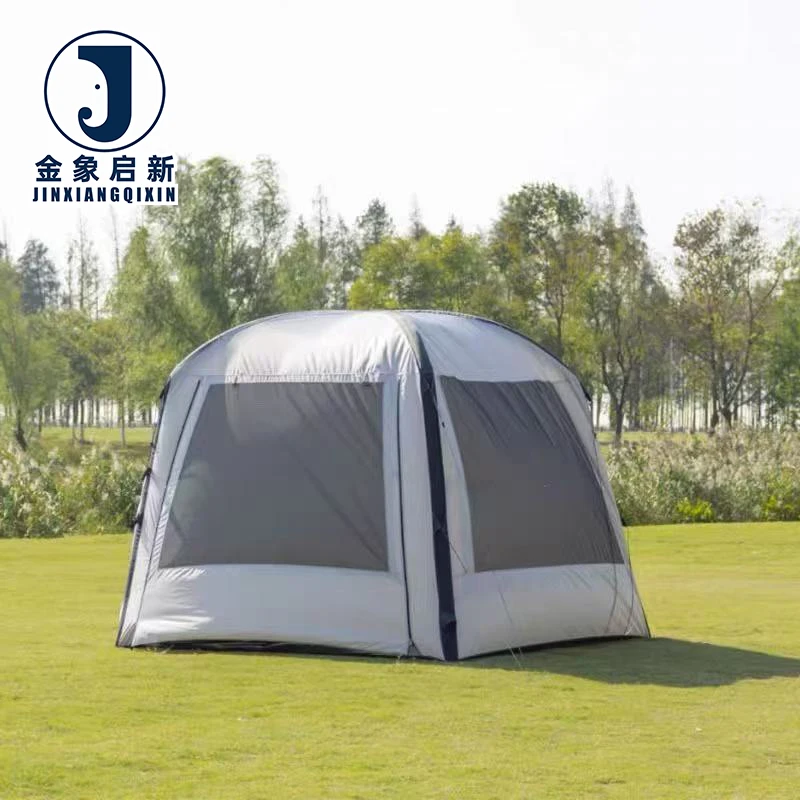
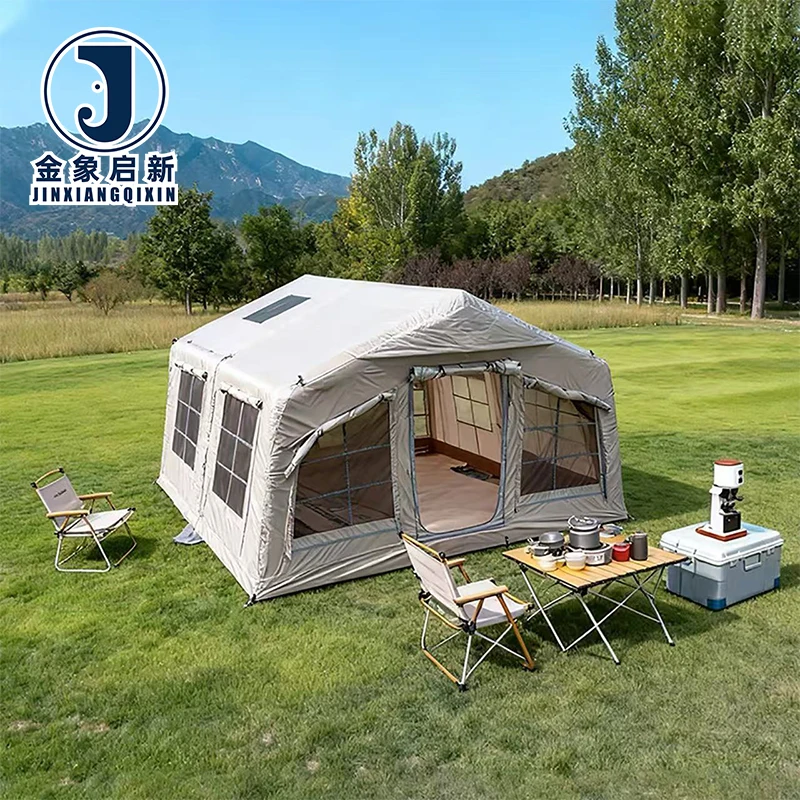
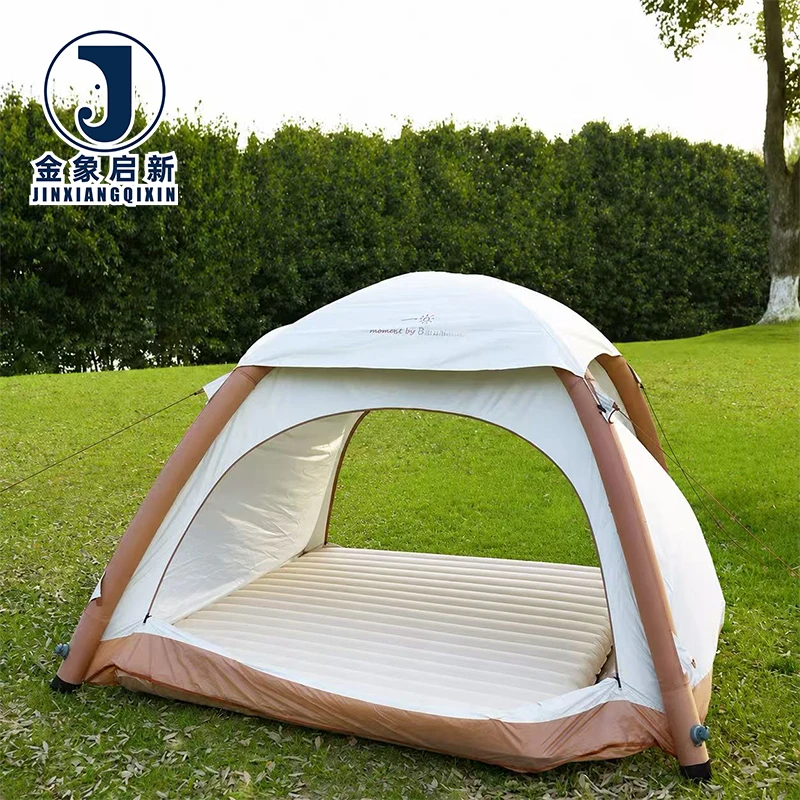
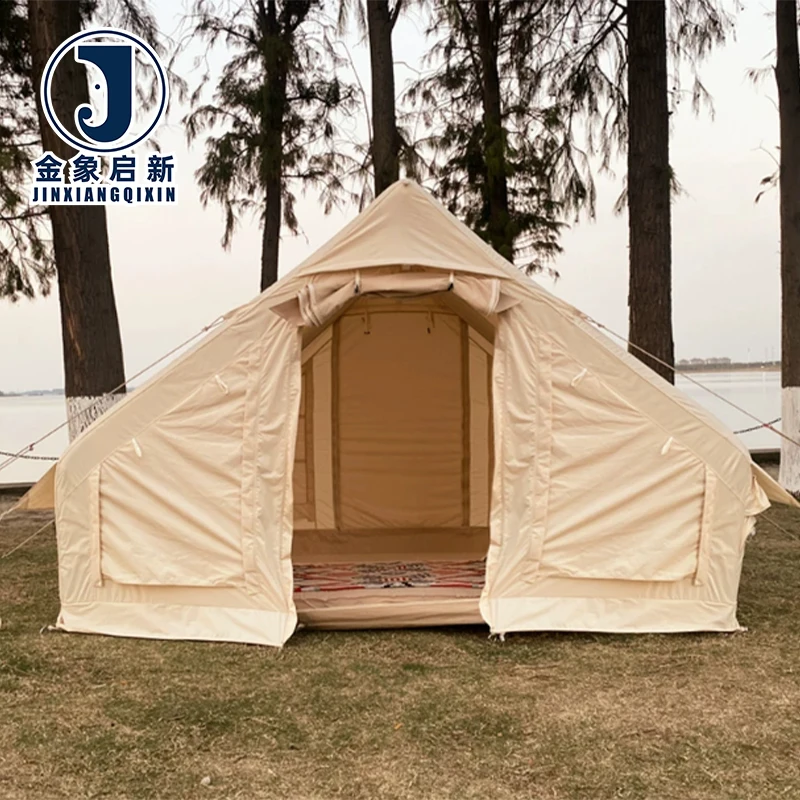
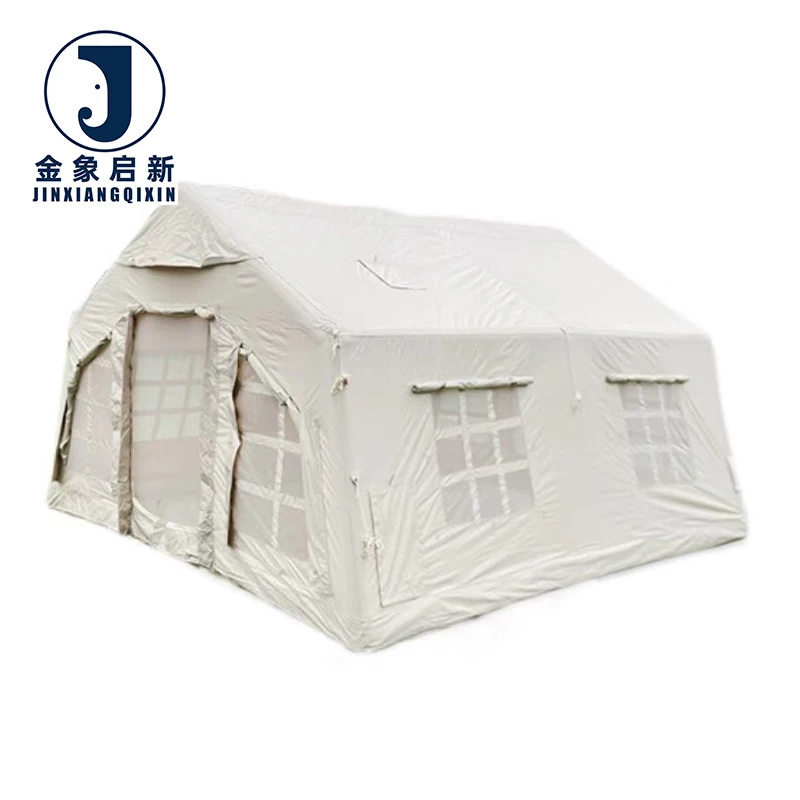
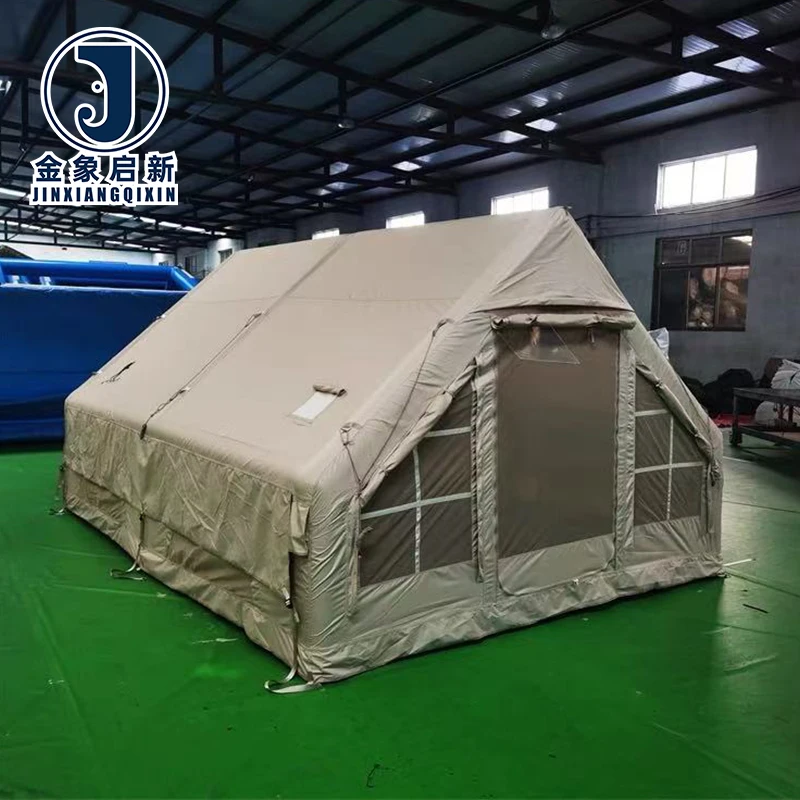
Process-Controlled Coating — Every roll of inflatable tent fabric is coated on one of three full production lines with dedicated QA at each stage, ensuring fire-retardant and anti-static treatments are verified before the material leaves the facility.
Technical Specifications
| Parameter | Value |
|---|---|
| Product Type | Inflatable Tent |
| Core Material | PVC tarpaulin |
| Product Form | Automatic Inflatable |
| Capacity | 3-5 Person |
| Waterproof | Yes |
| UV Treatment | Available (grade to be confirmed against project standard) |
| Flame Retardant | Available (grade to be confirmed against specific standard) |
| Anti-Static | Available (standard to be confirmed against project requirement) |
| Tear Resistance | Yes (test standard to be confirmed) |
| Customization | OEM & ODM — sample customization, pattern printing, material thickness adjustment, structural modifications |
| Quality Control | Full-process inspection, dedicated QA & QC staff, 100% pre-shipment inspection |
| Standards | ISO 9001, ISO 14001, ISO 45001, CE |
Application Suitability
| Application | Exposure & Requirement |
|---|---|
| Mining and tunnelling temporary ventilation shelters | Continuous exposure to dust, mechanical abrasion, and underground moisture; fire-retardant compliance mandatory for site approval |
| Aviation ground support inflatable structures | Static discharge risk around fuel handling and avionics; anti-static certification required by airfield safety protocols |
| Emergency response and disaster relief staging | Rapid deployment under unpredictable weather; waterproof integrity and structural stability under wind load |
| Construction site field offices and equipment protection | UV exposure, wind-driven rain, and frequent relocation; tear resistance at stress points during inflation and deflation cycles |
| Logistics operations temporary material storage | Abrasion from stored goods, forklift proximity, and temperature fluctuation; consistent batch performance across multi-site rollouts |
Why "Fire Retardant" on a Data Sheet Means Nothing Without a Test Standard
Inflatable tent fabric fire retardant anti-static certified must reference a specific grade and test method — otherwise the claim is marketing, not compliance.
I have reviewed supplier quotations where "fire retardant" appeared in the product description but the test report referenced a standard that did not match the buyer’s local building code. The tent passed factory inspection but failed the site safety audit, delaying the entire project. [NEED_CITE: fire classification standards for temporary structures vary by jurisdiction — confirm local requirements before specifying]
The same applies to anti-static claims. A surface resistance value measured under one standard may not satisfy aviation ground-handling regulations or mining ventilation directives. Buyers need the exact test method and result, not a checkbox on a spec sheet.
What Compliance Documentation Should Accompany Each Batch
When sourcing Inflatable Tent Fabric for regulated environments, the shipment documentation package must include more than a certificate of origin. Each batch should carry a test report that names the standard, the test date, and the result — whether that is a flame spread classification, a surface resistance value, or a smoke density rating. Without these specifics, site inspectors have no basis for acceptance.
Our documentation workflow ties each test report to a production batch number. If your project spans multiple deployments over several months, you can trace every roll back to its coating run and verify that the fire-retardant and anti-static treatments were applied under the same process parameters. This traceability matters when a site auditor asks for proof that the material in the field matches what was approved at the design stage. [NEED_CITE: batch traceability requirements for fire-rated materials in industrial temporary structures]
How OEM and ODM Customization Affects Performance Validation
Customizing an inflatable tent goes beyond choosing a colour or printing a logo. Material thickness adjustment changes the inflation pressure required, the thermal welding parameters at the seams, and the overall weight of the packed unit. Structural modifications — adding vestibules, partition walls, or equipment pass-throughs — alter the stress distribution across the fabric envelope.
Every customization request triggers a sample development cycle. Our 10-person R&D team builds a prototype, tests inflation behaviour and seam integrity, and ships the sample for your evaluation before bulk production begins. This step prevents a situation where a design change introduced to solve one problem creates a failure point elsewhere in the structure.
Reading Between the Lines on a PVC Tarpaulin Spec Sheet
The core material listed as PVC tarpaulin tells you the coating chemistry, but not the construction method. Coating weight, base fabric denier, and weave density together determine how the fabric behaves under inflation pressure. A heavier coating does not automatically mean higher tear strength — if the base fabric uses a low-denier yarn with loose weave spacing, the coating carries the load and becomes the failure point rather than the reinforcement.
Thermal welding performance depends on coating compatibility. PVC tarpaulin responds well to hot-air and high-frequency welding, but the weld temperature and dwell time must match the specific formulation. A coating that is too hard will crack at the weld line when the tent flexes; a coating that is too soft will creep under sustained inflation pressure. The balance between coating flexibility and adhesion strength is where process control separates one manufacturer’s output from another’s. [NEED_CITE: thermal welding parameters and peel strength testing for PVC coated fabrics per ISO 1421]
Fire-retardant grades available for this fabric cover different classification systems used across markets. Some jurisdictions require a specific flame spread index, while others test for smoke generation or dripping behaviour. Confirming the grade required for your market before placing a production order avoids the cost and delay of replacing material that fails the local authority’s inspection.
The Cost of Specifying Without Verifying
A common procurement failure is accepting a quotation based on a generic "inflatable tent" description without confirming the treatment grades. The tent arrives, performs adequately for the first deployment, and then fails a routine site safety inspection because the fire-retardant test report references a superseded standard or a standard that the local regulator does not recognize.
Batch inconsistency creates a different problem. When fabric from one production run differs in coating weight or plasticizer content from the next, thermal welding parameters that worked on the first batch produce weak seams on the second. The failure does not show up in factory testing — it appears in the field, after the tent is inflated and loaded with equipment. [NEED_CITE: coating weight variance and its effect on weld peel strength in PVC tarpaulin]
Colour variation between rolls in the same order is another issue that only becomes visible once multiple units are deployed side by side. For emergency response staging or high-visibility logistics operations, inconsistent colour signals poor quality control to the end user, even if the material performance is technically acceptable.
Why Procurement Teams Source This Fabric Here
Deep process control over coating weight and adhesion is maintained across three full production lines, each monitored at every stage by dedicated QA and QC staff. This means the fire-retardant and anti-static treatments applied to inflatable tent fabric are verified in-process, not assumed.
A 10-person R&D team handles material selection, structural modification, and sample development. When a mining contractor needs a specific ventilation duct connection integrated into an inflatable shelter, the team develops and tests the modification before committing to bulk production.
The 9,180 m² production facility houses 36 sets of processing equipment, providing the capacity to fulfil large-scale multi-site orders within typical lead times while maintaining batch-to-batch consistency.
Full-process inspection with 100% pre-shipment checks ensures that every roll or finished unit leaving the facility meets the stated specification. Inspection records are batch-specific and accompany the shipment.
ISO 9001, ISO 14001, ISO 45001, and CE certification provide the compliance framework that regulated industries require for vendor approval and site audit documentation.
Documentation & Verification
- Fire-retardant test report citing the specific standard and classification achieved for each production batch
- Anti-static surface resistance measurement documented against the mining or aviation standard required by your project
- Material specification sheet stating PVC tarpaulin construction, coating type, and confirmed treatment grades
- ISO 9001, ISO 14001, ISO 45001, and CE certificates included for compliance audit submission
- Batch-specific pre-shipment inspection record covering dimensional accuracy and visual quality
- Certificate of origin and customs documentation supporting international shipment clearance
Fabrication, Handling & Storage
- Set thermal welding temperature and dwell time to match the PVC tarpaulin coating formulation to prevent seam delamination under inflation pressure
- Reinforce all inflation valve and air-beam junction points with additional PVC patches to distribute stress across the coated fabric
- Store rolls upright on pallets in a dry, shaded area to prevent permanent creasing that weakens the coating at fold lines
- Allow cold-stored fabric to reach ambient temperature before unrolling to avoid cracking the PVC coating at low flexibility
- Use PVC-compatible cleaning agents only — solvent-based cleaners can dissolve plasticizers and reduce coating flexibility over time
- Field-repair minor punctures with matching PVC tarpaulin patches and hot-air welding for a bond that matches the original coating strength
Requesting a Specification Match
To move from inquiry to sample, provide the deployment environment and the specific compliance standards your site requires — particularly the fire-retardant classification and any anti-static surface resistance threshold. Include the required capacity, any structural modifications beyond the standard automatic inflatable form, and whether pattern printing or branding is needed. Confirm your target market so we can align test documentation with local regulatory expectations and arrange a pre-production sample for your evaluation.
Frequently Asked Questions
Q: What fire-retardant grade does the inflatable tent fabric achieve and which standard does it meet?
A: The fabric is available in fire-retardant grades, but the specific classification depends on the formulation selected for your order. Before production, we confirm which standard your project requires — such as a national building code or mining safety directive — and supply a test report referencing that exact standard with the batch shipment.
Q: Is anti-static surface resistance tested and documented per mining or aviation compliance requirements?
A: Anti-static treatment is available and can be tested against the surface resistance range specified by your project’s governing standard. The test result, measurement method, and date are recorded on a batch-specific report that ships with your order, providing the documentation needed for site safety audits.
Q: How are custom thickness and structural modifications validated before bulk production?
A: Every customization request goes through a sample development cycle led by our R&D team. A prototype is built with the requested thickness and structural changes, tested for inflation behaviour and seam integrity, and shipped to you for approval. Bulk production only begins after you sign off on the sample.
Q: What certifications are included in the shipment documentation package?
A: Each shipment includes ISO 9001, ISO 14001, ISO 45001, and CE certificates alongside a material specification sheet, batch-specific inspection record, and any applicable fire-retardant or anti-static test reports. Certificate of origin and customs support documents are provided for international orders.
Q: How is batch-to-batch consistency ensured for large-scale multi-site deployments?
A: All production runs are processed on the same set of calibrated equipment under identical process parameters, with dedicated QA and QC inspection at each stage. Coating weight, treatment application, and colour are checked per batch, and inspection records are maintained so every roll can be traced back to its specific production run.