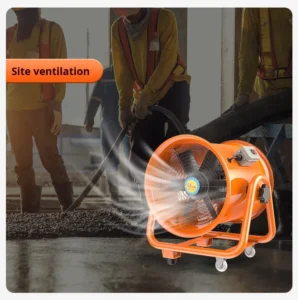
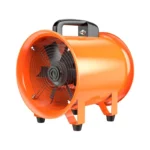
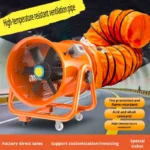


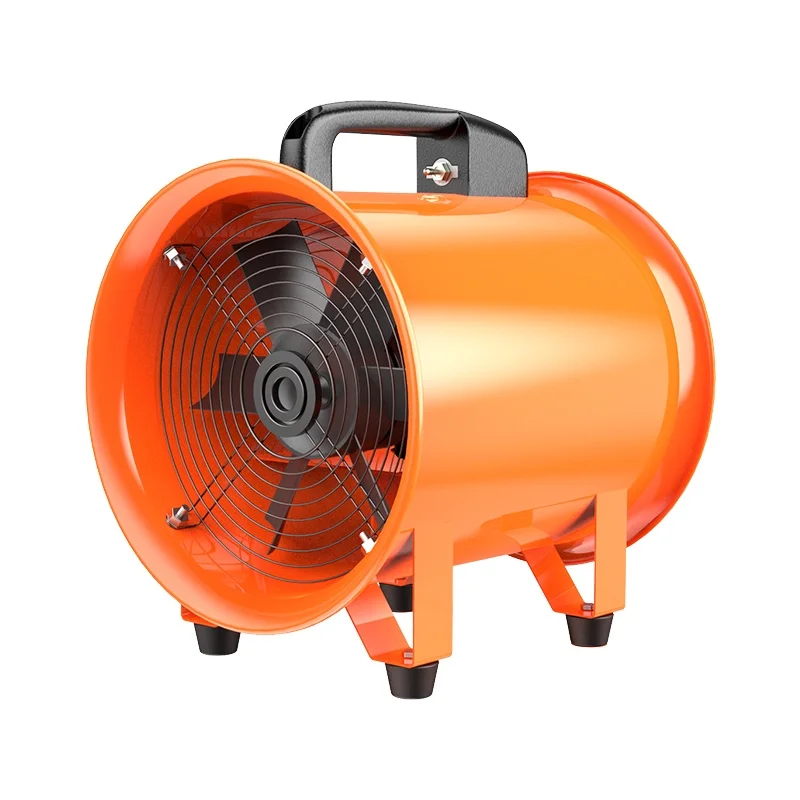


Ventilation Reliability — Equipment on mining and tunnelling sites must operate continuously under abrasive, confined conditions where a single bearing failure can halt an entire face. This axial flow fan is engineered with cast iron housing and ball bearing construction to sustain duty cycles in those environments.
Technical Specifications
| Parameter | Value |
|---|---|
| Product Type | Portable Axial Flow Exhaust Fan |
| Size Options | 200mm, 250mm, 300mm, 350mm, 400mm, 450mm, 550mm, 650mm, 750mm, 850mm, 900mm |
| Power Range | 250W to 5500W |
| Air Volume Range | 1300 m³/h to 28000 m³/h |
| Total Pressure Range | 140 Pa to 260 Pa |
| Voltage | 220V / 380V |
| Noise Level | 57–88 dB(A) |
| Bearing Type | Ball Bearing |
| Housing Material | Cast Iron |
| Customization | ODM Available, Custom Brand Printing, Custom Colors |
| Standards | ISO, CE (certificates included with dispatch) |
Application Suitability
| Application | Exposure & Requirement |
|---|---|
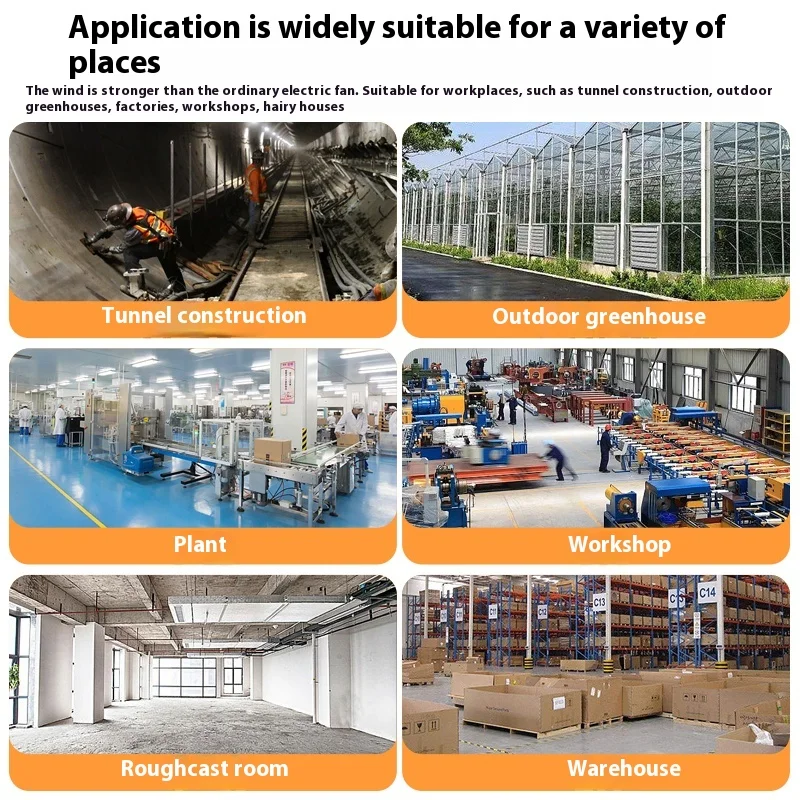
| Underground mining ventilation | Continuous operation in dust-laden, humid airways with fire-retardant and anti-static compliance mandatory on-site |
| Tunnel and shaft construction | High-volume air movement through confined bores where equipment access for maintenance is restricted |
| Confined space entry and tank work | Forced ventilation to displace hazardous fumes before and during personnel entry |
| Aviation and specialist structure airflow | Certified equipment documentation required for project handover and regulatory audit |
Why Fan Housing Material Decides Service Life on Mining Sites
A cast iron housing absorbs vibration and resists abrasive particle impact that degrades lighter materials over time.
Ventilation equipment in mining and tunnelling faces constant exposure to rock dust, moisture, and mechanical shock. When housing integrity degrades, the fan impeller loses alignment and airflow drops below the design threshold — often without visible warning. An Axial Flow Ventilation Fan for mining and construction must maintain structural rigidity across extended shifts, not just at commissioning. [NEED_CITE: ventilation equipment durability standards in underground mining operations]
Specifying the right fan starts with matching the housing and bearing type to the actual operating environment, not simply comparing air volume figures on a datasheet.
Continuous Duty Cycles Demand Ball Bearing Construction
The ball bearing system in this fan series supports extended runtime under the sustained loads typical of tunnelling and shaft-sinking projects. Sleeve bearings, by contrast, tend to overheat and lose tolerance when run continuously in high-ambient-temperature environments. For ventilation systems that operate around the clock on active mine faces, bearing selection directly determines maintenance intervals and unplanned downtime. This axial flow exhaust fan range is designed with that duty profile in mind.
Matching Airflow and Pressure to Duct System Design
Total pressure output ranges from 140 Pa to 260 Pa across the size spectrum. This pressure band suits duct runs of moderate length where friction loss accumulates gradually. For longer duct runs or systems with multiple bends, the pressure requirement rises and fan sizing must account for the cumulative static loss. [NEED_CITE: duct friction loss calculations for temporary mine ventilation systems] Selecting a fan without calculating total system resistance risks undersizing the unit, resulting in inadequate air delivery at the working face.
Size Range and Air Volume Across Project Phases
The eleven diameter options from 200mm to 900mm allow specifiers to match fan capacity to the ventilation volume required at each project phase. Early development headings may only need a 200mm or 250mm unit for short duct runs, while main tunnel drives advancing beyond several hundred metres demand the larger 750mm to 900mm frames pushing up to 28000 m³/h. Power consumption scales accordingly, from 250W at the lower end to 5500W at maximum output. Voltage compatibility at both 220V and 380V ensures the fan can be deployed across different site power configurations without transformer adaptation.
Understanding Noise Output in Confined Work Areas
Noise levels span 57 to 88 dB(A) depending on size and speed. In confined tunnelling environments, sound reflects off rock walls and compounds quickly, so selecting a fan that delivers the required air volume at the lowest acceptable noise level supports occupational exposure compliance. Hearing protection remains mandatory, but lower baseline noise reduces cumulative exposure for crews working adjacent to the ventilation column.
The Cost of Underspecifying Ventilation Equipment on Site
When a fan is selected on air volume alone without verifying pressure capability, the result is a unit that moves sufficient air on test but cannot overcome the resistance of a real duct run. Airflow at the face drops below the regulatory minimum, forcing the project to install additional booster fans mid-drive — doubling equipment cost and complicating the ventilation circuit. [NEED_CITE: consequences of inadequate ventilation planning in tunnel construction projects] Similarly, specifying a fan without confirming fire-retardant or anti-static compliance for the site can halt inspections and delay approvals. These failures are preventable when the specification accounts for system resistance, duty cycle, and regulatory requirements together.
Procurement Backed by Production Control
Each fan in this range is supported by a production process that includes in-process quality checks and full pre-shipment inspection before dispatch. The ten-person R&D team handles ODM configurations, including custom mounting arrangements and project-specific compliance documentation. Three full production lines provide the capacity to supply multiple units against a single project order without extended lead times. Quality assurance covers bearing verification, motor specification confirmation, and housing integrity inspection at each stage. Samples for custom configurations are developed within days, allowing site engineers to validate fitment and connection interfaces before committing to the full order.
Documentation & Verification
- Material specification sheet stating fan size, power rating, voltage, and air volume performance data
- Test report for fire-retardant and anti-static grades where applicable to site compliance requirements
- ISO and CE certificates included in dispatch documentation package
- Pre-shipment inspection record confirming bearing type, motor winding, and housing material
- Certificate of origin and customs documentation for international project shipments
Fabrication, Handling & Storage
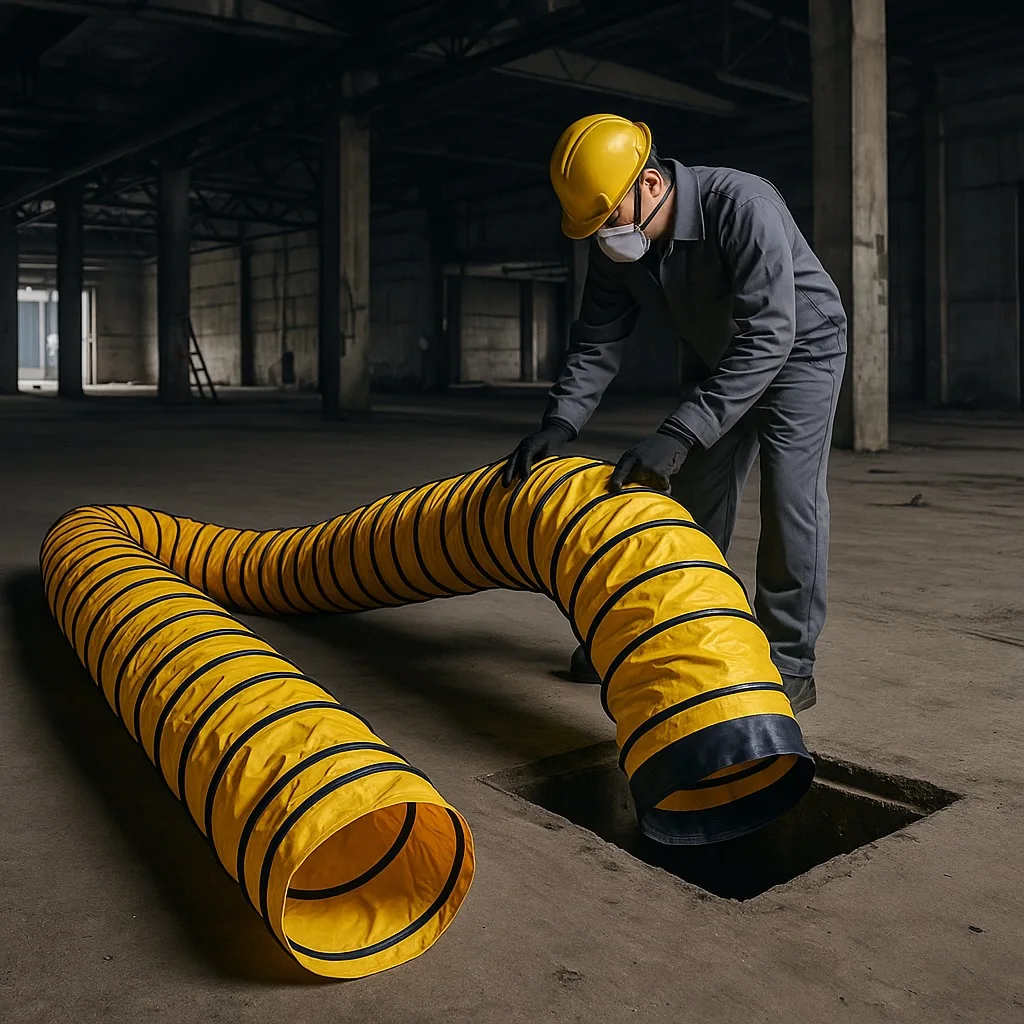
- Verify duct connection diameter matches fan outlet size before installation to avoid on-site adapter fabrication
- Store cast iron housing units on level, dry surfaces to prevent corrosion at the base mounting flange
- Inspect ball bearing seals after transit and before commissioning in dusty mining environments
- Confirm voltage at the site power supply matches the 220V or 380V motor specification before energizing
- Handle larger 750mm–900mm units with mechanical lifting equipment due to cast iron housing weight
Requesting a Site-Specific Recommendation
Provide the duct run length, number of bends, and required air change rate so the correct fan size and pressure rating can be confirmed. Include any fire-retardant or anti-static compliance standards your site authority mandates, along with the available power supply voltage. If your project requires custom mounting, duct connection interfaces, or branding on the housing, note those requirements in the initial enquiry to accelerate sample development.
Frequently Asked Questions
Q: What fire-retardant or anti-static certification does the fan carry for mining site approval?
A: The fan range is produced under ISO and CE certification frameworks. Specific fire-retardant or anti-static compliance documentation is available — confirm the exact standard your mine site or tunnel project authority requires before ordering, so the correct test report is included with dispatch.
Q: How do I match fan size and pressure rating to my ventilation duct system?
A: Calculate the total system resistance by summing duct friction loss and bend losses across the full run length. Compare the result against the fan’s total pressure range of 140 Pa to 260 Pa. Select the diameter that delivers the required air volume at or above your calculated system resistance.
Q: What maintenance interval applies to the ball bearing in continuous operation?
A: Ball bearing service intervals depend on ambient dust concentration, operating temperature, and duty cycle length on your specific site. Request the bearing manufacturer’s maintenance schedule for the installed bearing type and adjust based on your site’s environmental conditions and inspection records.
Q: Can the fan housing and motor be customized for specific project compliance standards?
A: ODM customization covers housing modifications, custom brand printing, custom colors, and motor configurations. Provide your project compliance requirements and dimensional specifications during the enquiry stage so samples can be developed and validated before full production commences.
Q: How is airflow performance verified before shipment?
A: Each unit undergoes pre-shipment inspection covering motor specification, bearing type, and housing integrity. Performance verification against the stated air volume and pressure data is conducted during the inspection process, with results recorded in the dispatch documentation package.