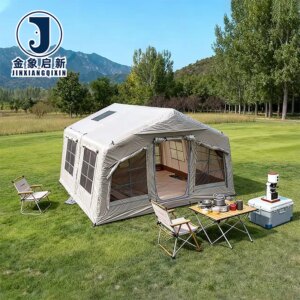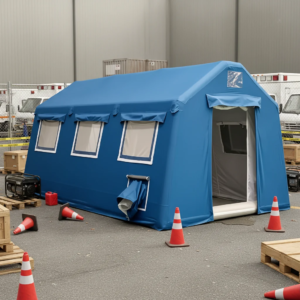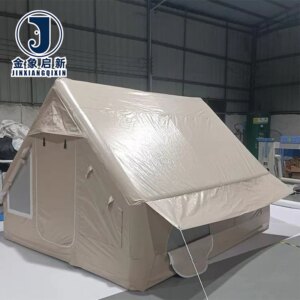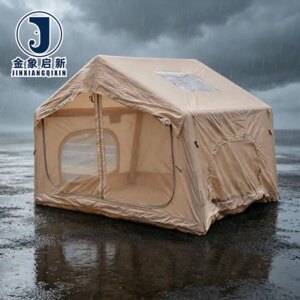
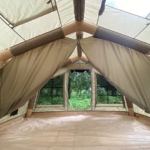
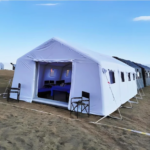

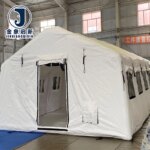
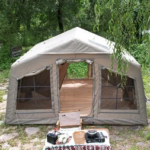
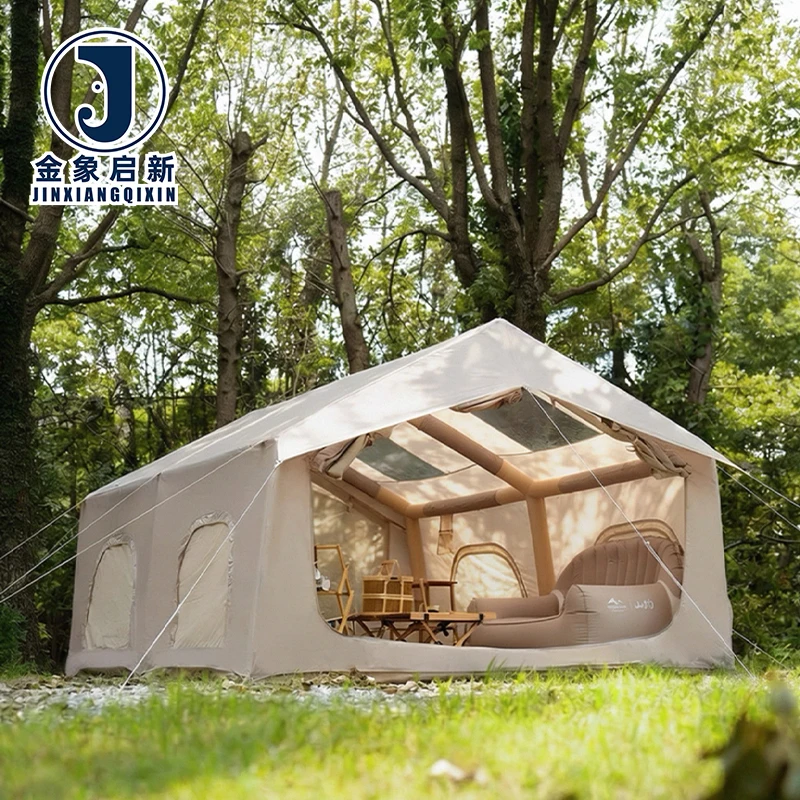
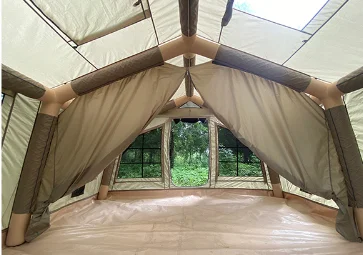
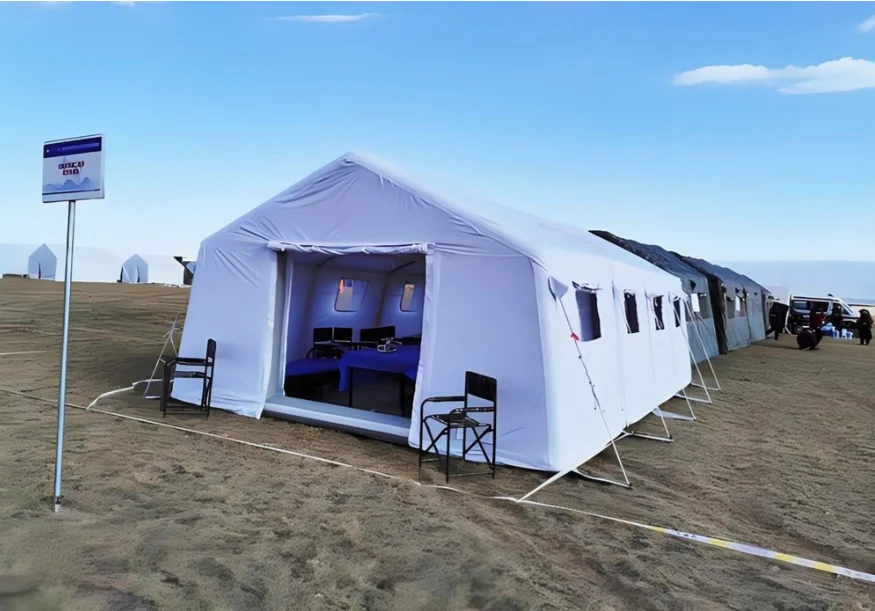

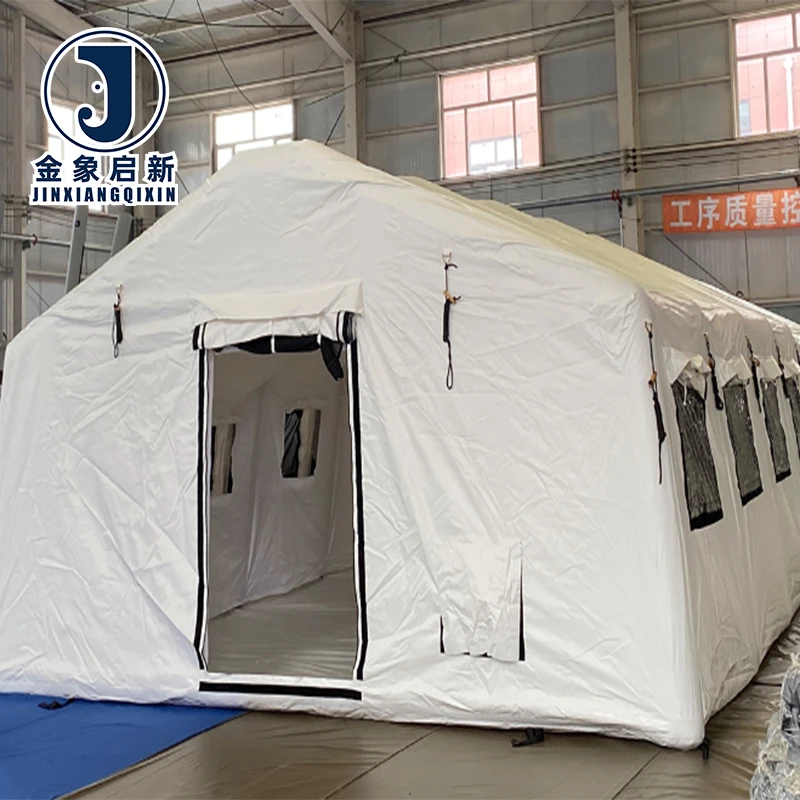

Near-30-Year PVC Coating Expertise — Every batch of inflatable tent fabric we produce carries full fire-retardant and anti-static test reports, matching the compliance documentation your site safety audit demands.
Technical Specifications
| Parameter | Value |
|---|---|
| Product Type | Inflatable Tent |
| Core Material | PVC tarpaulin |
| Key Performance | Waterproof, UV-resistant (test basis not stated in source), tear-resistant, fire-retardant (grade not stated in source), anti-static (standard not stated in source) |
| Product Forms | Inflatable structure with automatic opening mechanism |
| Construction | Single layer |
| Capacity Range | 1–12 person |
| Customization | OEM & ODM, sample customization, pattern printing |
| Production Facility | 9,180 m² with 3 full production lines |
| Processing Equipment | 36 sets of professional processing equipment |
| R&D Team | 10 technicians |
| Quality Control | Full-process inspection with dedicated QA & QC staff |
| Management Standards | ISO 9001, ISO 14001, ISO 45001, CE |
Application Suitability
| Application | Exposure & Requirement |
|---|---|
| Mining & tunnelling temporary shelter | Confined underground environments demanding fire-retardant and anti-static fabric compliance for personnel safety |
| Aviation maintenance inflatable structure | Rapid deployment around aircraft, resistance to jet fuel splash, UV exposure on open tarmac |
| Construction site operational facility | Wind load on inflated walls, daily entry-exit abrasion, dust and moisture ingress prevention |
| Disaster relief & emergency response | Immediate shelter deployment in unprepared terrain, multi-day continuous occupancy, weather extremes |
| Industrial storage enclosure | Protection of equipment and materials from precipitation, UV degradation, and site contaminants |
| Outdoor event management structure | Repeated inflation-deflation cycles, public occupancy fire safety compliance, branded exterior surfaces |
What Compliance Gaps Cost When Inflatable Structures Fail Inspection
Certified inflatable tent fabric with documented fire-retardant and anti-static properties eliminates the compliance risk that stops projects before they start.
Temporary structures deployed on regulated sites — mines, construction zones, aviation facilities — face immediate safety audits. The inflatable tent fabric must carry verifiable fire-retardant and anti-static documentation that matches the site’s regulatory framework. [NEED_CITE: fire safety classification requirements for temporary membrane structures on industrial sites]. When the fabric arrives without batch-specific test reports, the entire structure is rejected at inspection. Project timelines stall, penalty clauses activate, and the procurement team faces internal review. This is not a material quality issue — it is a documentation failure that could have been resolved before production started.
Compliance Documentation That Travels With Every Roll
The inflatable tent fabric we supply ships with a complete documentation package: fire-retardant test report tied to the specific batch, anti-static measurement record, material specification sheet, and ISO/CE certificates. Technical buyers in mining and aviation can submit these documents directly to site safety officers without requesting additional paperwork. This approach treats documentation as a production deliverable, not an afterthought.
Automatic Opening Meets Controlled Material Behaviour
The automatic opening mechanism of the inflatable structure places immediate stress on seams and valve attachment points during inflation. The PVC tarpaulin core must maintain consistent flex behaviour across the entire structure — panels that are stiffer than specified create uneven inflation, while under-coated sections develop weak points under internal pressure. [NEED_CITE: relationship between coating adhesion strength and seam integrity in inflatable membrane structures]. Our 10-technician R&D team develops samples that account for these inflation dynamics before bulk production begins.
Reading the Specification Sheet Beyond the Surface
Understanding what the specification sheet actually tells you requires knowing which parameters interact. The waterproof performance of PVC tarpaulin depends on both the coating weight and the base fabric weave density — a loose weave with heavy coating may seal well initially but risks delamination under repeated flex cycles. Fire-retardant treatment must penetrate the full coating thickness rather than sitting as a surface additive, because surface-only treatment abrades away during handling and transport. Anti-static properties require a specific surface resistivity range, and that range must be maintained across the full width of each roll, not just at the sample cut point. UV resistance interacts with colour selection, as darker pigments absorb more thermal energy and can accelerate plasticiser migration in warm climates. These interactions mean that changing one parameter — colour, width, or treatment — can shift the performance balance of the entire material. [NEED_CITE: interaction between coating formulation and fire-retardant additive dispersion in PVC tarpaulin].
When Specification Shortcuts Become Field Failures
A buyer specifies fire-retardant inflatable tent fabric for a mining camp shelter but does not confirm the grade required by local regulation. The fabric arrives with a fire-retardant treatment that meets a different market’s standard, and the site inspector rejects the structure upon installation. Similarly, anti-static treatment claimed on a quotation without a test report creates liability exposure in environments with combustible dust or flammable vapours. [NEED_CITE: anti-static surface resistivity standards for textile materials used in hazardous atmospheres]. Batch-to-batch colour variation across rolls in a single order becomes visible when multiple inflatable units are deployed side by side at an event or relief camp, forcing partial replacement and delayed deployment. Welded seams failing before the fabric body does indicates a heat-sealing temperature mismatch with the actual coating formulation — a preventable failure if the fabricator receives accurate material processing data.
Why Industrial Buyers Source Inflatable Tent Fabric From This Line
Three full production lines with 36 sets of professional equipment give us the capacity to fulfil large-scale inflatable structure orders within the project timeline your site schedule demands. Our 10-technician R&D team handles material selection, pattern printing, custom sizing, and sample development — meaning a prototype inflatable panel reaches you for approval before bulk coating begins. Dedicated QA and QC staff inspect every production stage, and 100% pre-shipment inspection catches coating defects, colour deviation, and weld weaknesses before the material leaves our 9,180 m² facility. Nearly 30 years of PVC coating process control ensures that coating weight, adhesion strength, and treatment dispersion remain consistent from the first roll to the last in your order. Full OEM and ODM capability means we produce to your structure design, not to our catalogue constraints.
Documentation & Verification
- Material specification sheet stating PVC coating weight, base fabric construction, and treatment type per batch
- Fire-retardant test report matching the specific production batch shipped
- Anti-static measurement record with surface resistivity values from roll samples
- ISO 9001, ISO 14001, ISO 45001, and CE certificates included in shipment documentation
- Pre-shipment inspection record with QA & QC sign-off at each production stage
- Certificate of origin and customs support documentation for international dispatch
Fabrication, Handling & Storage
- Heat-seal temperature profiles provided per batch to match the PVC coating formulation of the inflatable tent fabric
- Valve attachment zones require reinforced weld passes due to concentrated stress during inflation cycles
- Store rolls vertically on pallets to prevent permanent creasing in the PVC coating layer
- Allow material to acclimatise before unrolling in cold conditions to prevent low-temperature cracking
- Use mild detergent for surface cleaning to preserve fire-retardant and anti-static treatment integrity
- Field repairs on single-layer PVC tarpaulin require compatible adhesive and heat-activated patch material
Before You Request a Quote
Tell us the deployment environment — underground mine, open construction site, disaster relief zone — and the fire-retardant or anti-static grade your local regulation requires. Confirm whether you need rolls for your own fabrication facility or finished inflatable structures with valve placement and pattern printing to your drawing. Specify target colour references and whether batch colour consistency across multiple units is critical for your application.
Frequently Asked Questions
Q: What fire-retardant grade and anti-static standard does the inflatable tent fabric meet?
A: The PVC tarpaulin core is available in fire-retardant and anti-static grades. The specific grade must match your site’s regulatory framework — mining operations, aviation facilities, and construction zones each reference different standards. We confirm the applicable grade during the specification phase and provide batch-specific test reports with shipment. Contact our technical team with your site compliance requirements.
Q: Can you provide test reports for flame retardancy and anti-static properties with the shipment?
A: Yes. Every shipment includes fire-retardant and anti-static test reports tied to the specific production batch. These documents are generated during our in-process quality inspection and accompany the material specification sheet, ISO/CE certificates, and pre-shipment inspection record. This ensures your site safety audit has verifiable documentation without follow-up requests.
Q: How is batch-to-batch consistency ensured for large-scale inflatable structure orders?
A: Our three full production lines operate under strict full-process quality inspection with dedicated QA and QC staff. Coating weight, colour reference, and treatment dispersion are measured at each production stage. Pre-shipment inspection covers 100% of the order, and the inspection record ships with the documentation package so you can verify consistency before the material reaches your fabrication floor.
Q: What customization options are available for inflatable tent sizing, printing and valve placement?
A: Full OEM and ODM customization is available. Our 10-technician R&D team develops samples based on your structure drawings, including custom dimensions, pattern printing, and valve positioning. Sample approval happens before bulk production begins, ensuring the inflatable tent fabric meets your design specifications for inflation behaviour, seam placement, and surface branding.
Q: What documentation is included for customs clearance and site safety audits in international markets?
A: Each shipment includes a certificate of origin, material specification sheet, fire-retardant and anti-static test reports, ISO 9001, ISO 14001, ISO 45001, and CE certificates, a roll packing list, and a pre-shipment inspection record. This documentation package supports both customs processing in the destination country and regulatory compliance verification at the deployment site.