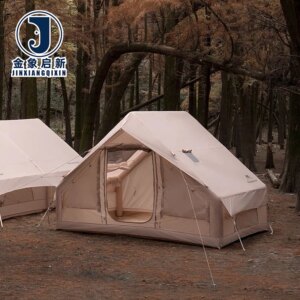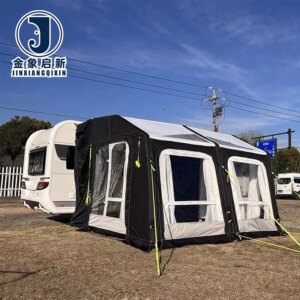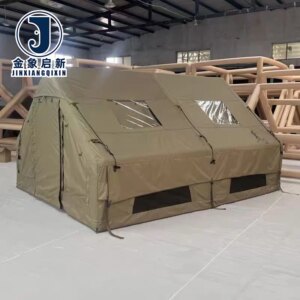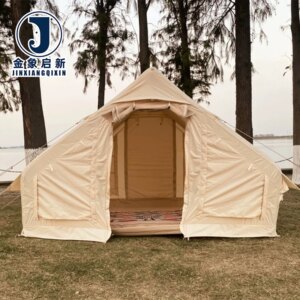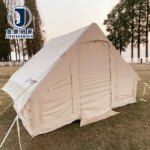
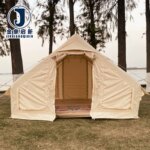
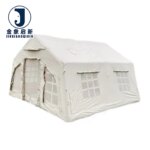
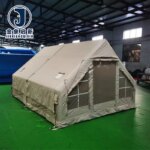

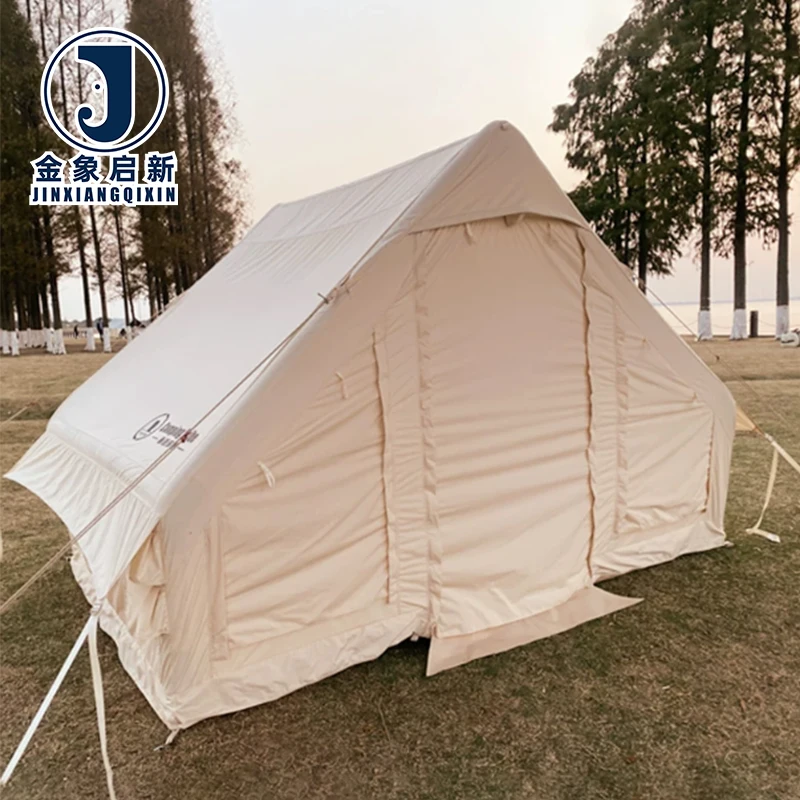
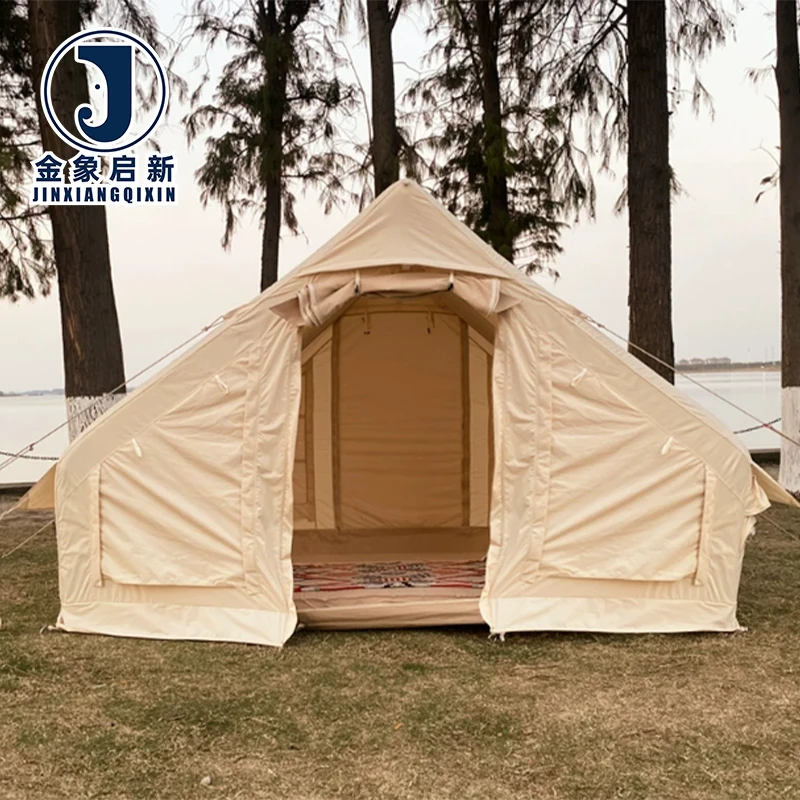
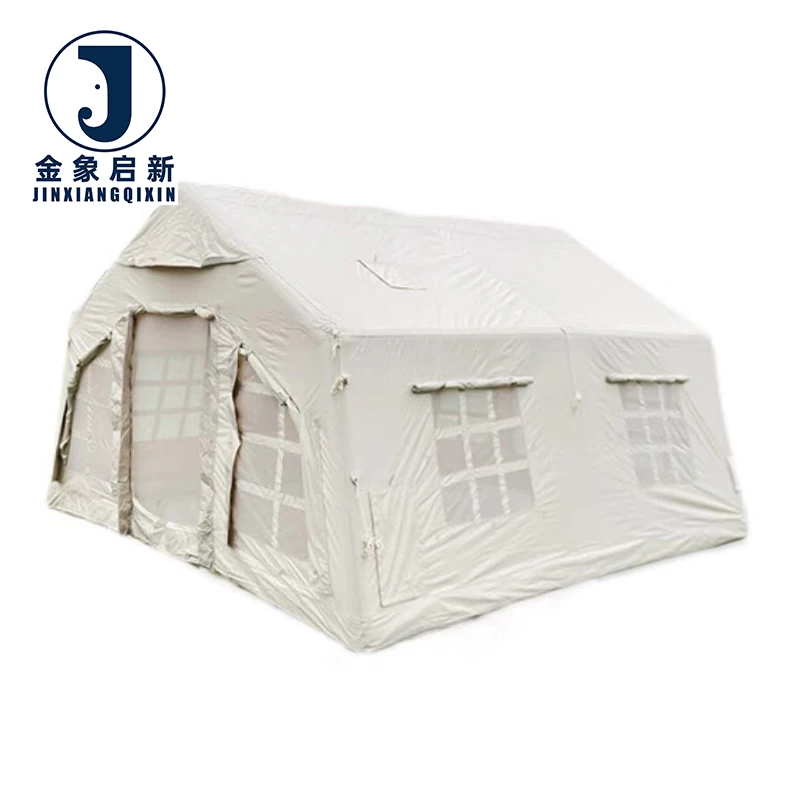
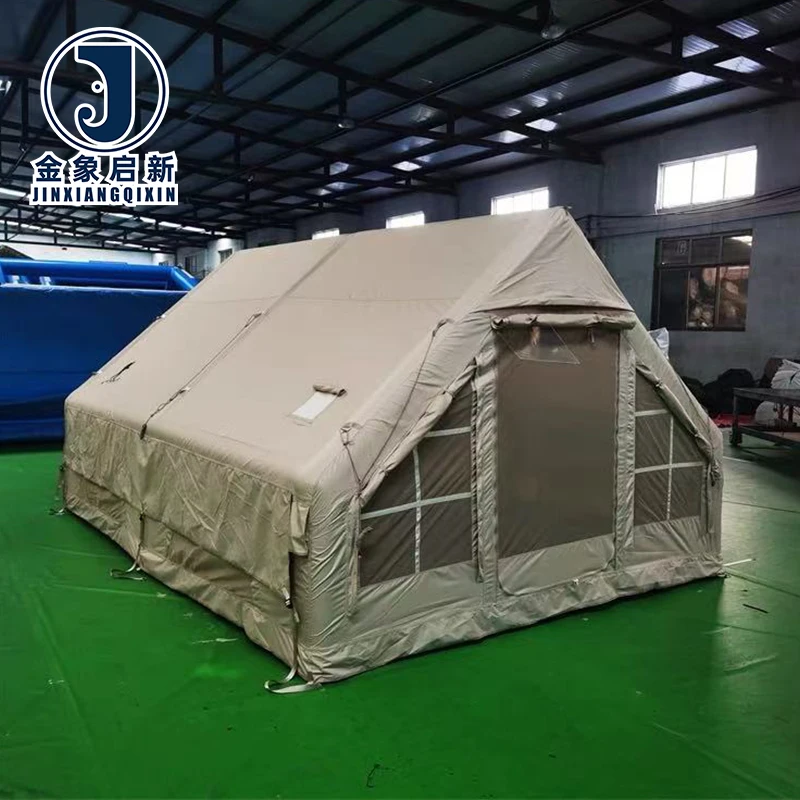
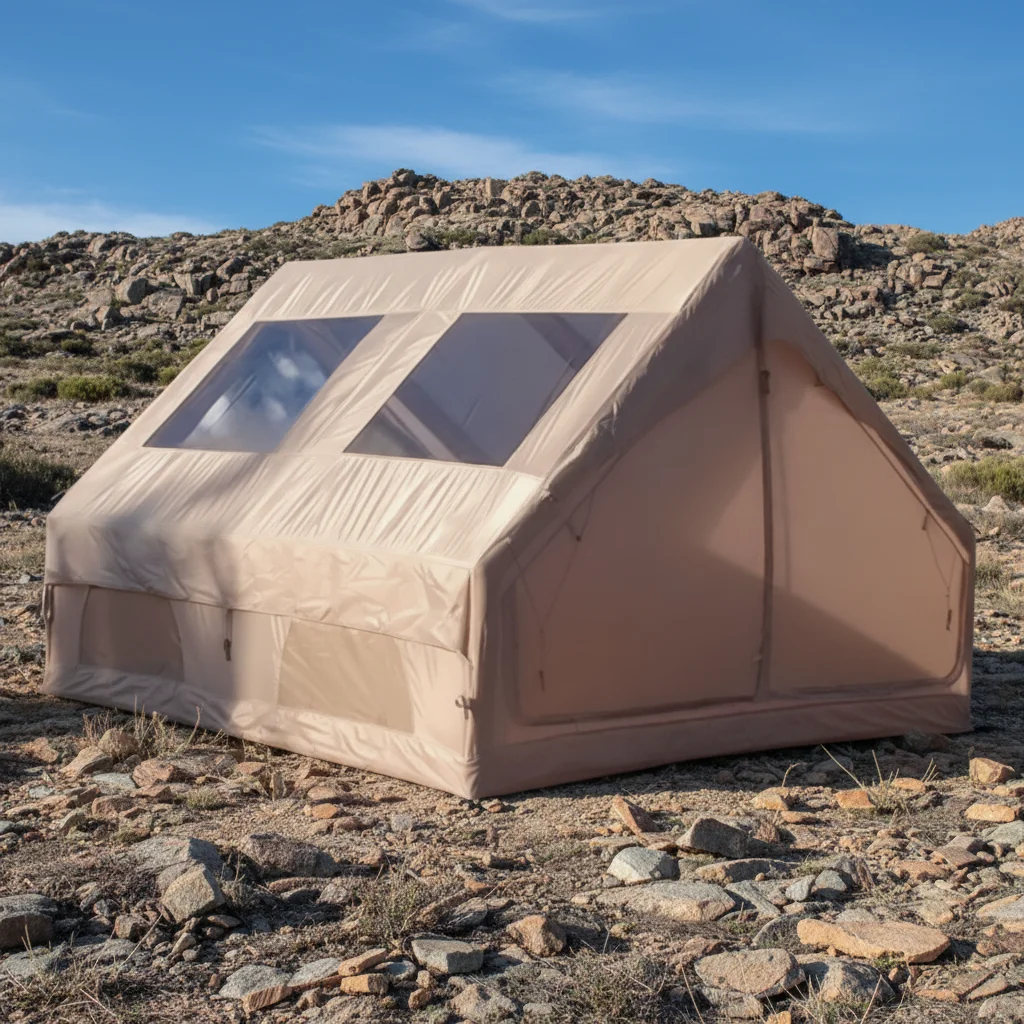

Custom PVC Inflatable Tent for Camping — Our dedicated QA/QC staff inspect every inflatable tent batch at the coating, cutting, welding, and packing stages before it leaves our facility.
Technical Specifications
| Parameter | Value |
|---|---|
| Product Type | Inflatable Camping Tent |
| Core Material | PVC Tarpaulin |
| Capacity | 2–8 Person |
| Season Rating | 4-Season |
| Construction | Single-Layer |
| Opening Mechanism | Quick Automatic Opening |
| Key Performance | Waterproof, UV-Resistant (test basis not stated), Tear-Resistant |
| Customization | OEM & ODM — sample customization, pattern printing, size adjustments, material thickness modifications |
| Certifications | ISO9001, ISO14001, ISO45001, CE |
Application Suitability
| Application | Exposure & Requirement |
|---|---|
| Commercial camping grounds | Continuous outdoor exposure, frequent inflation cycles, guest turnover durability |
| Temporary event shelters | Rapid deployment, wind loading, short- to medium-term weather resistance |
| Industrial site accommodation | Heavy daily use, dust and debris contact, temperature fluctuation across shifts |
| Outdoor exhibition areas | UV exposure under open sky, branding print adhesion, repeated assembly and teardown |
| Emergency response scenarios | Immediate inflation, harsh terrain puncture risk, all-weather waterproofing |
Why "UV-Resistant" Means Nothing Without a Test Report Behind It
A UV claim without a verified test standard leaves buyers exposed to premature fabric degradation and costly field replacements.
Many inflatable tent fabrics carry a UV-resistant label yet arrive at the project site with no documentation to back it up. When commercial operators deploy these tents across a camping season, the coating begins to chalk, lose flexibility, and show micro-cracks far earlier than expected. The result is not just an aesthetic issue — structural air retention drops as the PVC surface breaks down. [NEED_CITE: UV degradation mechanisms in plasticized PVC coatings per ISO 4892]
As a PVC Inflatable Tent manufacturer custom builders know, the difference between a tent that lasts a full commercial season and one that fails mid-deployment often comes down to whether the UV stabilizer package was verified at the raw material stage. Our approach is to supply test reports with every batch so the procurement team can close the file without a follow-up call.
Designing Air-Retaining Structures That Survive Continuous Commercial Use
The inflatable camping tent operates under a different stress profile than pole or frame tents. Every welded seam carries internal air pressure around the clock, and the PVC tarpaulin must resist both puncture from ground contact and sustained tension at the beam junctions. Our 36 sets of professional processing equipment allow us to control heat weld temperature and pressure at each joint, which directly determines whether the seam holds through hundreds of inflation cycles. As a PVC Inflatable Tent manufacturer custom teams work with, we develop samples in-house so the opening mechanism, valve placement, and beam geometry are validated before production begins.
How 4-Season Rating Translates to Real Temperature Extremes
A 4-season inflatable tent must maintain air-tight beam integrity whether the ambient air sits well below freezing or climbs into sustained summer heat. PVC tarpaulin naturally stiffens at low temperatures and softens at high temperatures — the challenge is keeping the coated fabric within its functional window across both extremes. [NEED_CITE: low-temperature flexibility and heat deflection behavior of plasticized PVC per ASTM D746] Our R&D team of 10 technicians selects the plasticizer system and coating weight to balance cold flexibility against hot-weather sag resistance, then verifies performance through the full-process QA/QC inspection before any roll enters cutting.
Single-Layer PVC Tarpaulin: What Waterproofing and Tear Resistance Actually Depend On
Waterproof performance in a single-layer inflatable tent is not just about the coating — it depends on the base fabric weave density and how completely the PVC penetrates the interstices. A loosely woven base allows water to track through pinholes even when the surface coating appears intact. Tear resistance follows a similar logic: the denier of the yarn and the warp-weft count determine how far a tear propagates once the fabric is nicked. Quick automatic opening places sudden stress on beam seams during inflation, and the PVC tarpaulin must absorb that load without delaminating. We specify the base fabric and coating parameters together, then inspect every roll for adhesion strength and coating uniformity before it reaches the production floor.
The Hidden Cost of Choosing the Wrong Material Thickness
Specifying a PVC tarpaulin that is too thin for the intended capacity leads to beam deflection under load and accelerated wear at high-stress fold points. For a 2–8 person inflatable camping tent deployed commercially, undersized material thickness means the structure loses rigidity in wind, the floor punctures on uneven ground, and the welded seams crack from repeated flex cycles. Buyers who focus on unit cost without verifying thickness against the deployment scenario often face replacement orders within the first season. [NEED_CITE: coated fabric thickness and puncture resistance correlation per ISO 1421]
Batch-to-batch inconsistency compounds the problem. If roll thickness varies across a single order, some tents in the batch fail early while others perform adequately, making quality control at the operator level nearly impossible. Our dedicated QA&QC staff measure material thickness on every roll and record it in the pre-shipment inspection report.
Why Procurement Teams Source This Inflatable Tent Here
Our facility runs three full production lines under one 9,180 m² roof, meaning the inflatable camping tent moves from coating to cutting to welding without leaving our quality control perimeter. This vertical integration eliminates the handoff gaps that cause specification drift between a fabric supplier and a separate tent converter.
The 10-person R&D team handles OEM and ODM development directly, adjusting size, material thickness, and pattern printing to project-specific requirements rather than routing requests through a sales intermediary. Pre-production samples are developed within days so the buyer confirms opening mechanism behavior and seam placement before mass production starts.
Every batch ships with documentation that matches the material specification sheet to the actual roll data — no generic certificates, no blank test reports filled in after the fact. ISO9001, ISO14001, ISO45001, and CE certification underpin the production system, not just the marketing materials.
Documentation & Verification
- Material specification sheet listing PVC tarpaulin composition, coating weight, and base fabric denier for each inflatable tent batch
- Waterproof rating test report accompanying every shipment for site compliance verification
- UV resistance test results provided per batch when UV treatment is specified in the order
- Customization parameter record capturing size, thickness, and pattern printing details for traceability
- Pre-shipment inspection record documenting dimensional checks and weld integrity on every unit
Fabrication, Handling & Storage
- Heat weld parameters must match the specific PVC tarpaulin thickness to avoid seam delamination at beam junctions
- Valve insertion points require reinforced patches sized to the chosen material thickness for reliable air retention
- Store deflated tents flat or loosely rolled to prevent permanent crease marks in the PVC coating
- Use neutral pH cleaners only — aggressive solvents attack the plasticizer in the PVC tarpaulin surface
- Field repairs should use matching PVC tarpaulin patches with solvent weld adhesive compatible with the coating formulation
- Allow tents to reach ambient temperature before inflation in cold conditions to avoid low-temperature cracking at fold lines
Requesting a Quotation for Your Project
To move forward with a PVC Inflatable Tent manufacturer custom order, provide the intended deployment environment, expected wind and temperature range, and whether pattern printing or branding is required. Specify the capacity range needed per unit, the quantity for the initial batch, and any fire safety or compliance standards your market demands. If you have an existing tent design, share drawings or photos so our R&D team can assess feasibility and recommend material adjustments before sampling begins.
Frequently Asked Questions
Q: What OEM and ODM customization options are available for the inflatable tent?
A: We customize capacity from 2 to 8 persons, adjust material thickness to match the deployment environment, add pattern printing or branded graphics, and modify the opening mechanism. Our R&D team develops a pre-production sample for buyer approval before any bulk run begins, ensuring every specification is locked in.
Q: How do you ensure batch-to-batch consistency across large commercial orders?
A: Our dedicated QA&QC staff inspect every roll for coating weight, thickness, and adhesion strength before it enters cutting. Weld parameters are calibrated per material batch, and a pre-shipment inspection record documents dimensional accuracy and seam integrity on every inflatable camping tent before dispatch.
Q: What certifications does the inflatable tent carry?
A: Production operates under ISO9001, ISO14001, and ISO45001 management systems, and the product carries CE marking. These certifications cover quality management, environmental controls, and occupational safety across the manufacturing process, supporting compliance with commercial procurement standards in most international markets.
Q: What quality documentation ships with each order?
A: Every shipment includes a material specification sheet, waterproof rating test report, UV resistance results where applicable, a customization parameter record for traceability, and a pre-shipment inspection report. Certificates of origin and customs documentation are provided on request to support international logistics.
Q: How does the sample approval process work before mass production?
A: We develop a physical sample based on your size, thickness, and feature requirements within days. The sample is shipped for your evaluation of opening mechanism performance, weld quality, and overall construction. Once you approve the sample, production proceeds with the exact parameters locked from that approved unit.