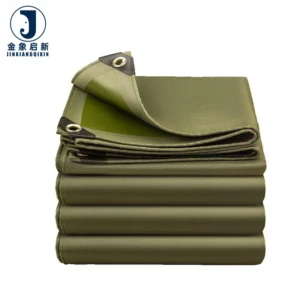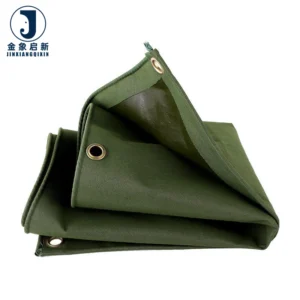
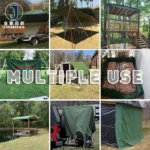
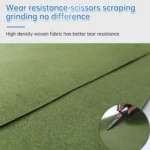
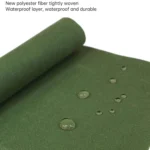
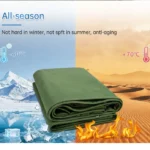


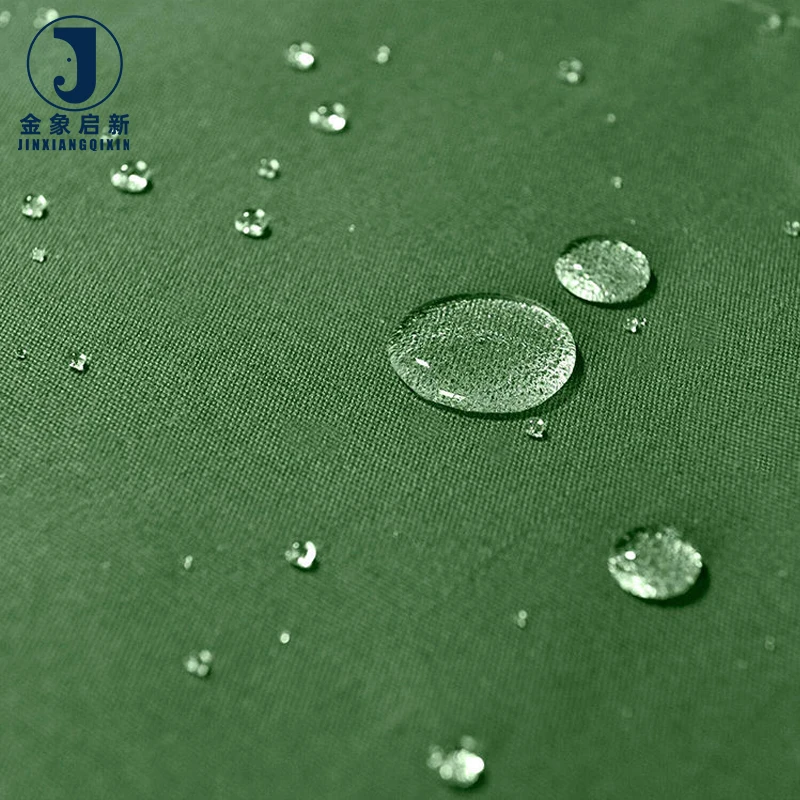
Coating Process Control — Deep expertise in laminated fabric production ensures consistent PVC adhesion across every roll, verified through stage-by-stage QA before dispatch.
Technical Specifications
| Parameter | Value |
|---|---|
| Product Type | Canvas Tarpaulin |
| Base Material | Polyester cotton industrial textile, 8-12 strands of fine cotton yarn |
| Coating | PVC laminated |
| Weight | 600gsm |
| Thickness | 0.5mm / 0.6mm / 0.7mm |
| Roll Width | 2m |
| Roll Length | 100m |
| Finish Product Size | Custom cut or inventory stock |
| Color | Army Green Camouflage / Custom |
| Eyelet Configuration | Rust-proof aluminum eyelets every 1 meter at corners and hem |
| Edge Treatment | Folded, seams welded and sewn with poly ropes |
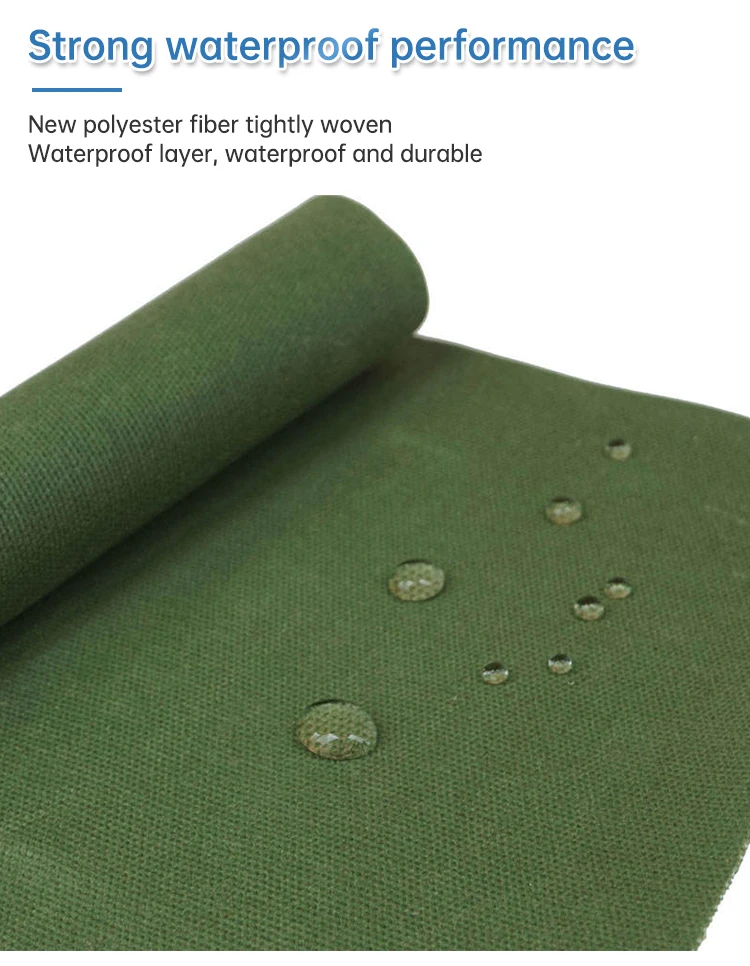
| Waterproof | Yes |
| UV Treatment | UV resistant (test basis not stated) |
| Anti-Mildew | Mold resistant |
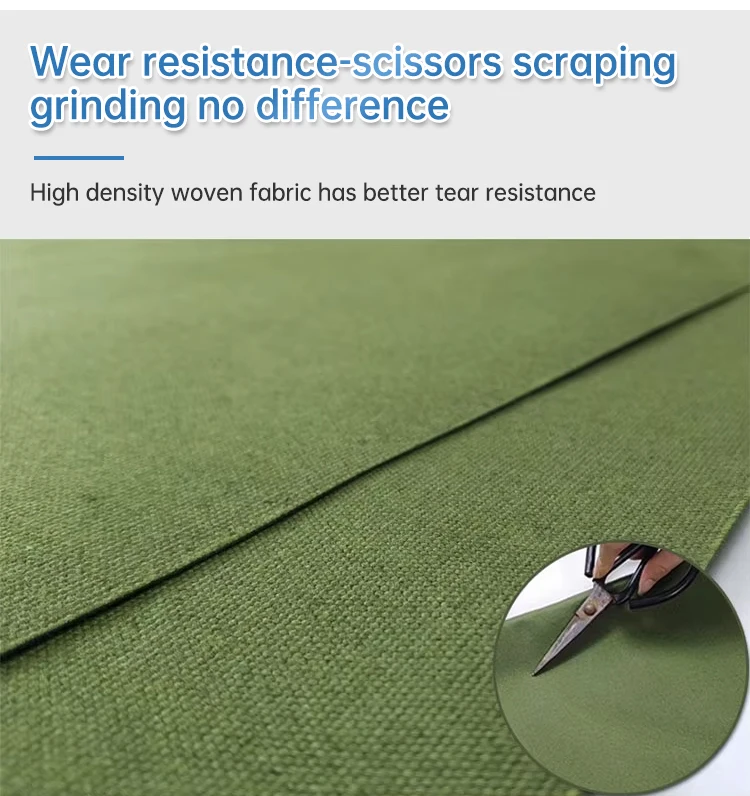
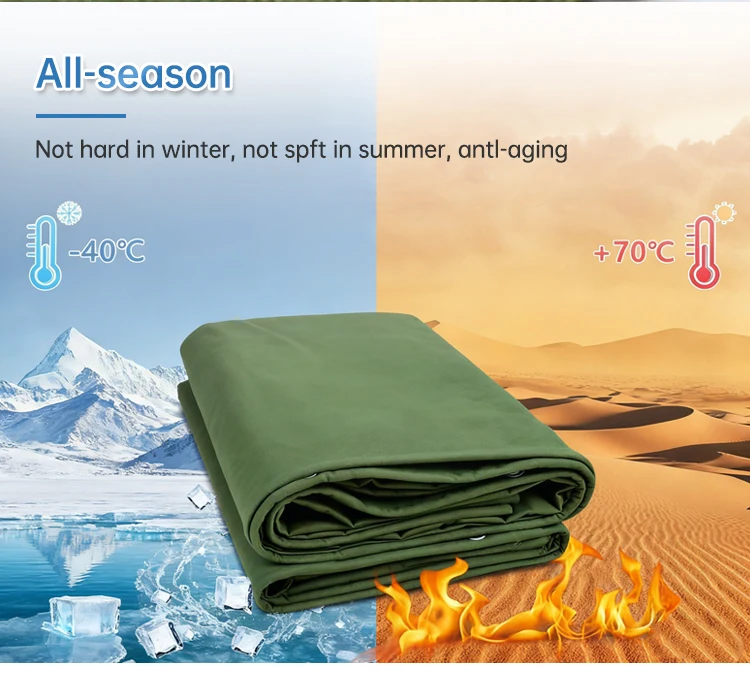
| Key Features | Wear-resistant, corrosion-resistant, tensile-resistant, high- and low-temperature resistant, shrink-proof |
Application Suitability
| Application | Exposure & Requirement |
|---|---|
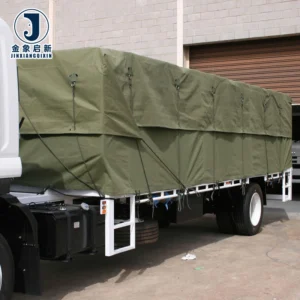
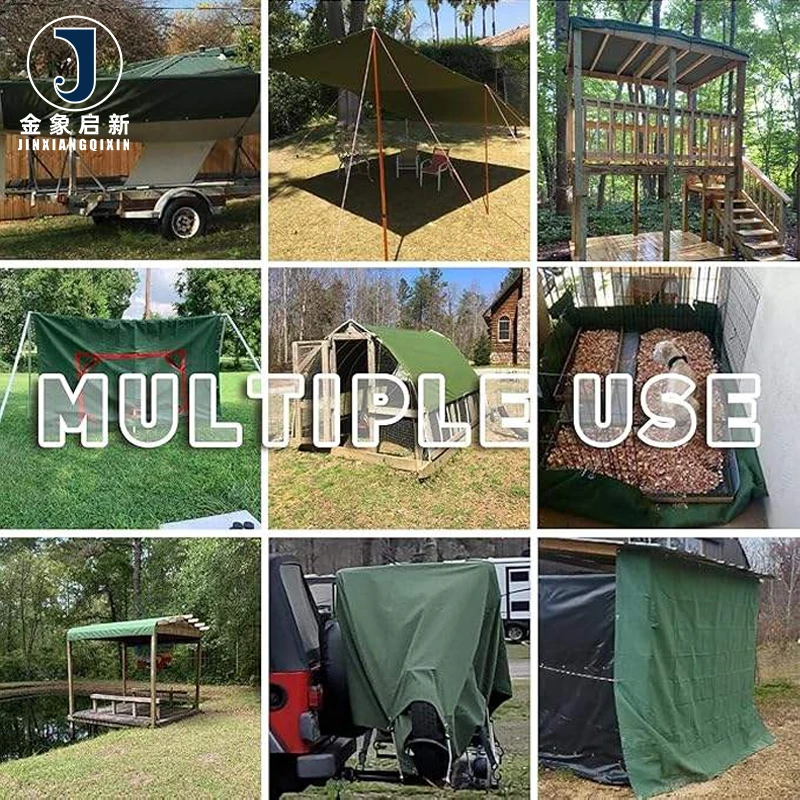
| Truck and transport canopy covers | Constant flexing at load points, road abrasion, wind-driven rain, UV exposure |
| Construction site equipment covers | Prolonged sun and rain exposure, dust, temperature variation, puncture risk from sharp edges |
| Outdoor awning and tent structures | Dimensional stability under tension, weatherproofing, repeated setup and teardown |
| Asphalt and industrial material covers | Heat exposure, chemical contact, heavy-duty abrasion from bulk materials |
Why Seam Strength Matters More Than Fabric Weight Alone
A laminated canvas tarpaulin can have the correct GSM on paper yet still fail where it matters most — at the welded seam under load.
Generic canvas tarps routinely split at the weld line or eyelet zone long before the body fabric shows wear. When a truck cover flexes at highway speed or an awning structure catches a gust, the stress concentrates at every point the fabric is joined or pierced. If the lamination bond is weak or the seam allowance too narrow, the result is a tear that propagates from the edge inward. [NEED_CITE: seam failure modes in laminated industrial fabrics per ISO 1421 tensile testing] Buyers who specify only by weight and colour often discover this gap after the first season of use, when warranty claims are already closed.
Lamination Bond and Structural Integrity
The PVC laminated backing on this heavy duty canvas tarpaulin creates a continuous waterproof barrier that is bonded under heat and pressure to the polyester-cotton woven base. This lamination method differs fundamentally from simple coating: the PVC film is fused to the textile rather than applied as a liquid layer, producing a distinct interface that resists delamination under mechanical stress. For applications like truck canopies and construction enclosures, this bond integrity determines whether the fabric holds together when subjected to repeated flexing and tie-down tension.
Reinforcement at Critical Stress Points
Every rust-proof aluminum eyelet is positioned at one-meter intervals along the hem and corners, with the surrounding fabric folded and welded before being sewn over poly rope. This triple-reinforcement approach distributes tie-down loads across a wider zone of the laminated canvas tarpaulin, preventing the eyelet from pulling through under wind load or cargo shift. The poly rope sewn into the hem acts as a load-bearing spine, so the tension from ropes and bungees is absorbed by the rope and the surrounding weld rather than concentrating on a single fabric point. [NEED_CITE: tie-down load distribution standards for transport covers]
Understanding the Base Fabric Construction
The polyester-cotton industrial textile base, constructed with 8-12 strands of fine cotton yarn, provides a balance of tensile strength and dimensional stability that pure synthetic or pure natural fibre weaves cannot match on their own. Polyester contributes resistance to stretching and shrinkage, while the cotton yarn component adds body and abrasion resistance at contact surfaces. The 600gsm total weight reflects both the base fabric density and the laminated PVC layer combined — a distinction that matters when comparing quotations, because a lighter base fabric with a heavier coating can show the same GSM but behave very differently under puncture and tear stress.
The Cost of Overlooking Specification Details
Accepting a canvas tarpaulin shipment without verifying the actual GSM against the quoted value is one of the most common sourcing failures in industrial fabric procurement. Rolls that arrive lighter than specified may look identical on the outside but lack the base fabric density needed for long-term durability, leading to premature tearing at flex points. Colour drift between rolls in the same order becomes visible only after installation, when adjacent panels are seen side by side on a truck or awning structure — forcing a full replacement rather than a simple swap. [NEED_CITE: batch colour consistency tolerance for coated fabrics] Welded seams that were not inspected before shipment can separate under the first significant load, exposing cargo or equipment to weather damage at the worst possible time.
Why Procurement Teams Source This Fabric Here
Three dedicated production lines and 36 sets of professional equipment support consistent output volume for laminated canvas tarpaulin orders, whether in full roll stock or custom cut sizes. A ten-person R&D team handles material specification, edge finishing design, and sample development for non-standard widths or colour requirements, producing samples within days rather than weeks. Quality control runs at every production stage with full inspection before dispatch, catching GSM deviations, seam defects, and colour inconsistencies before they reach the container. Documentation including material specification sheets, test reports, and certificates of origin ships with every order, giving procurement teams the paper trail needed for compliance and customs clearance. [NEED_CITE: pre-shipment inspection protocols for coated textile exports]
Documentation & Verification
- Material specification sheet confirming 600gsm with base fabric and PVC lamination breakdown
- UV resistance test basis documentation for outdoor exposure validation
- Pre-shipment inspection record covering eyelet spacing, weld quality, and colour consistency
- Roll packing list with individual roll weights and dimensions for receiving verification
- Certificate of origin and customs documentation for cross-border shipment
Fabrication, Handling & Storage
- Weld temperature and dwell time must suit the PVC laminated layer to avoid delamination at seams
- Rust-proof aluminum eyelets require correct die pressure to avoid crushing the surrounding 600gsm fabric
- Store rolls horizontally on padded racks to prevent permanent creasing in the laminated coating
- Allow cold-stored rolls to reach ambient temperature before unrolling to prevent PVC cracking
- Use mild detergent only; solvents can degrade the laminated PVC surface bond
- Overlap cuts by the seam allowance width to maintain weld integrity on custom-size panels
What to Include in Your Inquiry
Provide the specific application and exposure conditions — whether the laminated canvas tarpaulin will serve as a truck canopy, construction enclosure, or awning structure — along with the expected mechanical and weather stress. Confirm the required roll width, roll length, or finished panel dimensions, and specify any non-standard colour or edge finishing needs. If your market requires fire-retardant or anti-static certification for specialist structure use, state the applicable standard so the correct grade can be quoted and tested before production.
Frequently Asked Questions
Q: Can you supply this canvas tarpaulin in custom widths and roll lengths?
A: Custom widths and lengths beyond the standard 2m by 100m roll are available. The R&D team develops samples for non-standard specifications, and production is scheduled once the sample is approved. Minimum order quantities apply for custom runs and vary by colour and finishing requirement.
Q: How is the 600gsm weight verified before shipment?
A: Every roll undergoes weight verification during pre-shipment inspection, with results recorded against the quoted specification. The material specification sheet included with each shipment states the confirmed GSM along with the base fabric and PVC lamination breakdown for full traceability.
Q: What UV-resistance test basis supports the outdoor exposure claim?
A: UV-resistant treatment is applied during the lamination process. Buyers should request the specific test report to confirm the exposure duration and standard used. For projects requiring documented weathering performance, confirm the test basis needed for your market before placing the order.
Q: How are welded seams tested for strength at stress points?
A: Welded seams on the laminated canvas tarpaulin are inspected during production and again at pre-shipment inspection. The combination of heat welding and poly-rope sewing distributes load across the hem zone. Specific peel-strength test results can be provided upon request for critical applications.
Q: What documentation accompanies each shipment?
A: Each order ships with a material specification sheet, roll packing list, pre-shipment inspection record, and certificate of origin. Where applicable, UV or fire-retardant test reports and ISO or CE certificates are included to support customs clearance and project compliance requirements.