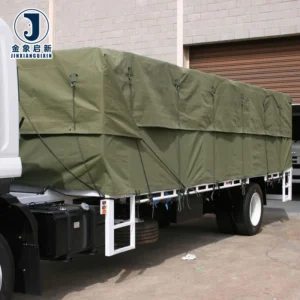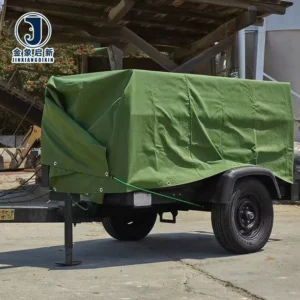

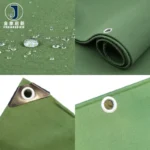


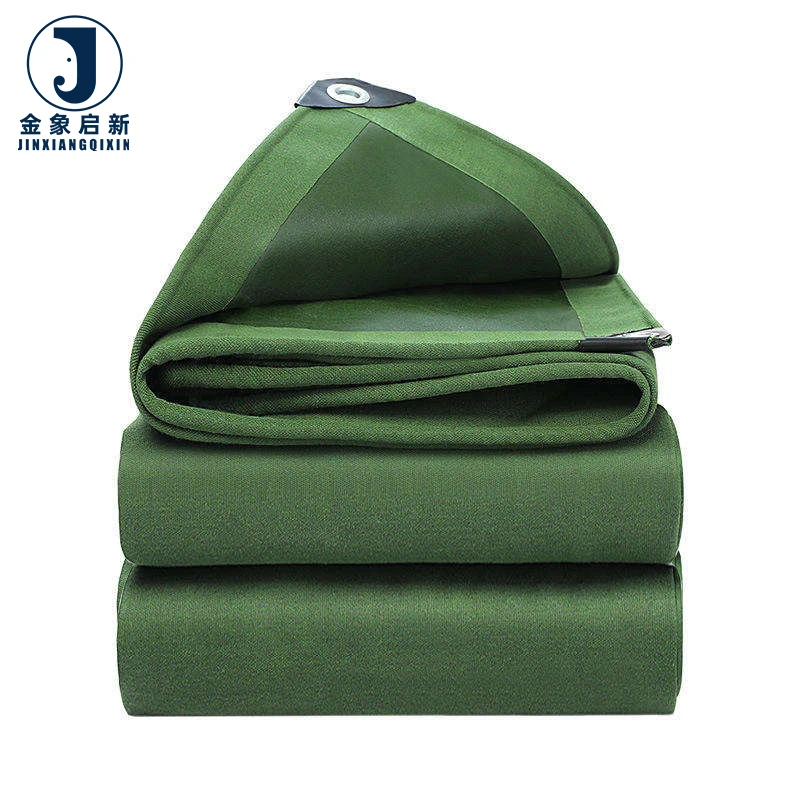
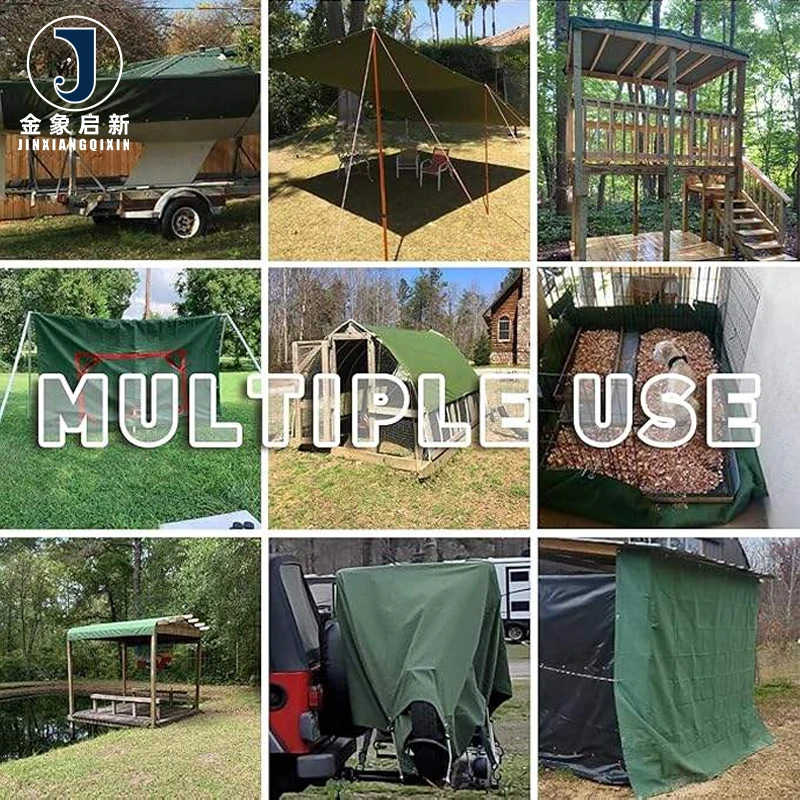

Controlled Coating Weight & Process — Nearly 30 years of focused coated fabric production gives us process control over GSM consistency, base fabric adhesion, and seam integrity across every roll we ship.
Technical Specifications
| Parameter | Value |
|---|---|
| Product Type | Canvas Tarpaulin |
| Base Fabric | Polyester cotton industrial textile, 8-12 strands of fine cotton yarn |
| Weight | 600gsm |
| Total Thickness | 0.5mm / 0.6mm / 0.7mm options |
| Roll Width | 2m |
| Roll Length | 100m |
| Color | Army Green Camouflage / Custom |
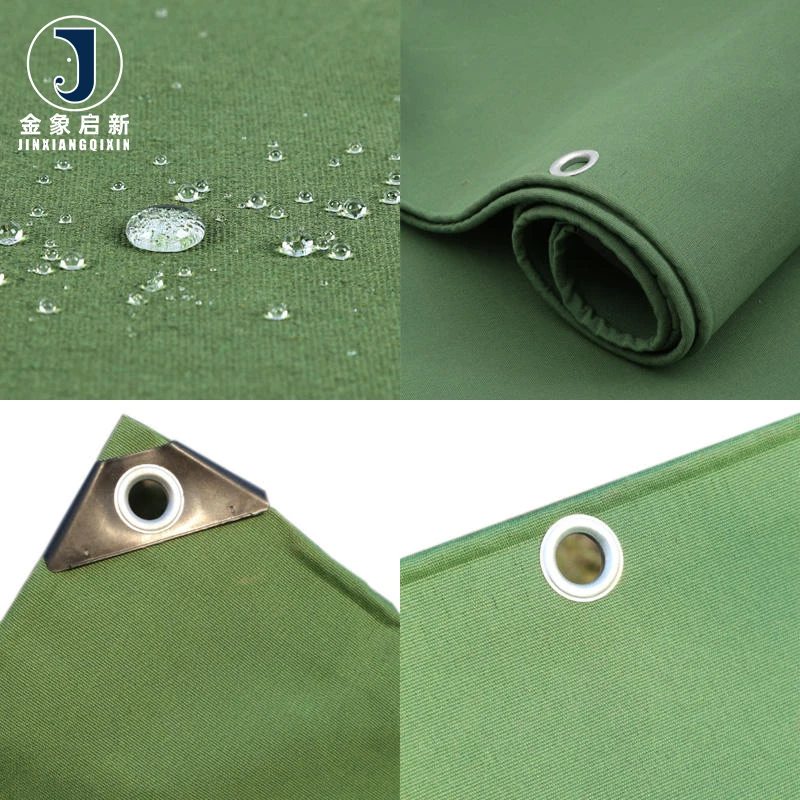
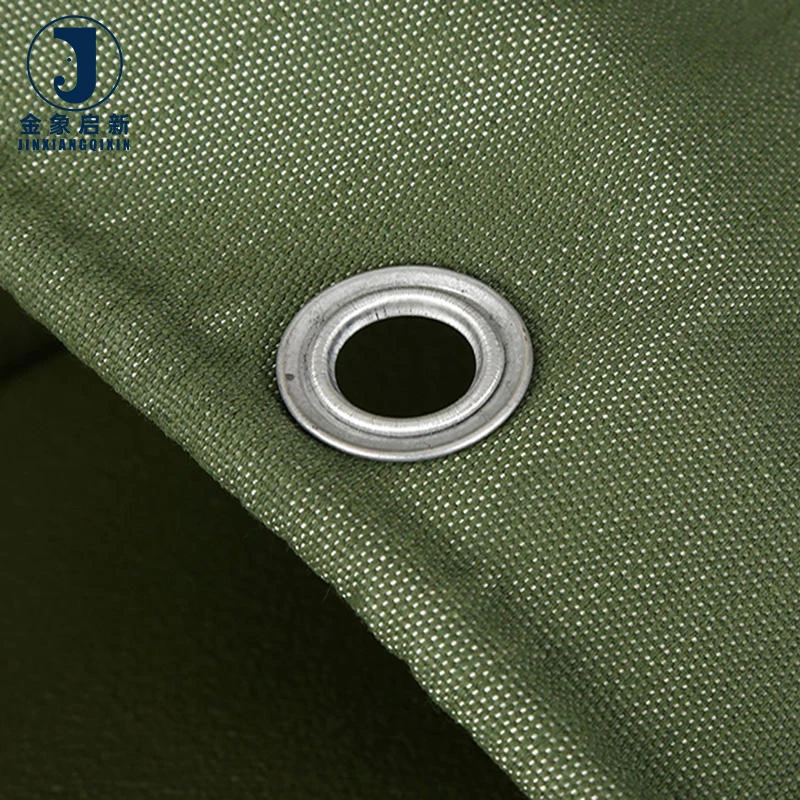
| Eyelet Configuration | Rust proof aluminum holes every 1 meter at corners and hem |
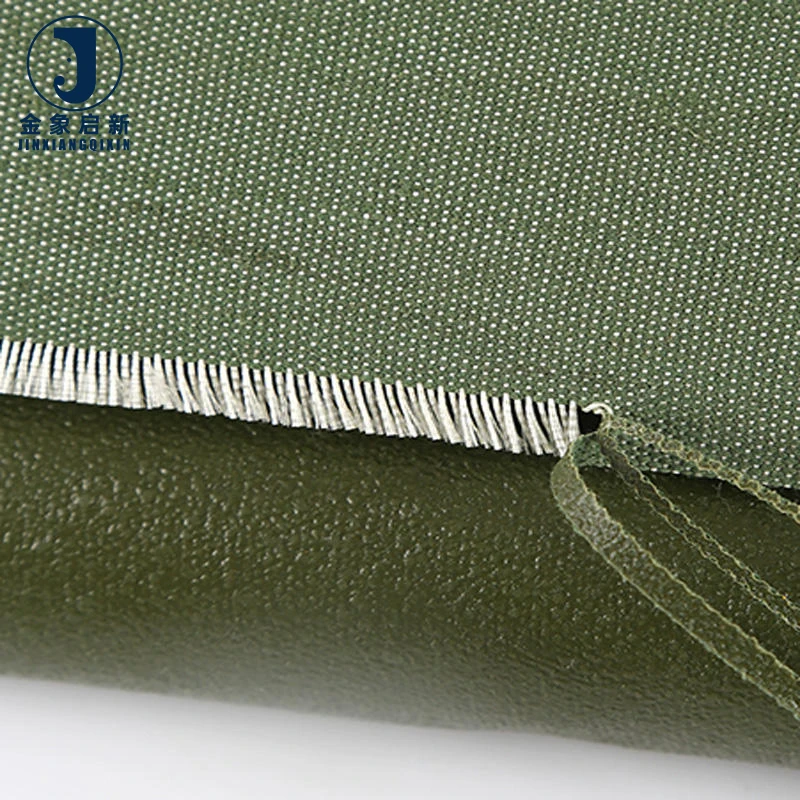
| Seam Construction | Welded and sewn with poly ropes |
| UV Treatment | UV resistant (test basis not stated — confirm test standard required for your project) |
| Anti-Mildew | Mold resistant (grade not stated — request test report) |
| Waterproofing | Waterproof (specific rating not stated — confirm hydrostatic head requirement) |
| Key Features | Wear-resistant, corrosion-resistant, tensile-resistant, high- and low-temperature resistant |
| Standards | CE, ISO |
Application Suitability
| Application | Exposure & Requirement |
|---|---|
| Mining ventilation outer wraps | Dust abrasion, chemical exposure, temporary enclosure flexing under negative pressure |
| Tunnelling temporary barriers | Continuous moisture, mechanical impact from equipment, rapid deployment and removal |
| Specialist membrane structure covers | Long-term UV exposure, wind uplift load, structural tension at fixing points |
| Aviation ground equipment covers | Fuel spill contact, outdoor weathering, frequent handling and repositioning |
| Industrial site partition curtains | Fire safety compliance requirements, high traffic contact, cleaning chemical resistance |
Why Certified Grade Matters More Than Generic "Fire Retardant" Claims on Your Site
A fire retardant claim without a grade is just a word — site inspectors need documentation that names the standard and the classification your canvas tarpaulin fire retardant grade achieved.
Ventilation duct and specialist structure contractors regularly face site audits where generic material claims fail to satisfy fire safety officers. The fabric arrives with a quotation stating "flame retardant" but no test report matching the local building code or mining regulation. Projects stall, rework begins, and the contractor absorbs the delay. I have seen entire temporary enclosure installations rejected at handover because the supplied material could not produce a certificate naming the required classification per DIN 4102 or NFPA 701 [NEED_CITE: fire classification standards for temporary building enclosures]. This canvas tarpaulin is available in flame retardant grades — confirm the specific grade your site authority requires before placing your order.
Base Fabric Density and Tensile Behaviour Under Ventilation Load
The 8-12 strand fine cotton yarn woven into a polyester cotton industrial textile creates a base fabric that distributes tension across multiple yarn intersections rather than concentrating stress at individual points. When this canvas tarpaulin is used as a protective outer wrap for ventilation ducting or as a temporary site enclosure, wind suction generates cyclic loading on the fixing points. The woven structure absorbs this cyclic load through yarn friction and elongation rather than brittle coating fracture.
Seam Construction and Failure Point Management
Welded and sewn seams reinforced with poly ropes address the most common failure mode in heavy-duty covers: the seam parting before the fabric body shows wear. On industrial air duct wraps and temporary mining enclosures, flexing at attachment points generates repeated peel forces on the joint. The combination of thermal welding and mechanical stitching with poly rope reinforcement provides both chemical bond and mechanical interlock [NEED_CITE: seam peel strength testing methods for coated industrial fabrics]. This dual approach keeps the joint intact through the service cycle.
How GSM and Thickness Together Define Real-World Performance
The 600gsm weight distributed across 0.5mm, 0.6mm, or 0.7mm thickness options tells you how the coating mass relates to the base fabric density. A thicker section at the same GSM means a lighter base fabric carrying more coating — suited to abrasion-heavy environments where surface wear is the primary degradation mechanism. A thinner section at the same GSM means a denser base fabric with a leaner coat — better where tensile load and flex fatigue dominate, such as membrane structure covers that experience wind-driven oscillation. Selecting the right thickness-to-weight ratio for your specific exposure condition prevents both over-engineering cost and under-performance in the field.
What Happens When Specification Verification Is Skipped at Order Stage
Contractors who accept material without requesting pre-shipment documentation frequently discover mismatches at site. Colour variation between rolls ordered for the same enclosure becomes visible once panels are installed side by side. GSM measured below the quoted value reduces both tensile capacity and abrasion life, accelerating replacement cycles. Flame retardant treatment claimed on the invoice but unsupported by a matching test report causes handover rejection and forces emergency resourcing [NEED_CITE: pre-shipment inspection practices for technical coated fabrics]. These failures are preventable when the purchase specification names the test standard, not just the property.
Why Procurement Teams Source This Material Here
Deep process control over coating weight and base fabric adhesion developed through decades of specialised coated fabric production ensures that the 600gsm stated on your quotation is the 600gsm measured on arrival. Three full production lines with 36 sets of professional equipment support bulk roll orders with consistent lead time performance, so your site programme does not slip waiting for material. A dedicated 10-person R&D team handles material selection, custom sizing, and sample development, producing physical samples within days for your evaluation before bulk commitment. Every production stage carries dedicated QA/QC with full inspection before any roll ships. ISO and CE certification accompanies the documentation package, giving your compliance team the paperwork foundation they need.
Documentation & Verification
- Material specification sheet stating 600gsm, base fabric denier, and coating type per roll
- Test report for UV and flame retardant grades where applicable, matching your site standard
- ISO and CE certificates included with shipment documentation package
- Pre-shipment inspection record confirming weight and visual check before dispatch
- Roll packing list with individual roll identification for traceability
- Certificate of origin and customs documentation support for cross-border delivery
Fabrication, Handling & Storage
- Weld at moderate temperature settings to avoid scorching the 0.5mm-0.7mm coating thickness range
- Space rust proof aluminum eyelets at the 1-meter intervals specified to distribute tie-down load
- Store rolls horizontally on pallets to prevent permanent creasing across the 2m roll width
- Allow cold-stored rolls to acclimatise before unrolling to prevent coating cracking at low temperature
- Use mild detergent for cleaning to preserve the waterproof and anti-mildew surface treatment
- Align poly rope reinforced seams with primary stress directions during panel layout
Before You Request a Quote
Provide your application type, whether ventilation duct wrap, temporary enclosure, or membrane structure cover, along with the specific exposure conditions the material will face. State the fire safety or building code classification your site authority requires so we can confirm whether the available flame retardant grade matches. Specify whether you need roll stock at 2m width by 100m length or finished panels cut to your dimensions with custom eyelet spacing.
Frequently Asked Questions
Q: How is the 600gsm weight verified and what documentation ships with the order?
A: Every roll undergoes weight verification against the stated 600gsm specification before dispatch. Your shipment includes a material specification sheet confirming GSM, base fabric composition, and coating type, along with a pre-shipment inspection record. For orders requiring flame retardant or UV certification, test reports naming the applicable standard accompany the documentation package.
Q: Can this canvas be supplied with a certified flame retardant grade for site compliance?
A: This canvas tarpaulin is available in flame retardant grades on request. Provide your site authority’s required classification — whether DIN 4102, NFPA 701, or another standard — so we can confirm availability and include the matching test report with your shipment documentation. Sample testing is available before bulk commitment.
Q: What UV test basis supports the outdoor durability claim?
A: UV resistant treatment is applied during production, but the specific test basis is not stated in the standard specification. Request the test standard your project requires — such as ISO 4892 or ASTM G154 — and we will confirm whether the treatment grade meets that protocol and provide supporting documentation with your order.
Q: What custom widths, lengths, and eyelet configurations are available for specialist projects?
A: Standard roll stock ships at 2m width by 100m length. Custom cut sizes with rust proof aluminum eyelets placed at your specified intervals are available through our R&D team. Provide your panel dimensions and fixing point layout, and we will develop a sample within days for your approval before production.