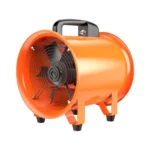
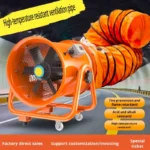





Proven Process Control — Three full production lines and a dedicated 10-person R&D team ensure that every portable axial flow exhaust fan is matched to its duct system with verified airflow and pressure data before it leaves the factory.
Technical Specifications
| Parameter | Value |
|---|---|
| Product Type | Axial Flow Fan / Electric Blower |
| Size Options | 200mm, 250mm, 300mm, 350mm, 400mm, 450mm, 550mm, 650mm, 750mm, 850mm, 900mm |
| Power Range | 250W – 5500W (varies by size) |
| Air Volume Range | 1300 – 28000 m³/h (varies by size) |
| Total Pressure Range | 140 – 320 Pa (varies by size) |
| Voltage | 220V / 380V |
| Noise Level | 57 – 88 dB(A) (varies by size) |
| Bearing Type | Ball Bearing |
| Housing Material | Cast Iron |
| Customization | ODM Available, Custom Color, Custom Brand Printing |
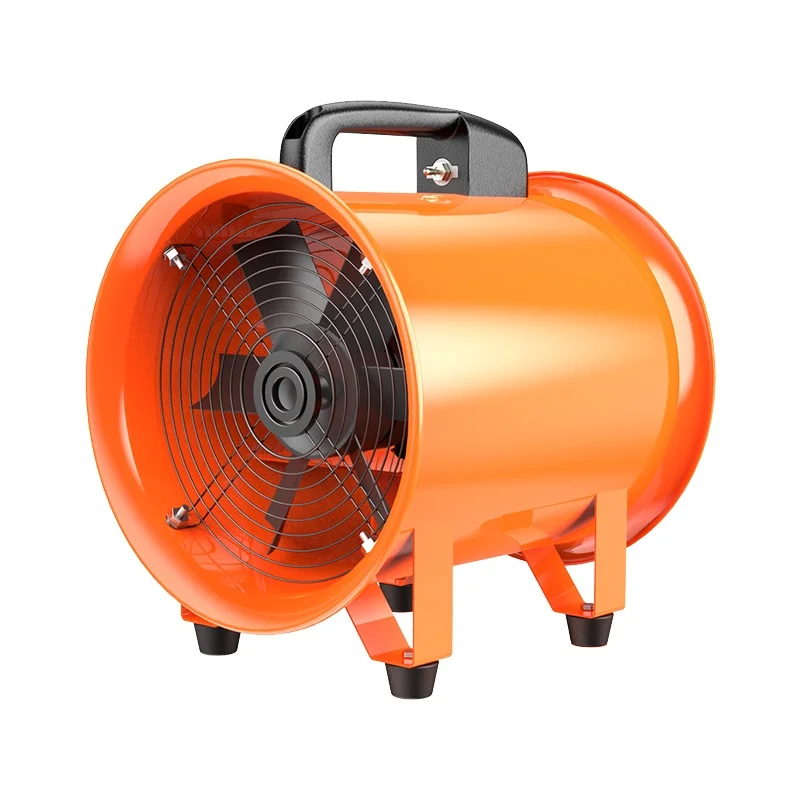
| Key Features | Compact form factor, impact-resistant housing, continuous-duty motor |
Application Suitability
| Application | Exposure & Requirement |
|---|---|
| Mining tunnel and shaft ventilation | Continuous high dust, rock debris impact, sustained high-pressure airflow over long duct runs |
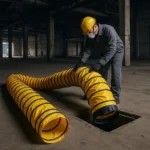
| Confined space air exchange on construction sites | Welding fumes, solvent vapours, restricted access, need for rapid air changes |
| Industrial workshop fume extraction | Particulate-laden airstream, oily residue, continuous duty during shift operations |
| Emergency ventilation for maintenance crews | Unplanned deployment, variable power supply, immediate high-volume airflow requirement |
Why Ventilation Duct Systems Fail When the Fan Is Undersized
Selecting a portable axial flow exhaust fan based on air volume alone, while ignoring total pressure and duct resistance, is the most common cause of inadequate airflow at the working face.
The fan must overcome the full static pressure of the duct run, including every bend and coupling.
Contractors frequently specify a fan that delivers the required cubic metres per hour at free air, only to find that the airflow at the end of a 100-metre duct is a fraction of the quoted figure. The duct fabric itself creates friction, and each coupling or bend adds resistance that compounds along the run. When the fan’s total pressure rating is too low for the system resistance, the air simply does not reach the workers who need it. [NEED_CITE: fan and duct system resistance calculation methods for industrial ventilation]
Matching Fan Pressure to Duct Length and Routing
The total pressure rating of a portable axial flow exhaust fan determines how far and through how many bends it can push air effectively. A fan rated at 320 Pa can sustain airflow through a substantially longer duct run than one rated at 140 Pa, assuming comparable air volume. For tunnel ventilation where the duct extends hundreds of metres with multiple directional changes, the higher-pressure models are typically required. Undersizing at this stage means adding booster fans mid-run, which introduces additional failure points and maintenance burden.
Duct-to-Fan Interface and Sealing Integrity
The connection between the fan outlet and the flexible ventilation duct is where air loss most commonly occurs. A poorly matched flange diameter or an inadequate clamping method allows pressurised air to escape before it enters the duct. The ODM capability on this portable axial flow exhaust fan range allows the flange interface to be configured to match the specific duct collar system in use, ensuring a sealed connection that maintains system pressure throughout the run. [NEED_CITE: air leakage losses at duct-to-fan connections in temporary ventilation systems]
Understanding the Air Volume and Pressure Relationship Across Sizes
The eleven size options in this range, from 200mm to 900mm, each deliver a different balance of air volume and total pressure. Smaller diameters, such as the 200mm and 250mm units, are suited to short duct runs in tight access areas where high velocity is needed to clear fumes from a localised zone. Larger diameters, such as the 750mm and 900mm units, move substantially greater air volumes but at lower velocities, making them appropriate for main-line ventilation in tunnel headings or large confined spaces. The ball bearing construction across all sizes supports continuous operation under the sustained loads typical of mining and construction shifts. The cast iron housing provides impact resistance against the rock falls, dropped tools, and general site abuse that would deform lighter enclosures. Selecting the correct size requires calculating the total system resistance of the duct layout and matching it to the fan curve for the chosen diameter.
The Hidden Cost of Specifying the Wrong Fan for the Duct System
When a fan with insufficient total pressure is paired with a long or complex duct run, the immediate consequence is inadequate airflow at the face. But the secondary effects are more costly. Workers in poorly ventilated headings experience fatigue and reduced concentration, increasing the risk of incidents. Diesel particulate and blasting fumes accumulate beyond safe exposure limits, forcing work stoppages while air quality is restored. The fan motor itself, operating continuously against a resistance it was not designed to handle, runs hotter and draws more current, accelerating bearing wear and shortening service life. [NEED_CITE: occupational exposure limits for diesel particulate and blasting fumes in underground workings]
Why Procurement Teams Source This Ventilation Fan Range Here
The 10-person R&D team reviews the duct layout and system resistance data you provide, recommending the fan size and pressure rating that matches the actual site conditions rather than a generic catalogue selection.
Each portable axial flow exhaust fan undergoes performance verification before dispatch, with air volume and pressure tested against the stated specifications for that size and power rating.
ODM configuration covers flange dimensions, mounting arrangements, and voltage requirements, so the fan arrives ready to connect to your existing duct system without field modification.
The cast iron housing and ball bearing assembly are specified for the sustained, high-load operation typical of mining and tunnelling shifts, not intermittent light-duty use.
Sample units can be developed and dispatched within days for site trials, allowing you to confirm fitment and performance before committing to a full order.
Documentation & Verification
- Air volume and total pressure test record for each fan size shipped
- Material certificate for cast iron housing confirming grade and composition
- Electrical compliance documentation matching the specified 220V or 380V configuration
- Bearing specification sheet with load rating and service interval data
- ODM configuration drawing showing customised flange and mounting dimensions
Fabrication, Handling & Storage
- Inspect the cast iron housing for transit damage before connecting to duct collars
- Verify voltage at the supply point matches the fan motor plate before energising
- Store spare units upright on pallets to prevent bearing load from housing weight
- Clean fan blades and housing interior with compressed air at scheduled intervals
- Secure the duct-to-fan clamping band to the specified torque to prevent air leakage
- Check ball bearing grease condition during quarterly maintenance shutdowns
What to Include in Your Ventilation Fan Enquiry
To receive an accurate specification recommendation, provide the total duct run length, the number and angle of bends, the duct diameter and fabric type, and the required air changes per hour for the space being ventilated. Specify the site voltage availability and whether single-phase or three-phase supply is standard. Indicate whether the fan will be stationary or moved between locations, as this affects the mounting and handling configuration.
Frequently Asked Questions
Q: How do I determine the total pressure my ventilation system requires?
A: Calculate the friction loss per metre of your duct fabric, add the resistance of each bend and coupling, and sum these for the total run length. The portable axial flow exhaust fan you select must have a total pressure rating that exceeds this calculated system resistance, with a margin for duct sag and minor leaks.
Q: Can this fan range connect directly to flexible ventilation ducting?
A: Yes. The ODM capability allows the outlet flange to be configured to match the collar system on your flexible duct. This ensures a sealed connection that maintains system pressure and prevents air loss at the interface, which is critical for long duct runs.
Q: What is the maintenance schedule for the ball bearing assembly?
A: Ball bearings in continuous-duty ventilation fans should be inspected for grease condition and axial play at intervals determined by operating hours and dust exposure. The cast iron housing protects the bearing from direct contamination, but high-dust mining environments require more frequent checks than clean-air workshop applications.
Q: Is 220V or 380V better for continuous operation on a mining site?
A: Three-phase 380V supply is generally preferred for the larger fan sizes, as it delivers power more efficiently and places less thermal stress on the motor windings during sustained operation. Smaller sizes in the range operate effectively on single-phase 220V for localised ventilation tasks.
Q: What information do I need to provide for a site-specific fan recommendation?
A: Supply the duct run length and layout including bends, the duct diameter and fabric type, the volume of the space being ventilated, and the target air changes per hour. With this data, the R&D team can calculate system resistance and recommend the correct fan size and pressure rating.