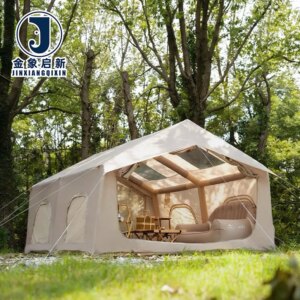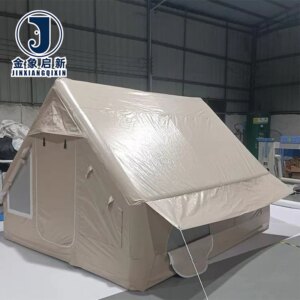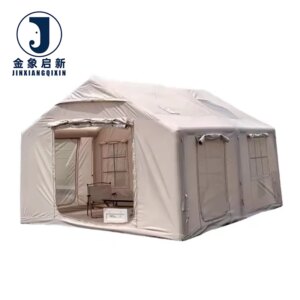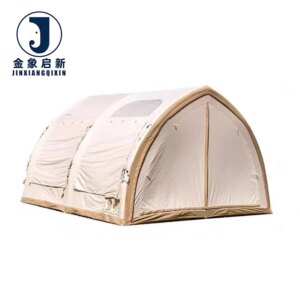




Specialist Membrane Fabric — nearly 30 years of coated fabric production under ISO and CE certified processes, with documented QA traceability for every roll shipped to aviation, mining and temporary structure contractors.
Technical Specifications
| Parameter | Value |
|---|---|
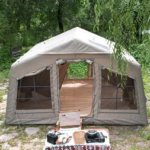
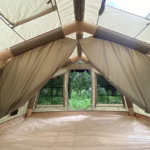
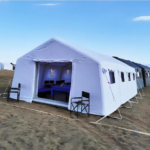
| Product Type | Inflatable tent |
| Core Material | Waterproof PVC Fabric |
| Waterproof Rating | Waterproof (grade not stated in source) |
| UV Treatment | UV-resistant (test basis not stated in source) |
| Flame Retardant Grade | Fire-retardant (grade not stated in source) |
| Anti-Static | Anti-static (surface resistance or standard not stated in source) |
| Tear Strength | Tear-resistant (test standard not stated in source) |
| Deployment Method | Quick automatic opening with pump |
| Seasonal Rating | Four-season design |
| Customization | OEM & ODM (sample customization, pattern printing, material selection, product design) |
| Standards | ISO 9001, ISO 14001, ISO 45001, CE |
Application Suitability
| Application | Exposure & Requirement |
|---|---|
| Mining and tunnelling temporary shelters | Constant inflation cycling, rock dust abrasion, strict fire-retardant compliance on site |
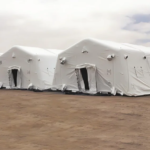
| Aviation ground support enclosures | Fuel vapour proximity, fire-retardant certification for airside structures, rapid deployment demands |
| Commercial glamping and event structures | UV exposure across seasons, guest-facing aesthetics, tear resistance under repeated inflation |
| Construction site welfare facilities | High foot traffic contact, equipment impact, weather exposure on active sites |
| Equipment storage and staff accommodation | Extended static inflation, thermal variation, puncture risk from stored materials |
What Happens When the Fire Certificate Is Missing from the Shipment
Inflatable Tent Fabric fire retardant certified only matters when the test report travels with the material, not when it sits in a supplier’s filing cabinet.
Contractors on mining leases, aviation aprons and large commercial event sites are routinely asked by site safety officers to produce documentation proving the inflatable structure fabric meets the fire-retardant and anti-static standards specified in the project brief. When that paperwork does not arrive with the roll, installation halts, inspectors flag non-compliance, and the contractor absorbs the cost of downtime and resubmission [NEED_CITE: fire safety documentation requirements for temporary membrane structures on regulated sites]. Sourcing Inflatable Tent Fabric fire retardant certified material means the test report, material specification sheet and production traceability record are confirmed before dispatch, not chased after delivery.
Coating Formulation and Compliance Alignment
The PVC coating applied to this inflatable tent fabric is formulated to carry fire-retardant and anti-static additives through the full coating weight, not as a surface treatment that wears away after the first deployment cycle. Contractors specifying membrane structures for aviation or mining environments need confirmation of the exact fire-retardant grade their local regulations require — available grades and the corresponding test standards can be confirmed at the inquiry stage. Anti-static treatment is integrated for environments where electrostatic discharge control is mandated, with the surface resistance testing basis confirmed against the project specification.
Four-Season Fabric Behaviour Under Thermal Cycling
Inflatable structures deployed across seasonal temperature variation subject the PVC fabric to repeated expansion and contraction cycles that test both the coating adhesion and the base fabric tear resistance [NEED_CITE: thermal cycling effects on PVC coated fabric tensile and tear properties per ISO 1421]. This four-season rated inflatable tent fabric is engineered to maintain tear resistance across these deployment cycles, reducing the risk of seam and flex-point failures that typically appear after the first winter-to-summer transition. The combination of tear-resistant construction and UV-resistant treatment supports extended outdoor exposure without the early-stage degradation that forces premature replacement.
Reading the Specification Sheet Beyond the Headline Numbers
The relationship between base fabric denier, weave density and coating weight determines how the material actually performs under inflation pressure and external load. A higher GSM reading alone does not guarantee superior tear resistance if the base fabric weave is loosely constructed — both elements must be evaluated together when specifying inflatable tent fabric for load-bearing membrane structures. The coating method influences how well the material accepts welded seams, which is critical because seam integrity at the flex points where the structure curves under wind load often determines service life more than the fabric body itself. Fire-retardant grade selection should be matched to the deployment jurisdiction: different markets reference different classification systems, and confirming the required standard avoids rejection at the inspection stage.
The Cost of Specifying on Price Alone
When membrane structure fabric arrives without verifiable fire-retardant or anti-static documentation, the contractor faces more than a paperwork problem. Site safety officers on regulated projects have the authority to halt installation until compliance is demonstrated, and the delay cost on a mining or aviation project compounds quickly across crew standby, equipment rental and programme slippage [NEED_CITE: financial impact of compliance-driven work stoppages on temporary structure installations]. Colour variation between rolls in the same order becomes a visible problem once multiple inflatable units are installed side by side at a commercial glamping site, forcing selective replacement or full re-dye. Welded seams that fail before the fabric body does typically trace back to coating formulations that were not designed for consistent heat-weld performance at the inflation stress points.
Why Contractors Source This Fabric Here
Three full production lines and dedicated equipment sets give this facility the capacity to run custom inflatable tent fabric orders without the extended lead times that single-line operations impose on specialist membrane projects. A 10-person R&D team handles material selection, pattern printing, valve configuration design and sample development in-house, which shortens the path from initial specification to approved production sample. QA and QC checkpoints at every production stage ensure that the fire-retardant and anti-static properties stated on the material specification sheet are verifiable in the finished roll. The material traceability system tracks component origins for any production batch, supporting the documentation chain that regulated sites require. Pre-shipment inspection covers every roll before it leaves the facility, not a statistical sample.
Documentation & Verification
- Material specification sheet stating coating weight, base fabric construction, and colour reference for every roll
- Independent third-party test reports for fire-retardant and anti-static performance supplied with shipment
- Pre-shipment inspection record covering dimensional accuracy and surface quality
- Certificate of origin and customs documentation for cross-border shipment
- Production batch traceability record linking finished rolls to raw material origins
- ISO 9001, ISO 14001, ISO 45001 and CE certificates available for compliance submission
Fabrication, Handling & Storage
- Heat-weld parameters should be matched to the specific PVC coating formulation — request the recommended temperature and dwell time sheet before fabrication
- Store rolls horizontally on racking to prevent permanent creasing in the PVC coating that transfers to the inflated surface
- Use compatible PVC adhesive for field repairs, confirming chemical compatibility with the fire-retardant additive package
- Avoid dragging cut panels across abrasive surfaces during assembly to protect the coated face
- Allow cold-stored rolls to reach ambient temperature before unrolling to prevent coating micro-cracking
- Plan panel cutting layout to minimise welded seams at high-stress inflation flex points
Starting Your Specification Conversation
Provide the deployment environment and the fire-retardant or anti-static standards your site safety team requires, along with the intended inflation dimensions and expected deployment frequency. If your project involves multiple units installed together, specify whether batch-to-batch colour consistency is a contractual requirement. Confirm whether you need raw roll stock for your own fabrication facility or finished panels cut and welded to your pattern, and whether pattern printing or branding is part of the design brief.
Frequently Asked Questions
Q: What fire-retardant certifications can be provided with the inflatable tent fabric?
A: The fabric is available in fire-retardant grades with independent third-party laboratory test reports. The specific grade and test standard applicable to your project market can be confirmed during the inquiry stage. Documentation ships with the material so that site compliance submission is straightforward and does not require follow-up requests after delivery.
Q: How is anti-static performance verified for specialist environments?
A: Anti-static treatment is integrated into the PVC coating formulation for environments requiring electrostatic discharge control. The surface resistance testing basis and the standard against which the fabric is measured are confirmed with the test report provided at shipment. Specify your site requirements at inquiry to ensure the correct treatment level is applied.
Q: Can custom dimensions, valve configurations and branding be accommodated?
A: OEM and ODM services cover custom dimensions, material thickness selection, valve configuration design and pattern printing. A pre-production sample is developed for approval before the full production run begins. Minimum order requirements and lead times for custom specifications are confirmed at the quotation stage based on the complexity of the design brief.
Q: How is batch-to-batch colour consistency maintained across multiple units?
A: Every production run passes through QA checkpoints that verify colour consistency against the approved reference. Rolls within the same order are inspected side by side before dispatch to catch any visible variation. For projects where multiple inflatable units are installed adjacent to each other, batch consistency is documented in the pre-shipment inspection record.
Q: What documentation ships with each order for site compliance purposes?
A: Each shipment includes the material specification sheet, applicable test reports for fire-retardant and anti-static performance, a pre-shipment inspection record, certificate of origin and batch traceability documentation. ISO and CE certificates are available to support contractor compliance submissions on regulated sites.