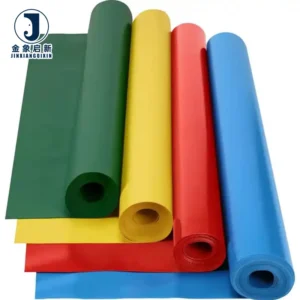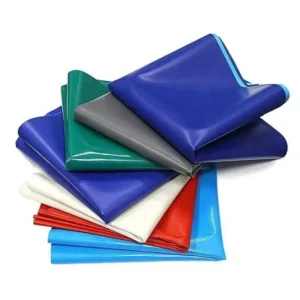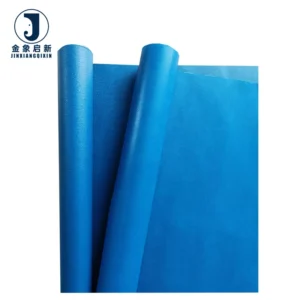

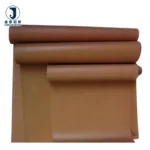
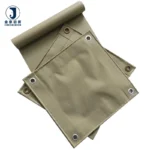
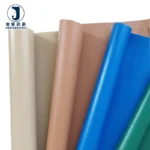
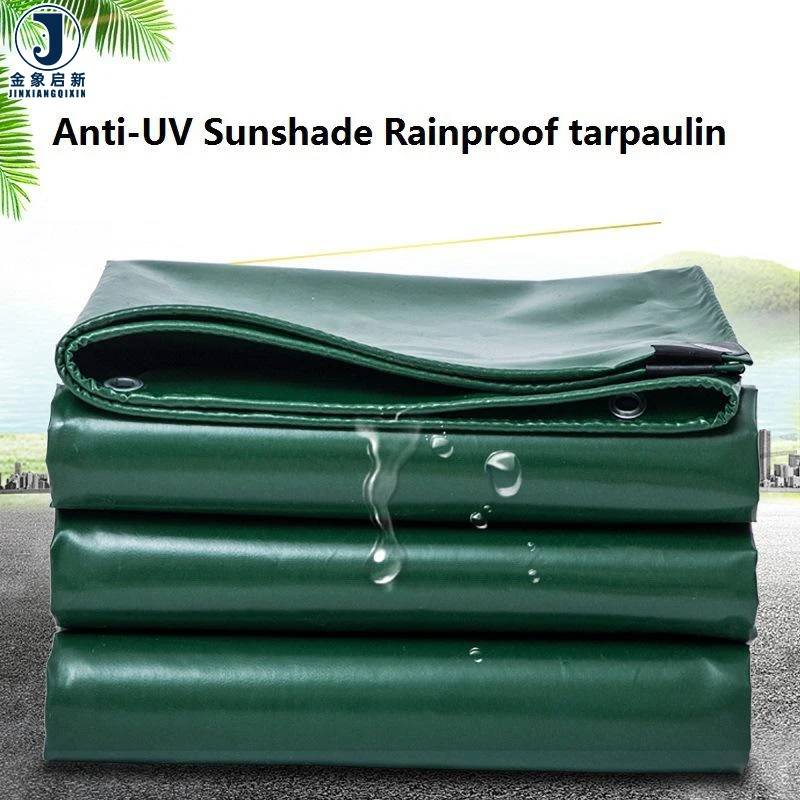
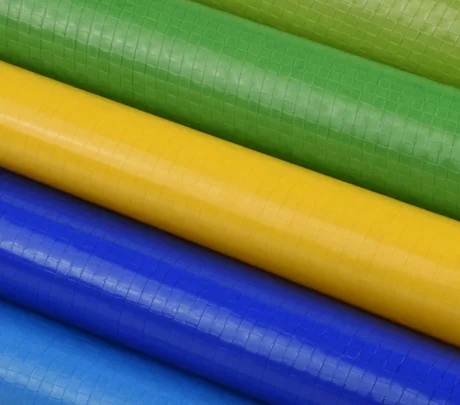
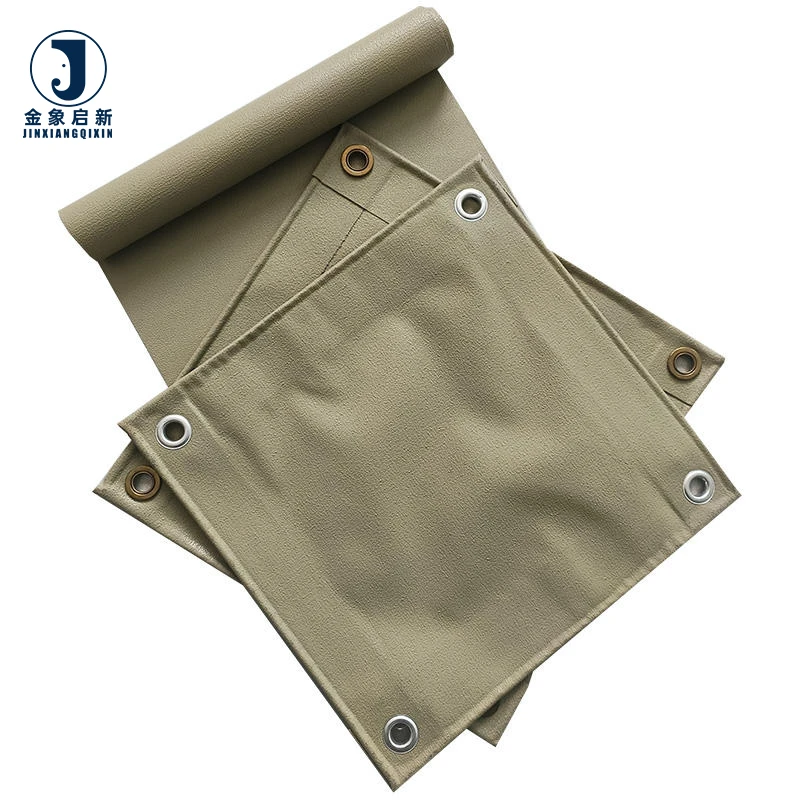
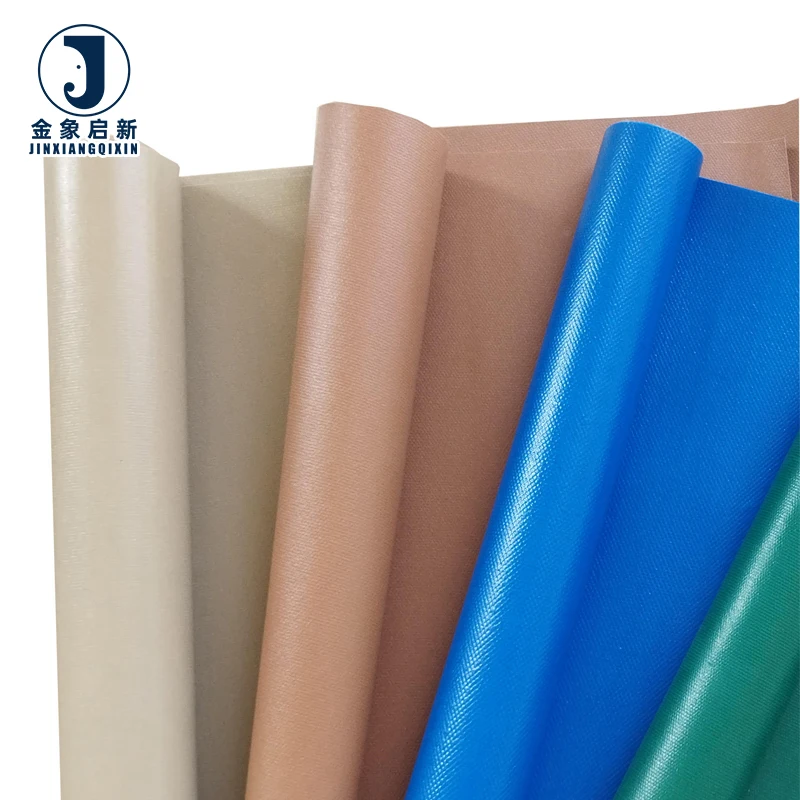
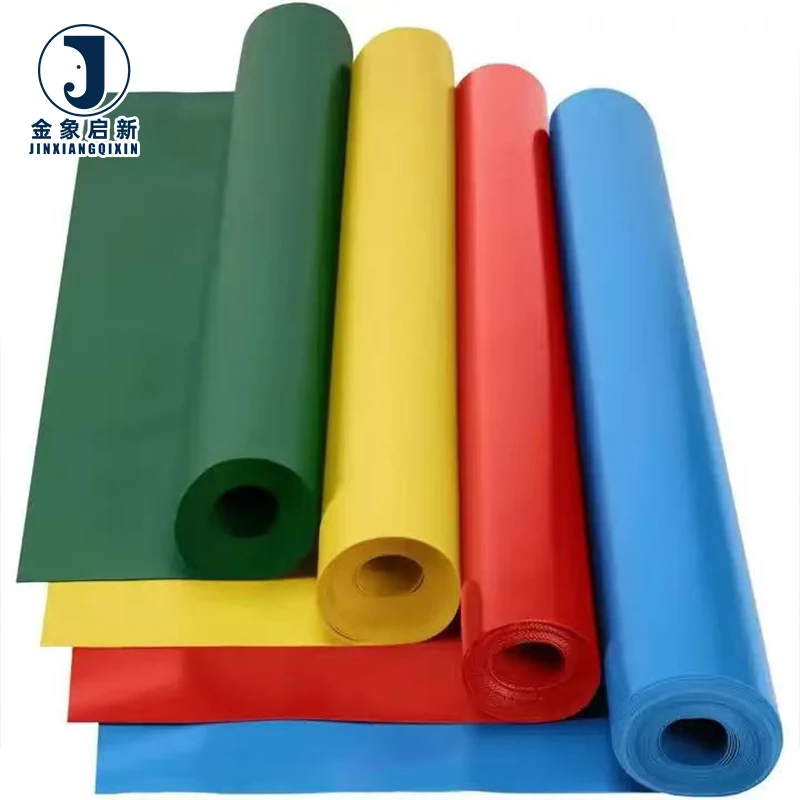
Hot-Melt Coating Expertise — three full production lines controlling PVC adhesion to high-tenacity polyester mesh, ensuring welded seams hold under the sustained internal pressure of industrial ventilation ducts.
Technical Specifications
| Parameter | Value |
|---|---|
| Product Type | PVC Tarpaulin Roll |
| Material | PVC + High-strength polyester mesh fabric |
| Weight Options | 350gsm / 420gsm / 500gsm / 550gsm / 600gsm / 750gsm |
| Total Thickness | 0.32mm / 0.35mm / 0.4mm / 0.45mm / 0.5mm / 0.65mm |
| Coating Material | PVC |
| Coating Method | Laminated technology & Hot-melt Coating technology |
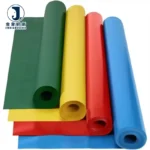
| Color Options | Blue / Red / Yellow / Light blue / Grey (Customized) |
| Roll Size | 2m width × 75m length / 2.1m width × 50m length |
| Flame Retardant | Available in flame retardant grades — confirm the grade required for your market |
| Anti-Static | Available with anti-static treatment — confirm surface resistance standard for your application |
| UV Treatment | Available with UV stabilisation — confirm test basis for your exposure conditions |
| Anti-Mildew | Yes |
| Cold Crack Resistance | Yes |
| Waterproof | Yes |
| Special Treatments | Flame retardant, anti-static, anti-cold, anti-mildew, 3P |
| Service Life | 3–7 years under normal circumstances |
| Standards | ISO, CE |
Application Suitability
| Application | Exposure & Requirement |
|---|---|
| Mining and tunnelling ventilation ducts | Continuous airflow pressure, flex at section joints, anti-static compliance for underground environments |
| Aviation ground support air ducts | Flame retardant compliance, repeated inflation-deflation cycles, tarmac UV exposure |
| Inflatable and membrane structures | Tensile load under inflation, weld seam integrity at curved panels, weather exposure |
| Temporary industrial enclosures | Wind load, abrasion at tie-down points, rapid deployment and tear-down |
| Plant and refinery maintenance covers | Chemical splash contact, flame retardant requirements in processing zones |
What "Certified" Ventilation Fabric Means Without Test Reports Behind the Claim
Fire-retardant and anti-static compliance must be documented with stated grades — a datasheet claim without a test reference is a liability on site.
When a ventilation duct arrives on a mining or tunnelling project without the fire-retardant or anti-static certification the site safety officer requires, the entire installation halts. Contractors we supply have faced shutdowns because the roll label said "FR" but no test report matched the grade the local regulator demanded. PVC Coated Tarpaulin Roll for ventilation and technical fabric applications must carry documentation that names the standard, the test method, and the result — not a generic statement. The cost of a compliance gap is never just the fabric; it is the idle crew, the delayed milestone, and the audit finding. [NEED_CITE: mining ventilation duct fire safety standards and anti-static requirements]
Hot-Melt Coating and Weld Integrity for Duct Fabrication
The hot-melt coating technology used on these PVC coated tarpaulin rolls creates a bond between the PVC layer and the polyester mesh that withstands the thermal stress of heat-welded seams. In ventilation duct fabrication, the weld line is the most stressed point — internal air pressure pushes outward while the duct flexes at every section joint. A coating that delaminates under welding heat produces a seam that fails before the fabric body does. Hot-melt coating penetrates the mesh structure rather than sitting on the surface, giving the welder a consistent melt zone across the join.
Anti-Static Treatment for Underground Compliance
Underground mining and tunnelling environments demand ventilation fabric that dissipates static charge to prevent ignition in combustible atmospheres. These rolls are available with anti-static treatment — buyers must confirm the surface resistance value their local regulation requires, as standards vary between jurisdictions. We provide the treatment option and can supply the test data specifying the measured resistance range. Without documented anti-static properties, duct sections installed below ground face rejection at the next safety inspection. [NEED_CITE: anti-static surface resistance requirements for underground ventilation materials]
Reading GSM, Base Fabric, and Coating Weight Together
Weight in GSM alone does not define how a PVC coated tarpaulin roll performs under duct operating pressure. The base polyester mesh — its yarn denier and weave density — determines the tensile and tear baseline, while the PVC coating weight adds puncture resistance and weld-seal capability. A 500gsm roll built on a dense, high-denier mesh will resist tear propagation far better than a 500gsm roll where most of the weight sits in a thick coating over a light scrim. The 0.32mm to 0.65mm thickness range across the weight options reflects different balances between base fabric and coating mass. Hot-melt coating locks these layers together so that the composite behaves as one structure when a weld is applied, rather than separating under thermal load. The coating method directly influences peel strength — laminated technology delivers a cost-effective bond for general-purpose ducts, while hot-melt coating provides the adhesion demanded by high-pressure ventilation sections.
The Hidden Cost of Specifying Ventilation Fabric on Price Alone
When procurement selects a PVC coated tarpaulin roll based on the lowest per-kilogram cost, the GSM on the invoice rarely matches what arrives on site. Lighter fabric than specified means the duct wall cannot sustain design pressure — sections balloon and collapse at bends. Weld seams on underweight material melt through rather than fuse, creating pinhole leaks that worsen with every flex cycle. Colour inconsistency between rolls in the same shipment becomes visible once the duct is installed in sections, triggering client complaints on high-profile projects. A flame-retardant claim without a matching test report surfaces only when the safety auditor asks for paperwork, and by then the duct is already hung. [NEED_CITE: common causes of ventilation duct fabric failure in mining installations]
Why Fabrication-Grade Roll Stock Matters Here
Our 10-person R&D team handles material selection specifically for ventilation duct and technical fabric applications, matching GSM grade to duct diameter and operating pressure. Three full production lines and 36 sets of equipment mean that custom-width orders for large-diameter ducts do not face extended minimums or padded lead times. Dedicated QA/QC runs at every production stage — coating weight is checked against the specification sheet before the roll leaves the line, not just at final packing. Sample rolls for new duct designs are developed within days, allowing fabricators to test weld parameters before committing to bulk. ISO and CE certification underpins the documentation package that accompanies every shipment, giving site safety officers the paperwork they need on day one.
Documentation & Verification
- Material specification sheet confirming GSM, base fabric denier, coating weight, and colour reference for each roll
- Test report stating the fire-retardant grade where applicable, matched to the batch supplied
- Anti-static surface resistance measurement documented per roll for underground ventilation compliance
- Pre-shipment inspection record verifying roll-to-roll colour consistency and dimensional accuracy
- ISO and CE certificates included in the dispatch documentation package
- Certificate of origin and customs support documents for international shipment clearance
Fabrication, Handling & Storage
- Set hot-melt weld temperature based on the specific GSM and coating method — 550gsm and 750gsm rolls need higher dwell times than 350gsm grades
- Store rolls upright on pallets in a dry, shaded area to prevent flat-spot deformation on the outer wrap layers
- Allow cold-stored rolls to reach ambient temperature before unrolling to prevent coating crack at low flex points
- Use compatible PVC welding tape matched to the coating formulation for field repair of duct section joins
- Plan cut patterns around the 2m or 2.1m roll width to minimise longitudinal weld seams on duct sections
- Clean welded seams with a PVC-compatible solvent to remove plasticiser residue before pressure testing
Before You Enquire — What We Need to Specify Correctly
Provide the duct diameter, operating pressure, and whether the installation is above or below ground so we can recommend the correct GSM and treatment package. Confirm the fire-retardant grade and anti-static standard your local regulator or site safety plan requires. Let us know your annual roll consumption and whether you need stock widths or custom slit sizes for your welding table.
Frequently Asked Questions
Q: What fire-retardant grades are available for mining and aviation ventilation ducts?
A: Flame-retardant treatment is available in multiple grades. The specific grade you need depends on your jurisdiction — mining regulations typically differ from aviation ground-support requirements. Share your compliance standard with us and we will confirm which grade applies, supply the matching test report, and note the classification on your material specification sheet.
Q: Can you provide an anti-static test report for underground ventilation compliance?
A: Anti-static treatment is available as a special option. We supply measured surface resistance data on request. Underground mining standards vary by country and operator, so confirm your required resistance range before production. The test result is then documented per roll and included in the dispatch package for your site safety audit.
Q: How do I verify GSM on arrival matches the specification sheet?
A: Every roll ships with a pre-shipment inspection record stating the measured weight. On receipt, cut a measured sample from the roll edge and weigh it on a calibrated scale. Compare the result against the GSM stated on your material specification sheet. We support any discrepancy investigation with production-stage QA records.
Q: What are the heat welding parameters for PVC coated duct fabrication?
A: Welding temperature, pressure, and dwell time depend on the GSM grade and coating method — hot-melt coated rolls behave differently from laminated grades under the same weld head settings. Request our fabrication guide for your specific weight option. We recommend running test welds on sample material before setting production parameters on bulk stock.
Q: How do I choose roll width and length for my duct fabrication setup?
A: Rolls are supplied at 2m × 75m or 2.1m × 50m as standard. Match the roll width to your duct circumference to minimise longitudinal seams — a larger-diameter duct may require custom slit widths. Confirm your typical section length so we can advise whether standard roll length covers your run without mid-section joins.