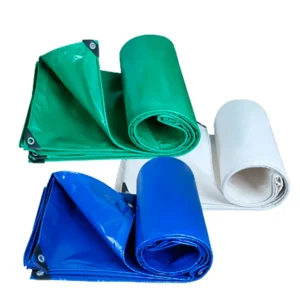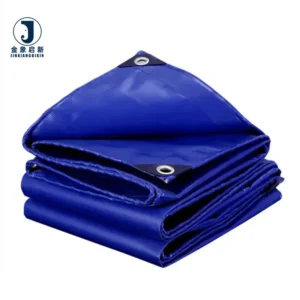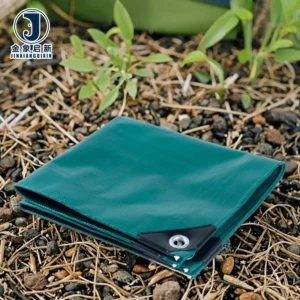
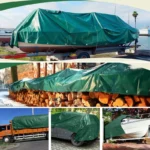
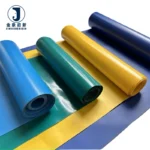
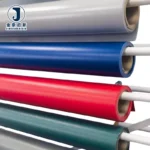
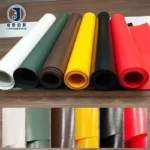
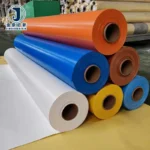
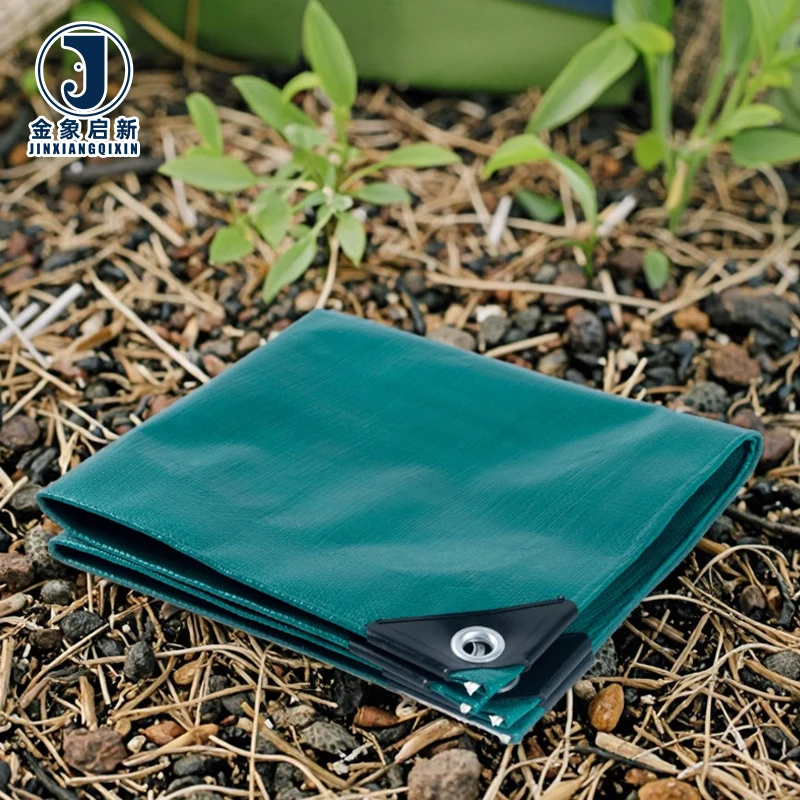
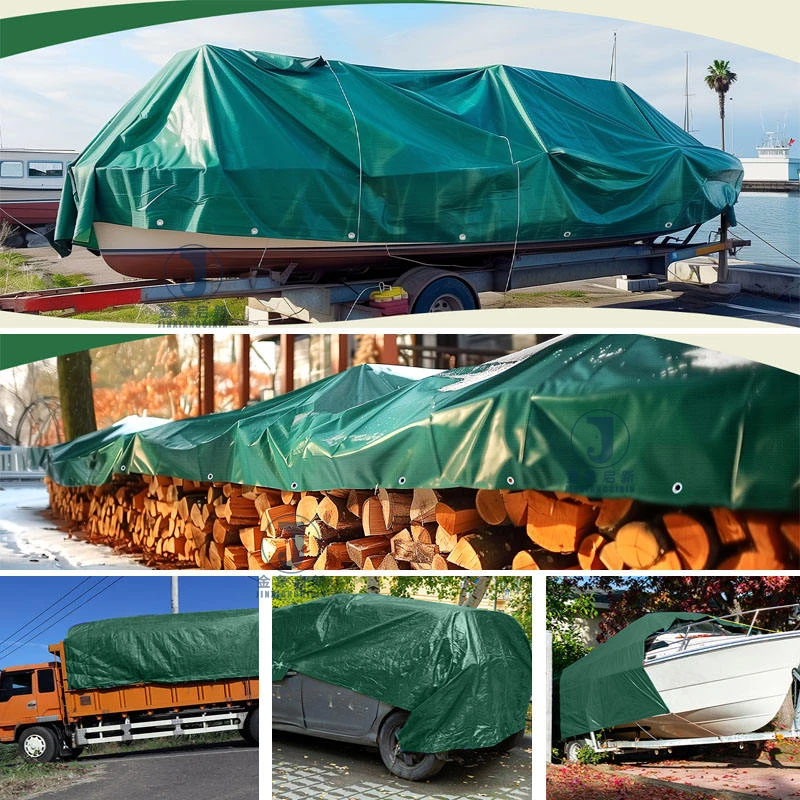
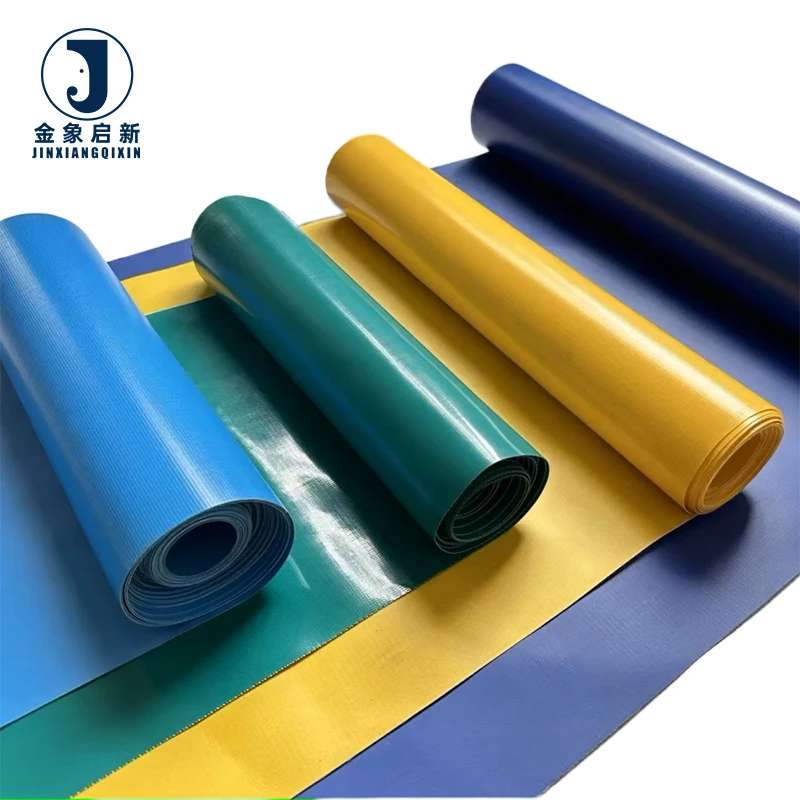
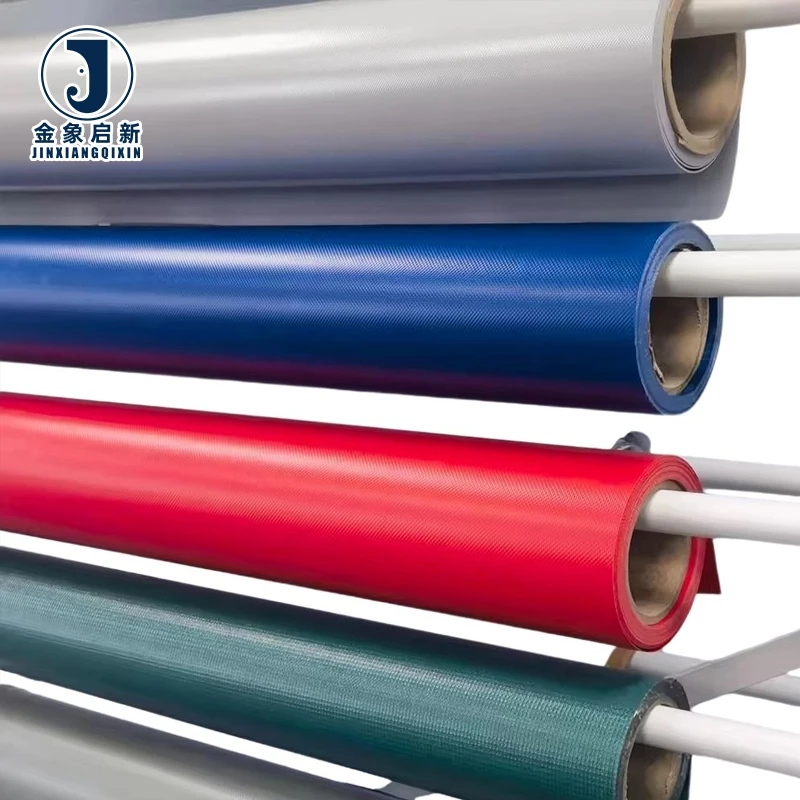
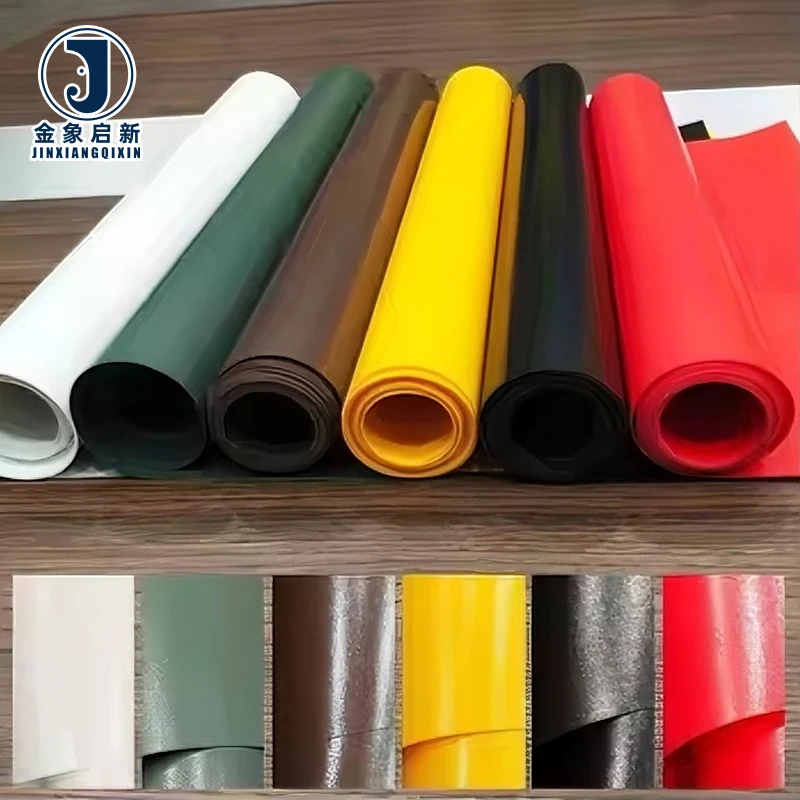
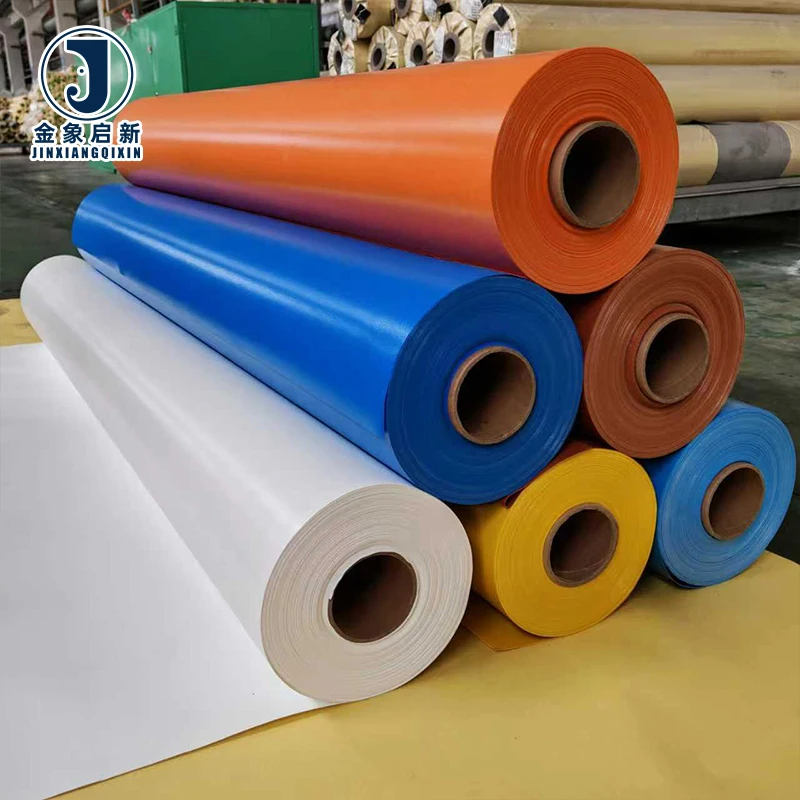
Production Line Consistency — Three full coating lines and 36 sets of equipment ensure batch-to-batch uniformity in coating weight and surface finish for industrial ventilation fabric orders.
Technical Specifications
| Parameter | Value |
|---|---|
| Product Type | PVC Coated Tarpaulin |
| Material | PVC + High-strength polyester mesh fabric |
| Coating Method | Laminated & Hot-melt Coating technology |
| Weight Options | 350gsm / 420gsm / 500gsm / 550gsm / 600gsm / 750gsm |
| Total Thickness | 0.32mm / 0.35mm / 0.4mm / 0.45mm / 0.5mm / 0.65mm |
| Roll Width | 2m / 2.1m |
| Roll Length | 75m / 50m |
| Color | Blue, Red, Yellow, Light Blue, Grey (custom colors available) |
| Service Life | 3–7 years under normal conditions |
| Special Treatments Available | Flame Retardant (grade not stated), Anti-Static (test basis not stated), Anti-cold, Anti-mildew |
| Key Features | Waterproof, cold crack resistant, UV resistant (test basis not stated), anti-mildew |
Application Suitability
| Application | Exposure & Requirement |
|---|---|
| Mine and tunnel ventilation ducts | Continuous positive/negative air pressure, rock dust abrasion, fire safety compliance underground |
| Aviation maintenance hangars — flexible exhaust shrouds | Jet fuel vapor exposure, FOD risk, fire authority certification required |
| Inflatable membrane structures | Sustained internal air pressure, wind uplift cycling, UV and thermal exposure |
| Temporary industrial enclosures on construction sites | Weather exposure, scaffold contact abrasion, periodic relocation |
| Specialist ducting for refinery and plant shutdowns | Chemical splash contact, confined-space fire code requirements |
What "Flame Retardant" Means Without a Test Certificate Attached
Specifying PVC coated tarpaulin ventilation and technical fabric for confined or underground use requires a documented fire classification, not a catalogue claim.
When a ventilation duct arrives on a mine site or inside an aviation hangar without a fire test report matching the local regulatory framework, the installation halts. The contractor cannot commission the ventilation system, the safety officer signs nothing, and the duct rolls sit on the pallet accumulating demurrage. The cost is not the fabric — it is the idle crew and the missed commissioning window [NEED_CITE: fire safety classification frameworks for underground ventilation materials].
Airflow Dynamics and Duct Fabric Behaviour
Ventilation ducts built from PVC knife-coated fabric operate under sustained internal pressure that cycles with fan start-stop sequences. The base fabric must resist circumferential stress without creep, while the PVC coating maintains air tightness at every welded seam. The laminated and hot-melt coating technology used here provides the adhesion strength needed so that the coating does not delaminate from the polyester mesh under repeated pressurisation. When fabricating ducts, welders working with PVC coated tarpaulin ventilation and technical fabric should note that seam integrity depends on matching the heat input to the total thickness selected — heavier grades absorb more energy before the coating reaches fusion temperature.
Selecting Thickness and Weight for Ventilation Service
The available thickness range from 0.32mm to 0.65mm, paired with weight grades from 350gsm to 750gsm, allows duct designers to match fabric mass to the expected static pressure and duct diameter. Larger-diameter ducts running at higher pressures need heavier fabric to prevent ballooning between support rings, while smaller auxiliary ventilation lines in development headings can use lighter grades to reduce the load on hanging hardware. The high-tenacity polyester yarns provide the dimensional stability that keeps the duct round under negative pressure sections, preventing the collapse that restricts airflow and forces the fan to work harder. Flame retardant and anti-static treatments are available — confirm the grade and test standard required for your specific jurisdiction before placing the production order [NEED_CITE: anti-static surface resistivity test methods for industrial textiles].
Reading GSM and Thickness Beyond the Quotation Line
A common assumption is that higher GSM directly means stronger fabric, but the relationship between weight, base fabric denier, and weave density is what actually determines tensile and tear performance. Two PVC coated fabrics at the same 550gsm can behave very differently if one uses a heavier coating with a lighter base mesh while the other distributes mass more evenly between yarn and coating. The hot-melt coating process allows PVC to penetrate the mesh interstices, improving peel strength compared to simple surface lamination. For ventilation ducts, this matters because the weld zone is where coating and base fabric must act as a single composite — if peel strength is low, the seam splits under duct pressure before the body fabric reaches its limit. Always request the material specification sheet stating base fabric construction and coating weight separately, not just total GSM [NEED_CITE: ISO 1421 test methods for tensile properties of coated fabrics].
The Hidden Cost of Wrong Specification on a Duct Run
A duct specified without confirmed anti-static treatment in a coal mine ventilation circuit risks accumulating electrostatic charge on the internal surface, which the safety regulator will flag during the next inspection. A flame retardant claim unsupported by a recognised test standard — such as those aligned with mining or aviation authority requirements — means the duct cannot be signed off, and the entire run may need to be replaced before the facility is allowed to operate. Colour inconsistency between rolls on a membrane structure project is not merely cosmetic; it signals variation in coating batch chemistry that can also affect weld parameters and long-term weathering behaviour. These are failures that appear not at delivery but at commissioning, when the cost of replacement multiplies the original material saving.
Why Source Ventilation Fabric Through This Production Setup
The three full production lines running in parallel allow large-diameter duct orders to be manufactured within a single batch, reducing the risk of roll-to-roll coating variation that affects weld consistency in the field. The 10-person R&D team develops sample panels cut to your specified thickness and treatment combination, so weld trials can be run on your own hot-air or wedge equipment before bulk production starts. Every roll undergoes inspection against the stated GSM and visual surface criteria before packing, which matters when a duct failure underground can only be repaired during a scheduled shutdown. Custom widths and lengths beyond the standard 2m × 75m or 2.1m × 50m rolls are available, reducing the number of longitudinal welds in large-diameter duct fabrication.
Documentation & Verification
- Material specification sheet stating total GSM, base fabric denier, coating weight, and coating method
- Fire classification test report matching the standard required by your site authority
- Anti-static surface resistivity test data where specified for underground or explosive atmosphere use
- Pre-shipment inspection record with roll-by-roll GSM and visual check confirmation
- Certificate of origin and customs documentation for cross-border project logistics
Fabrication, Handling & Storage
- Hot-air weld temperature must be matched to the selected thickness — 0.65mm grades need higher heat input than 0.32mm to achieve full fusion at the seam
- Store rolls upright on end caps to prevent flat-spotting that causes tracking issues during duct fabrication
- Allow cold-stored rolls to acclimatise to workshop temperature before unrolling to avoid coating crack on the outer layers
- Cut patterns should nest duct panel shapes to maximise yield from the 2m or 2.1m roll width and minimise longitudinal weld seams
- Clean welded ducts with mild detergent only — solvent-based cleaners can soften the PVC coating and reduce surface adhesion at repair patches
- Repair minor field damage with PVC-compatible adhesive patches matched to the coating method used on the original fabric
How to Structure Your Enquiry
Provide the static pressure rating and duct diameter so the correct GSM and thickness can be recommended for the application. State the fire classification or anti-static standard your site authority requires, and whether you need raw roll stock for your own fabrication shop or finished duct sections with welded joints and flanges. Include your target delivery window and port of destination so production scheduling and logistics can be confirmed at the quotation stage.
Frequently Asked Questions
Q: Which fire classification standard should I specify for underground mining ventilation ducts?
A: The required standard depends on your jurisdiction — common frameworks include national mining safety regulations and international fire test classifications. Provide the regulation reference from your site safety officer so the correct flame retardant treatment and supporting test report can be arranged with your order.
Q: How is anti-static performance measured on PVC coated ventilation fabric?
A: Anti-static treatment is assessed by surface resistivity testing, typically reported in ohms per square. The acceptable range depends on your application environment. Specify the resistivity threshold required by your safety authority when requesting a quotation so the treatment can be formulated accordingly.
Q: Can you supply finished duct sections or only roll stock?
A: Both options are available. Roll stock in standard or custom widths suits fabricators with their own welding equipment, while finished duct sections with welded seams, flanges, and hanging hardware can be supplied for direct installation on site.
Q: How do I ensure consistent weld quality across different roll batches?
A: Request sample panels from the production batch before full fabrication begins. Run weld trials at your standard hot-air settings on the sample to confirm seam strength, then adjust parameters if needed before committing the main stock to cutting.